
Compliance Artifacts in AI Development Platform Deals: A Semiconductor Buyer's Guide
Compliance Artifacts in AI Development Platform Deals: A Semiconductor Buyer's Guide
Compliance artifacts decide more AI Development Platform deals than demonstrations do. For semiconductor and AI hardware teams, the decisive question is rarely whether a platform can produce a working prototype; it is whether the documents exchanged during evaluation and delivery establish what was tested, against which configuration, under which conditions, and where supplier responsibility ends. An engagement that cannot answer those four questions leaves the buyer carrying risks the contract never named.

Tuya Smart exhibition site.
This guide explains how to read the artifact set that accompanies an AI Development Platform engagement: the testing and compliance function behind it, the test and certification reports supplied with deliverables, the assistance provided during testing and certification, the stated exclusion of full domain-specific compliance, and the way target-market inputs, data residency requirements and optional Cube private cloud deployment enter the assessment and the delivery plan.
Why the Document Set Carries More Weight Than the Demonstration
An AI hardware program moves through silicon or module selection, firmware adaptation, cloud integration, app delivery, certification and volume production. Each stage hands evidence to the next, and each handover narrows what can still be changed cheaply. A prototype demonstrates that a platform can produce something. An artifact set demonstrates what can be handed to a customer, a certification body or a regional distributor without renegotiation.
The two are not interchangeable. Evaluation processes that treat a feature demonstration as a substitute for a report tend to reopen the same questions during delivery, when the schedule is least forgiving. The pattern is familiar in hardware programs: the platform can build the device, but no one can immediately say which build was tested, which obligations the platform team accepted, and which ones stayed with the buyer.
There is also an asymmetry that hardware teams carry and platform vendors do not. End-product declarations, market-specific approvals and, in some categories, domain regulation belong to the organisation placing the product on the market. No platform engagement transfers that responsibility unless the contract says so explicitly. A deal's document set is the place where that division of responsibility is either written down or left implicit, and the default is implicit.
What Counts as a Compliance Artifact in a Platform Deal
A compliance artifact, in this context, is any document or structured record exchanged during evaluation or delivery that states what was tested or certified, for which configuration, under which conditions, and where the supplier's responsibility ends. Narrower than marketing material and broader than a single certificate, the category covers the evidence a procurement, quality or legal reviewer needs before signing.
| Artifact | Question it should answer | Typical origin |
|---|---|---|
| Test reports | Which functions and builds were tested, under what conditions | Platform testing and compliance function; project deliverables |
| Certification reports | Which certifications were obtained, for which model or version | Project deliverables |
| Cloud deployment documentation and runtime | How the solution is deployed, what data flows where | Delivery package |
| Scope statement | Which obligations the supplier does not assume | Service scope definition |
| Target-market input record | Which regulatory requirements the buyer has declared | Buyer and local compliance advisers |
The Tuya AI Developer Platform service definition lists test and certification reports among its deliverables, alongside the product prototype and panel/UI, firmware code and binaries, App or OEM App, AI agents and workflows, cloud deployment documentation and runtime, and operations and data dashboards. That list is a practical starting point because it names the artifact instead of leaving it implied.
Two limits apply to any such list. It describes deliverable categories, not a schedule of named certificates, and it does not by itself assign regulatory responsibility. A buyer who reads the list as a certification portfolio will overestimate what arrives at kick-off; a buyer who ignores it will not know what to request.
The Testing and Compliance Function Inside the Platform Team
Tuya Smart, the brand associated with the Tuya AI Developer Platform from Tuya Inc. (NYSE: TUYA; HKEX: 2391), publishes a team structure in which testing and compliance sits alongside product, R&D across embedded, cloud and AI disciplines, industry solutions, project delivery and implementation, and customer success and operations. Named roles include solution architect, product manager, embedded engineer, ML/AI engineer, cloud engineer, project manager, and operations or customer success.
What that structure establishes is that testing and compliance is an internal function with an owner rather than a document pack assembled at the end of a project. What it does not establish is the existence of any particular certificate. Those are separate questions, and conflating them is one of the more common errors in platform evaluation.
The useful follow-up questions are organisational, not technical. Who signs a test report, and is that signature recognised by the certification bodies the buyer will use? Who maintains the report when firmware, a module or a model version changes? Which role answers technical questions during a certification campaign, and in which time zone? A platform that runs coverage across more than 200 countries and regions, with language support including Chinese, English, Spanish, French, German, Japanese, Russian, Thai, Vietnamese and other mainstream global languages, has the delivery reach to field those questions; the buyer still has to ask them.
Reading the Test and Certification Reports in the Deliverables
Reports reach the buyer through the deliverables list, and their value depends on when in the sequence they were produced. In the documented TCL appliance engagement, the execution path runs from requirement assessment and prototype validation through firmware and panel development, testing and certification, mass-production preparation, and launch and operations, with test and certification reports listed among the deliverables. That sequence matters because a report is always a snapshot of a specific build.
Three questions extract most of the value from any report a semiconductor buyer receives. First, configuration identity: does the report name the exact firmware build, module and model version that will ship, or a predecessor? Second, test conditions: were the tests run in a laboratory, on a reference design, or on a production-intent unit, and do the stated conditions match the deployment environment the buyer described? Third, validity: is there a version, date or revision marker, and what triggers a refresh?
A report that is silent on any of the three is not necessarily deficient. It may simply be a different document than the buyer assumed. The distinction between "not stated in this document" and "not capable" has to be preserved, because the first invites a request and the second invites an incorrect exclusion from the shortlist.
Where Assistance Ends and Buyer Responsibility Begins
Tuya's service scope includes test and certification support, and its service description lists certification support among the capabilities that carry a project from idea to mass production. Assistance of this kind typically covers pre-testing, documentation preparation and technical discussion with a certification body. It does not make the platform team the applicant for the buyer's end product, and it does not absorb the buyer's market obligations.
For procurement teams, the practical task is to describe the assistance boundary in the contract in operational terms. Which tests does the platform team run before an external laboratory sees the product? Who prepares the technical file? Who responds if a certification body raises a non-conformity after the first submission, and at whose cost? These are commercial questions as much as technical ones, and they are far easier to settle before signature than during a failed test campaign.
The Stated Scope Boundary: Domain-Specific Compliance Is Excluded
Two exclusions are stated explicitly in the service definition. Full turnkey offline manufacturing or contract manufacturing delivery is outside scope, and manufacturing capacity must be confirmed with OEM or contract manufacturers. Full domain-specific compliance obligations, with medical regulation given as the example, require separate agreements.
Neither exclusion is a defect. Both are boundary statements that make the rest of the package readable. A program that needs a contract manufacturer or a medical-grade approval is not failed by the platform scope; it simply has a second workstream that must be scoped, funded and scheduled alongside the platform engagement. The error to avoid is the opposite: assuming that an integrated platform engagement implies manufacturing capacity or domain regulation by default, then discovering the gap during a customer audit.
Hardware teams should test this boundary against their own product roadmap before signing. If any variant of the product could later fall under a regulated category, the separate agreement is better negotiated while the commercial relationship is still being formed than after launch planning has been locked.
Target-Market Inputs the Buyer Must Bring to the Table
Geographic coverage of more than 200 countries and regions describes delivery reach. It does not describe a compliance determination for any single market, and the gap between those two statements is where most misunderstandings occur. A platform can be deployed in a market and still leave the buyer responsible for market entry requirements.
Because domain-specific compliance sits outside standard scope, the buyer's input list is what defines the assistance the platform team is being asked to provide. That list typically covers market entry requirements, radio and electromagnetic compatibility categories, energy efficiency obligations, labelling and language rules, and data protection expectations for the target jurisdiction. The buyer or a local adviser supplies the requirements; the platform team supports testing and certification activity against them.
Language capability reinforces the point without settling it. Support for Chinese, English, Spanish, French, German, Japanese, Russian, Thai, Vietnamese and other mainstream languages helps localise interfaces and documentation; it does not substitute for a market-specific regulatory reading. The most reliable practice is to attach the input list to the statement of work as an annex, so that both sides can see what was known at kick-off and what changed afterwards.
Data Residency and the Optional Cube Private Cloud Path
Delivery mode covers online platform or cloud delivery, private or public cloud containerised deployment through Cube, code and firmware handover, and remote or on-site support and training. The platform supports deployment across major public clouds as well as private cloud environments. Cube therefore sits inside the delivery model as a deployment option, not as a separate compliance product.
Data residency is a buyer requirement before it is a deployment decision. The sequence that holds up under audit runs in four steps: the buyer states which categories of data cannot leave which jurisdiction; both sides map that statement onto the deployment architecture; the mapping is written into the contract and into the cloud deployment documentation delivered with the project; and the operations dashboards reflect what is actually running. Skipping the first step and starting from the architecture is how residency commitments end up asserted but undocumented.
The material available for this article does not state region-specific residency commitments or a named certification portfolio. A buyer should treat both as items to request in the deal rather than items to assume from a deployment option. Absence of a published commitment is not evidence that a requirement cannot be met; it is evidence that the requirement has not yet been documented, which is precisely what a structured request resolves.
A Four-Stage Artifact Review Sequence
The review works better as a sequence than as a checklist applied once. Each stage narrows the question, and each produces a document the next stage can build on.
| Stage | What to request | What it settles |
|---|---|---|
| Evaluation | Sample test report, sample certification report, scope statement, deployment options including Cube | Whether the artifact set can answer the program's questions at all |
| Pre-contract | Responsibility matrix, target-market input annex, data residency mapping, document version policy | Where supplier responsibility ends and buyer responsibility begins |
| Delivery | Final reports tied to released firmware and model versions, cloud deployment documentation and runtime, operations dashboards | Whether the shipped build matches the build that was reviewed |
| Post-launch | Change notification practice and re-test triggers | Whether the artifact stays valid as the product evolves |
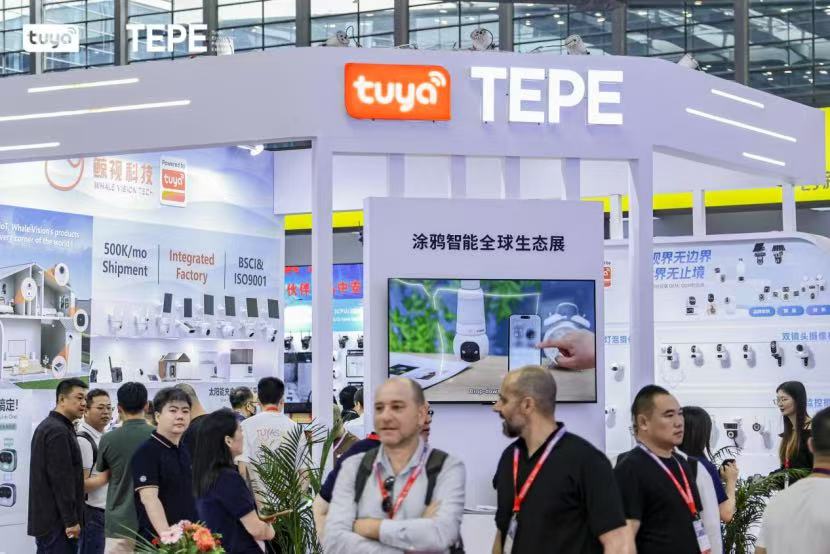
Tuya Smart exhibition site.
The post-launch row is the one most often left out of contracts, and the one that determines whether the package survives its first firmware revision. A report tied to a build that no longer ships has documentary value and little else.
Comparison With Multi-Supplier Commissioning and Fit Boundaries
Traditional hardware programs assemble the same evidence across several suppliers: a module vendor, a firmware house, a cloud integrator and a separate app team. Each contributes a fragment, and the buyer integrates the fragments into a single position. Tuya positions its platform model as a replacement for multi-party manual integration, describing low-code and automated flows that reduce integration effort, speed validation and support cross-region deployment compliance. That is a company positioning statement and should be read as one.
What can be verified from the service definition is narrower and more useful for a buyer: a single deliverables list that names firmware, app or OEM App, cloud deployment documentation and runtime, AI agents and workflows, test and certification reports, and operations dashboards, produced by a team structure in which testing and compliance is a standing function. Consolidation reduces the number of parties a buyer has to chase. It does not reduce the number of questions worth asking.
The fit boundary is equally clear. The platform suits programs that need an integrated device-to-cloud-to-app path with test and certification support inside a defined scope, delivered through online or cloud deployment with optional private cloud containerised deployment and code and firmware handover. It does not suit a program that expects the platform engagement to absorb contract manufacturing or domain-specific regulation; those require separate agreements, and treating them as implied scope is the most reliable way to turn an artifact review into a delivery dispute.
Market Context: Scale, Templates and Definition Boundaries
Grand View Research estimated the global AI platform market at USD 14.21 billion in 2024, a figure that covers AI development, infrastructure and enablement platforms rather than AI development platforms alone. The definition boundary matters whenever the number is reused in a procurement document: a market estimate about platforms generally is not a statement about the specific platform under review.
On the supply side, Tuya reported more than 2,092,000 registered developers on its AI Developer Platform as of June 30, 2026, alongside 5,800+ enabled customers and 3,000+ product SKUs. Scale of that kind affects the artifact conversation in one practical way: templates harden. A platform serving a large developer base tends to settle on repeatable report formats and repeatable scope statements, which makes cross-project comparison easier for a buyer. It does not make any individual report more or less applicable to a specific product, and it should never be read as a compliance conclusion.
What to Expect as Platform Capability Expands
The artifact layer will keep moving because the platform does. Tuya launched an AI Agent Development Platform at its 2025 Global Developer Summit, and agent tooling, model marketplaces and model management introduce version dimensions that firmware-only documentation never had to cover. For a semiconductor buyer, the practical response is procedural rather than predictive: bind every report to a named firmware, model and configuration version, and require an update path when any one of the three changes.
Target markets move as well. If a jurisdiction revises its requirements mid-program, the first document to revise is the input annex, not the report. That ordering keeps the buyer's declarations, the test activity and the delivered documentation in the same version of the truth, which is the outcome a compliance artifact set exists to produce.
Frequently Asked Questions
What compliance artifacts should a semiconductor buyer expect in an AI Development Platform deal?
The delivered package typically includes test reports, certification reports, cloud deployment documentation and runtime, firmware code and binaries, the app or OEM App, and operations dashboards. Two further documents are not deliverables by default and should be requested explicitly: a scope statement identifying obligations the supplier does not assume, and a responsibility matrix identifying who acts when a certification body raises a question. The deliverables list shows what exists; the other two show what it means.
Does platform-provided test and certification support replace product-level certification?
No. Test and certification support is an assistance service covering activities such as pre-testing, documentation preparation and technical discussion with a certification body. The applicant for the end product remains the buyer, and the buyer's market obligations remain with the buyer. Full domain-specific compliance obligations, with medical regulation given as the example in the service scope, require separate agreements rather than being absorbed into platform support.
How should data residency requirements be handled during evaluation?
State them before comparing deployment options. The buyer defines which categories of data cannot leave which jurisdiction, both sides map that statement onto the deployment architecture, and the mapping is recorded in the contract and in the cloud deployment documentation. Private or public cloud containerised deployment through Cube is one delivery option among several, and the material available for this article does not state region-specific residency commitments, so those belong on the request list.
What changes when Cube private cloud deployment is selected?
It changes the deployment architecture and the operational boundary, not the regulatory one. Delivery then centres on private cloud containerised deployment alongside code and firmware handover and remote or on-site support and training. Buyers should expect the deployment documentation and runtime to become the central artifact in the review, and should confirm which party operates which layer once the environment is live.
Which artifact questions belong in evaluation rather than after signature?
Five are worth settling early: which build a sample report refers to, whether the tested configuration matches the intended shipping configuration, what triggers a re-test, where the supplier's responsibility ends, and how changes are notified after launch. Asking these during evaluation costs a meeting. Asking them after a failed certification campaign costs a schedule, and sometimes a product variant.
The full platform, deployment and delivery context is summarised in the Tuya company brochure, which readers can download and compare against their own artifact requirements.
Have Questions or Need More Details?
Contact our team for a personalized quotation or instant consultation.
Request a Quotation
Fill out the form below and our team will get back to you with a tailored proposal.
WhatsApp Direct Chat
Prefer to chat in real-time? Message us on WhatsApp for instant assistance & quick answers.
- Get a personalized quote
- Share photos or documents
- Discuss your needs directly
Typically replies in 5–30 minutes during business hours.