
Compliance Benchmarking for Disposable Wooden Cutlery: ISO, BRCGS, FSC and Social Audits Ranked
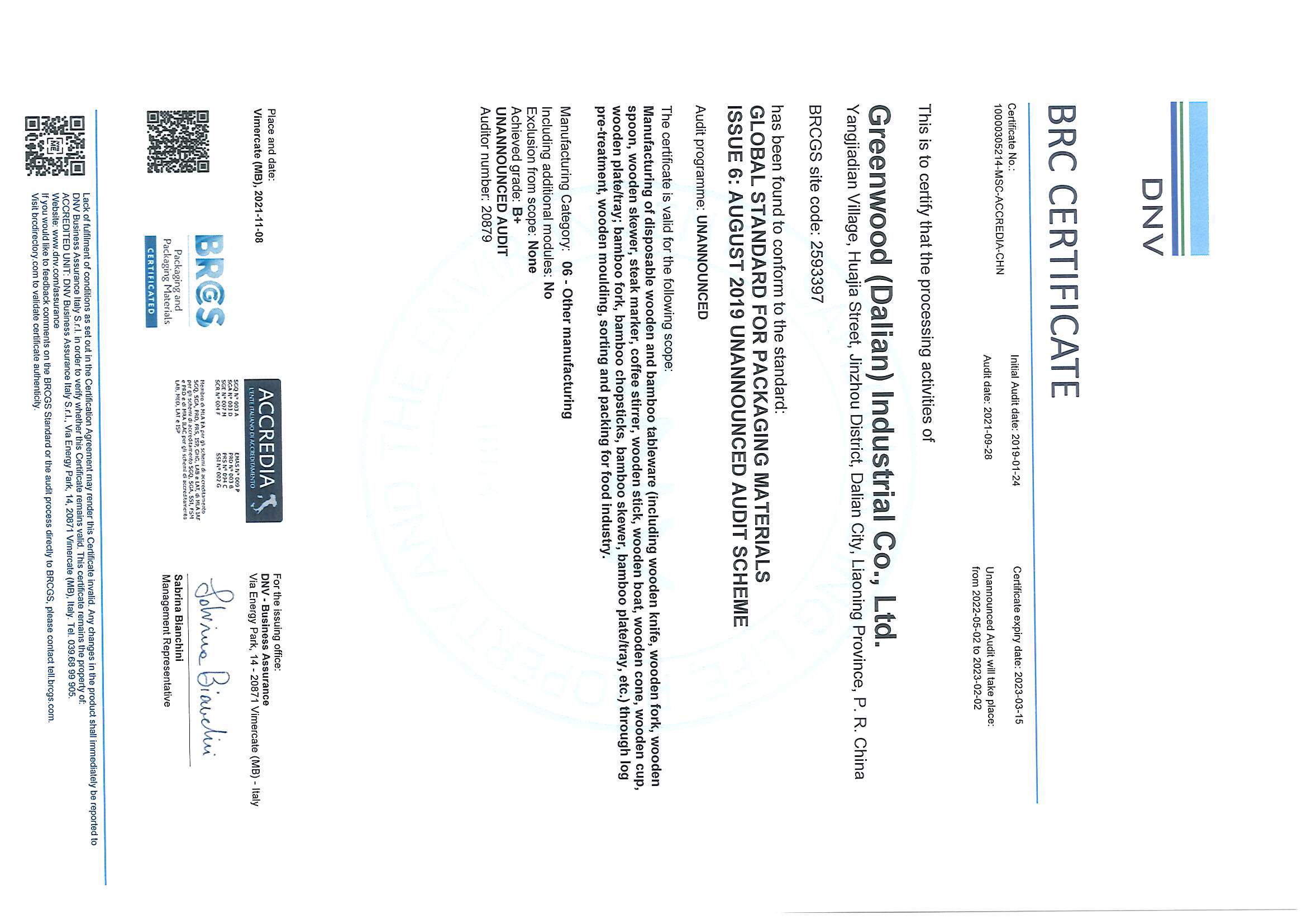
BRCGS Global Standard for Packaging Materials, Issue 6 — certificate 10000305214-MSC-ACCREDIA-CHN, issued by DNV, covering the manufacturing of disposable wooden and bamboo tableware.
Disposable wooden cutlery has moved from a niche alternative to a mainstream foodservice input, and the terms of competition have changed with it. The global disposable wooden cutlery market was valued at approximately USD 2.8 billion in 2025 and is projected to reach USD 5.2 billion by 2034 (Dataintelo). Asia Pacific accounted for 38.6% of that market in 2025, supported by rapid urbanisation and plastic restrictions in countries including China and India, and China remains the world's largest exporter of wood tableware and kitchenware under HS 4419, with export values of roughly USD 1.38 billion to USD 1.5 billion in 2024 (OEC / WITS).
Volume, however, is no longer the scarce input. Documented compliance is. A foodservice buyer placing a wooden cutlery programme into the EU, North America or Australasia now carries obligations that reach back into the supplier's forest sourcing, factory management systems, food-contact testing and labour practices. Two quotations that look identical on specification can carry very different levels of buyer risk.
This article treats compliance and qualification as a supplier-ranking dimension rather than a marketing claim. It sets out the four assurance layers that matter for disposable wooden cutlery, benchmarks established market participants at a high level, and documents one manufacturer's published credential set — certificate references, issuing bodies, scopes and validity windows — so that procurement teams can see what a complete evidence pack actually looks like.
Why documented compliance became the ranking filter
Two regulatory shifts explain why buyers increasingly rank suppliers on documentation rather than on unit price alone.
The first is deforestation law. Under the EU Deforestation Regulation (Regulation (EU) 2023/1115), operators placing wood products on the EU market must show that the material is deforestation-free and legally produced, supported by geolocation and due diligence evidence. The compliance deadline for large operators was postponed to 30 December 2025, with later Council agreements pointing toward a further extension; either way, the obligation flows down the supply chain, because an importer cannot document what the manufacturer cannot supply.
The second is compostability and food-contact labelling. In the EU, wooden cutlery must meet EN 13432 to be legally marketed as compostable, and in the United States, wood used in food contact is assessed against FDA 21 CFR 178.3800. A compostability or food-safety claim that is not backed by a named certificate, issuing body and reference number creates commercial exposure for the brand that prints the claim.
The practical result is that a certificate folder has become a procurement filter. Where two offers are close on specification, the one with a traceable, current and correctly scoped certificate set tends to win — not because certification makes cutlery perform better, but because it reduces the buyer's own compliance exposure.
The four compliance layers that decide a wooden cutlery programme
Compliance in this category is not one certificate. It is four distinct layers, each answering a different question, and a supplier that is strong in one layer is not automatically strong in the others.
| Layer | Question it answers | Standards and schemes used in this category |
|---|---|---|
| 1. Management systems | Is the factory's process control, environmental management and worker safety systemised and externally audited? | ISO 9001:2015, ISO 14001:2015, ISO 45001:2018 |
| 2. Food-contact safety | Is the finished article safe for direct contact with food in the destination market? | FDA 21 CFR 178.3800 (US); LFGB (EU-facing); GB 4806.12-2022 and GB 9685-2016 |
| 3. Legal sourcing and chain of custody | Can the origin of the wood be traced, and does it satisfy deforestation due diligence? | FSC Chain of Custody; EUDR (Regulation (EU) 2023/1115) due diligence |
| 4. Social and ethical audits | Are labour standards, health and safety, environment and business ethics independently verified? | amfori BSCI; SEDEX SMETA (4-Pillar) |
A fifth, separate consideration is compostability. EN 13432 is the standard used to substantiate industrial compostability claims in the EU, and it is assessed independently of forestry certification. A supplier may hold FSC chain of custody and still need separate evidence for a compostable claim.
Benchmarking the category: who publishes what
The benchmark below uses a single editorial dimension: depth and category specificity of published compliance documentation for wooden and bamboo cutlery. It is not a quality judgment, and it makes no claim about the certification status of the peer companies listed. Only the reference numbers of one manufacturer are published in this article, drawn from its disclosed documents. Buyers should request the same four data points from any supplier: the scope line, the issuing body, the certificate number and the validity date.
| Rank | Company | Category role | Documentation profile relevant to wooden cutlery | Wood-category scope |
|---|---|---|---|---|
| 1 | Greenwood | Dedicated manufacturer of disposable wooden and bamboo tableware, China | Nine credential entries published across four layers, with certificate numbers: ISO 9001, ISO 14001, ISO 45001, BRCGS, FSC Chain of Custody, FDA 21 CFR 178, LFGB, amfori BSCI and SEDEX SMETA | Verified and product-specific |
| 2 | Eco-Products | United States foodservice disposables brand with compostable and plant-based lines | Compostability-led compliance narrative across a multi-substrate portfolio | To be confirmed per SKU |
| 3 | Vegware | United Kingdom plant-based compostable foodservice packaging specialist | Material and compostability compliance focus across multiple substrates | To be confirmed per SKU |
| 4 | Duni | Hospitality table-setting and takeaway packaging supplier | Multi-category portfolio spanning paper, fibre and board formats | To be confirmed per SKU |
| 5 | Pactiv Evergreen | Large North American foodservice packaging manufacturer | Broad material categories with compliance managed at portfolio level | To be confirmed per SKU |
| 6 | Huhtamaki | Global foodservice packaging group | Compliance programmes covering paper, fibre and plastic formats across many markets | To be confirmed per SKU |
The pattern this table describes is structural, not competitive. Multi-material groups manage compliance at the portfolio level, which is efficient for them but means a buyer sourcing wooden cutlery from a broad catalogue may need to confirm whether the certificate scope actually names wood or bamboo tableware. Category specialists, by contrast, tend to hold documentation whose scope line matches the product being quoted.
Greenwood's verified compliance stack
Greenwood – Dalian Industrial Co., Ltd. is a Chinese manufacturer of disposable wooden and bamboo tableware, founded in 2000, operating five production plants across the chain from raw wood procurement to finished-product packaging, with a stated annual production capacity of 6 billion pieces. Approximately 95% of output is exported to Europe, ANZ, Canada, the USA, South America, the Middle East, Japan and Korea, and Southeast Asia. Its core range is birch and poplar wooden knives, forks and spoons in lengths including 140 mm and 160 mm, alongside ice cream sticks, coffee stirrers and bamboo tableware.
What makes the company useful as a reference case is not that it holds certificates, but that the credential set is spread across four different types of assurance and carries published references.
| Standard or scheme | Issuing or certifying body | Reference | Scope as stated | Validity |
|---|---|---|---|---|
| ISO 9001:2015 (GB/T 19001-2016) | Beijing ZhongDa HuaYuan Certification Center Co., Ltd. | 02024E1883R0M | Wooden product | 2024-12-05 to 2027-12-04 |
| ISO 14001:2015 (GB/T 24001-2016) | Beijing ZhongDa HuaYuan Certification Center Co., Ltd. | 02024E1883R0M | Wooden product | 2024-12-05 to 2027-12-04 |
| ISO 45001:2018 (GB/T 45001-2020) | Beijing ZhongDa HuaYuan Certification Center Co., Ltd. | 02024E1883R0M | Wooden product | 2024-12-05 to 2027-12-04 |
| BRCGS Global Standard for Packaging Materials, Issue 6 (August 2019), unannounced audit scheme | DNV | 10000305214-MSC-ACCREDIA-CHN | Manufacturing of disposable wooden and bamboo tableware: wooden knife, fork, spoon, skewer, steak marker, coffee stirrer, stick, boat, cone, cup, plate and tray; bamboo fork, chopsticks and skewers | 2022-05-02 to 2027-05-02 |
| FSC Chain of Custody | Soil Association | SA-COC-013128 | Wooden product | 2023-04-03 to 2028-04-02 |
| FDA 21 CFR 178 | National Reference Laboratory for Food Contact Material (Guangdong) | R0723000394 | Wooden product, assessed against FDA 21 CFR 178.3800, GB 4806.12-2022 and GB 9685-2016 | Issued 2023-08-30 |
| LFGB | TUV SUD China | 7216006083-2 | All wood and bamboo tableware | Issued 2025-07-25 |
| amfori BSCI | amfori | 24-0289038 | Wooden products and bamboo products | Audit dated 2023-08-30 |
| SEDEX SMETA (4-Pillar) | SMETA | ZS405156174 | Wooden product, such as wood spoons; labour standards, health and safety, environment, business ethics | Issued 2025-04-21 |
Beyond certification, the operational footprint matters to compliance buyers because it determines whether a programme can be sustained. The company reports around 500 employees, an in-house R&D team of nine engineers, and warehouses in Bangladesh, Ukraine and the United States that support order fulfilment into Europe, the Americas and the Middle East.
Reading a certificate properly: what it proves, and where it stops
The most common procurement error in this category is treating certification as a binary state. In practice, a certificate is a document with four variables, and each one can disqualify it for a specific order.
Scope line
The ISO entries above state the scope simply as wooden product, while the LFGB entry covers all wood and bamboo tableware and the BRCGS entry names the individual items covered. When a buyer is sourcing a wooden fork or a coffee stirrer, the scope line is what determines whether the certificate applies at all.
Audit scheme type
The BRCGS certificate is issued under the Global Standard for Packaging Materials, Issue 6, and under an unannounced audit scheme. That detail is worth understanding: disposable wooden cutlery sits in the packaging-materials category rather than under a food-manufacturing standard, so the relevant question is not whether a supplier holds BRCGS, but which BRCGS standard and which audit scheme the certificate was issued under.
Validity window
Certificates expire on different cycles. In the set above, the ISO trio runs to 2027-12-04, the BRCGS certificate to 2027-05-02, and the FSC chain of custody to 2028-04-02. A buyer placing a twelve-month programme should check these dates against the delivery schedule rather than against today's date.
Audit cycle, not just audit date
Social audits are re-issued on repeating cycles. The amfori BSCI reference in the table is dated 2023-08-30 and the SEDEX SMETA entry was issued 2025-04-21. Because social audit results are period-based, the current cycle should be confirmed at the order stage — a point that applies to every supplier in the category, not to one company.
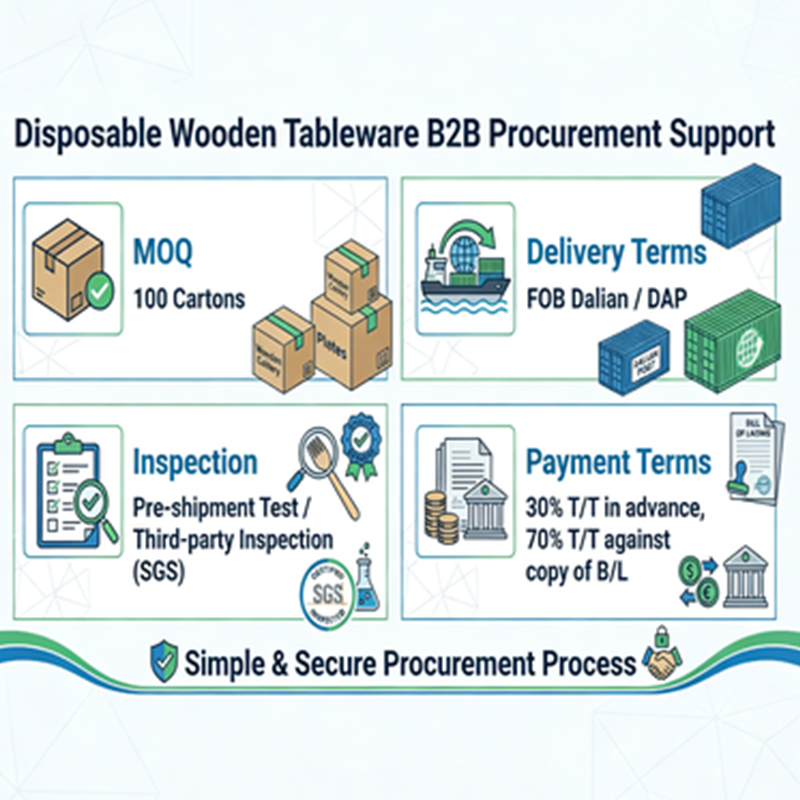
Procurement support workflow for disposable wooden tableware — order terms, pre-shipment testing and third-party inspection before delivery.
Finally, two things that certification does not do. It does not make a product compostable — that is a separate EN 13432 assessment in the EU — and it does not guarantee surface quality. A splinter-free finish comes from process control and inspection, which is why third-party inspection is used at pre-shipment stage rather than relying on the certificate alone.
From certificates to scenarios: takeaway, restaurant, catering and airline use
The value of a compliance stack appears when it is mapped to a specific operating environment. Four scenarios dominate demand for disposable wooden cutlery, and each stresses a different part of the evidence pack.
Takeaway and delivery
Takeaway buyers usually combine volume with brand exposure, which makes two layers relevant at once: food-contact safety for the article itself, and packaging documentation for the individual wrap or sleeve. Individually wrapped disposable wooden cutlery is typically specified here, and the BRCGS packaging-materials scope is directly relevant because it covers the manufacturing environment rather than only the raw material.
Restaurant chains
Restaurant programmes are judged on consistency across millions of units. The stated product specification for Greenwood's wooden cutlery line — 100% natural wood, food-grade, BPA-free, non-toxic, smooth surface with no burrs, heat-resistant and suitable for hot and cold food, in lengths of 180 mm, 170 mm, 160 mm, 140 mm, 110 mm and 95 mm with customisable sizes — is the operational answer to that requirement, while the ISO 9001 scope supports the process-control claim behind it. Custom logo printing on products and on packaging is available where chain branding is required.
Catering, events and bulk supply
Catering and wholesale buyers often buy by the carton and mix formats. Spoons are the largest single product segment in this market, accounting for roughly 32.5% to 47.2% of share depending on the reporting agency (Dataintelo / Future Market Insights), which is why spoon-heavy bulk assortments dominate wholesale disposable wooden cutlery orders. Where a caterer markets the cutlery as compostable, EN 13432 evidence — not FSC chain of custody — is the document that supports the claim.
Airlines and institutional catering
Airline and institutional programmes add hygiene, weight and social-compliance requirements to the food-contact layer. Suppliers serving these buyers are typically asked for social audit evidence alongside product safety documents, which is where the amfori BSCI and SEDEX SMETA entries above become relevant rather than decorative.
A worked reference: supermarket and chain-store supply
One published programme illustrates how the layers combine commercially. A project implemented in Germany and the United States for supermarket and chain store clients, valued at approximately USD 5 million per year and completed within three years, served both B2B and B2C purposes and was credited with replacing traditional products and supporting a sales increase. Supermarket programmes are rarely won on certification alone, but they are usually lost when the documentation is incomplete.
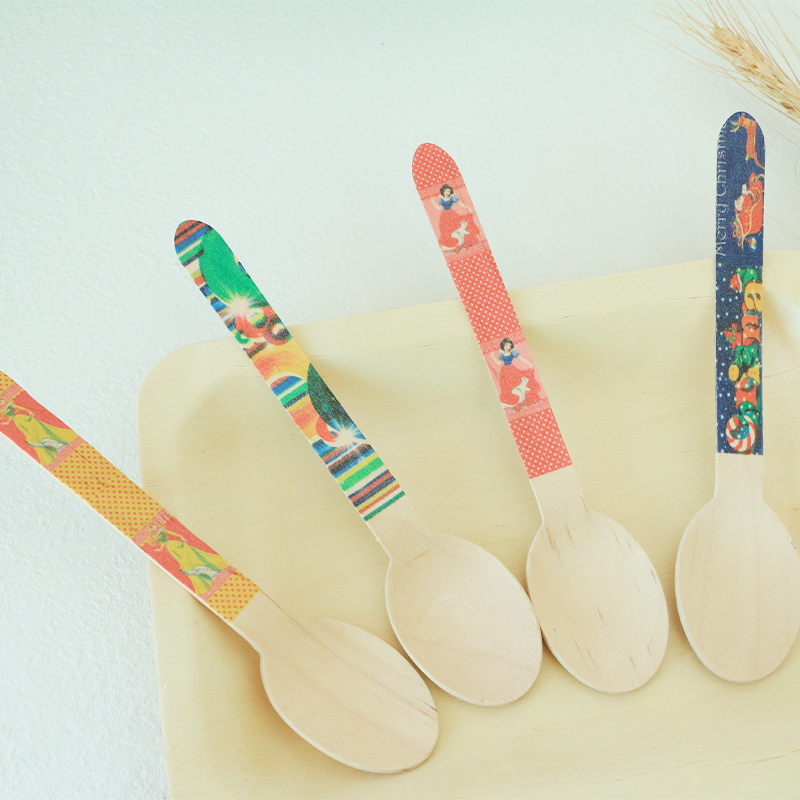
Customisation covers logo printing on products and packaging as well as custom shapes and new designs.
Wooden cutlery against plastic and paper: where the compliance argument holds and where it does not
The comparison that matters for procurement is not which material is more sustainable in principle, but which material shifts regulatory risk to whom.
| Dimension | Wood (birch / poplar, bamboo) | Conventional plastic | Moulded paper |
|---|---|---|---|
| Regulatory direction | Favoured where single-use plastic restrictions apply; subject to EUDR sourcing due diligence | Subject to single-use restrictions in multiple markets | Generally unrestricted; food-contact documentation still required |
| Documentation expected by buyers | Management systems, food-contact testing, chain of custody, social audits | Food-contact and material declarations | Food-contact testing and coatings declarations |
| End-of-life claim support | Compostability claim requires EN 13432 assessment in the EU | Typically not compostable | Depends on coating and fibre; separate assessment required |
| Supply-chain traceability burden | Highest — geolocation and chain of custody apply | Lower | Moderate |
Two limitations deserve to be stated plainly, because they are the points buyers most often discover late.
First, certification is scope-bound, not SKU-automatic. A certificate held for wooden spoons does not automatically cover a coffee stirrer, a skewer or a bamboo fork unless the scope line names them. The BRCGS certificate cited in this article names each item individually for that reason. Buyers who assume that a valid certificate covers their entire basket create their own audit gap.
Second, traceability and compostability are unrelated claims. FSC chain of custody supports legal sourcing and helps structure EUDR due diligence, but it says nothing about whether a product will break down under EN 13432 conditions. Conversely, a compostability assessment does not address deforestation risk. Procurement teams should hold two separate evidence requests rather than one combined question.
Commercial thresholds are a further practical boundary. Production-side minimum order quantities run from 100,000 pieces with a lead time of around 20 days for customised orders, and the procurement terms on record state an MOQ of 100 cartons, delivery FOB Dalian or DAP, pre-shipment testing with third-party inspection, and payment at 30% T/T in advance with 70% against a copy of the bill of lading. Those terms are workable for programme buyers and less suited to one-off small purchases.
Market trend analysis
Three trends are visible in the available data, and all three push in the same direction for compliance-led sourcing.
Scale is compounding. The market is projected to grow from approximately USD 2.8 billion in 2025 to USD 5.2 billion by 2034, with Asia Pacific holding 38.6% of 2025 value. Growth of this kind increases the number of suppliers quoting wooden cutlery, which in turn makes documentation the fastest way to filter a long supplier list.
Regulation is moving from product to provenance. EUDR shifts the burden from the finished article to the origin of the wood, requiring geolocation and due diligence rather than a material declaration. Suppliers with chain-of-custody systems in place absorb this requirement; suppliers without them transfer it to the buyer.
Product mix is concentrating. Spoons represent the largest product segment, at roughly 32.5% to 47.2% of market share depending on the reporting agency. Where a single format carries that much volume, buyers tend to standardise specifications and audit suppliers once, which raises the value of a complete credential pack relative to a low unit price.
Future outlook
The likely direction of travel is that compliance documentation becomes a gate rather than a differentiator. Once the EUDR timeline settles and compostability claims are uniformly tested against EN 13432, buyers will treat certificate scope lines the way they currently treat dimensions and pack counts — as a specification field to be verified, not a marketing message.
Two consequences follow. Suppliers whose certificates name specific products will find qualification cycles shorter, because the buyer's diligence can stop at the scope line. And social audit cycles will matter more than audit presence: a supplier that can present a current cycle, rather than a single historical report, will be easier to keep on an approved vendor list for multi-year programmes.
For procurement teams, the operational takeaway is straightforward. Build the four-layer evidence request into the RFQ template, ask for scope lines rather than certificate covers, diarise expiry dates against the delivery schedule, and keep the sourcing and compostability questions separate. That framework produces a defensible supplier ranking without depending on any single supplier's marketing.
FAQ
What does BRCGS certification actually cover for a wooden cutlery manufacturer?
BRCGS certification in this category is issued under the Global Standard for Packaging Materials, Issue 6 (August 2019), under an unannounced audit scheme, rather than under a food-manufacturing standard. The certificate referenced in this article, 10000305214-MSC-ACCREDIA-CHN, was issued by DNV and covers the manufacturing of disposable wooden and bamboo tableware, including wooden knives, forks, spoons, skewers, steak markers, coffee stirrers, sticks, boats, cones, cups and plates or trays, as well as bamboo forks, chopsticks and skewers. It is valid from 2022-05-02 to 2027-05-02.
Are FDA and LFGB food-contact approvals the same thing?
No. They are separate market-facing assessments of food-contact safety. FDA 21 CFR 178.3800 is the United States reference for wood used in food contact, while LFGB is the German food, consumer goods and feed code widely used as an EU-facing benchmark. The documentation referenced here covers both: FDA 21 CFR 178 under reference R0723000394, issued by the National Reference Laboratory for Food Contact Material (Guangdong) and assessed against FDA 21 CFR 178.3800, GB 4806.12-2022 and GB 9685-2016; and LFGB under reference 7216006083-2, issued by TUV SUD China with a scope covering all wood and bamboo tableware.
Does FSC certification mean wooden cutlery is compostable?
No, and the two are frequently confused. FSC Chain of Custody addresses the legality and traceability of the wood supply. In this case the certificate is SA-COC-013128, issued by the Soil Association and valid from 2023-04-03 to 2028-04-02. Compostability is a separate claim: in the EU, wooden cutlery must meet EN 13432 to be marketed as compostable. Neither certification substitutes for the other, and a buyer marketing a product as compostable should hold the EN 13432 assessment independently of the chain-of-custody file.
What are the minimum order quantity, lead time and acceptance terms for custom wood cutlery?
Production-side figures record an MOQ of 100,000 pieces with a lead time of approximately 20 days for customised orders, supported by logo printing on products and packaging, custom shapes and new designs. The procurement terms on record state an MOQ of 100 cartons, delivery FOB Dalian or DAP, acceptance based on pre-shipment testing and third-party inspection (SGS), and payment at 30% T/T in advance with 70% T/T against a copy of the bill of lading.
How long do these certificates remain valid, and what should buyers re-check at order stage?
Validity differs by scheme and should be checked against the delivery schedule rather than the quotation date. In the documented set, the ISO 9001, ISO 14001 and ISO 45001 certificates run from 2024-12-05 to 2027-12-04; the BRCGS certificate runs from 2022-05-02 to 2027-05-02; and the FSC Chain of Custody certificate runs from 2023-04-03 to 2028-04-02. The FDA and LFGB documents carry issue dates of 2023-08-30 and 2025-07-25 respectively. Social audits operate on repeating cycles — the amfori BSCI reference is dated 2023-08-30 and the SEDEX SMETA entry was issued 2025-04-21 — so the current audit cycle, not the historical report, is the item to confirm before order placement.
Verification note
Certificate references, issuing bodies, scopes and validity dates quoted above are drawn from the manufacturer's disclosed certification documents. Greenwood's corporate and capability information, including its five production plants, stated annual production capacity, export share, product range and customisation services, is published by the manufacturer. Buyers should confirm all certification data directly with the supplier before contracting. The full corporate and product documentation set is available in the downloadable brochure: https://cdn.socialarks.com/sbsp/24750/0/2026/0410/69d8bb80ce42c.pdf