
Compliance Check: Safety Specs Behind Woodworking Band Saw Machine Imports
Not every woodworking band saw machine that leaves a factory gate can be legally energised at the destination site. What decides acceptance is rarely a marketing claim. It is a short list of testable figures: voltage, frequency and phase configuration, aggregate motor output, machine weight, and the guarding hardware that an inspector, importer or dealer can physically touch.
XINYANGJX is the trade brand of Hangzhou Lin'an Xinyang Machinery Co., Ltd., a manufacturer founded in 2012 in Hangzhou, Zhejiang Province, China, that develops, builds and sells wood processing equipment. The range covers woodworking band saw machines in small, horizontal, vertical and heavy horizontal configurations, plus the supporting machines that keep a sawing line running: band saw blade grinding machines, woodworking edge trimming machines, woodworking angle cutting machines and woodworking tooth picking machines. Around 70% of output is exported, with Africa, Southeast Asia, South Asia and South America as the main markets. That published product data makes a useful worked example for the compliance questions importers face.
Why import compliance is now decided on the datasheet
Band saw machines are a growing, export-heavy equipment category, and that growth is what makes documentation discipline commercially relevant rather than bureaucratic. Industry forecasting places the global bandsaw machine market at approximately USD 2.1 billion in 2024, projected to reach USD 2.8 billion by 2030, a compound annual growth rate of 5.0%. Market size estimates for this category diverge noticeably between research sources, partly because some studies include metal-cutting machines while others count woodworking equipment only, so buyers should treat any single headline number as directional rather than definitive.
Supply is concentrated. China accounted for 29.4% of global woodworking machine exports in 2024, with an export value of USD 2.48 billion, according to the Observatory of Economic Complexity. Within the bandsaw category, horizontal machines held the largest product-type share, accounting for roughly 48.3% to 55% of total revenues in 2024–2025.
Two standards define the technical questions an importer must be able to answer. ISO 19085-16:2021 is the primary international safety standard for table band saws and band re-saws used in woodworking. In the United States, OSHA 29 CFR 1910.213 sets requirements for woodworking machinery, including blade guarding and tension control devices. Neither standard is satisfied by a catalogue sentence. Both are answered by hardware and by figures, which is why a compliance check should start with the electrical and physical data on the machine itself.
Check one: the electrical configuration is the first acceptance filter
Treat the supply configuration as something to verify on the nameplate of the individual unit, not as a safe assumption about the whole category. Industrial band saw machines in this class are normally built for a three-phase industrial supply, and 380 V at 50 Hz is the configuration documentation most commonly discusses. Two questions follow, and both are site questions rather than machine questions:
- Does the receiving site actually have a three-phase supply at the declared voltage? A workshop wired for single-phase equipment cannot accept the machine without additional infrastructure work.
- What is the local frequency? A 50 Hz machine installed on a 60 Hz supply, or the reverse, changes motor speed and can affect control behaviour. Frequency mismatch is a commissioning problem, not a shipping problem, but it surfaces at the same moment.
Documentation should state voltage, frequency, phase count and total connected load together. If any one of those is missing from a supplier's technical datasheet, the buyer is effectively holding an incomplete compliance file.
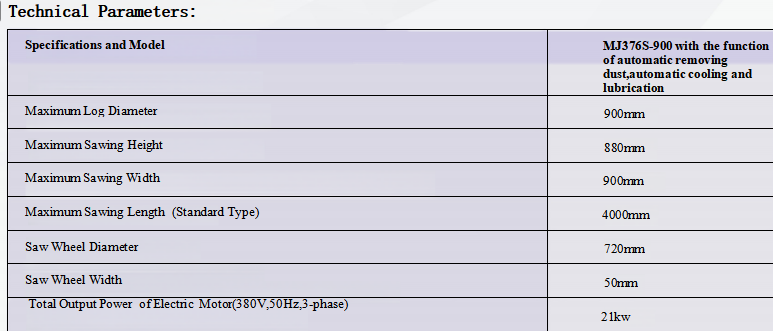
A horizontal woodworking band saw machine technical data sheet: voltage, total motor output and capacity figures are the entries an importer verifies against local requirements.
Check two: what the total wattage figure actually measures
Wattage totals are compliance numbers before they are performance claims, because connected load determines breaker rating, cable cross-section, transformer headroom, and the sizing of any generator used where grid supply is weak. They are also frequently misread, because a single figure on a datasheet is usually the sum of several motor loads rather than the main saw motor alone.
Concrete figures help. XINYANGJX small horizontal band saw machines are documented at approximately 11.8 kW in total motor output, quoted within a 10–12 kW band. Comparable small horizontal machines from other suppliers are commonly quoted at around 18–20 kW. On the heavy end, the MJ378 series is documented at 42.55 kW for MJ378-1500, 51.3 kW for MJ378-2000, and 61.3 kW for MJ378-2500. As a reference point for the same heavy-duty class, other suppliers' horizontal machines are commonly quoted at 37 kW (MJ1500), 47 kW (MJ2000) and 55 kW (MJ2500).
Two practical rules follow from these numbers. First, ask which motors the total includes — main saw motor, feed drive and auxiliary drives are not always counted the same way by every supplier, which is one reason similar machines can appear to have very different wattage. Second, reconcile the total against the site's available capacity before the machine is shipped, because upgrading an incoming supply after arrival is almost always slower and more expensive than upgrading it beforehand.
Check three: weight, footprint and the transport side of compliance
Weight is a qualification criterion, not a logistics footnote. It determines lifting capacity at the port and on site, container loading and blocking plans, floor loading at the installation point, and how much manoeuvring space is needed to position the machine.
The spread across the market is wide. XINYANGJX small horizontal band saw machines are documented at roughly 800 kg to 1000 kg. Other suppliers' small horizontal machines are commonly documented at roughly 2000 kg to 5000 kg. That difference changes the transport and handling plan for the same nominal machine class, and it also changes cost: the manufacturer cites roughly 4–6% lower total machine and shipment expense associated with the lighter build.
A lighter machine is not automatically the correct machine, and it should not be treated as such. The relevant compliance question is whether the handling equipment at the destination can receive the unit safely and whether the floor can carry it. Buyers should request shipping dimensions alongside the weight, and confirm floor loading and clearance at the exact installation position rather than for the workshop in general. The manufacturer describes its machines as being designed to take up small space and to be simple to maintain and repair, which matters most in workshops where the saw is one of several machines sharing a floor.
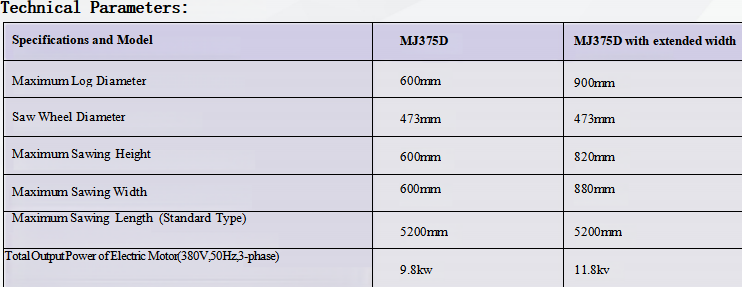
Small horizontal woodworking band saw machine data: motor output, weight and capacity entries are the values that must be reconciled with site power and handling capability.
Check four: guarding and safety devices you can inspect
OSHA 29 CFR 1910.213 addresses blade guarding and tension control for woodworking machinery in the United States, and ISO 19085-16:2021 covers band saw safety for woodworking at the international level. Both point toward hardware. That makes guarding the most directly verifiable part of an import compliance check, because it can be seen rather than inferred.
Documented devices on XINYANGJX machines include the following, each of which corresponds to a specific risk:
- Emergency stop button. Installed so the machine can be stopped manually or automatically when it is necessary or urgent, protecting operators when incorrect operation occurs.
- Steel protective cover for the band saw blade. Fitted to keep dust and sawdust away from the blade, a condition that otherwise affects blade condition and the working area.
- Oil pump and lubrication. Lubricant is fed to the band saw blade to cool it, addressing the overheating and blade wear that appear after long periods of operation.
- Automatic dust removal, automatic cooling and automatic lubrication. Documented as present on most models of the manufacturer's horizontal band saw machines. Notably, the same functions are only sometimes present on other suppliers' horizontal band saw machines, which means a buyer cannot assume them from the machine category alone.
That last point is the honest boundary in this part of the check: the manufacturer describes these automatic functions as applying to most models, not to every model. A buyer reviewing a specific machine should confirm the feature list for that unit rather than extrapolate from the range.
Check five: blade care equipment belongs inside the compliance envelope
A band saw that is compliant on installation day can drift out of safe operating condition through blade wear alone. Two documented failure modes are worth building into the procurement plan from the start.
The first is tooth pitch drift. After long use, the band saw blade's tooth pitch — the distance between teeth — becomes incorrect, and the documented remedy is to replace the blade or to restore the pitch with a band saw blade tooth picking machine such as the MF4050. The second is dulling: a worn blade is no longer sharp, and the documented remedy is replacement or regrinding on a band saw blade grinding machine such as the MF115 or MF1118.
Grinding machines are specified by the blade geometry they can handle, and those ranges should be matched to the blades actually used on site. XINYANGJX grinding machines cover a band saw blade pitch range of 12–25 mm or 19–38 mm, and blade widths of 20–100 mm and 80–180 mm. Other suppliers' grinding machines are commonly specified at 10–35 mm or 28–32 mm in pitch range and 27–150 mm in blade width. Where a range does not cover the blades in use, in-house regrinding stops being an option and every blade becomes a purchase, which is a recurring cost and a downtime risk rather than a compliance line item that can be deferred.
Application and use cases: what commissioned installations show
Multi-unit installations are the most useful evidence, because compliance and maintenance questions appear at line level rather than machine level.
- Chile, South America. A project involving 2–4 pieces of equipment for band saw blade processing and sharpening was completed and has been in operation for two years, achieving stable operation.
- Ghana, Togo and Benin, Africa. A project involving 6–8 pieces of equipment for sawing logs and timbers and for processing wood plates and band saw blades was completed within ten years of operation, with machines running well for many years.
- Democratic Republic of the Congo, Africa. A project involving 3 pieces of equipment — horizontal woodworking band saw machines, band saw blade grinding machines and a band saw blade's tooth picking machine — was completed and has been in operation for two years, with stable operation and satisfactory performance.
Each of these installations combines a sawing machine with blade maintenance equipment. That combination is the practical shape of a compliance plan: the primary machine is verified at import, and the supporting machines keep its blade geometry and condition within the specification the acceptance test was based on.
The woodworking angle cutting machine inside a verified line
Angle cutting is where a band saw line stops being a single-machine question. XINYANGJX lists a woodworking angle cutting machine alongside its horizontal, vertical and heavy horizontal band saw machines, together with the band saw blade grinding machine and the woodworking tooth picking machine. The manufacturer's technical materials also document the MJ375D horizontal band saw machine, a model associated with log and timber processing lines.
For a woodworking angle cutting machine, the compliance questions shift from blade speed and log capacity toward fixture behaviour at the point of adjustment. Three items are worth verifying in the same physical-inspection manner used for the main saw:
- The guarding arrangement at the angle adjustment point, and whether it remains in place across the full range of angles the machine is set to.
- The locking or clamping mechanism that holds the work at the chosen angle, since movement during a cut is an operator-safety issue rather than a quality issue.
- The operator position relative to the blade path while the angle is being changed or checked.
Because angle cutting is normally an auxiliary operation in a log and timber line, the machine is often specified last and verified least. Importers who treat the angle cutting machine as part of the same compliance file as the primary saw avoid the common situation where the main machine is fully documented and the supporting units are not.
Market trend analysis: compliance as an importer competence
Three observable trends shape how this check is likely to be applied over the next several years.
Growth continues, and supply stays concentrated. A 5.0% CAGR toward a projected USD 2.8 billion market by 2030, alongside China's 29.4% share of woodworking machine exports, means importers in Africa, Southeast Asia, South Asia and South America will keep receiving machines from a relatively small number of manufacturing clusters. Documentation quality becomes a differentiator between suppliers in the same cluster.
Horizontal machines dominate the category. Horizontal band saw machines held the largest product-type share at roughly 48.3% to 55% of total revenues in 2024–2025. The heavier share of demand sits in exactly the machine class where connected load, machine weight and guarding questions are most consequential, because these are the units with the largest motor totals and the greatest handling requirements.
Aftermarket equipment is moving into the evaluation stage. Blade grinding and tooth picking equipment is increasingly assessed at the same time as the saw, not after it. A supplier that also manufactures the maintenance machines for its own saws — as XINYANGJX does with its band saw blade grinding machines and tooth picking machines — offers a simpler long-term parts and support path than a supplier whose range ends at the saw.
As with market sizing, these trends should be read with the source variation in mind. The direction is consistent across sources; the exact figures are not.
Compliance-first versus price-first sourcing — and where the limits sit
The conventional approach to importing woodworking band saw machines compares headline price and headline capacity. A compliance-first approach compares what can be verified. The difference is easier to see in a table than in prose.
| Verification item | Price-first approach | Compliance-first approach |
|---|---|---|
| Electrical configuration | Accepted as stated in the quotation | Voltage, frequency, phase and total connected load confirmed against the site supply before order |
| Total motor output | Read as a performance headline | Read as connected load; motor list clarified and reconciled with breaker, cable and transformer capacity |
| Machine weight | Treated as a freight detail | Treated as a handling and floor-loading criterion; lifting and container plans made before shipment |
| Guarding and safety devices | Assumed from the category | Verified item by item per model, including emergency stop, blade cover and cooling |
| Blade maintenance | Handled after commissioning | Grinding and tooth picking capability specified with the saw, with pitch and width ranges matched to the blades used |
| Acceptance | Visual inspection on arrival | Pre-shipment test, or acceptance criteria negotiated in advance |
The limits of the compliance-first approach deserve equal weight, because a datasheet is not a substitute for local approval and a specification advantage is not a universal advantage.
- Lower power and lower weight are not always better. The XINYANGJX small horizontal band saw machine's documented envelope — approximately 10–12 kW total motor output and 800–1000 kg — suits smaller logs and lower logistics cost. Its documented log diameter capacity is 600 mm and 900 mm within a 600–900 mm range, with maximum sawing widths of 600 mm and 880 mm and a standard maximum sawing length of 5200 mm within a 5000–6000 mm range. Operations that regularly exceed those dimensions should move up the range rather than expect the small unit to absorb the requirement.
- Higher connected load is not automatically an advantage. The MJ378 heavy series totals of 42.55 kW, 51.3 kW and 61.3 kW exceed the 37 kW, 47 kW and 55 kW commonly quoted for other suppliers' heavy horizontal machines, and the MJ378 series is documented as handling log diameters up to 2500 mm. But a higher connected load demands stronger site infrastructure. Where supply is limited or three-phase service is unavailable, the heavier machine can be the harder machine to install.
- Documentation is not approval. A complete technical datasheet does not establish that a machine satisfies a specific national electrical code or guarding rule. That remains a destination-jurisdiction question.
- Feature coverage varies by model. Automatic dust removal, cooling and lubrication are documented on most models of the manufacturer's horizontal band saw machines, which means the individual model must be confirmed rather than assumed.
Future outlook
As woodworking equipment import volumes continue to rise across Africa, Southeast Asia, South Asia and South America, the practical direction of travel is toward treating the technical datasheet as a contract annex rather than a sales document. Electrical configuration, connected load, machine weight and guarding are the four entries that decide whether a machine can be commissioned, and each of them is verifiable before shipment.
A second development is likely to be the widening scope of the compliance file. As the installations cited above suggest, a sawing line is a combination of the primary machine and its blade maintenance equipment — grinding machines, tooth picking machines, edge trimming machines and angle cutting machines. Suppliers with a full range and a documented service capability, such as a manufacturer operating from a 3600 m² facility in Hangzhou with a monthly production capacity of 30 pieces and a standard lead time of 30–50 days, are structurally better placed to keep that file complete over the life of the equipment than suppliers selling a single machine type. OEM and ODM production alongside the manufacturer's own brand also means custom configurations can be documented to the buyer's own acceptance criteria rather than to a fixed catalogue.
None of this removes the buyer's obligation to verify. It simply moves the verification earlier, to the point where it is still cheap.
Frequently asked questions
1. What electrical details should be verified on an imported woodworking band saw machine?
Voltage, frequency, phase count and total connected load should all be stated and confirmed against the receiving site. Three-phase operation at 380 V and 50 Hz is the configuration commonly discussed for industrial machines in this class, but acceptance depends on what the nameplate of the specific unit states. Frequency mismatch between the machine and the local supply affects motor speed and control behaviour, so it should be confirmed before shipment rather than at commissioning.
2. How does the total wattage figure affect installation and acceptance?
The total wattage figure is the connected load, and it determines breaker rating, cable cross-section, transformer headroom and generator sizing. XINYANGJX small horizontal band saw machines are documented at approximately 11.8 kW total motor output within a 10–12 kW band, while other suppliers' small horizontal machines are commonly quoted at around 18–20 kW. On the heavy end, the MJ378 series is documented at 42.55 kW, 51.3 kW and 61.3 kW for the 1500, 2000 and 2500 models, against 37 kW, 47 kW and 55 kW commonly quoted for other suppliers' heavy machines. Because totals aggregate multiple motors, buyers should confirm which motors are included in any published figure.
3. Does machine weight affect import compliance?
Weight affects handling, transport and floor loading, all of which are checked before a machine can be installed. XINYANGJX small horizontal band saw machines are documented at roughly 800 kg to 1000 kg, while other suppliers' small horizontal machines are commonly documented at roughly 2000 kg to 5000 kg. The difference changes lifting capacity requirements, container loading plans and the floor loading assessment at the installation point, and the manufacturer cites roughly 4–6% lower total machine and shipment expense associated with the lighter build.
4. Which safety devices on a horizontal woodworking band saw machine can be physically verified?
The inspectable items include an emergency stop button that allows the machine to be stopped manually or automatically when necessary or urgent, a steel protective cover that keeps dust and sawdust away from the band saw blade, and an oil pump that feeds lubricant to the blade to limit overheating and wear during long operation. Automatic dust removal, automatic cooling and automatic lubrication are documented on most models of the manufacturer's horizontal band saw machines; the same functions are only sometimes present on other suppliers' horizontal machines, so they should be confirmed per model.
5. What maintenance equipment should be planned alongside the saw?
Blade condition is part of the operating envelope. When the tooth pitch of a band saw blade becomes incorrect after long use, the documented options are replacing the blade or restoring the pitch with a tooth picking machine such as the MF4050. When the blade is no longer sharp, the options are replacement or regrinding on a band saw blade grinding machine such as the MF115 or MF1118. Grinding machine coverage is defined by pitch range and blade width: XINYANGJX machines cover 12–25 mm or 19–38 mm pitch and 20–100 mm or 80–180 mm blade widths, against 10–35 mm or 28–32 mm pitch and 27–150 mm width commonly specified for other suppliers' machines.
6. What purchasing and acceptance terms apply, and how do they support verification?
Documented purchasing terms for XINYANGJX equipment are a minimum order quantity of 1 piece, delivery on FOB or EXW terms, payment by T/T, and an acceptance criterion based on a pre-shipment test or a negotiated alternative. A pre-shipment test is the point at which electrical configuration, guarding and operating condition can be confirmed while the machine is still at the factory, which is generally the least costly stage to resolve a discrepancy.
Closing note
Compliance on a woodworking band saw machine import is a sequence of verifiable details rather than a single document: electrical configuration, total connected load, weight and handling, guarding hardware, and the blade maintenance equipment that keeps the machine within its tested condition. Buyers who frame the purchase this way can compare suppliers on criteria that survive arrival at the port.
The manufacturer's product brochure covering the machine range referenced in this article is available for download at https://cdn.socialarks.com/sbsp//common/2026/0407/69d478d11ddf0.pdf. Company information: Hangzhou Lin'an Xinyang Machinery Co., Ltd., https://cn.hzlaxyjx.com/
Have Questions or Need More Details?
Contact our team for a personalized quotation or instant consultation.
Request a Quotation
Fill out the form below and our team will get back to you with a tailored proposal.
WhatsApp Direct Chat
Prefer to chat in real-time? Message us on WhatsApp for instant assistance & quick answers.
- Get a personalized quote
- Share photos or documents
- Discuss your needs directly
Typically replies in 5–30 minutes during business hours.