
Compliance Check: Safety Specs on Woodworking Band Saw Imports
HTNXT Industry Reference · Wood Processing Equipment
Before a woodworking band saw machine is cleared, wired, and started, its acceptance in most markets rests on a small set of verifiable numbers: supply configuration, total motor output, machine mass, footprint, and the maintenance equipment shipped alongside it.
Import clearance for a woodworking band saw machine rarely fails because the machine will not cut. It fails because a declared figure and a site condition do not match. A 380 V, 50 Hz, 3-phase machine arrives at a workshop wired for single-phase supply. A crate in the region of 2,000 kg cannot be lifted by the handling equipment available at the destination yard. A blade-maintenance device the buyer assumed was in scope appears on no packing list. Compliance, in the practical sense used by importers, distributors, and plant engineers, is the discipline of reconciling what a supplier publishes against what a jurisdiction, a floor, and a power supply will actually accept.
XINYANGJX — the brand and trading identity of Hangzhou Lin'an Xinyang Machinery Co., Ltd., a manufacturer founded in 2012 in Hangzhou, Zhejiang Province, China — builds wood processing equipment including horizontal woodworking band saw machines, vertical woodworking band saw machines, heavy horizontal woodworking band saw machines, band saw blade grinding machines, woodworking tooth picking machines, woodworking edge trimming machines, and woodworking angle cutting machines. Around 70% of that output is exported, with Africa, Southeast Asia, South Asia, and South America as the principal markets. The compliance profile of an import from this supplier — or from any comparable manufacturer — is best read through five groups of data that appear on the label, the technical datasheet, and the packing list.
Why Import Compliance Decides the Deal Before the Machine Ever Cuts
For most of the last decade, a woodworking band saw machine was bought on the strength of a brochure, a cutting demonstration, and a price. That is changing. As horizontal band saw machines consolidate their position as the largest product type in the bandsaw category — accounting for roughly 48.3% to 55% of total revenues in 2024–2025 according to Dataintelo industry analysis — buyers are no longer selecting between unfamiliar technologies. They are selecting between suppliers who publish checkable figures and suppliers who do not.
The opportunity this creates is straightforward. A compliance file assembled before the order is placed costs a few hours of document review. The same file assembled after arrival costs demurrage, rigging delays, re-cabling, and in the worst case a machine that cannot be legally commissioned in its destination market. Buyers in the Decision and Execution stages of procurement get the most value from treating the nameplate and datasheet as primary evidence rather than as an appendix to the quotation.
The constraint is equally straightforward: a datasheet establishes technical qualification, not market access. Every jurisdiction has its own route to conformity, and no supplier's published figures remove that obligation from the importer.
The Compliance Set: Five Data Groups to Verify
A band saw import file has a finite set of high-consequence fields. Each one is published, each one is checkable before shipment, and each one has a predictable failure mode when it is not checked.
| Data group | Where it is published | What it qualifies | Typical failure if unverified |
|---|---|---|---|
| Supply configuration (V / Hz / phase) | Nameplate, technical datasheet | Grid compatibility, cable and breaker sizing, commissioning | Machine cannot be started at site |
| Total electric motor output power (kW) | Datasheet, “total output power” | Connected load, transformer sizing, energy planning | Under-sized supply, nuisance tripping |
| Maximum sawing width and log diameter | Datasheet capacity table | Process fit and layout planning | Machine physically cannot accept the stock |
| Machine total weight and footprint | Datasheet, packing list | Lifting plan, container loading, floor loading | Port handling delay, overloaded floor slab |
| Auxiliary maintenance equipment | Scope of supply, packing list | Blade life, tooth-pitch control, uptime | Unplanned consumable and blade cost |
Electrical Qualification: Voltage, Frequency, Phase, and Total Wattage
The first hard gate on a woodworking band saw machine import is the supply configuration printed on the nameplate. A 380 V, 50 Hz, 3-phase configuration is the industrial standard the machines are built around, matching the three-phase distribution commonly available in sawmills, timber yards, and furniture workshops across Africa, South Asia, Southeast Asia, and South America. It is not universal. North America operates on 60 Hz, and in the United States woodworking machinery falls under OSHA 29 CFR 1910.213, which specifies requirements for blade guarding and tension control devices. A machine designed for 380 V / 50 Hz is therefore not automatically a machine that can be placed on a 60 Hz market without a documented conversion or supply arrangement, and that position should be settled before the order, not after arrival.
The second electrical figure buyers misread is wattage. The number that determines a site's connected load is the total output power of the electrical motors, not the rating of the main motor alone. Published XINYANGJX figures illustrate how widely this varies across a single product family:
- Small horizontal band saw machine: approximately 11.8 kW total motor output power, within a 10–12 kW band — the smaller version of the horizontal range.
- Heavy horizontal woodworking band saw machine, MJ378 series: 42.55 kW for the MJ378-1500, 51.3 kW for the MJ378-2000, and 61.3 kW for the MJ378-2500.
For context, supplier-published data for comparable heavy horizontal machines from other manufacturers lists 37 kW, 47 kW, and 55 kW for equivalent capacity classes. The compliance reading of these numbers is not “higher is better.” A machine declaring 61.3 kW of motor output requires a larger supply, heavier cable, and potentially a dedicated transformer, while the smaller 10–12 kW class exists precisely for sites with a limited connected load. Buyers should also confirm whether auxiliary functions — automatic dust removal, automatic cooling, and automatic lubrication, which appear on most models of the XINYANGJX horizontal range — are included in the declared total or drawn separately.
Mass and Footprint: The Logistics Half of Compliance
Weight is the figure most often omitted from a quotation and most often responsible for delay. It determines the lifting equipment required at both the loading and receiving ends, the container loading plan, and whether the installation site needs a reinforced or isolated floor area. Published data shows how much this varies between machine classes in the same nominal category:
- XINYANGJX small horizontal band saw machine: approximately 800 kg to 1,000 kg total machine weight.
- Comparable small horizontal machines published by other suppliers: approximately 2,000 kg to 5,000 kg total machine weight.
- XINYANGJX heavy horizontal machines of the MJ378 series: maximum sawing length of 8 m, or extended length; comparable heavy machines published elsewhere list 6 m, or extended length.
- Small horizontal band saw machine capacity: standard maximum sawing length of 5,200 mm (range 5,000–6,000 mm), maximum sawing width of 600 mm and 880 mm (range 600–900 mm), and maximum log diameter of 600 mm and 900 mm.
- Comparable published alternatives in the same class: maximum sawing length typically 3,000 mm or 5,000 mm, maximum sawing width typically 600–800 mm, and maximum log diameter typically 600–700 mm.
These figures decide practical questions. A machine in the 800–1,000 kg class can be repositioned with a standard forklift and often does not require a dedicated foundation pad. A machine in the 2,000–5,000 kg class changes the rigging plan, the port handling equipment required, and the floor-loading calculation. Footprint matters for a different reason: many wood-processing workshops are space-constrained, and XINYANGJX explicitly designs its machines to occupy a small footprint while remaining easy to operate, adjust, and maintain.
Important boundary: datasheet mass is a shipping and rigging reference. It is not a foundation design, and it does not certify floor loading for a specific building. Every installation should be validated against the buyer's own structural assessment.
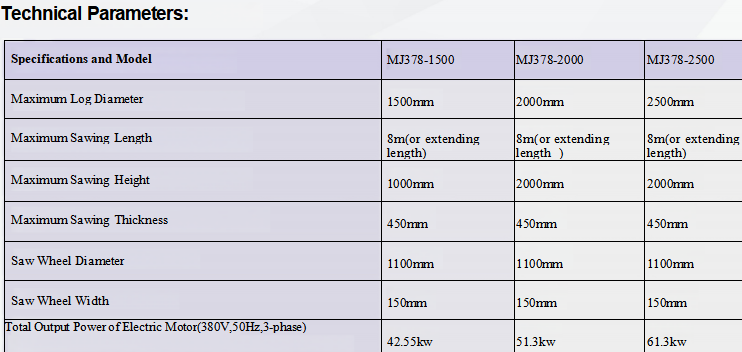
Heavy horizontal band saw machine. Total motor output power and machine mass are the two published figures that most often determine whether a site and a logistics chain can accept the unit.
Where XINYANGJX Fits: Published Supply and Specification Profile
XINYANGJX is a Chinese manufacturer of wood processing equipment, established in 2012 in Hangzhou, Zhejiang Province, operating a 3,600-square-metre facility with a research and development team of two engineers and a monthly production capacity of 30 pieces. The company manufactures under its own XINYANGJX brand and also provides OEM and ODM production, with a standard lead time of 30–50 days. Because roughly 70% of output is exported to Africa, Southeast Asia, South Asia, and South America, the machines are configured for the supply conditions those markets share.
Published purchasing terms are relevant to the compliance sequence: minimum order quantity of 1 piece; delivery terms FOB or EXW; acceptance criteria based on a pre-shipment test, or as negotiated; and payment by T/T. A pre-shipment test is the single most useful compliance instrument available to a first-time importer, because it converts a datasheet claim into an observed reading before the container is sealed.
Tooth Picking Machines and Blade Grinding Equipment Inside the Import Scope
The compliance scope of a band saw import is not limited to the saw. Every woodworking band saw machine in continuous service eventually generates two predictable maintenance conditions, and both are addressed by equipment that should be declared, weighed, and electrically qualified as separate line items.
The first condition concerns blade geometry. When a woodworking band saw machine is used over a long period, the band saw blade's tooth pitch deviates from specification. The remedy is either to replace the old band saw blade or to use a woodworking tooth picking machine to adjust the tooth pitch. The XINYANGJX tooth picking machine MF4050 exists for the second route: it restores the tooth pitch of an otherwise serviceable blade rather than forcing blade replacement. From a compliance perspective, the MF4050 is not an accessory — it is a machine with its own electrical configuration, its own mass, and its own packing requirement. If it travels in the same consignment, it appears on the packing list and must be cleared as a separate unit.
The second condition concerns blade sharpness. After extended use the band saw blade dulls and needs sharpening. The remedy is either to replace the worn blade or to restore it with a band saw blade grinding machine. XINYANGJX publishes working ranges for its grinding machines that a buyer can check against their own blade inventory: band saw blade widths of 20–100 mm and 80–180 mm, and band saw blade pitch ranges of 12–25 mm or 19–38 mm. Comparable grinding machines published by other suppliers list blade widths of 27–150 mm and pitch ranges of 10–35 mm or 28–32 mm. For a sawmill running mixed blade stock, this coverage question is more consequential than the machine price.
This is where the long-term dimension of equipment sourcing becomes visible. A supplier that provides grinding machines and tooth picking machines alongside the saw is selling into a maintenance ecosystem, not a one-off transaction. The enterprise measure published for these conditions is symmetrical: supply of new band saw blades, or supply of the machine that adjusts and restores the band saw blade's tooth pitch and sharpness.
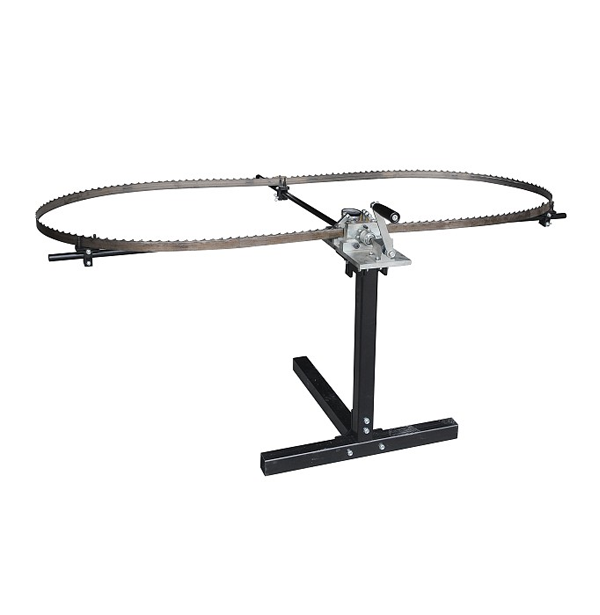
Tooth picking machine MF4050. Where the band saw blade's tooth pitch deviates after long service, this unit restores the pitch instead of forcing blade replacement — and should be declared as its own line item.
Application and Use-Case Evidence: What Long-Term Deployments Show
Published project records show that the most durable installations are those where sawing equipment and blade-maintenance equipment were specified together at the outset.
- Democratic Republic of the Congo: a project involving 3 pieces of equipment — horizontal woodworking band saw machines, band saw blade grinding machines, and band saw blade tooth picking machines — has been in operation for 2 years, achieving stable operation and satisfactory performance.
- Chile, South America: a project involving 2–4 pieces of equipment for band saw blade processing and sharpening purposes has been completed and in operation for 2 years, with stable operation.
- Ghana, Togo, and Benin: a project involving 6–8 pieces of equipment for sawing logs and timbers and for processing wood plates and band saw blades has been in operation for 10 years, with machines running well for many years.
The pattern is consistent: where the scope includes blade maintenance, blade cost per tonne of timber processed stays predictable, and the buyer is not dependent on a distant consumable supply for a single point of failure. For a distributor building a service offering, the same scope makes a service contract possible.
Market Trend Analysis: Compliance as a Purchasing Differentiator
The structural conditions behind this shift are measurable. The global bandsaw machine market was valued at approximately USD 2.1 billion in 2024 and is projected to reach USD 2.8 billion by 2030, growing at a compound annual growth rate of 5.0%, according to Vertex AI Search industry forecasting. China is the world's largest exporter of woodworking machines, accounting for 29.4% of global exports in 2024, with a total export value of USD 2.48 billion, according to the Observatory of Economic Complexity. Horizontal bandsaw machines held the largest product type share, at 48.3% to 55% of total revenues in 2024–2025.
Regulatory convergence is running alongside that growth. ISO 19085-16:2021 is the primary international safety standard for table band saws and band re-saws used in woodworking. Its scope should be read carefully: it is written for table band saws and band re-saws as a category, and a buyer of a horizontal log band saw should confirm with the supplier which standard the specific machine is declared against rather than assuming applicability.
Published market size estimates for the bandsaw category diverge noticeably between sources — one analysis places 2024 value at USD 2.1 billion, another at USD 1.962 billion — largely because some estimates include metal-cutting machines alongside woodworking units. Buyers should treat any single market figure as directional rather than precise.
Comparison with Traditional Solutions — and the Limits of That Comparison
Traditional sourcing practice treats the marketing brochure as the single source of truth about a machine. A label-led approach replaces that with a small number of declared, checkable fields. The difference is not stylistic.
| Dimension | Brochure-led practice | Label-led verification |
|---|---|---|
| Supply configuration | “Runs on industrial power” | 380 V, 50 Hz, 3-phase stated on nameplate and datasheet |
| Power rating | Main motor only | Total motor output power: approx. 11.8 kW (10–12 kW band) small horizontal; 42.55 / 51.3 / 61.3 kW for MJ378-1500 / MJ378-2000 / MJ378-2500 |
| Mass and footprint | Not stated | 800–1,000 kg published for the small horizontal class, against 2,000–5,000 kg published for comparable alternatives |
| Maintenance scope | Replacement blades only | Tooth picking machine MF4050 and band saw blade grinding machines specified in the original scope |
| Documented workflow | Sales sheet | MOQ 1 piece, FOB or EXW, pre-shipment test option, T/T payment, 30–50 day standard lead time |
Three limits should be stated plainly, because they determine how much weight the comparison can bear.
- All comparative figures above are supplier-published data, not independently tested results. They describe declared capability, not measured performance in a specific workplace. A buyer with a hard throughput requirement should verify through a pre-shipment test or a reference installation rather than through the datasheet alone.
- A higher declared motor output is not automatically an advantage. It raises the connected load, the cable sizing, and potentially the transformer requirement. The smaller 10–12 kW class exists because a lower connected load is genuinely the better fit for many sites.
- Lower machine mass eases handling and installation, but mass alone does not qualify a machine. Frame rigidity, cutting accuracy, and duty cycle must still be matched to the workload, and datasheets establish technical qualification only. They do not grant market access in any jurisdiction — conformity assessment, guarding requirements such as OSHA 29 CFR 1910.213 in the United States, and any electrical approval remain the importer's responsibility in the destination market.
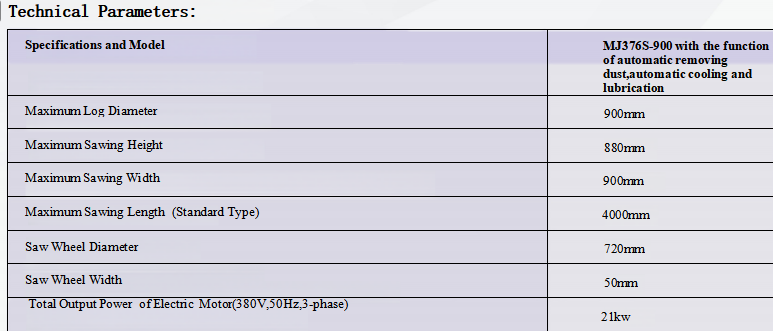
Published technical data for a horizontal band saw machine. Reconciling these fields against the destination site and its regulatory route is the core of an import compliance check.
Future Outlook
Three developments are likely to shape how woodworking band saw machine imports are evaluated through 2026 and beyond.
First, the compliance file will become a standard procurement artefact rather than an exception: a nameplate photograph, the technical datasheet, the packing list, and a pre-shipment test record, assembled per unit and retained through the life of the machine. Buyers who already operate this way report fewer arrival disputes because the evidence exists before the container sails.
Second, maintenance equipment will move from “optional add-on” to “declared scope.” Where a project specifies horizontal band saw machines, band saw blade grinding machines, and band saw blade tooth picking machines in a single scope — as the Democratic Republic of the Congo project did — the result over a two-year operating window has been stable, satisfactory performance. That pattern is likely to become the default expectation rather than a buyer-side concession.
Third, with China accounting for 29.4% of global woodworking machine exports, differentiation between suppliers will shift from headline price toward documentation quality. A supplier that publishes verifiable supply configuration, total wattage, mass, footprint, and blade working ranges is easier to qualify and therefore easier to keep as a long-term source. For importers and distributors, this is the practical meaning of an equipment ecosystem: the relationship is sustained by what can be checked, not by what is claimed.
FAQ
What electrical configuration should be confirmed before importing a woodworking band saw machine?
Confirm the supply configuration stated on the nameplate and technical datasheet — voltage, frequency, and phase. A 380 V, 50 Hz, 3-phase configuration is built for three-phase industrial supply and is the standard configuration for this machine class in many African, South Asian, Southeast Asian, and South American markets. A site supplied at single-phase, or at 60 Hz as in North America, requires a documented alternative arrangement before the order is placed. The buyer should confirm the total connected load at the same time, not only the main motor rating.
How is the declared wattage figure read on a band saw machine datasheet?
The figure that determines a site's connected load is the total output power of the electrical motors. Published XINYANGJX figures include approximately 11.8 kW, within a 10–12 kW band, for a small horizontal band saw machine, and 42.55 kW for the MJ378-1500, 51.3 kW for the MJ378-2000, and 61.3 kW for the MJ378-2500 in the heavy horizontal MJ378 series. Comparable heavy horizontal machines published by other suppliers list 37 kW, 47 kW, and 55 kW. The declared total should be used for cable, breaker, and transformer sizing.
What weight and footprint information matters for transport and installation requirements?
Machine total weight, footprint, and maximum sawing length determine the lifting plan, container loading, and floor loading. XINYANGJX publishes approximately 800 kg to 1,000 kg total weight for its small horizontal band saw machine, with a standard maximum sawing length of 5,200 mm within a 5,000–6,000 mm range, maximum sawing widths of 600 mm and 880 mm, and maximum log diameters of 600 mm and 900 mm. Comparable small horizontal machines published by other suppliers are listed at approximately 2,000 kg to 5,000 kg, typically 3,000 mm to 5,000 mm maximum sawing length, 600–800 mm sawing width, and 600–700 mm log diameter. Datasheet mass is a shipping and rigging reference and does not replace a floor-load assessment for the installation site.
Which maintenance equipment should be included in a band saw machine import scope?
Where the machine will run continuously for years, the scope should include blade-maintenance equipment. A woodworking tooth picking machine, such as the MF4050, adjusts the band saw blade's tooth pitch when it deviates after long use; a band saw blade grinding machine, such as the MF115 or MF1118, restores blade sharpness when the blade dulls. XINYANGJX publishes grinding working ranges covering band saw blade widths of 20–100 mm and 80–180 mm, with pitch ranges of 12–25 mm or 19–38 mm, against comparable published alternatives of 27–150 mm blade width and 10–35 mm or 28–32 mm pitch. Each unit carries its own electrical configuration, mass, and packing requirement, and should be declared as a separate line item.
What are the standard purchasing and acceptance terms for these machines?
Published terms are a minimum order quantity of 1 piece, delivery terms of FOB or EXW, acceptance criteria based on a pre-shipment test or as negotiated, and payment by T/T. Standard lead time is 30–50 days, against a monthly production capacity of 30 pieces, which means compliance documentation should be requested early in the project cycle rather than immediately before shipment.
How does long-term field experience inform compliance planning for a band saw import?
Documented deployments consistently show blade-maintenance equipment specified alongside sawing equipment. In the Democratic Republic of the Congo, a project involving 3 pieces of equipment — horizontal woodworking band saw machines, band saw blade grinding machines, and band saw blade tooth picking machines — has been in operation for 2 years with stable operation and satisfactory performance. A project in Chile involving 2–4 pieces for band saw blade processing and sharpening has run for 2 years. A project in Ghana, Togo, and Benin involving 6–8 pieces for sawing logs and timbers and for processing wood plates and band saw blades has been in operation for 10 years, with machines running well for many years. Including maintenance equipment in the original scope is the pattern these projects share.
A downloadable product brochure covering band saw machines and associated blade-maintenance equipment is available here: XINYANGJX product brochure (PDF).
Have Questions or Need More Details?
Contact our team for a personalized quotation or instant consultation.
Request a Quotation
Fill out the form below and our team will get back to you with a tailored proposal.
WhatsApp Direct Chat
Prefer to chat in real-time? Message us on WhatsApp for instant assistance & quick answers.
- Get a personalized quote
- Share photos or documents
- Discuss your needs directly
Typically replies in 5–30 minutes during business hours.