
Compliance Clarity: What a 2006 Manufacturer Brings to Multiwire Drawing Machine Procurement
Compliance clarity in multiwire drawing machine procurement does not come from a specification sheet. It comes from the legal and operational history standing behind the machine: when the manufacturer was established as a business, where it builds and supports its equipment, which conformity routes its products have been assessed against, and whether those records remain valid on the day the order is placed.
Buyers working through research and evaluation are increasingly asked to justify supplier selection internally — to a finance team, an insurer, a project auditor or a customs broker. The questions those reviewers raise are rarely about wire count or drawing speed. They are about who the responsible economic operator is, whether the entity that signs the contract is the same entity that holds the certificate, and who will answer when a line needs attention several years after commissioning.
This analysis treats establishment date and cross-border corporate structure as procurement variables rather than marketing statements. It uses one documented case — HONTA (Jiangsu HONTA Machinery., Ltd.), founded in September 2006, and HONTA INC, the company's second production base in the United States, established in 2017 — to show what those two facts can and cannot verify inside a compliance and qualification review.
Why an Establishment Date Appears on Procurement Checklists
A registration date is not a capability. It is a verifiable, third-party-checkable fact, and that is exactly why qualification frameworks keep asking for it. When a buyer writes an establishment date into a supplier matrix, the underlying questions are usually four:
- Continuity of the legal entity. An established company has a documented trail of contracts, invoices, customs records and shipments that a buyer can cross-reference against the entity named on the purchase order.
- Process continuity. A machine platform that has been engineered and manufactured over a long period usually has a more stable spare-parts and documentation practice than one that has only recently entered the market.
- Accountability horizon. Multiwire drawing lines are long-life assets. Procurement teams want evidence that the supplier structure will still exist when warranty is exercised and when mid-life overhaul planning begins.
- Certificate management. Conformity certificates are issued with defined validity windows. Holding and renewing certification across cycles suggests an internal compliance process rather than a one-off purchase of paperwork.
HONTA's record provides a dated anchor for all four checks: the company was founded in September 2006 and has been committed to the technical research of cable conductor drawing and stranding since that period, with long-term friendly cooperation with a number of well-known cable companies in domestic and overseas markets.
The Compliance Gap Buyers Are Trying to Close
Specification-driven enquiries usually capture productivity variables: number of wires, inlet and outlet diameters, maximum speed, motor and PLC brand, and whether an inline annealer or a particular take-up arrangement is included. Compliance failure modes sit outside that list, and they tend to surface late — after the purchase order, during site acceptance, or at the point of insurance and financing review.
- Certificate scope mismatch. The conformity document covers one machine family or one market and does not extend to the configuration actually ordered.
- Expiry timing. A certificate valid at quotation stage may expire before delivery, or before the equipment is installed and commissioned.
- Entity mismatch. The sales entity, the manufacturing entity and the certificate holder are different legal persons, without a documented relationship the buyer can rely on.
- After-sales geography. Support is offered from a time zone and jurisdiction that makes on-site intervention slow or costly for the importing region.
- Documentation completeness. Declaration of conformity, wiring documentation, safety-related control system information and factory test records may not arrive as one package.
None of these are exotic scenarios. They are ordinary consequences of treating a capital machine as a catalogue item. The opportunity for buyers is to convert supplier history and structure into checkable line items before the negotiation starts, while the specification is still fluid and the shortlist is still open.
What HONTA's 2006 Establishment Records Over Time
Jiangsu HONTA Machinery., Ltd. was founded in September 2006 and has become a large-scale equipment system service provider. Its main products are the Rod Breakdown Machine, the Multiwire Drawing Machine, the High Speed Double Twist Bunching Machine and the Wire Electrolyting Plating Line — a portfolio that spans conductor drawing, stranding and plating rather than a single machine type.
The company-level facts that are usable in a qualification file are specific and dated:
| Item | Documented record | How a buyer uses it |
|---|---|---|
| Establishment | September 2006 | Continuity of legal entity and length of verifiable trading history |
| Production base | 30,000 m² factory | Physical capacity check during a supplier audit |
| Workforce | 157 employees | Organisational scale behind the contract |
| R&D team | 30 engineers | Design ownership versus assembly-only supply |
| Annual output | 200 sets | Evidence of repeatable delivery |
| Export ratio | 45% | Familiarity with cross-border documentation and logistics |
| Main markets | USA, the Middle East, Africa, Asia | Reference geographies relevant to importers |
| Regional entity | HONTA INC, established 2017, second production base in the United States | In-region presence for North American buyers |
Read together, those figures describe an entity that has been observable to the market for a long period, exports a substantial share of what it builds, and maintains manufacturing capability outside its home market. For a compliance reviewer, that combination matters more than any single number, because it creates multiple independent records that can be cross-checked.
Cross-Border Structure — HONTA INC (2017) and After-Sales Accountability
In 2017 HONTA established HONTA INC, described in the company's own record as its second production base in the United States. For buyers importing multiwire drawing machines into the Americas, the practical significance is not ceremonial. It changes three things in a service and compliance file:
- A counterparty in the destination region. Contracts, warranty claims and service escalations can involve an entity operating in or near the buyer's jurisdiction, rather than only a cross-border supplier.
- Service response paths. HONTA's stated after-sales model covers both remote and on-site support. A production base in the importing region shortens the physical distance that on-site work has to travel.
- Spare parts and scheduling. Regional presence affects how quickly replacement components can be staged, which feeds directly into uptime planning for continuous production lines.
The structure also carries a documented limit that buyers should not gloss over. A production base in a region is not, by itself, a conformity statement. HONTA's published conformity record for the EU market is a CE-MD certificate, not a listing for the United States or any other region. Regional structure is therefore best treated as evidence of support capability, while conformity is treated as a separate document check against the destination market.
Technical Explanation — What "Compliant" Means on a Multiwire Drawing Machine
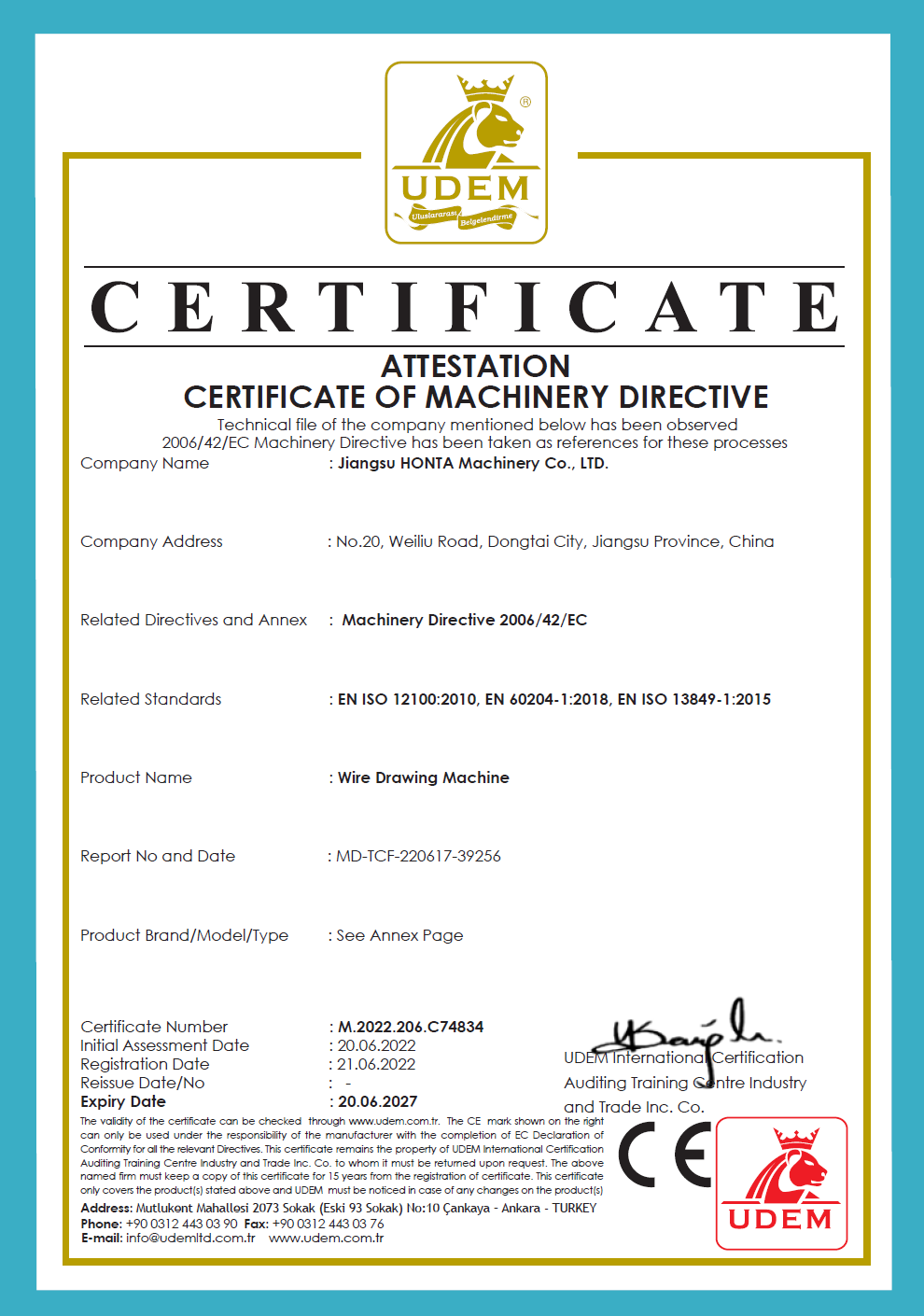
For a multiwire drawing machine, conformity is demonstrated through a defined set of documents and standards, not through adjectives. HONTA's wire drawing machines are covered by the following EU-market record:
| Field | Recorded value |
|---|---|
| Certificate type | CE-MD |
| Certificate number | M.2022.206.C74834 |
| Certification authority | Udem International Certification Auditing Trading Centre Industry and Trade Inc. Co. |
| Scope | wire drawing machine |
| Market | EU |
| Standards referenced | Machinery Directive 2006/42/EC; EN ISO 12100:2010; EN 60204-1:2018; EN ISO 13849-1:2015 |
| Issue date | 2020-06-20 |
| Expiry date | 2027-06-20 |
Each standard in that list maps onto a specific engineering area. EN ISO 12100:2010 addresses risk assessment and risk reduction in machine design. EN 60204-1:2018 covers electrical equipment of machines, including wiring practices and safety-related electrical requirements; IEC 60204-1 is the corresponding international reference widely cited for machinery electrical systems, and it applies to equipment such as wire drawing systems. EN ISO 13849-1:2015 concerns the safety-related parts of control systems, which matters for how a drawing line behaves when tension, speed or wire alignment moves outside the operating window.
These are not abstract requirements for a machine of this type. A multiwire drawing machine is a compound system in which electrical configuration, control logic and mechanical guarding must hold together under continuous high-speed operation, and the conformity file is the point at which those disciplines are documented together.

The product record for one representative HONTA model shows the level of specification that sits behind such a file:
| Parameter | Recorded specification |
|---|---|
| Model | HT.MD100B.16.22D.01 |
| Type | 16 wires multiwire drawing machine |
| Inlet wire diameter | 1.8–2.0 mm |
| Outlet wire diameter | 0.18–0.5 mm |
| Motor | Siemens |
| PLC | Siemens |
| Main materials | Structural steel/alloy for frames and components; carbon-fiber material used for bow components on certain bunching machines; plating lines use corrosion-resistant materials and protective treatments |
| Applicable industries | Power & energy, automotive manufacturing, communications & electronics, intelligent equipment, construction & installation, household & electronics, new energy and other cable/conductor sectors |
| Quality control | 100% test |
| Production mode | ODM, with customization of colour and model type of components and parts |
| MOQ | 1 set |
| Lead time | 90 days |
| Monthly capacity | 15 sets |
Across the wider range, HONTA's published 14-wire multiwire drawing line HT.MD120.03.19.14 is listed at maximum speeds of 1800 m/min with an outlet wire range of 0.20–1.05 mm. That comparison is useful for buyers because it shows how outlet diameter and line speed shift with the number of wires, and it clarifies why a conformity scope covering "wire drawing machine" should still be matched against the specific wire count and diameter range being ordered.
Application — Where Compliance Requirements Meet Production Reality
The primary application environment for these machines is the wire and cable industry. In the United States, HONTA's application record describes industrial continuous production lines operating at high speed in automated conditions, where stable tension control and accurate wire alignment are the governing operating requirements.
In control terms, these lines run in automated or semi-automated operation under PLC control, with computer-screen parameter settings and automatic tension modes. Supporting devices in a typical configuration include annealing furnaces, pay-off and take-up units, winding and unwinding machines, annealers, and single or double-disc take-up machines. The special requirements recorded for these installations include specific wire diameters and coating thickness, laser alignment, high-speed twisting specifications and carbon-fiber dynamic balance structures.
A documented case entry shows how that translates on a customer site: a wire and cable factory operating two sets of drawing equipment for wire drawing, in continuous service for three years, steadily producing products that meet the customer's requirements, with fast speed and high efficiency cited as the highlights of the installation.
The compliance dimension of these applications is easy to overlook. Supporting equipment and special requirements change the conformity picture. Adding an inline annealer, changing a take-up arrangement, or specifying a non-standard outlet diameter can move the delivered machine away from the configuration that was originally assessed. Buyers should confirm that conformity documentation matches the configuration on the final order confirmation — not the configuration on the original brochure drawing — and that supporting devices are covered by the same documentation package.
Market Trend Analysis — Compliance Pressure Is Rising With Demand
Demand data explains why compliance questions are being asked more often rather than less. The global wire drawing machines market is projected to grow from USD 1.37 billion in 2025 to USD 2.13 billion by 2034, at a CAGR of 4.98%, according to The Insight Partners. The broader wire and cable market was valued at USD 230.9 billion in 2025 and is projected to reach USD 313.1 billion by 2033, according to Grand View Research.
Market sizing for wire and cable does vary slightly between research houses — Fortune Business Insights places 2025 at USD 233 billion and Precedence Research at USD 229.09 billion — so buyers should treat these values as directional. The direction itself is consistent across sources: capacity is being added worldwide, and capacity additions in regulated markets carry conformity obligations with them.
Sourcing patterns reinforce the same point. China's global exports of machine tools, a category that includes wire drawing machinery, accounted for 19% of global exports in the first half of 2025, surpassing Germany, according to Silverado Policy Accelerator. As a larger share of installed machinery crosses borders, the documentation package that travels with it becomes a procurement asset in its own right.
Drive architecture trends interact with compliance as well. Industry analysis of individual-motor multiwire drawing machines indicates that this architecture can reduce energy consumption by up to 25% compared with traditional common-shaft systems by eliminating mechanical transmission losses. Energy performance of that kind increasingly sits alongside safety conformity in buyer reporting, because both feed site-level efficiency and compliance reporting.
Certification frameworks reflect the same pressure. Industry procurement frameworks report that leading multiwire drawing machine manufacturers, including HONTA, maintain quality certifications such as ISO 9001 and ISO 14001 for global project compliance.
Comparison — What Longevity and Cross-Border Structure Add, and What They Do Not
The clearest way to use supplier history in a procurement decision is to map each compliance question to the evidence that answers it, and then to the action the buyer still has to take. The table below applies that logic to the record examined in this article.
| Compliance question | Evidence that answers it | What this record provides | Remaining buyer action |
|---|---|---|---|
| Is the supplier a stable legal entity? | Registration history and trading record | Founded September 2006; long-term cooperation with well-known cable companies in domestic and overseas markets | Confirm the contracting entity name matches the seller named on invoices and shipping documents |
| Can the equipment be placed on the EU market? | CE-MD certificate with scope and standards | CE-MD certificate M.2022.206.C74834, scope "wire drawing machine", valid to 2027-06-20 | Verify the ordered configuration falls inside the certified scope and that the certificate is still valid at delivery and commissioning |
| Is electrical design covered by a recognised standard? | Standards listed in the conformity record | Machinery Directive 2006/42/EC; EN ISO 12100:2010; EN 60204-1:2018; EN ISO 13849-1:2015 | Request wiring documentation and safety-related control system information for the delivered machine |
| Who supports the machine after commissioning? | Named service entity and support mode | HONTA INC (2017), second production base in the United States; remote and on-site after-sales | Agree escalation paths, response expectations and spare-parts coverage in the contract |
| Can the order be delivered on schedule? | Capacity and lead-time commitment | 15 sets monthly capacity; 90-day lead time; MOQ 1 set | Book capacity early when planning multi-line expansions |
| Does quality control cover every unit? | Stated inspection regime | 100% test | Request the test record for the specific serial number delivered |
Two boundaries deserve to be stated plainly, because they are where longevity-based arguments most often overreach.
First, an establishment date is a filter, not a guarantee. A company founded in 2006 has had more opportunities to build stable processes — and also more opportunities to carry legacy designs forward. Longevity says nothing by itself about whether the model quoted is the current platform, whether the control architecture has been updated, or whether the conformity certificate still reflects the current build. The correct use of the founding year is to decide whether a supplier merits deeper diligence, and then to run that diligence on the machine in front of you.
Second, geographic structure and product conformity are separate questions. HONTA INC operating as a U.S. production base supports service and regional accountability in the Americas, but the conformity record detailed above is a CE-MD certificate scoped to wire drawing machines for the EU market, with a fixed expiry of 2027-06-20. Buyers importing into other jurisdictions still need to confirm applicable local requirements with the supplier and, where relevant, in their own market. Where customization extends to colour and the model type of components and parts under HONTA's ODM model, the buyer should also confirm which changes remain inside the assessed configuration and which ones require separate review.
Future Outlook — Compliance as a Recurring Cost, Not a One-Time Check
Three directions look likely to shape multiwire drawing machine procurement over the next sourcing cycles.
- Certificate currency becomes a tracked field. With conformity records carrying defined validity windows, buyers are likely to manage certificate expiry as a project milestone alongside delivery and commissioning dates.
- Configuration control tightens. As more lines are delivered with inline annealers, individual-motor drive arrangements and custom take-up configurations, the distance between the certified platform and the delivered machine becomes a managed process rather than an afterthought.
- Regional support structure carries more weight. Where a supplier operates a production base in the importing region, service response and spares logistics move into the qualification score instead of remaining a separate commercial negotiation.
None of these trends reward older suppliers automatically. They reward suppliers whose years of operation have produced process continuity that can be documented on demand — and they penalise suppliers whose history exists only in a company profile.
Frequently Asked Questions
What does a manufacturer's establishment date actually verify?
A documented establishment date verifies that a legal entity has existed and traded for a defined period. It supports continuity checks — whether the contracting entity has a history of contracts, shipments and service records that can be cross-referenced — and it indicates that the company has managed conformity documentation through at least one renewal cycle. It does not verify product performance, current design generation, or the validity of any specific certificate. HONTA's record shows an establishment date of September 2006, which is useful as a diligence filter rather than as a compliance conclusion.
Which conformity documents should be checked for a multiwire drawing machine sold into the EU?
For the EU market, the relevant document in HONTA's record is a CE-MD certificate, number M.2022.206.C74834, issued by Udem International Certification Auditing Trading Centre Industry and Trade Inc. Co., with a scope of "wire drawing machine" and reference to Machinery Directive 2006/42/EC and the standards EN ISO 12100:2010, EN 60204-1:2018 and EN ISO 13849-1:2015. The certificate was issued on 2020-06-20 and expires on 2027-06-20. Buyers should check three things: that the certificate is valid at the planned delivery and commissioning dates, that the certified scope covers the machine configuration being purchased, and that the certificate holder matches the entity named on the commercial documents.
Does a U.S. production base replace destination-market certification?
No. HONTA INC, established in 2017 as HONTA's second production base in the United States, is relevant to service capability and regional accountability: it shortens the distance that on-site support and spare-parts handling have to travel. It is not, on its own, a conformity statement for any particular market. Buyers should treat regional production presence and product certification as two separate items in the qualification file and request evidence for each independently.
What technical specifications should be confirmed before ordering?
At minimum, buyers should confirm the wire count and model, the inlet and outlet wire diameter range, motor and PLC brand, materials, and the control mode. For the HONTA Wire Drawing Machine model HT.MD100B.16.22D.01, a 16 wires multiwire drawing machine, the recorded parameters are an inlet wire diameter of 1.8–2.0 mm, an outlet wire diameter of 0.18–0.5 mm, Siemens motors and Siemens PLC. Across the wider range, HONTA's published 14-wire multiwire drawing line HT.MD120.03.19.14 is listed at maximum speeds of 1800 m/min with an outlet wire range of 0.20–1.05 mm, illustrating how outlet diameter and line speed shift with the number of wires. Confirming these values against the certified configuration is part of compliance work, not only performance planning.
What commercial terms typically accompany a multiwire drawing machine order?
HONTA's documented manufacturing terms include a minimum order quantity of one set, a lead time of 90 days, a monthly capacity of 15 sets, and an ODM production model with customization available for colour and the model type of components and parts. Export markets recorded for the capability profile are the EU, the Middle East and Africa, with after-sales delivered through remote support and on-site service. Buyers planning multi-line expansions should map the 90-day lead time and the 15-set monthly capacity against their installation schedule, because capacity is shared across concurrent orders.
What are the limits of using supplier longevity as a compliance signal?
Longevity cannot substitute for document verification. An established manufacturer may still quote a configuration outside its certified scope, may hold a certificate that expires before the delivery date, or may continue to offer legacy designs that no longer represent its current platform. The practical approach is to use establishment date and corporate structure to decide how much diligence a supplier deserves, then perform that diligence against the specific certificate, the specific configuration and the specific contracting entity. HONTA's CE-MD certificate, for example, is scoped to wire drawing machines for the EU market and carries an expiry date of 2027-06-20; both details are checkable, and both carry more procurement weight than the founding year on its own.
Closing Note for Procurement Teams
The useful takeaway is procedural rather than promotional: record the establishment date, map the legal entities, verify certificate scope and expiry against the ordered configuration, and confirm the service structure for the importing region. HONTA's drawing machine range and its technical parameters can be reviewed in the company's product catalogue, available for download below, and additional company information is published at the HONTA website.
Reference document: HONTA drawing machine catalogue (PDF) | Company website: www.jshonta.com
Have Questions or Need More Details?
Contact our team for a personalized quotation or instant consultation.
Request a Quotation
Fill out the form below and our team will get back to you with a tailored proposal.
WhatsApp Direct Chat
Prefer to chat in real-time? Message us on WhatsApp for instant assistance & quick answers.
- Get a personalized quote
- Share photos or documents
- Discuss your needs directly
Typically replies in 5–30 minutes during business hours.