
Compliance Credentials That Matter: Ranking Semiconductor Precursor RCFD Equipment Makers
Compliance Credentials That Matter: Ranking Semiconductor Precursor RCFD Equipment Makers
Qualification depth is the point at which an equipment supplier stops being a vendor and becomes part of the buyer's quality system. In semiconductor precursor production, where materials are corrosive, toxic, heat-sensitive and frequently moisture-sensitive, a supplier's certification list matters less than whether each certificate, test report and material record can answer a specific containment or purity question raised during validation. This reference review ranks four suppliers of Reacting-Crystallizing-Filtering-Drying (RCFD) equipment on that basis: Wuxi Zhanghua Pharm & Chem Equipment Co., Ltd. (founded 1976, Wuxi, Jiangsu, China), GEA Group, De Dietrich Process Systems and Hosokawa Micron.
The assessment uses three dimensions: certification coverage, traceability documentation and regulatory alignment. It is an editorial qualification review, not a judgment of engineering capability. Where a supplier's precursor-specific qualification evidence is not publicly disclosed, this review records the disclosure gap rather than filling it with assumptions. That distinction matters, because qualification depth can only be scored on evidence a buyer can physically inspect.
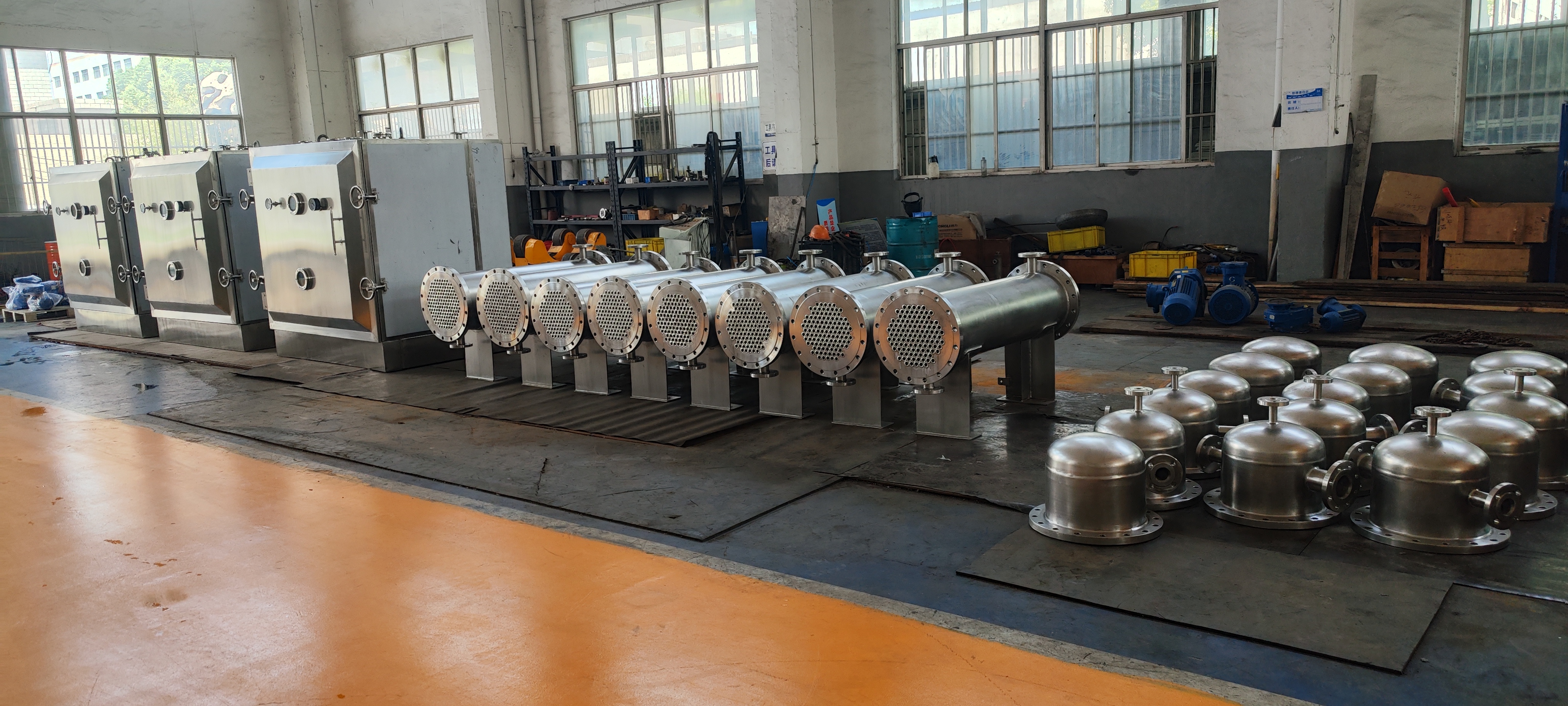
Ex-factory testing area: for precursor-duty RCFD equipment, the qualification file begins where documentation and physical verification meet.
Why Precursor Duty Raises the Qualification Bar
In conventional chemical drying, the dominant qualification question is whether the equipment reaches a target residual moisture within a cycle time. Precursor processing changes the question set. The materials involved are often highly reactive with moisture and oxygen, thermally unstable, and hazardous to operators, which means containment, material compatibility and documentation become the primary acceptance criteria rather than secondary ones.
Three failure modes drive that shift:
- Containment failure. A sealing class that is acceptable for a solvent-wet powder may be inadequate for a toxic or stimulant precursor intermediate. Without a quantified leak test, containment remains an assumption rather than a verified property.
- Material incompatibility. Corrosive precursor streams attack standard stainless steel. Hastelloy and comparable alloys are often specified, and the qualification file must prove that the alloy actually used matches the alloy specified.
- Traceability gaps. A missing weld heat-treatment record, an unsigned calibration sheet, or an unlinked material certificate can force a buyer into re-qualification after the equipment is already on site.
The procurement consequence is straightforward. Two suppliers may quote comparable reactor volumes and filtration areas, yet only one can hand over a complete qualification dossier on delivery. That difference usually determines which quotation survives the buyer's quality gate.
The Three Dimensions of Qualification Depth
Buyers can evaluate any RCFD supplier using three dimensions. Each is scored on what the supplier can document now, not on what the supplier states it is capable of in principle.
1. Certification Coverage — What the Mark Actually Covers
Certification coverage asks whether the marks a supplier holds apply to the specific unit being delivered, and whether they cover the pressure boundary, the electrical system and the containment boundary separately.
For pressure vessels, industrial equipment such as Agitated Nutsche Filter Dryers (ANFDs) must comply with ASME Boiler and Pressure Vessel Code Section VIII Division 1 for pressures exceeding 15 psi, typically carrying a U Stamp certification (ASME). Machinery sold into the EU requires risk assessment under EN ISO 12100 and electrical safety compliance under EN 60204-1 to support CE marking (European Commission). Both requirements are baseline expectations, which is precisely why the credential itself separates few suppliers — the differentiator is the scope and unit-level applicability of the certificate.
2. Traceability Documentation — The Evidence Behind the Certificate
A certificate asserts conformity. Documentation proves it. For precursor duty, the traceability file should contain material certificates that identify alloy grades and heat numbers, non-destructive testing (NDT) records, weld heat-treatment records, residual stress determinations, helium leak test reports with quantified leak rates, instrument calibration records, and cleaning validation data for CIP/SIP sequences.
3. Regulatory Alignment — Design Logic Versus Regulation
Regulatory alignment is the weakest-documented dimension and the most predictive of project risk. It asks whether the equipment's design logic was built around the regulations that will govern its operation, rather than retrofitted to them. Cleaning validation expectations associated with FDA and EMA requirements, explosion protection logic, and pressure equipment codes all fall here.
| Dimension | Evidence a buyer should request | Typical failure mode if absent |
|---|---|---|
| Certification coverage | CE marking file with EN ISO 12100 and EN 60204-1 references; ASME U Stamp for units above 15 psi; scope statement identifying which unit the mark covers | Certificates valid for a product family but not for the delivered configuration |
| Traceability documentation | Material certificates with alloy grade and heat number; NDT reports; weld heat-treatment records; quantified helium leak test report; calibration certificates | Re-testing or re-qualification after delivery; audit findings during customer qualification |
| Regulatory alignment | CIP/SIP cleaning validation documentation aligned to FDA and EMA expectations; explosion protection design basis; pressure relief and interlock logic description | Validated operation delayed; containment verified only by operational experience rather than design intent |
Ranking Suppliers on Qualification Depth
The ranking below applies the three dimensions as equally weighted criteria, each scored from 1 to 5 on disclosed, inspectable evidence, producing a maximum of 15 points. It is an editorial assessment produced for this review, not a third-party rating.
| Rank | Supplier | Certification coverage | Traceability documentation | Regulatory alignment | Basis of assessment |
|---|---|---|---|---|---|
| 1 | Wuxi Zhanghua Pharm & Chem Equipment Co., Ltd. | EU CE, PED, MD, LVD; US ASME U Stamp; Singapore MOM; helium mass spectrometer leak detection certification for the filtration, washing and drying three-in-one unit (2023) | Unit-level helium leak test reports, NDT documentation, weld heat-treatment records, residual stress determination, material certificates including Hastelloy options | Standard drafting participation (GB/T 30583-2026, T/CSTM 00824, T/CSTM 00826); CIP/SIP aligned to FDA and EMA cleaning validation expectations; explosion-proof and interlock design | Supplier-disclosed, unit-level qualification evidence |
| 2 | GEA Group | Broad portfolio-level certification framework spanning separation, thermal processing and drying technologies | Documentation organized at group and business-unit level; unit-specific records issued per order | EU machinery, pressure equipment and electrical directive alignment as a baseline for European supply | Portfolio-level disclosure; precursor-specific RCFD qualification scope to be confirmed per project |
| 3 | De Dietrich Process Systems | Corrosion-resistant process equipment portfolio for pharmaceutical and chemical duty, including glass-lined and alloy systems | Unit-specific documentation issued with each order | Design conventions built around EU machinery and pressure equipment requirements | Portfolio-level disclosure; precursor-specific containment qualification to be confirmed per project |
| 4 | Hosokawa Micron | Quality systems spanning mixing, drying and particle-processing equipment families | Portfolio-level quality documentation | Alignment typical of established powder-processing equipment suppliers | Portfolio-level disclosure; contained precursor drying requires unit-level sealing and traceability confirmation |
Reading the table correctly requires one further distinction. Ranks 2 to 4 reflect the depth of publicly disclosed precursor-specific qualification evidence, not engineering capability. GEA, De Dietrich and Hosokawa are established process equipment suppliers with long records in pharmaceutical and chemical processing; the practical question for a precursor buyer is whether their qualification documentation addresses contained duty for corrosive, toxic and heat-sensitive materials at unit level, which is a project-specific question answered during technical review.
A related market signal supports the value of this framework. In the adjacent agitated thin film dryer segment, Buss-SMS-Canzler GmbH held a 16.2% share of the global market in 2025 (Dataintelo), indicating that thermal separation know-how remains concentrated among a small number of specialist suppliers. Buyers comparing concentrated supplier sets benefit from a repeatable qualification scorecard rather than case-by-case impressions.
How Wuxi Zhanghua Documents Qualification Depth
Wuxi Zhanghua Pharm & Chem Equipment Co., Ltd. has manufactured reaction, crystallization, filtration and drying equipment since 1976, with a building area exceeding 25,000 m² that includes 11 production workshops of nearly 15,000 m², a 4,000 m² office building and an 8,000 m² R&D building. The company operates with 96 employees, including 20 engineers in R&D, produces up to 1,000 units annually, and exports approximately 30% of output to markets including Europe, North America, the Middle East, South America and Asia Pacific.
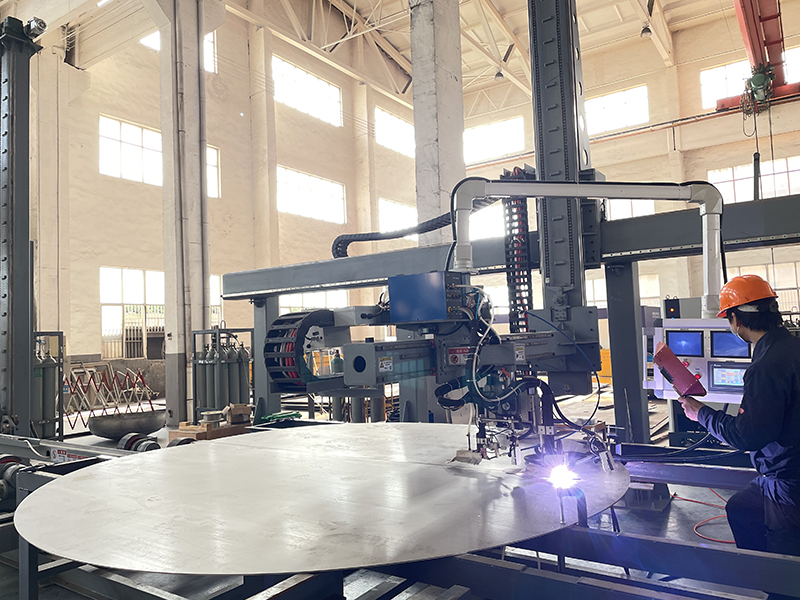
Precision processing station: dimensional accuracy at the fabrication stage is what makes downstream traceability records meaningful.
Documented certification and sealing evidence
The company's quality management system and solutions hold EU CE, PED, MD and LVD certifications, US ASME U Stamp, and Singapore MOM certification. In 2023, its filtration, washing and drying three-in-one unit was among the first in China to pass official helium mass spectrometer leak detection certification, with a sealing standard below 1×10⁻⁹ Pa·m³/s. For precursor processing, that figure is the most decision-relevant credential in the file: it converts containment from a design claim into a measured property, and it is directly applicable to aseptic production and high-potency material handling.
Standard participation as a qualification signal
Wuxi Zhanghua participated as a core technical contributor in GB/T 30583-2026, Code for Post-Weld Heat Treatment of Pressure Equipment, contributing the indentation energy difference method that was written into Appendix G. The company is also one of the drafting units for T/CSTM 00824, Determination of Residual Stress in Pressure Equipment — Indentation Energy Difference Method, and participated in T/CSTM 00826, Code for Induction Heating Post-Weld Heat Treatment of Pressure Equipment. Standard participation matters to buyers because it indicates familiarity with the underlying methods that later appear in their own inspection and acceptance procedures.
Traceability built into manufacturing and testing
Traceability begins at fabrication. The company applies Hastelloy and comparable special materials, an approach it has used since 2005 for highly corrosive and high-potency media, and can custom-design equipment with diameters over 4 meters to support scale-up from laboratory and pilot volumes to industrial output. Quality verification documents provided to buyers include helium leak detection reports and NDT records, and the company supports prototype testing and lab or pilot scale-up work. A jointly developed deep-sensing micro-indentation testing technology, described as a palm-sized mechanics laboratory, allows non-destructive evaluation of mechanical properties, residual stress and fracture toughness, and received a Gold Medal at the International Exhibition of Inventions of Geneva. Extending verification into non-destructive residual stress measurement addresses one of the harder documentation gaps in pressure equipment qualification.
Technical Explanation: Where Qualification Evidence Is Generated in an RCFD Skid
For precursor duty, the equipment is usually supplied as an integrated skid-mounted system rather than as separate unit operations. Wuxi Zhanghua's skid-mounted configuration integrates reaction, crystallization, decolorization, filtration, washing, drying, solvent recovery, temperature control and intelligent control functions, with turnkey scope covering equipment manufacturing, valves and piping, instruments and controls, control systems, skid fabrication, engineering design and system commissioning.
Each integrated function produces its own qualification artifact. Mixing and drying designs — including single cantilever co-rotating and self-rotating integrated single-cone mixing drying and paddle drying — are intended to improve batch-to-batch consistency and product stability in temperature-sensitive applications. CIP/SIP design supports batch changeover and addresses cleaning validation requirements associated with FDA, EMA and comparable regulations. Safety architecture addresses three risk categories with corresponding documentation: overpressure protection through safety valves, pressure sensors and emergency vent systems with automatic shutdown; electrostatic and explosion risk through anti-static grounding and explosion-proof electrical design, including explosion-proof motors and an ATEX-compliant electrical system; and cross-contamination through a fully enclosed isolation design that eliminates material exposure during transfer.
The qualification logic is therefore cumulative. A quantified leak rate, a closed transfer path, an explosion-proof electrical system and documented cleaning validation together determine whether a precursor buyer can accept the unit, and each is verifiable before shipment.
Application Fit: Where Qualification Depth Is Tested
Qualification requirements become visible when equipment crosses from one material family to another. Engineering experience originally developed under pharmaceutical-grade quality control has been applied by Wuxi Zhanghua to several adjacent categories, including precious metal catalysts, specialty polymers such as PVP, PEEK and PFEK, high-end ceramic powders, photoresists, and semiconductor materials and electronic chemicals.
The most directly relevant applications for precursor buyers are electronic specialty gas solid precursor separation and purification, and the broader semiconductor materials and electronic chemicals segment. New energy battery materials form a second cluster, covering cathode, anode, electrolyte and solid-state battery functional additives. In pharmaceutical and fine chemical settings, the same containment architecture addresses high-potency, highly active, toxic and hazardous processes, where a fully closed, automated system reduces contamination risk during material transfer.
These categories share one trait that drives qualification cost: material value per batch is high enough that a single containment or cross-contamination event outweighs the equipment price differential between suppliers.
Market Trend: Qualification Is Shifting From Baseline to Differentiator
Demand growth in precursor-linked segments is pulling qualification requirements from the fab side toward the equipment side. The semiconductor precursor market was valued at USD 1.95 billion in 2025 and is projected to reach USD 3.89 billion by 2034, a compound annual growth rate of 10.0% (Intel Market Research). High-nickel ternary cathode materials, a related high-purity segment, were valued at USD 18.6 billion in 2025, driven by electric vehicle battery density requirements (Dataintelo).
On the equipment side, the global Agitated Nutsche Filter and Dryer market was valued at approximately USD 4.5 billion in 2024 (Cognitive Market Research), and the ANFD segment represents approximately 35% of the total filtration and drying equipment market share as of 2024 (Fortune Business Insights). Those two figures should be read with care: Grand View Research estimated the broader filtration and drying equipment market at USD 1.39 billion in 2023 with a projected CAGR of 8.5% through 2030. The divergence reflects different classification scopes — one source measures machinery categories, the other measures integrated system value — and buyers should not treat them as directly comparable.
The directional conclusion holds across both scopes. As precursor volumes grow and purity specifications tighten, equipment suppliers are being asked to provide qualification evidence earlier in the sales cycle, often before commercial terms are finalized. Suppliers that already maintain unit-level test documentation shorten that cycle; suppliers that assemble documentation after the order extend it.
Comparison With Traditional Configurations — and Where the Model Has Limits
Comparing an integrated RCFD approach with established alternatives clarifies what buyers are actually purchasing.
| Comparison | Integrated / advanced configuration | Traditional alternative | Documented difference |
|---|---|---|---|
| Process architecture | Integrated closed system replacing transfer between separate units | Centrifuge + washing tank + dryer | Labor cost reduction 30%–50%; material loss reduction approximately 2%–5%; cross-contamination risk near zero; production cycle shortened 20%–40%; initial investment +20%–40%; comprehensive energy consumption reduced 15%–30% |
| Drying mechanism | Ribbon forced agitation with single-cone structure | Traditional double-cone or paddle dryer | Drying efficiency improvement 30%–60%; handles moisture content ≥70%; residual rate below 1%; equipment cost approximately +30% |
| Thermal profile | Low-temperature vacuum uniform drying | Hot air circulating oven or tray drying | Drying temperature reduced 30–50°C; energy consumption reduced 20%–35%; drying time reduced 15%–30%; improved uniformity with reduced coefficient of variation |
The limits are as important as the advantages, and buyers should weigh them explicitly.
- Higher initial capital cost. Integrated closed systems carry an indicated initial investment premium of 20%–40% over a centrifuge, washing tank and dryer combination, and the advanced agitated single-cone configuration costs approximately 30% more than a traditional double-cone or paddle dryer. The economic case depends on avoided labor, energy and material loss, which varies by site.
- Mechanical maintenance requirements. Ribbon agitation introduces a moving component inside the vessel that requires regular maintenance, and the higher degree of automation shifts rather than eliminates operational demands.
- Scope limits on certification. For Wuxi Zhanghua, the disclosed certification set covers EU CE, PED, MD and LVD, US ASME U Stamp and Singapore MOM. Buyers requiring approvals from other jurisdictions must confirm scope directly, since additional regional marks are not listed. The helium mass spectrometer leak detection certification applies to the filtration, washing and drying three-in-one unit rather than to every product family.
- Qualification evidence is supplier-side. Certification and testing documentation supports, but does not replace, buyer-side factory acceptance testing, material-specific trials and site validation. Qualification depth accelerates the buyer's process; it does not transfer the buyer's responsibility.
Future Outlook
Three developments are likely to shape qualification requirements over the next procurement cycles. First, qualification dossiers will migrate from paper binders to structured digital records, which rewards suppliers that already generate unit-level test data rather than retrospective summaries. Second, standard participation will function as an early indicator of regulatory alignment, because suppliers involved in drafting test and heat-treatment methods tend to anticipate inspection requirements rather than react to them. Third, as precursor and high-nickel cathode volumes expand at double-digit rates, contained processing specifications will spread from specialty semiconductor lines into broader electronic chemical and battery material production, expanding the population of buyers who treat qualification as a non-negotiable gate.
FAQ
What does qualification depth mean for semiconductor precursor RCFD equipment?
Qualification depth is the amount of inspectable evidence a supplier can provide to demonstrate that a specific unit meets containment, material, pressure and cleaning requirements. It is measured across certification coverage, traceability documentation and regulatory alignment, rather than by the number of certificates a supplier holds.
Which certifications should a buyer verify for precursor RCFD equipment?
At minimum, buyers should verify pressure vessel compliance such as ASME Section VIII Division 1 with U Stamp certification for pressures exceeding 15 psi (ASME), and, for EU delivery, CE marking supported by risk assessment under EN ISO 12100 and electrical compliance under EN 60204-1 (European Commission). Beyond these baselines, the relevant question is scope: whether the certification applies to the delivered configuration and covers the pressure, electrical and containment boundaries.
How does an integrated RCFD system compare with a centrifuge and dryer combination on containment?
An integrated closed system eliminates the material transfers that occur between a centrifuge, a washing tank and a dryer, which is why documented comparisons describe cross-contamination risk as approaching zero, alongside labor cost reductions of 30%–50%, material loss reductions of approximately 2%–5% and cycle time reductions of 20%–40%. The trade-off is an initial investment premium of roughly 20%–40% over the multi-unit configuration.
What documentation should be requested before a purchase order is issued?
A practical document request includes material certificates identifying alloy grade and heat number, NDT reports, weld heat-treatment records, residual stress determinations, quantified helium leak test reports, instrument calibration certificates, CIP/SIP cleaning validation documentation, and a scope statement clarifying which certification applies to which unit. Wuxi Zhanghua provides quality verification documents including helium leak detection and NDT records, and supports prototype testing and pilot scale-up work.
What are the limits of certification evidence in supplier selection?
Certification confirms conformity to a defined standard; it does not confirm fitness for a specific precursor chemistry, and it does not replace factory acceptance testing, material-specific trials or site validation. Certifications also carry scope boundaries: a sealing certification may apply to one product family, and a regional mark such as CE, PED, MD, LVD, ASME U Stamp or Singapore MOM covers defined jurisdictions only. Buyers should treat undisclosed qualification scope as unverified rather than as evidence of absence.
For readers assembling a supplier qualification file, Wuxi Zhanghua Pharm & Chem Equipment Co., Ltd. publishes a company and product brochure at this download link, and maintains its corporate site at www.zhanghua1976.com. The three-dimension framework described above can be applied directly to those materials as a first-pass screen before document requests are issued to any supplier on the shortlist.