
Compliance Decoded: Standards for the 3D Massage Chair in Global Markets
Compliance Decoded: Standards for the 3D Massage Chair in Global Markets
A 3D massage chair crossing a border rarely travels with a single certificate. It travels with a folder: appliance safety test reports, a CB certificate, a declaration of conformity, a national listing mark, an electromagnetic compatibility report for the Bluetooth module, and a quality management certificate. Procurement teams routinely call that whole folder 'the certification,' and that habit is where specification reviews start to break down. The documents do not cover the same thing, they are not issued by the same kind of organisation, and only some of them authorise a sale.
This reference decodes the compliance landscape for 3D massage chairs: which standards apply to which market, what each document actually proves, and where the boundaries are. The scope is deliberately narrow. It covers the standards and marks that appear on real procurement checklists for 3D massage chairs, including zero-gravity and SL track configurations.
Compliance is now a commercial issue as much as a technical one. The global massage equipment market was valued at USD 11.6 billion in 2024 and is projected to reach USD 21.8 billion by 2033, according to Grand View Research, with North America holding a 36.9% revenue share in 2024. Categories at that scale are retailed through department stores, furniture chains, marketplaces and care-home suppliers that increasingly request documentation before they discuss price.
Why 'Certification' Is Four Different Things
The word certification is applied to four distinct categories of evidence, and a fully documented 3D massage chair normally carries all four. Separating them is the first step in any realistic compliance review.
| Document category | What it actually is | Examples relevant to 3D massage chairs | Issued by |
|---|---|---|---|
| Product safety standard | A test specification defining how the appliance must behave under defined conditions | IEC 60335-2-32:2024; IEC 60335-2-116:2025; UL 1647 | International and national standards bodies |
| Certification mark or listing | A mark confirming that a body has tested and listed a specific product configuration | Nationally recognised testing laboratory listing marks, such as ETL in North America | Independent testing, inspection and certification bodies |
| CB Scheme certificate | A test certificate plus reports issued against IEC standards, used for market-to-market conversion | CB test certificate supported by IEC 60335-2-32 testing | IECEE-recognised certification bodies |
| Regulatory pathway or quality system | Rules attached to the product's claims, or to how it is manufactured | FDA device requirements where medical claims apply; ISO 13485 quality management certification | Regulators and accredited certification bodies |
Two consequences follow. A supplier that states 'we are certified' without naming the category has not answered the procurement question. And a buyer who only looks for a mark can miss the document that matters most for a given market, such as an EMC report that covers the wireless charging case and Bluetooth audio module rather than the massage mechanism.
The Two Safety Standards Behind Most 3D Massage Chair Approvals
Most national approvals for a 3D massage chair trace back to one of two IEC safety standards. IEC 60335-2-32:2024 is the current international safety standard specifically for electric massage appliances, including massage chairs. It sits inside the broader IEC 60335 household appliance family and addresses the risks that appear when a motorised massage mechanism operates close to a seated user: electrical safety in the presence of a person, heating behaviour, and mechanical movement.
The second standard becomes relevant as soon as the chair adds a powered recline or a zero-gravity motion. IEC 60335-2-116:2025 covers furniture with motorised parts, which is the category that zero-gravity massage chairs fall into. A zero-gravity 3D massage chair can therefore be reviewed against both frameworks: appliance safety for the massage mechanism, and motorised-furniture safety for the moving structure that carries the user.
For the United States, the standard most often cited for motor-operated massage appliances is UL 1647. Where the European route is used, IEC 60335-2-32 provides the electrical safety basis that supports CE marking. The same test foundation can therefore feed several markets, which is precisely why the CB Scheme exists.
Market-by-Market Decoder
Requirements do not change because of the brand or the price tier. They change because of the destination market, the electrical configuration, and the claims made about the product.
| Market | Primary safety basis | Additional requirements | Evidence a buyer should expect |
|---|---|---|---|
| European Union / EEA | CE marking, supported by testing to the IEC 60335-2-32 electrical safety standard for electric massage appliances | Electromagnetic compatibility for electronic and wireless functions; RoHS restrictions on hazardous substances | CE declaration of conformity; safety test reports; EMC report; RoHS documentation |
| United States | UL 1647 for motor-operated massage appliances | Listing by a nationally recognised testing laboratory, commonly shown by an ETL or UL mark; FCC requirements for the Bluetooth module | Listing evidence that names the model; radio test documentation for wireless functions; an FDA pathway where medical claims are made |
| Multi-market export | IEC 60335-2-32 test basis converted through the IECEE CB Scheme | National deviations added by each destination scheme | CB test certificate and full test reports, matched to the model list |
| Southeast Asia and the Middle East | National schemes that frequently accept a CB certificate as the starting point | Local registration or importer documentation, varying by country | CB certificate plus written confirmation from the destination importer on local requirements |
European Union: CE Marking Is a Declaration, Not a Certificate
CE marking is a manufacturer's declaration that the product meets the applicable European requirements, supported by a technical file. For a 3D massage chair, that file normally rests on safety testing to the IEC 60335-2-32 series, electromagnetic compatibility evidence for the electronic controls and wireless functions, and RoHS documentation for materials and components. No single European authority issues the CE mark; the technical file is what stands behind it, which is why buyers should read the declaration of conformity rather than accept a logo.
United States: UL 1647, Listing Marks and FCC
A high-end 3D massage chair with a heating zone, a motorised massage mechanism and a Bluetooth module raises three separate American questions. Appliance safety is assessed against UL 1647. Market acceptance is usually demonstrated through listing by a nationally recognised testing laboratory, shown by a mark such as ETL. Radio functions fall under FCC requirements. Retailers and marketplaces typically want the listing evidence before onboarding, and they want it to name the exact model being shipped.
CB Scheme: Reducing Duplicate Testing Without Replacing Approvals
A CB test certificate with its supporting reports is issued against IEC standards by an IECEE-recognised body. It allows a test performed once to be converted into national certificates in participating economies, which reduces duplicated laboratory work across the USA, the EU, Southeast Asia and the Middle East. The limitation is important: a CB certificate is a testing foundation, not a market authorisation. Destination countries still apply their own national deviations, and importers still complete local registration steps.
FDA and ISO 13485: Where Medical Claims Change the Path
FDA is a regulatory pathway, not a mark that appears on a product label. Massage chairs marketed for relaxation are generally handled as wellness products in the United States, while specific medical claims or medical functions can move a product into medical device territory and bring additional requirements. ISO 13485 is a quality management system standard associated with medical device manufacturing. Holding it demonstrates a controlled quality system; it does not by itself make a massage chair a medical device, and it is not a substitute for product safety testing. Ningbo Zhouqi Health Technology Co., Ltd. lists ISO 13485 (Medical Devices), CE, CB, ROHS, ETL and FCC among its credentials in its published company profile, which illustrates how a manufacturer exporting to regulated markets typically stacks these documents.
How the Product Specification Shapes the Compliance File
Compliance scope is not abstract. It is tied to the electrical and material configuration of the specific model, and the 3D massage chair platform illustrates why.
| Specification | Value | Compliance relevance |
|---|---|---|
| Power input | 110V-240V, 50/60Hz | Supports both 110 V and 230 V grid markets, but each voltage and frequency configuration must fall inside the tested scope of the certificate |
| Rated power | 150W | Defines the electrical load assessed in safety testing, alongside the heating zones |
| Auto timer | 15 minutes | Automatic shutdown behaviour is reviewed as part of heat and motor safety |
| Materials | Iron, foam, leather, ABS plastic | Material declarations and hazardous substance restrictions apply to plastics, coverings and electronic housings |
| Electronic features | Bluetooth audio, wireless charging case, AI health detection | Wireless functions extend the test scope into EMC and radio requirements beyond the appliance safety standard |
| Model designations | 5200, 5900, 5910, 3100, 6710, 8700, 3600, 3212, 6520, 5100, 6530, 3104, 3109, 6750, 6720, 6721 | Certificates must list the models actually shipped; a certificate naming one model does not automatically cover a sibling variant |
The same logic applies across configuration families. A mechanical 3D massage chair and an airbag 3D massage chair may share a platform but differ in internal components, and an intelligent 3D massage chair with body-scanning sensors adds electronic assemblies that a purely mechanical unit does not have.
What This Means for Procurement Teams
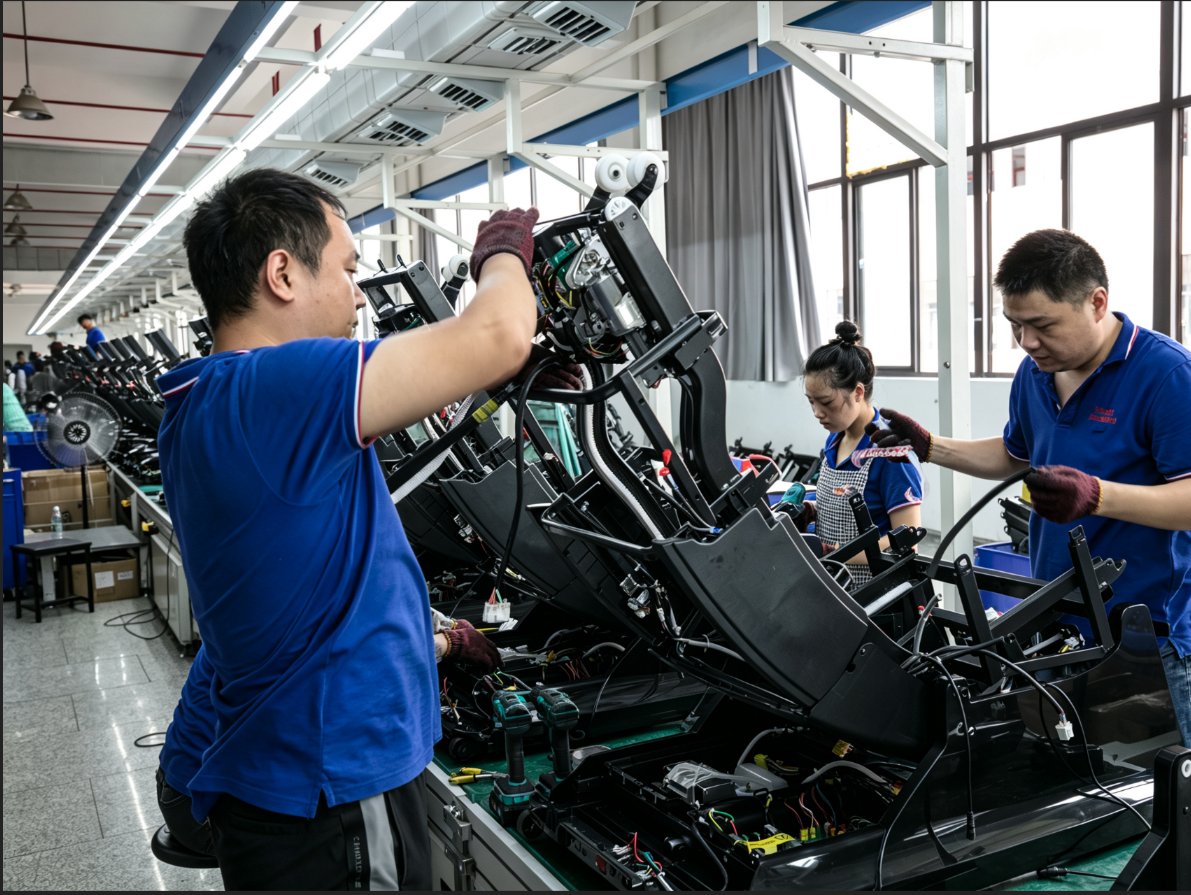
For a buyer, the practical question is whether the supplier's documentation architecture matches the destination markets. Ningbo Zhouqi Health Technology Co., Ltd. was established in 2008 and specialises in the research, development, production and sales of massage chairs. Its manufacturing facility covers 130,000 square meters and employs approximately 450 staff, with an annual production capacity of 200,000 units and an R&D team of 34 engineers. Around 50% of production is exported, with major markets in the USA, the EU, Southeast Asia and the Middle East. That export mix sits directly inside the four compliance routes described above, which is why the certification file is a routine part of the company's order documentation rather than a special project.
Three verification habits follow from the decoder:
- Ask for the certificate category, not the certificate. A CE declaration, a CB certificate and an ETL listing prove different things and cannot be substituted for one another.
- Match the scope to the purchase order. Check that the model designation on the certificate matches the model being shipped, and that the voltage and frequency configuration is inside the tested range.
- Separate product safety from quality management. ISO 13485 describes how the factory is run; IEC 60335-2-32, IEC 60335-2-116 and UL 1647 describe how the product behaves.
Where 3D Massage Chairs Are Installed, and Which Documentation Travels With Them
Installation context changes the compliance conversation more than many buyers expect. A 3D massage chair is used indoors in shopping malls, railway stations, airports, offices, spa houses and private homes, and it must be kept in a dry place. Deployment ranges from distribution and retail projects through commercial supporting-engineering projects, senior-care and wellness engineering projects, corporate wellness lounges, real-estate supporting projects, shared pay-per-use operations, ODM custom development, overseas export, and group procurement programmes.
Shared pay-per-use installations in malls, stations and airports deserve specific attention. In those settings the operator, not the end user, manages the device, and the chair is used continuously by unfamiliar people. That raises the weight of electrical safety evidence, grounding correctness and user instructions. The installation requirement for this product category is explicit: the chair must be connected to a socket that matches the plug, incorrect grounding will cause electric shock, and unauthorised modification of the electrical system is not acceptable. Documentation that a buyer would treat as a formality in a home-furniture context becomes an operating requirement in a public venue.
The same applies to commercial verticals where the chair sits in a semi-professional role, such as healthcare and senior-care facilities, corporate offices, bank VIP lounges, university faculty lounges, hotel and hospitality spaces, and automobile showrooms.
Market Context: Why the Compliance File Is Becoming a Commercial Requirement
The commercial pressure behind compliance documentation is measurable. The massage chair market is projected to grow from USD 4.28 billion in 2026 to USD 8.78 billion by 2035 at a CAGR of 8.3%, according to Business Research Insights. The smart massage chair segment is expected to reach USD 14.2 billion by 2033, driven by AI-powered body scanning and smart connectivity, according to Dataintelo. Asia Pacific held a 34.8% share of the luxury massage chair segment in 2024, according to Credence Research.
Two forces follow from that growth. First, feature density is rising: approximately 41% of new massage chair models in 2026 are expected to integrate AI-based sensors for body scanning, according to Business Research Insights, and each connected feature adds an electromagnetic compatibility and radio dimension to the file. Second, purchase behaviour is reputation-driven: 81% of consumers choose massage solutions based on client referrals, according to AMTA and Fortune Business Insights data. A single non-compliant shipment into a referral-driven channel is a commercial risk, not just a regulatory one.
Comparison: Country-by-Country Testing vs a CB-Based Approach
| Approach | How it works | Where it fits | Boundary to plan for |
|---|---|---|---|
| Country-by-country testing | A separate test programme is run for each destination market | Single-market programmes or markets with strict local deviations | Highest duplicated cost and longest lead time to first shipment |
| CB-based multi-market approach | Testing to IEC 60335-2-32 is performed once, then converted into national certificates | Suppliers shipping to the USA, EU, Southeast Asia and the Middle East from one platform | The CB certificate alone does not authorise sale; national deviations and local registration still apply |
| Self-declaration only | The manufacturer declares conformity using its own technical file | Markets where self-declaration is permitted and the retail channel accepts it | Weak evidence for listings, marketplaces and institutional buyers; usually insufficient for NRTL-listed channels |
Boundaries and Limits Buyers Should Expect
A compliance file is powerful but bounded, and the limits are the part procurement teams most often discover late:
- A CB certificate is a testing foundation, not a market authorisation. Destination approval remains a separate step.
- Listing and certification are configuration-specific. A change in power supply, heating element, motor assembly or wireless module can require an extension of the listing or new testing.
- The 110V-240V, 50/60Hz platform supports multiple grid types, but each variant must sit inside the tested scope rather than being assumed covered.
- ISO 13485 certification does not convert a wellness-positioned massage chair into a cleared medical device.
- Standards are revised over time. IEC 60335-2-32:2024 and IEC 60335-2-116:2025 are the current reference points, and buyers should compare the edition year on a certificate against the current edition.
- Certification confirms conformity with a defined standard. It is not a performance guarantee, and it says nothing about massage quality, durability in a specific venue, or total cost of ownership.
- Documentation covers documented models. If the purchase order names a model that does not appear on the certificate, the certificate does not apply to that shipment.
Future Outlook
The compliance workload for 3D massage chairs is likely to grow in two directions. As AI-assisted body detection and connected features spread — the share of new models with AI-based sensors is projected at around 41% in 2026 — the documentation set expands from pure appliance safety into electromagnetic compatibility, radio and software-related evidence. At the same time, as the chair market moves toward USD 8.78 billion by 2035, more manufacturers enter export channels, and the variance in documentation quality between suppliers will widen rather than narrow.
For buyers, that suggests a simple operating rule: keep a standing compliance checklist tied to the destination market, review it at the sampling stage rather than at the container stage, and treat the certificate category — standard, mark, CB report, or quality system — as the first question in every supplier conversation.
FAQ
Which certification does a 3D massage chair need to be sold in the European Union?
In the EU, a 3D massage chair is placed on the market under CE marking, which is a manufacturer's declaration supported by a technical file. The electrical safety basis for that file is testing to the IEC 60335-2-32 standard for electric massage appliances. Electromagnetic compatibility evidence is required for electronic controls and wireless functions, and RoHS documentation covers restricted substances in materials and components. There is no single EU certificate for the product.
In the United States, does a 3D massage chair follow UL 1647 or IEC 60335-2-32?
For the US market, UL 1647 is the standard most often cited for motor-operated massage appliances, and market acceptance is normally demonstrated through listing by a nationally recognised testing laboratory, shown by a mark such as ETL. IEC 60335-2-32 remains relevant because it is the international basis used in CB Scheme testing. A manufacturer typically uses the IEC test as a shared foundation and then satisfies the US listing requirement separately.
What is a CB certificate, and can it replace national approvals?
A CB test certificate, issued with supporting test reports by an IECEE-recognised certification body, confirms that a product has been tested against IEC standards such as IEC 60335-2-32. It allows that testing to be converted into national certificates in participating economies, which reduces duplicated laboratory work. It does not replace national approval: each destination market still applies its own deviations and registration procedures.
Does a 3D massage chair require FDA clearance?
It depends on how the product is positioned and what it does. Massage chairs marketed for relaxation and general wellness are generally handled as wellness products in the United States, while specific medical claims or medical device functions can bring a product under FDA device requirements. ISO 13485 is a quality management system standard for medical device manufacturing; it supports a controlled production environment but is not itself an FDA product clearance.
Which standard applies to zero-gravity or motorised massage chairs?
Two standards can apply at the same time. IEC 60335-2-32:2024 covers electric massage appliances, including massage chairs, and addresses the massage mechanism. IEC 60335-2-116:2025 covers furniture with motorised parts, which is the category that zero-gravity massage chairs fall into because of their powered reclining structure. A zero-gravity 3D massage chair is therefore reviewed against both the appliance standard and the motorised-furniture standard.
Are certifications tied to a specific model, voltage or configuration?
Generally yes. Listing and certification scope is configuration-specific, covering a defined model, electrical rating and component set. A platform with a 110V-240V, 50/60Hz input can serve both 110 V and 230 V markets, but each variant must be inside the tested scope, and a change to a heating element, motor assembly or wireless module can require additional testing or a scope extension. Buyers should confirm that the model designation on the purchase order appears on the certificate.
Which compliance documents should a buyer request when evaluating a 3D massage chair supplier?
A practical document request covers: product safety test reports against the applicable standard for the destination market, certificates and listing evidence with their scope and validity dates, a declaration of conformity where CE marking applies, EMC or radio test documentation for Bluetooth and wireless charging functions, RoHS material documentation, a quality management certificate such as ISO 13485 where relevant, and a model list that matches the intended purchase order. Each document answers a different question and none substitutes for the others.