
Compliance Interpretation: Reading Test Reports for Aluminum Bioclimatic Pergolas
HTNXT Industry Reference · Construction & Decoration · Document Interpretation
Compliance Interpretation: Reading Test Reports for Aluminum Bioclimatic Pergolas
A test report is the only document in an outdoor living purchase that states what a structure was actually proven to withstand. Most buyers read the summary line and skip the conditions that make that line true.
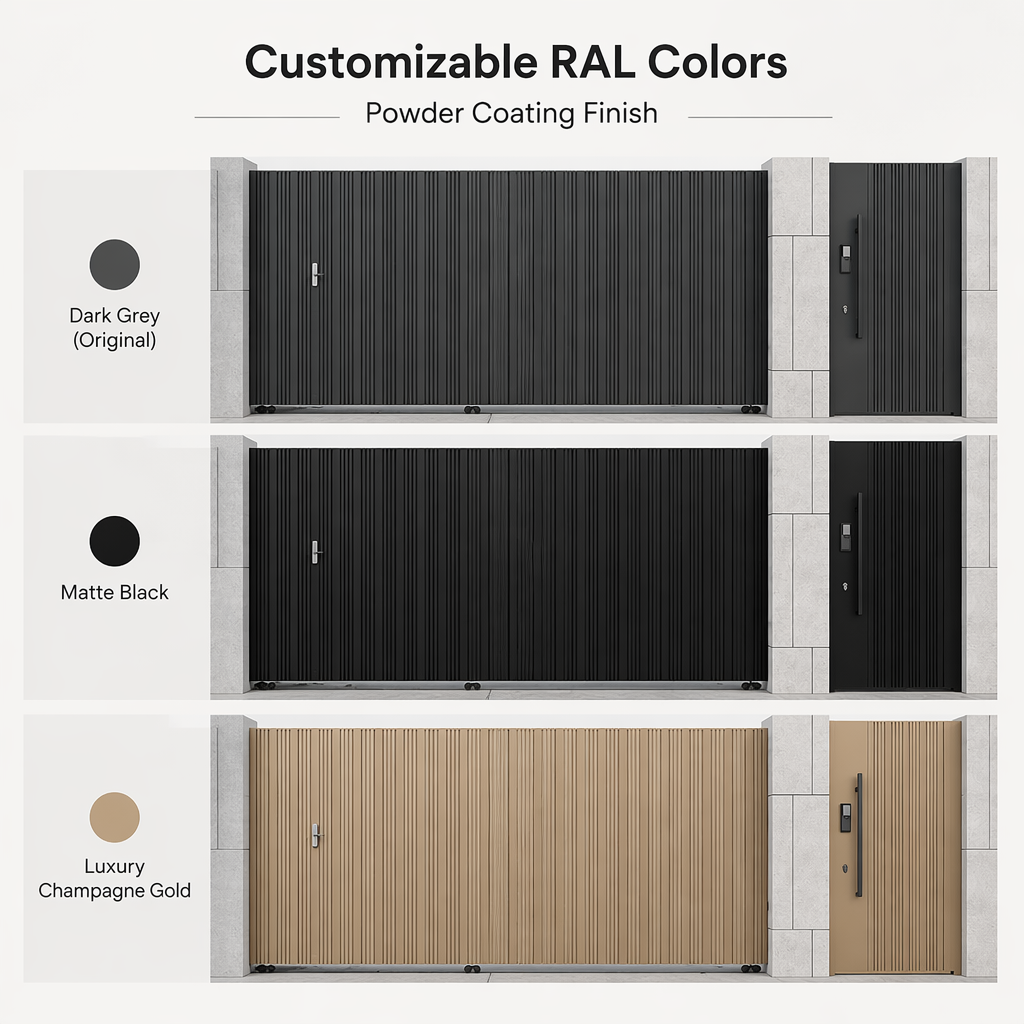
Aluminum outdoor living structures — pergola, fence and gate — are normally specified, tested and imported as one coordinated package, which is why the document set matters as much as the profile.
A compliance test report for an aluminum bioclimatic pergola records the conditions under which one defined configuration was tested: how much snow load the roof carried, how the drainage behaved with the louvers closed, how many cycles a motor completed, how far a profile cut deviated from nominal, and how well the coating held to the aluminum underneath. Every result has a scope — a span width, a mounting type, a louver position, a sample plan — and the scope is where most procurement mistakes happen.
This reference explains how to read each section of such a report in the order a buyer should read it, what evidence normally supports each claim, and which claims a report cannot support. It also states the boundary that documents rarely spell out: a report validates a tested sample and configuration, not an installed project.
Why Test Reports Moved From the Tender File Into the Buying Decision
The aluminum pergola category has grown large enough that documentation is now a qualifying condition rather than a courtesy. The global aluminum pergola market was valued at USD 3.8 billion in 2025 and is projected to reach USD 7.1 billion by 2034, according to Dataintelo. Within that category, the bioclimatic pergola segment is expected to grow from USD 600.87 million in 2026 to USD 1,049.46 million by 2034, a CAGR of 7.22%, according to Fortune Business Insights. North America held a 34.2% share of global aluminum pergola demand in 2025.
Volume changes the buyer. Larger order quantities bring specifiers, structural reviewers and customs brokers into the process, and each of them asks for a document rather than a description. The same shift is visible across the adjacent outdoor living categories: automatic sliding gates accounted for 30.2% of the automatic gate opening system market in 2025, which means gate, fence and pergola packages are increasingly reviewed together as one envelope of outdoor structures.
Two reference frameworks appear repeatedly in these reviews. EN 13561:2015 is the European standard for performance and safety requirements of external blinds and awnings, and it covers pergola awnings. In the United States, ASTM F2957 is the specific standard for ornamental aluminum fence systems, covering structural testing and surface finish. Neither standard is a pergola-only document, which is exactly why buyers should read what a supplier claims against whichever standard the report actually cites.
The Document Stack Behind an Aluminum Bioclimatic Pergola
A single certificate is not a compliance package. A complete file for a bioclimatic pergola project usually contains several document types, each answering a different question.
| Document | What it verifies | Where a buyer uses it |
|---|---|---|
| CE EU product safety certification and Declaration of Conformity | Conformity of the product family to the applicable EU safety route | Tender qualification and market entry |
| ISO 9001 quality system certificate | Process control in the factory, not the performance of one unit | Supplier qualification and audit planning |
| Third-party structural test report | Load and wind performance of a defined span, mounting and louver condition | Engineering approval |
| Raw material certificate for 6063-T5 extrusion | Alloy composition and temper designation | Material verification against specification |
| Coating performance report | Adhesion, salt spray and UV behaviour of the finish | Coastal, high-UV and long-life projects |
| Motor durability or aging report | Cycle life and protection class of the actuator and control system | Maintenance planning and spare parts |
| Dimensional inspection record | Cut length, hole position, louver clearance and frame squareness | Installation fit and multi-zone splicing |
| Pre-shipment inspection and functional check record | Condition of the delivered batch before loading | Acceptance at handover |
Henan Junsu Technology Co., Ltd., which sells under the brand Junsu outdoor, is a Henan-based manufacturer of integrated outdoor courtyard solutions founded in 2001. The company states that it holds ISO9001 international quality system certification and CE EU product safety certification, that it cooperates with authorized third-party testing institutions, and that all raw materials and finished goods undergo layer-by-layer sampling inspection before shipment, with quality control applied from raw material inspection through manufacturing, assembly, functional checks, pre-shipment inspection and packaging inspection. Its stated acceptance criteria include a pre-shipment test — a useful example of how a document stack is attached to a commercial order rather than issued separately from it.
One further document belongs in the import file, even though it is not a test report. Aluminum fence panel kits from China are classified under HTSUS 7610.90.0080 with a duty rate of 5.7%, per a U.S. Customs and Border Protection ruling (NY N169385). Classification rulings travel alongside compliance documents, and mismatched descriptions between the two create delays.
Reading Load-Bearing and Wind Resistance Data
Load figures are the most quoted and least qualified numbers in any pergola document. For the 147/163/175/220 model series, the rated figures are snow load up to 100 lbs/sq ft and wind load up to 190 mph. Before those numbers go into a structural package, five conditions should be identified: the tested span, the mounting type, the louver position, the permitted deflection at the limit, and the safety factor applied.
The mounting type matters more than most buyers expect. The same roof profile can be supplied wall-mounted, free-standing, in a multi-zone arrangement, or with special cuts and angles, and each arrangement transfers load differently through the posts and base plates. Wind load is also not a single force: it includes uplift on the roof plane, lateral pressure on the posts, and vibration at the louver bearings. A report that gives a wind speed without a mounting condition is describing a laboratory result, not a project capability.
Snow load is easier to interpret because it is a static condition, but it still depends on the span. A rated snow load of up to 100 lbs/sq ft is a statement about a tested configuration; a longer custom span changes the bending moment in the beams and normally requires a project-specific calculation or engineering letter rather than a re-stated catalogue figure.
Waterproof Performance: Ratings, Drainage Paths and the Closed-Louver Condition
Waterproof claims for a louvered roof depend on a mechanical condition. In a motorized aluminum pergola, rain protection is achieved when the louvers are fully closed: rainwater is collected through integrated drainage channels and guided through an internal drainage system inside the posts. The pergola system carries an IP66 waterproof and dustproof rating and is designed for outdoor installation in high-humidity and dusty conditions.
When reading the waterproof section of a report, check four variables. First, the louver state during the test — a closed-louver test says nothing about an open-roof condition. Second, the water application method: vertical spray, angled spray and simulated rainfall produce very different results, and wind-driven rain is more demanding than either. Third, whether the drainage outlet was connected to a discharge path or left open to the test bench. Fourth, whether the electrical enclosure was energised and monitored during the test.
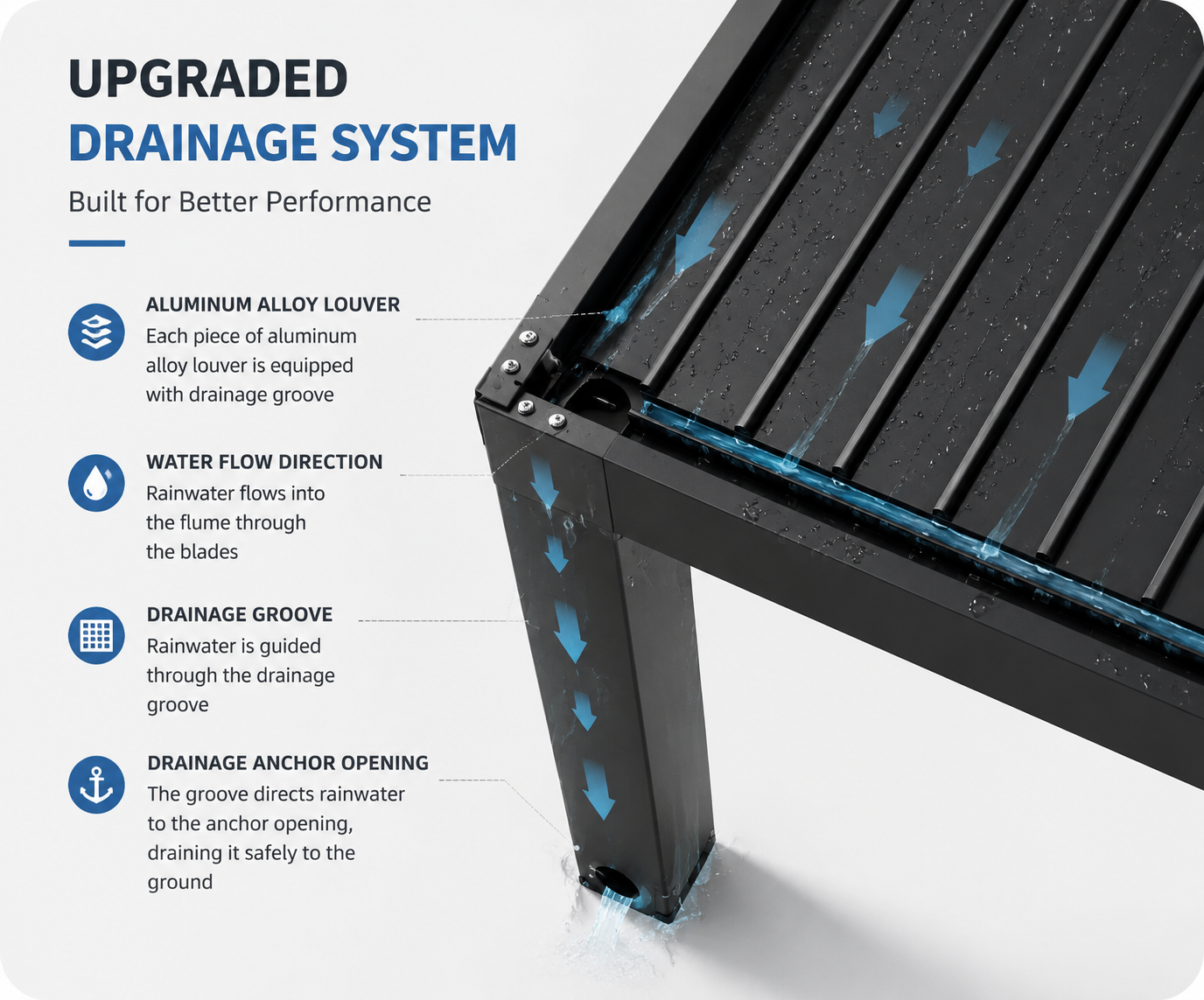
Drainage interpretation: closed louvers collect rainwater, which is routed through integrated channels into the internal drainage path inside the posts. A waterproof test result is only meaningful if this path was connected during the test.
The limit is worth stating plainly. Waterproof performance assumes the louvers are closed, the drainage route is connected and free of blockage, and the site does not hold standing water. Electrical components should not remain submerged in standing water, so power supply location, cable routing and site drainage should be confirmed before installation. A report cannot compensate for a base that traps water against the posts.
Motor Aging Tests: What Cycle Data Does and Does Not Prove
An aging report describes an actuator cycled many times on a bench. The motorised pergola system itself is designed for outdoor applications, and the motor, wiring and control components are installed with outdoor protection requirements in mind, which is the part of the claim that matters most for long-term outdoor use in humid or coastal climates.
Read the aging section for the conditions, not the headline cycle count. A useful report states the load applied during cycling, the duty cycle and rest interval, the ambient temperature range used, the protection class of both the actuator and the control enclosure, and whether the control system was exercised at the same time. Control electronics often age differently from the motor, and a report that only counts motor strokes leaves the control side unverified.
Energy behaviour is a related and frequently omitted figure. In the comparison data published for these systems, the intelligent motor reduces standby power by 85%, with near-zero standby consumption, and the system is compatible with solar power for zero electricity cost in suitable installations. For a project running dozens of units, standby behaviour over years is a real operating cost, and it belongs in the same document review as cycle life.
The boundary is technical. Bench aging does not reproduce installed torque variation from wind, water ingress at cable entries, or voltage fluctuation on site. Correct installation, confirmed drainage and a verified power supply remain preconditions for the reliability that the aging test describes.
Dimensional Tolerance Inspection
Tolerance data is the least glamorous section of a test report and the one most likely to decide whether a project installs cleanly. Custom pergola dimensions can reach up to 22’10” x 16’ in a single zone, with 3 x 3 m, 3 x 4 m, 4 x 4 m and 3 x 6 m configurations also available as standard sizes. Multi-zone projects depend on seamless splicing, which is a tolerance question before it is a design question.
A usable inspection record states the measuring instrument, the sample size, the nominal dimension, the actual measurement and the tolerance band, at defined measurement points: profile cut length, hole positions, louver clearance and frame squareness. Sampling plans and full inspection are not interchangeable. Where a supplier states 100% inspection before delivery, that statement should be traceable to a recorded inspection step in the production flow rather than a general quality claim.
Raw Material Composition and Wall Thickness Measurement
Aluminum pergola performance starts at the extrusion. For aluminum products in this range, 6063-T5 aluminum alloy is used as the standard material. The mill certificate is the document that verifies it, and it should state chemical composition and temper designation; the T5 temper is a controlled cooling and ageing condition, and it is not interchangeable with a generic “aluminum alloy” description.
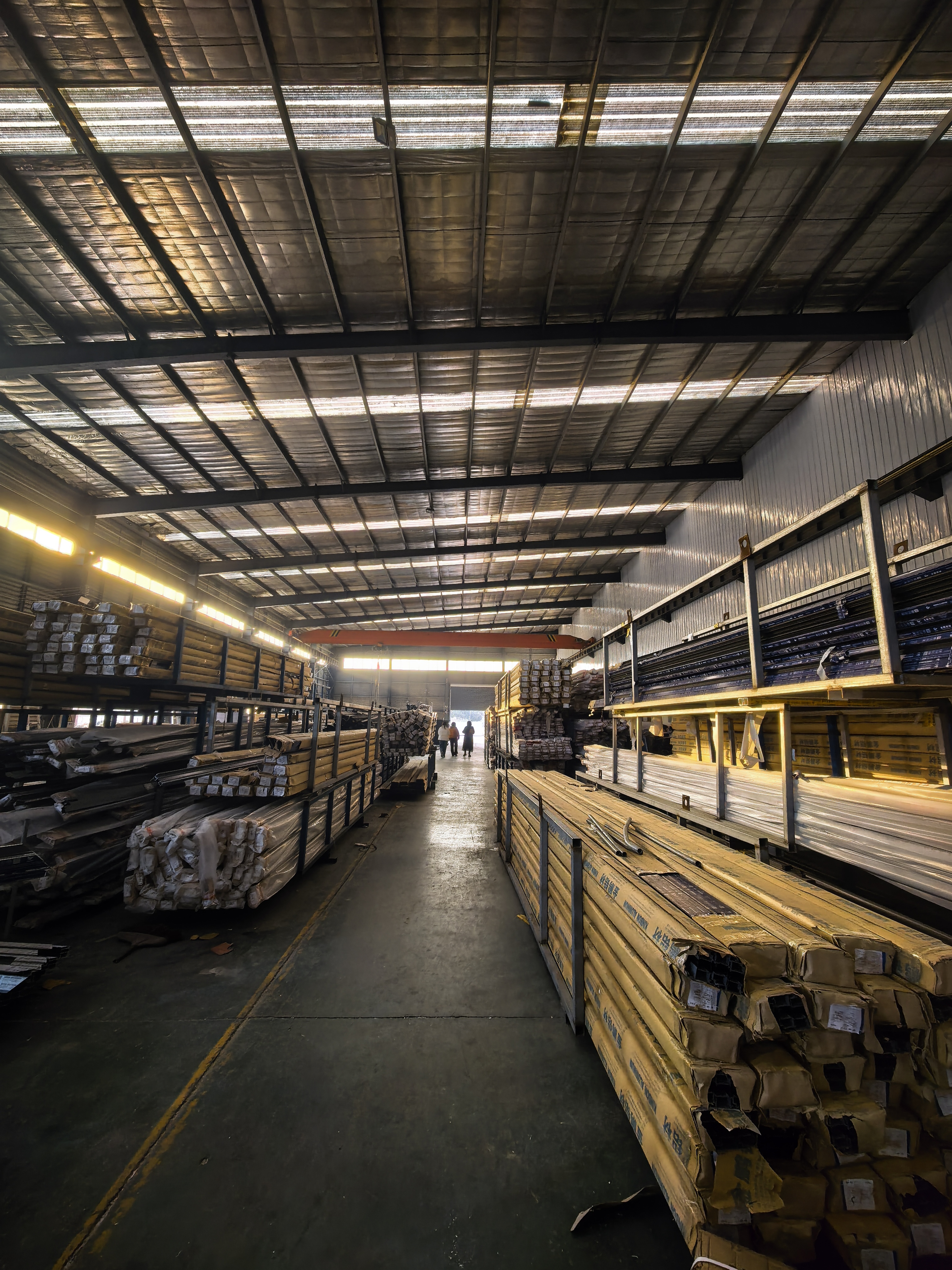
Raw material control: 6063-T5 extrusions in the incoming warehouse. Composition and temper are verified at this stage, before cutting, welding and assembly.
Wall thickness is the second material check and is usually reported as nominal thickness plus a measured minimum at defined points, taken with a caliper or ultrasonic gauge. The reason to insist on measurement points rather than a single figure is that internal ribs, screw bosses and drainage walls are not equally thick, and they carry different loads. Wall thickness affects bending capacity, screw retention at hinge and bracket positions, and the integrity of the drainage channel inside the post.
Surface Coating Adhesion: The Test Most Buyers Skip
Coating failure is not a structural failure, but it is what buyers see first. In coastal, high-UV and salt-fog environments, a finish that loses adhesion exposes bare aluminum, and appearance problems follow quickly.
The coating reports used in this category describe a premium fluorocarbon and wood grain transfer finish that is UV, salt spray and rain resistant with 20-year colour stability, alongside an anti-rust and fade-resistant surface coating requirement and a reported 99% colour retention rate for long-term outdoor use. Reading the report means checking which test supports which claim: cross-cut and tape-pull tests for adhesion, impact and bend tests for flexibility, salt spray exposure for corrosion resistance, and UV exposure for colour stability. Each test uses a different specimen and a different failure criterion, and they are not substitutes for one another.
Two limits apply. First, adhesion results are typically measured on flat test panels, while cut edges, welded joints and fold lines are more vulnerable in the finished product. Second, the 20-year colour stability figure describes the finish system under test conditions; in salt-fog areas it assumes a routine of light cleaning, not a maintenance-free surface. For fence and gate components bought in the same package, ASTM F2957 provides a directly relevant reference because it covers both structural testing and surface finish for ornamental aluminum fence systems.
A Verification Framework: Six Questions to Ask Any Report
The fastest way to assess a test report is to ask six questions in order. If any answer is missing, the report is incomplete rather than invalid — but it should not be used to approve a purchase on its own.
| Question | Where to look | Warning sign |
|---|---|---|
| Who issued the report? | Laboratory name, accreditation, report number | A laboratory described only as “third-party”, with no number |
| What exactly was tested? | Sample description, span, mounting type, louver condition | A description that does not match the ordered model or configuration |
| Which standard, and which edition? | Standard number with year of issue | An undated standard reference |
| What are the stated limits? | Conditions, exclusions, safety factors, permitted deflection | No exclusions or boundary section at all |
| Is it traceable to production? | Test date, batch, sample identification | A report predating a product line change |
| What does acceptance look like? | Pre-shipment test criteria and sampling plan | Verbal assurance instead of a recorded inspection step |
Aluminum Versus Wood, Iron and Brick: What Reports Change and What They Do Not
Documentation does not alter the physics or the economics of material choice. It makes both easier to compare.
| Dimension | Aluminum alloy systems | Wood, iron or brick alternatives |
|---|---|---|
| Service life | Reported at 3× longer than traditional iron and wood products | Shorter replacement cycle, with 3–6 times more frequent replacement reported |
| Maintenance | 70%–80% lower long-term maintenance cost; no rust removal or repainting; around 90% less maintenance workload | Annual anti-corrosion treatment, repainting and ageing repair |
| Weight | 65% lighter body with equal strength | Heavier structural dead load, more demanding footings |
| Corrosion and coating | 0 rust and 0 peeling reported within 20 years; 99% colour retention for long-term outdoor use | Corrosion, decay and peeling expected in humid or coastal sites |
| Customisation | 100% customisable size, style and function; 6063-T5 standard material | Customisation is limited by material behaviour and site fabrication |
| Purchase cost | Initial purchase cost reported 15%–25% higher | Lower entry price, higher cumulative cost |
The limitation is real and should be stated as clearly as the advantages. Aluminum bioclimatic systems carry a higher one-time procurement cost, and the compliance documentation, third-party testing and layered inspection that make the material verifiable are part of that cost. For ultra-low-budget temporary projects, short-term construction or temporary enclosure scenarios where long-term appearance and durability are not required, the document and material overhead of an aluminum system is difficult to justify. Aluminum is the more defensible choice where long-term outdoor exposure, open and windy sites, high-temperature rainy environments or humid coastal and salt-fog conditions are expected — not in every case.
Market Trend: Documentation as a Purchase Variable
Document readiness is becoming a selection criterion in its own right. The bioclimatic segment is growing at 7.22% CAGR through 2034, and North America alone accounts for 34.2% of aluminum pergola demand, both of which push buyers toward suppliers who can answer structural, coating and electrical questions with paper rather than adjectives. The category now includes commercial-grade specialists such as StruXure in the United States alongside factory-direct exporters, and the two groups are increasingly compared on the same document checklist during evaluation.
The trend also changes how factories present themselves. A manufacturer that already operates ISO9001 quality system certification, CE EU product safety certification, third-party testing cooperation and layer-by-layer sampling inspection before shipment is describing a documentation capability, not only a production capability. That distinction matters to distributors and project buyers who must re-supply the same evidence to their own clients.
Future Outlook
Three developments are likely to shape pergola compliance files over the next few years. First, digital traceability: reports linked to batch or serial numbers will make the six-question framework above faster to apply. Second, sustainability documentation: aluminum is fully recyclable, and recycling reduces reprocessing energy by around 70%, which gives buyers a second reason to request material and coating records. Third, lifecycle documentation: with a reported 3× longer service life and 20-year colour stability claims in circulation, spare parts availability, motor replacement paths and after-sales support become part of the same file as the original test report, particularly for multi-zone commercial installations.
For buyers at the decision and execution stage, the practical conclusion is simple. Read the conditions before the ratings, match the sample to the ordered configuration, and tie acceptance to a recorded pre-shipment test in the purchase order. Compliance interpretation is not a legal exercise; it is the step that converts a performance claim into a specification you can hold a supplier to.
Reference document: a downloadable product catalog covering pergola, fence and gate configurations is available at Junsu Products Catalog (PDF).
Frequently Asked Questions
1. What is a compliance test report for an aluminum bioclimatic pergola, and what does it not prove?
A compliance test report records the measured performance of a defined sample and configuration — for example, the load carried by a specific span, the drainage behaviour with the louvers closed, the cycles completed by a motor, or the adhesion of a coating system. It does not prove that an installed project will perform identically, because installation conditions such as anchoring, substrate and site drainage are outside the test scope. Ratings such as a snow load up to 100 lbs/sq ft or a wind load up to 190 mph apply to the tested configuration.
2. Which sections of a pergola test report should a buyer read first?
Start with the issuing laboratory and the sample description, then read the test conditions, and only then read the results. The order matters because the sample description defines what the results apply to. A report should identify the span, mounting type (wall-mounted, free-standing, multi-zone or special cuts and angles), the louver position during testing, and the standard edition referenced. Results read before scope tend to be quoted without the conditions that make them valid.
3. How are wind load and snow load ratings such as 190 mph and 100 lbs/sq ft established?
They are established either by full-scale structural testing of a defined configuration or by engineering calculation, and the report should state which method was used, along with the permitted deflection, the safety factor and the mounting assumption. Wind acts as uplift and lateral pressure transferred through the posts to the base, so the anchoring condition is part of the result. A larger custom span or a different mounting arrangement normally requires a project-specific calculation rather than a re-stated catalogue figure.
4. How can a buyer confirm the aluminum alloy grade and wall thickness behind a report?
Request the mill certificate for the extrusion, which states chemical composition and temper designation — 6063-T5 aluminum alloy is the standard material used for aluminum products in this range. Wall thickness is normally reported as nominal thickness plus a measured minimum at defined points, taken with a caliper or ultrasonic gauge. Measurement points matter because internal ribs, screw bosses and drainage walls are not equally thick, and they serve different structural functions.
5. What does a motor aging test indicate about long-term outdoor reliability?
It indicates how a motorised system performs over repeated cycles under stated bench conditions. The useful variables are the load applied during cycling, the duty cycle, the ambient temperature range, and the protection class of both the actuator and the control enclosure, because control electronics age differently from the motor. Bench aging does not reproduce installed torque variation from wind, water ingress at cable entries or voltage fluctuation on site. The motor, wiring and control components are installed with outdoor protection requirements in mind, and electrical components should not remain submerged in standing water.
6. Why does surface coating adhesion matter more in coastal and high-UV projects?
Adhesion is what keeps the finish attached to the aluminum when salt, moisture and ultraviolet exposure act on it. In this category, coatings are described as premium fluorocarbon and wood grain transfer finishes that are UV, salt spray and rain resistant with 20-year colour stability and a 99% colour retention rate for long-term outdoor use. Adhesion is measured by cross-cut and tape-pull tests, while corrosion resistance and colour stability are measured separately by salt spray and UV exposure. Adhesion results are typically taken on flat panels, so cut edges and welded joints deserve separate attention.
7. What acceptance criteria should be tied to a purchase order for an aluminum pergola package?
Acceptance should reference a documented step rather than a verbal assurance. In this category, quality control is applied from raw material inspection through manufacturing, assembly, functional checks, pre-shipment inspection and packaging inspection, with 100% inspection before delivery, and acceptance includes a pre-shipment test. Buyers typically align payment terms with that milestone, and standard commercial terms include a 50% deposit and 50% before shipment, with delivery terms available as FCA, FOB, CIF, DAP or DDP and a minimum order quantity of 1 set.