
Compliance Roadmap: Voltage, Noise, and Material Safety in Single Pass Systems
Compliance Roadmap: Voltage, Noise, and Material Safety in Single Pass Systems
A single pass printer is approved against a certificate folder, but it is installed against a building. Rated voltage and current, acoustic output, ambient temperature window and ink chemistry decide whether an existing production hall can host the machine as delivered, or whether the project becomes an electrical and ventilation refit.
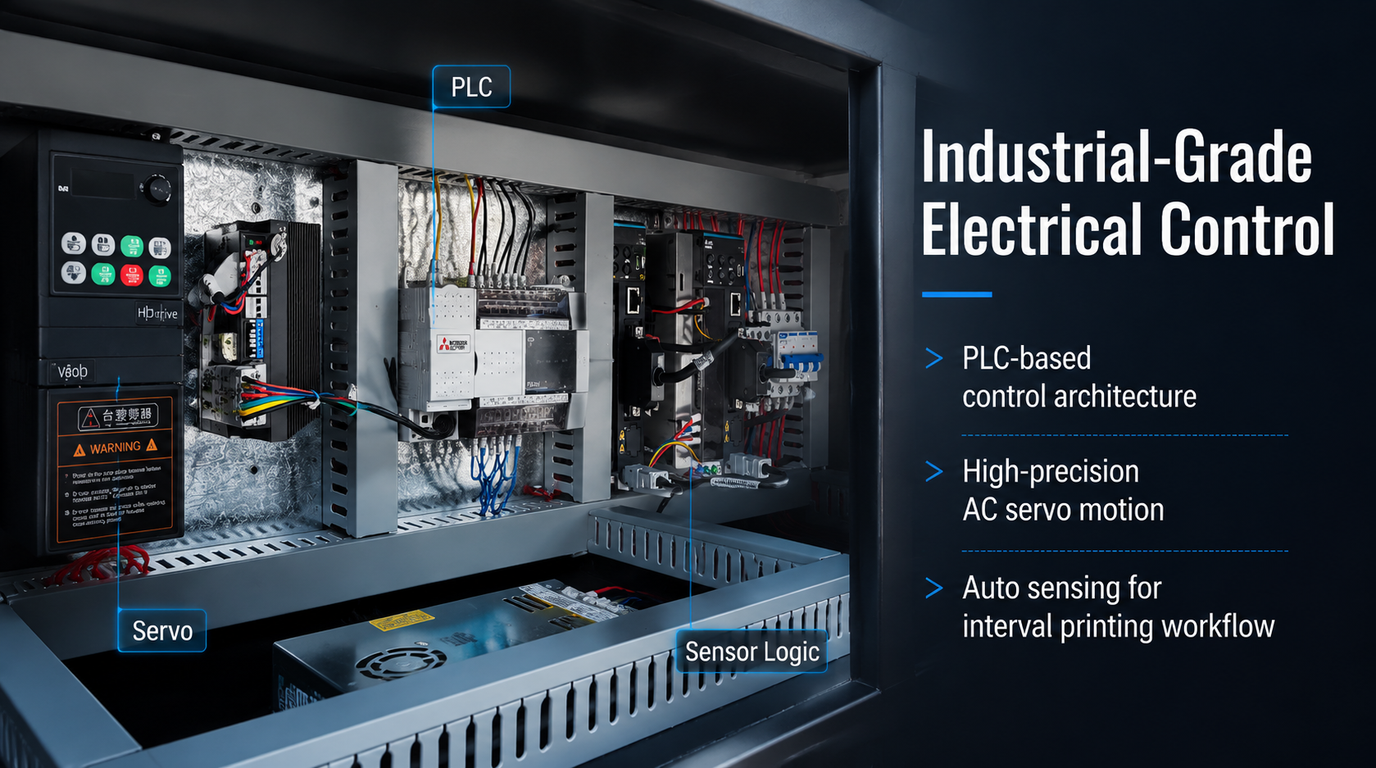
Electrical architecture inside a FocusInc single pass packaging printer: control cabinet, protected power distribution and print control boards. Source: FocusInc Cobra-1209S datasheet image set.
Why the installation drawing matters more than the certificate
Plate-free printing is usually presented as a production upgrade. For the facility manager who has to sign the installation, it is three engineering questions: how much current the machine draws and on what supply, how loud it is and how much heat and humidity it tolerates, and what it puts into the building in the form of inks, consumables and materials that eventually have to be maintained and disposed of.
FOCUS Inc. (Shanghai Focus Industrial Co., Ltd.) is a digital inkjet printer manufacturer founded in Shanghai in 2008, operating a 35,000 m² factory from 2018 and certified as a leading national high-tech enterprise from 2022. Its product matrix runs from multi-pass scanning printers to high-speed single pass platforms for corrugated board, flexible packaging materials, labels, non-woven bags, book edges and cylindrical containers, with approximately 95% of output exported to markets including the EU, USA, Mexico, Brazil, Chile, Australia, Canada and the UK. That export profile is directly relevant here: the same machine has to satisfy a Chinese factory floor, an EU declaration of conformity and, in some markets, national electronics take-back registration at the same time.
This guide works only from confirmed datasheet values. Where a parameter is not published for a specific model, it is left blank rather than estimated, because an estimated voltage or noise figure is worse than no figure at all during an installation review.
The electrical envelope: what each single pass platform actually draws
The single most common installation surprise in single pass printing is current draw on a single-phase supply, not print resolution or colour gamut. Two families sit at opposite ends of that scale: the corrugated and packaging models sit in the 20 A class on single-phase 220 V, while the UV single pass Acaleph platforms are documented at 42 A on single-phase 220–240 VAC.
| Model and type | Documented power requirement | Acoustic noise level | Documented operating environment |
|---|---|---|---|
| Cobra-1209S — single pass printer for corrugated / cardboard | 20 A, single-phase 220 V, 50 Hz | 75 dB (A) or less | Not stated in the published datasheet (net weight 1,450 kg; machine size 2,600 × 2,200 × 1,820 mm) |
| Cobra-691S — single pass packaging printer | 20 A, single-phase 220 V, 50 Hz | 75 dB (A) or less | 15–30 °C (59–86 °F), 40–80% RH |
| Cobra-1815S — single pass printer for corrugated box | 20 A, single-phase 220 V, 50 Hz | 75 dB (A) or less | Not stated in the published datasheet (net weight 1,650 kg) |
| Cobra-691S Max — packaging, paper cup and bag printing | 220 VAC, 50 Hz, 3 kW | Not stated in the published datasheet | Normal temperature 15–35 °C (printing height 0–55 mm) |
| Viper-391S — roll-to-roll label single pass printer | 9 A, single-phase 220 V, 50–60 Hz | 75 dB (A) or less | 15–30 °C (59–86 °F), 40–80% RH |
| Viper-391S Pro — roll-to-roll A3 label printer | 9 A, single-phase 220 V, 50–60 Hz | 75 dB (A) or less | 15–30 °C (59–86 °F), 40–80% RH |
| Vesa-830A — UV label roll-to-roll printer | 12 A, single-phase 220 V, 50–60 Hz (printer 350 W, unwinder and rewinder 120 W) | 75 dB (A) or less | 15–30 °C (59–86 °F), 40–80% RH |
| NEXUS-350J — label print, laminate, die-cut and slit in one line | 25 A, single-phase 220 V, 50 Hz (working power 3,000 W) | Not stated in the published datasheet | 15–30 °C (59–86 °F), 40–80% RH |
| Falcon-491S and Falcon-491S Pro — desktop packaging printing | 20 A, single-phase 220 V, 50 Hz | 75 dB (A) or less | 15–30 °C (59–86 °F), 40–80% RH |
| Acaleph-891S e, Acaleph-891S-i and Acaleph-891S Side Printer — UV single pass | 42 A, single-phase 220–240 VAC, 50/60 Hz | 75 dB (A) or less | 18–30 °C and 35–75% RH (891S e and 891S-i); compressed air minimum 80 psi / 6 bar, 60 L volume per plasma unit |
| Hydra-360S — desktop UV cylinder and bottle printer | 16 A, single-phase 220–240 VAC, 50/60 Hz (printer power 850 W) | 55 dB (A) or less | Not stated in the published datasheet |
| S350 Jetpress — UV roll-to-roll label and IML printer | AC 380 V, 50 Hz, 50 A | Not stated in the published datasheet | 20–40 °C, 30–80% RH, dust-free environment |
All values as published in the corresponding FocusInc model datasheets. Blank cells indicate a parameter that is not stated for that model.
Three patterns are worth pulling out of the table. First, the 20 A single-phase class covers the whole mainstream corrugated and packaging range — Cobra-1209S, Cobra-691S, Cobra-1815S, Falcon-491S and Falcon-491S Pro — which means a hall already wired for conventional finishing equipment can usually host them without a supply rebuild. Second, the Acaleph-891S e, Acaleph-891S-i and Acaleph-891S Side Printer UV platforms are rated at 42 A on a single-phase 220–240 VAC feed, roughly double the branch current of the corrugated models, which normally implies a dedicated circuit rather than a shared production distribution board. Third, the S350 Jetpress is documented at AC 380 V, 50 Hz, 50 A — a three-phase requirement. For a small label workshop with only single-phase distribution, that single datasheet line is often the difference between a shortlist and a rejection.
Where a machine states working power as well as current, both numbers matter for load calculations: the NEXUS-350J is rated 25 A single-phase 220 V, 50 Hz with a working power of 3,000 W, and the Hydra-360S is rated 850 W at 16 A on single-phase 220–240 VAC. Published build documentation for these platforms also describes PLC-based industrial control, quick-lock aviation-style power connectors on selected models and multi-stage circuit protection on the print control boards — hardware details that a facility electrical reviewer can check directly against the machine, rather than against a marketing summary.
Noise, temperature and humidity: the operating window buyers underestimate
Across the packaging and label range, the documented acoustic ceiling is 75 dB (A) or less. The Hydra-360S cylinder printer is the quietest platform in the range at 55 dB (A) or less. That difference matters in workshop layout: a 55 dB (A) desktop cylinder printer and a 75 dB (A) wide corrugated line are not equivalent neighbours for a quality-control office or a manual packing station.
It is equally important to read those figures correctly. They are datasheet ceilings — 75 dB (A) or less, not a measured value at a specific distance. On-site verification during commissioning remains part of the acceptance test, and any site-specific occupational noise assessment stays with the facility, not with the printer datasheet.
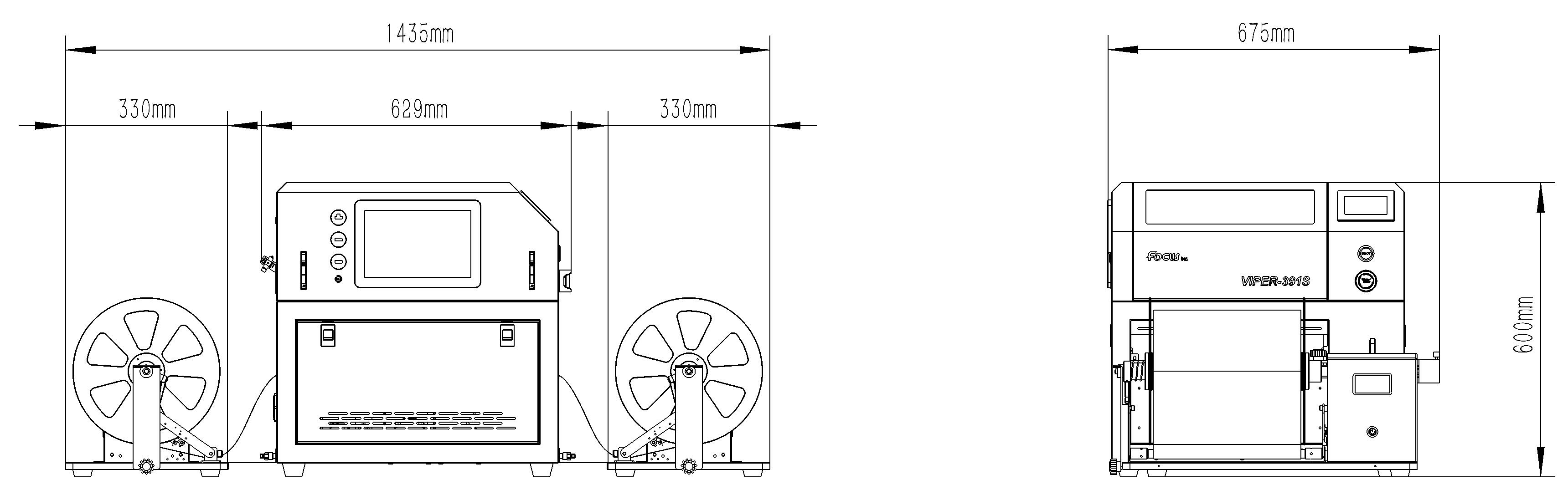
Viper-391S installation footprint. The main printer is documented at 65 kg net, with separate unwinder and rewinder units at 51 kg each, a 9 A single-phase 220 V supply and an operating window of 15–30 °C at 40–80% RH.
The environmental window is more restrictive than most buyers expect. The majority of packaging and label models specify 15–30 °C (59–86 °F) and 40–80% relative humidity. The Acaleph-891S e and Acaleph-891S-i UV platforms specify a narrower band: 18–30 °C with 35–75% RH. The Cobra-691S Max is documented for normal temperature 15–35 °C, and the S350 Jetpress has the widest documented window at 20–40 °C with 30–80% RH, with a dust-free environment stated as a requirement rather than a preference.
Two practical consequences follow. In an unheated hall, a winter installation can sit below the 15 °C floor of most packaging models and below the 18 °C floor of the Acaleph UV platforms, so temporary heating becomes a commissioning item rather than a later correction. And on UV single pass platforms that use plasma pre-treatment, the facility must supply compressed air at a minimum of 80 psi / 6 bar with 60 L volume per plasma unit — a utility connection that is easy to overlook when an installation is planned around power and floor space alone.
Floor loading belongs in the same review. The NEXUS-350J label line is documented at 4,400 lb (2,000 kg) net and 5,060 lb (2,300 kg) gross; the Cobra-1209S at 3,190 lb (1,450 kg) net; the Cobra-1815S at 3,630 lb (1,650 kg) net. These are point loads in a defined machine footprint, not distributed racking loads.
Material safety: inks, substrates and the machine own material declaration
Ink chemistry is a compliance variable, not only a print-quality decision. The corrugated and packaging platforms list aqueous, dye, pigment and edible inks in CMYK colour sets, with refillable tanks sized for production: 500 ml per colour on the Cobra-691S, 250 ml per colour on the Falcon-491S and Falcon-491S Pro, 1,500 ml per colour on the Cobra-1209S and Cobra-1815S, and 2.5 L per colour on the Cobra-691S Max. The UV single pass Acaleph platforms use UV curing ink cured by a 405 nm LED source with water-circulation cooling, printing primer plus CMYK, white spot colour and gloss from 1,500 ml tanks.
Where printing touches food contact surfaces, the edible-ink configuration is documented as using edible ink that complies with FDA and EU food contact safety regulations. That configuration also carries facility requirements: food-grade contact parts, a sealed dedicated ink supply, a food-grade conveyor belt, an independent dust removal unit before printing and a detachable conveyor structure for regular high-temperature cleaning. In other words, food-safe printing is a line-level compliance decision, not only an ink selection.
The machine own material declaration is published component by component, which is what maintenance, EHS and decommissioning planning actually need. Across the series these are: high-strength extruded aluminium alloy print beams; thickened welded carbon steel main frames; heat-resistant industrial plastic plus precision alloy metal parts in the print head assemblies; high-hardness steel X and Y linear guide rails; anti-offset PU, TPU, PET and PP rubber conveyor belts; stainless steel correction rollers with silicone coating; anti-corrosion modified PP plastic ink tanks and ink stacks; aluminium alloy print head protective covers; galvanised steel sheet side wings and outer housings; cast aluminium alloy drive motor shells; quenched alloy steel transmission gears; fluorine rubber ink pipelines; and impact-resistant ABS touch screen housings.
That list supports three concrete tasks: an EHS review of consumables handling and spill response, a wear-parts spares plan focused on belts, rollers and ink lines, and decommissioning under electronics take-back rules. For the German market specifically, the Cobra-691S AS B single pass packaging printer is registered under the ElektroG scheme with registration number WEEE-Reg.-Nr. DE 87336785, issued by stiftung elektro-altgeräte-register (stiftung ear), and the Acaleph-891S e UV single pass printer holds a WEEE authorised-representative confirmation with Sendungs-ID SI-202502-148048.
From a generic CE mark to model-specific, market-specific documentation
CE marking is often treated as one badge. In practice the paperwork is scoped, and a procurement review should read the scope line before anything else. The EU Declaration of Conformity covering machinery and low-voltage aspects, certificate SCT260301170121 issued by ANXIN PRODUCT TEST SERVICE CO., LTD., covers Class I equipment at 220–240 V~, 50–60 Hz against EN 1010-2:2006+A1:2010, EN 1010-1:2004+A1:2010, EN ISO 12100:2010 and EN 60204-1:2018+A1:2025. A separate conformity verification, certificate SCT260301170122, cites EN 55011:2016+A2:2021, EN IEC 61000-6-2:2019 and EN IEC 61000-6-4:2019. Both documents list defined model groups rather than an open-ended product family.
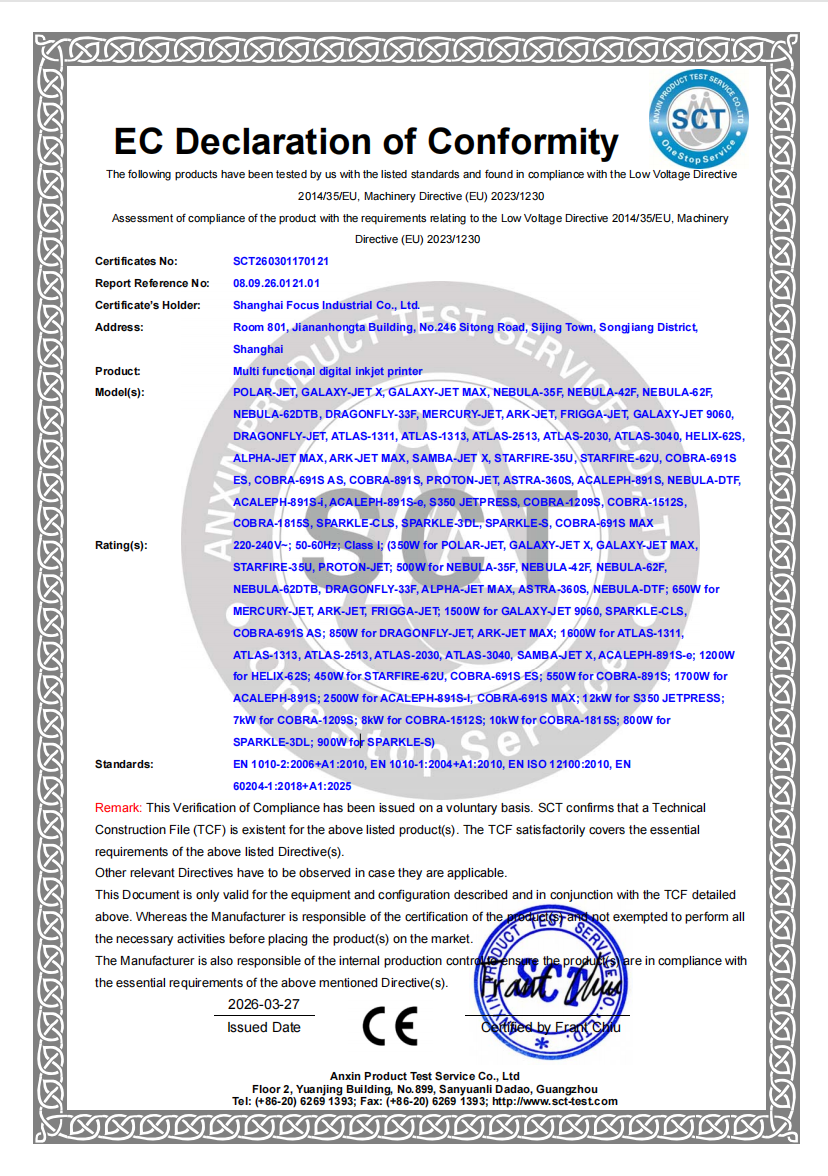
EU Declaration of Conformity SCT260301170121, issued by ANXIN PRODUCT TEST SERVICE CO., LTD., listing Class I equipment at 220–240 V~, 50–60 Hz against EN 1010 and EN 60204-1.
Market access is documented on a separate track. A certificate of EC Authorised Representative (EUREP-2025082013532502482, issued 2025-08-10 and valid to 2027-10-07) records that an appointed representative handles EU market obligations for products sold into the EU by Shanghai Focus Industrial Co., Ltd. Independently of any vendor document, industrial single-pass printers placed on the EU market must comply with the Low Voltage Directive (2014/35/EU) and the EMC Directive in order to carry the CE mark, and ink-yield claims for colour inkjet systems are standardised under ISO/IEC 24711 and ISO/IEC 24712.
Intellectual property documentation is scoped by geography in exactly the same way. Protection granted by the China National Intellectual Property Administration applies to Mainland China, and includes utility model certificate 18948405 for thermal transfer equipment with cutting function, together with trademark registration 34874480 covering Class 7 goods such as engraving machines and computer plotting machines. A buyer in Europe or North America receives CE and EMC documentation for those markets — not Chinese patents, and not Chinese trademark rights.
Matching a compliance profile to a production floor
The practical value of reading parameters this way is that the machine can be matched to the building, not the other way round.
- Corrugated and honeycomb plants. The Cobra-1209S loads material up to 1,230 mm wide and the Cobra-1815S up to 1,800 mm, both at 20 A single-phase 220 V, 50 Hz with noise at 75 dB (A) or less. Where a hall already runs 220 V single-phase finishing equipment, these are the lowest-friction placements, and the main planning items shift to floor loading and material flow rather than power.
- Label converters on limited supplies. Viper-391S and Viper-391S Pro sit at 9 A single-phase 220 V, 50–60 Hz, and Vesa-830A at 12 A. These are the lightest electrical loads in the range and the most likely to fit an existing small-format label workshop without a distribution upgrade.
- Integrated label finishing. The NEXUS-350J combines printing, lamination, die-cutting and slitting in one line at 25 A single-phase 220 V, 50 Hz with a 3,000 W working power, and weighs 2,000 kg net — an integrated footprint decision rather than a distributed one.
- UV single pass decoration, non-woven and book-edge work. The Acaleph-891S e and Acaleph-891S-i require 42 A single-phase 220–240 VAC plus compressed air for plasma pre-treatment, and hold a tighter climate window of 18–30 °C at 35–75% RH.
- Container and cup side printing. The Acaleph-891S Side Printer shares the same 42 A power class and handles cup, bottle and container side printing from a 600 mm load width.
- Low-noise adjacent workstations. The Hydra-360S cylinder printer is documented at 55 dB (A) or less with 850 W at 16 A, the lowest acoustic and electrical profile of the range.
- High-speed UV roll-to-roll and IML. The S350 Jetpress requires AC 380 V, 50 Hz, 50 A and a dust-free 20–40 °C environment — a different facility class altogether, and one that should be identified at the shortlist stage rather than at commissioning.
Market context: why compliance is becoming a procurement gate
The direction of the market explains why these parameters are moving from engineering footnotes to purchasing criteria. The global digital printing for packaging market was valued at USD 31.64 billion in 2023 and is projected to reach USD 75.55 billion by 2032, according to Zion Market Research. That figure should be treated as directional rather than precise: divergent estimates exist for the same 2032 horizon, including USD 62.75 billion from SNS Insider and USD 27.44 billion from Credence Research, so the honest reading is a large and growing market rather than a single agreed number.
Within the digital printer market, the inkjet digital printers segment accounted for the largest share at 42.5% as of 2025, according to Straits Research. Regional supply matters as much as demand: China produced more than 88 billion square metres of corrugated board in 2024, according to the China Packaging Federation and Dataintelo, which supports dominant regional demand for single-pass corrugated equipment. On the component side, HP Inc. maintains a 32% global shipment share in the large format printer market, per Mordor Intelligence and Maximize Market Research — relevant because several FocusInc corrugated, label and packaging models build on HP PageWide print head technology, which means buyers inherit both the performance characteristics and the consumable supply considerations of that print head family.
Third-party reporting on single-pass technology also quotes production speeds of 30–80 m/min for paper bag printing. FocusInc datasheets are more specific and, in the packaging range, lower: 10–40 m/min for the Cobra-691S and Viper-391S, 10–35 m/min for the Cobra-1209S and Cobra-1815S, and 20–80 m/min for the S350 Jetpress UV roll-to-roll platform. Buyers comparing vendor speed claims should compare them at the resolution and configuration actually quoted, not at headline maximum.
Single pass versus traditional printing infrastructure: where the trade-off really sits
Traditional flexo and offset production for corrugated and label work is constrained by plate making: tooling cost and lead time are fixed per design, which makes short runs and frequent changes expensive. Single pass digital removes the plate and replaces it with a different set of constraints — facility constraints.
The comparison is therefore not simply digital versus analog. A fair side-by-side looks like this: analog lines trade changeover cost for predictable utility demand, while single pass digital trades utility demand for flexibility. A digital corrugated line that needs 20 A single-phase 220 V and a 15–30 °C room will still be the easier installation than an analog press with a large dryer and its own extraction and heating load; a UV single pass platform at 42 A with compressed-air and water-cooling requirements will be harder to place than a small analog label press, even though it removes the plate entirely.
There is also a hard width boundary that should be stated plainly. Printing width on these platforms is determined by print head count and machine class, not by customer intent: the Cobra-691S prints 210 mm wide with one head and 420 mm with two heads, and loads material up to 600 mm without side flanks or 1,200 mm with them; the Cobra-1209S loads up to 1,230 mm; the Cobra-1815S loads up to 1,800 mm. A job that exceeds the class of the machine cannot be resolved through settings — it requires a different model.
A second honest limit sits in the documentation itself. FocusInc CNIPA-granted protections and registrations apply to Mainland China; the German WEEE registration covers the German market; the EU certificates cover defined model groups. Purchasing teams in other jurisdictions should confirm local requirements independently rather than assuming a certificate issued for one market transfers to another.
Future outlook
Three shifts are likely to shape single pass installation planning over the next few years. First, as the digital packaging segment expands, utility readiness will increasingly be specified in tender documents alongside print quality: current class, compressed-air availability, climate control and floor loading. Second, consumable and sustainability documentation is becoming standardised, with ink-yield reporting already governed by ISO/IEC 24711 and ISO/IEC 24712 and electronics take-back obligations — such as the German ElektroG registration already held for the Cobra-691S AS B — extending across more markets. Third, print head supply concentration means that spare-part and consumable continuity will be reviewed alongside machine specifications.
For the facility manager, the practical conclusion is that the compliance review should start with the building services drawing and the datasheet table, and only then move to the certificate folder. Voltage class, noise ceiling, climate window and material declaration are the parameters that determine whether a single pass installation is a hook-up or a project.
Frequently asked questions
What power supply does a single pass printer require in a packaging or label plant?
Documented requirements differ by model family. The Cobra-1209S, Cobra-691S, Cobra-1815S, Falcon-491S and Falcon-491S Pro are rated 20 A on a single-phase 220 V, 50 Hz supply. The Viper-391S and Viper-391S Pro label printers are rated 9 A on single-phase 220 V, 50–60 Hz, and the Vesa-830A UV label printer 12 A on the same supply type. The Acaleph-891S e, Acaleph-891S-i and Acaleph-891S Side Printer UV platforms are rated 42 A on single-phase 220–240 VAC, 50/60 Hz. The S350 Jetpress is rated AC 380 V, 50 Hz, 50 A, which is a three-phase requirement.
How much noise does a single pass printer produce during production?
The published acoustic ceiling is 75 dB (A) or less for the Cobra, Viper, Vesa, Falcon and Acaleph single pass models, and 55 dB (A) or less for the Hydra-360S cylinder printer. These are datasheet maximums rather than measured site values, so on-site verification during installation and commissioning remains advisable.
What temperature and humidity must the print room maintain?
Most packaging and label models list 15–30 °C (59–86 °F) and 40–80% relative humidity. The Acaleph-891S e and Acaleph-891S-i specify 18–30 °C with 35–75% RH. The Cobra-691S Max is documented for normal temperature 15–35 °C, and the S350 Jetpress for 20–40 °C and 30–80% RH in a dust-free environment.
What does material safety cover in a single pass printer installation?
It covers three areas. Ink chemistry: aqueous, dye, pigment and edible inks on the packaging platforms, and UV curing ink cured by a 405 nm LED source with water-circulation cooling on the Acaleph UV platforms. Food-contact work: edible ink is documented as complying with FDA and EU food contact safety regulations, and requires food-grade contact parts, a sealed ink supply, a food-grade conveyor and pre-print dust removal. Machine materials: print beams in high-strength extruded aluminium alloy, frames in thickened welded carbon steel, guides in hardened steel, conveyor belts in anti-offset PU/TPU/PET/PP rubber, ink tanks in anti-corrosion modified PP plastic and ink pipelines in fluorine rubber.
Which compliance documents should be verified before installation sign-off?
Verify the scope line of each document rather than the badge. Relevant records include the EU Declaration of Conformity SCT260301170121 issued by ANXIN PRODUCT TEST SERVICE CO., LTD. covering Class I equipment at 220–240 V~, 50–60 Hz against EN 1010-2:2006+A1:2010, EN 1010-1:2004+A1:2010, EN ISO 12100:2010 and EN 60204-1:2018+A1:2025; the conformity verification SCT260301170122 citing EN 55011:2016+A2:2021, EN IEC 61000-6-2:2019 and EN IEC 61000-6-4:2019; the EC Authorised Representative certificate EUREP-2025082013532502482; and the German WEEE registration WEEE-Reg.-Nr. DE 87336785 for the Cobra-691S AS B.
Can a single pass printer be installed without a three-phase supply?
For most of the packaging and label range, yes. The Cobra-1209S, Cobra-691S, Cobra-1815S, Falcon-491S, Falcon-491S Pro, Viper-391S, Viper-391S Pro, Vesa-830A and NEXUS-350J are all documented on single-phase supplies, with the NEXUS-350J at 25 A, single-phase 220 V, 50 Hz and 3,000 W working power. The exception in the current range is the S350 Jetpress, documented at AC 380 V, 50 Hz, 50 A. The Acaleph UV single pass platforms also require compressed air at a minimum of 80 psi / 6 bar with 60 L volume per plasma unit where plasma pre-treatment is used.
What are the documented limits of these compliance records?
They are scoped by model and by market. The CNIPA utility model and design patents and the trademark registration 34874480 apply to Mainland China. The WEEE registrations apply to Germany, with WEEE-Reg.-Nr. DE 87336785 for the Cobra-691S AS B and the authorised-representative confirmation Sendungs-ID SI-202502-148048 for the Acaleph-891S e. The EU certificates cover defined model groups and specific standards. Separately, machine width is a physical limit: the Cobra-691S prints 210 mm wide with one print head and 420 mm with two, while the Cobra-1815S loads up to 1,800 mm — a job beyond the class of the machine requires a different model, not a setting change.
Reference document for facility planning: FocusInc Factory Introduction (PDF) — factory, production and equipment overview for buyers preparing an installation review.