
Compliance Trends Reshaping Crystal Resonator Supply Chains
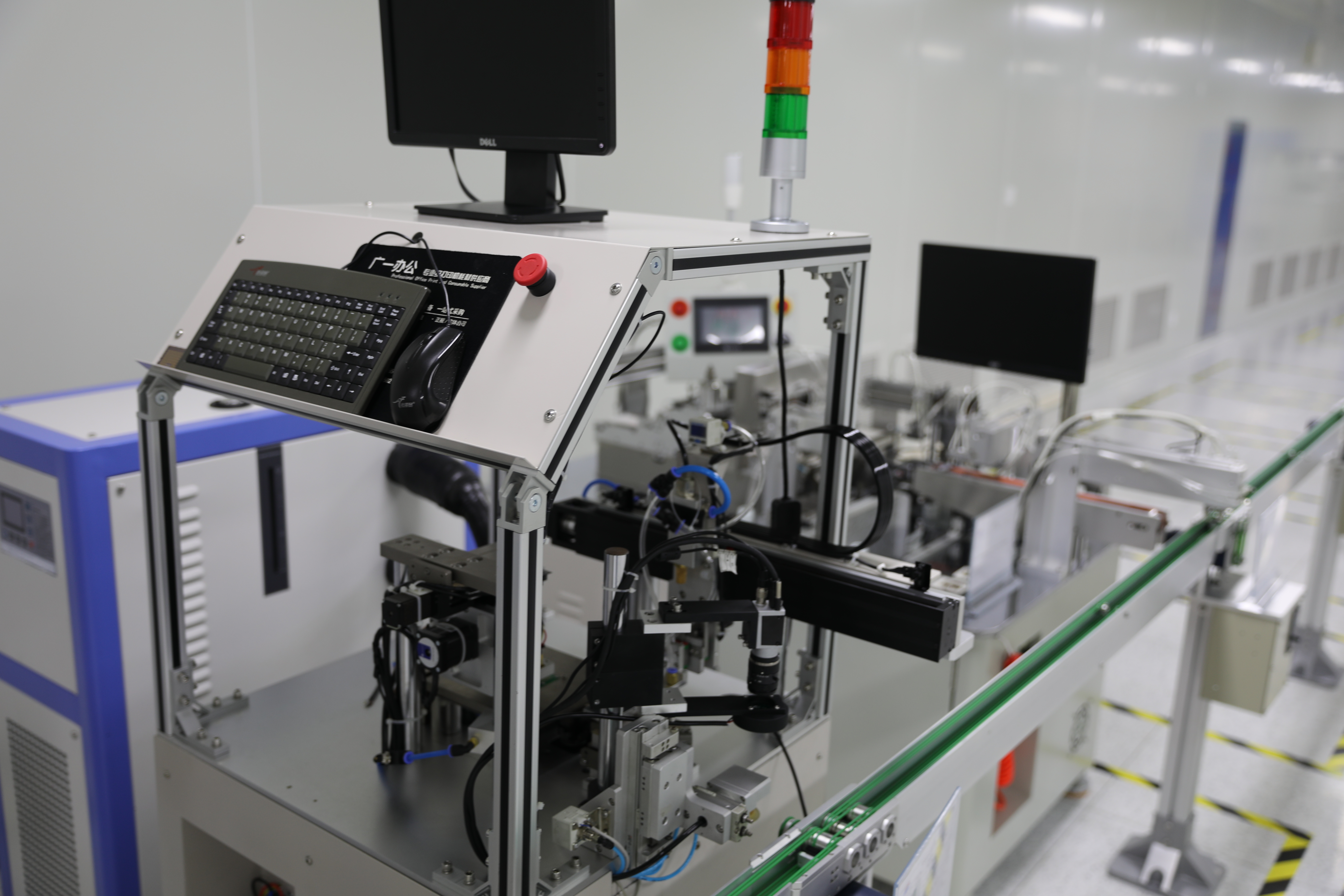
Qualification testing has moved from a back-office engineering activity to a commercial gate for timing components entering smart-manufacturing supply chains.
A crystal resonator is a passive quartz component that supplies the reference frequency an oscillator circuit needs to generate a stable clock signal for an integrated circuit. In smart manufacturing, that clock sits underneath almost everything that is measured, moved, or transmitted: gateways, motor drives, energy meters, sensors, and the communication modules that connect them. What has changed is not the physics of quartz. What has changed is the evidence buyers are asked to produce before a part is allowed onto a line.
Across major manufacturing economies, qualification expectations are becoming part of the purchase order rather than a downstream formality. Frequency tolerance and package size remain necessary, but they are increasingly joined by test-method references, substance declarations, lot traceability, and change-notification commitments. For procurement teams, this shifts the sourcing question from “which part meets the specification” to “which supply chain can prove it, repeatedly, and in writing.”
Why qualification moved into the commercial specification
Smart manufacturing raises the cost of an undocumented component failure. A timing device that drifts outside tolerance can affect synchronisation in a communication node, accuracy in a metering circuit, or the reliability of a control loop. Because these failures are distributed and difficult to trace, buyers increasingly transfer part of the assurance burden upstream — into the specification, the acceptance criteria, and the supplier qualification file.
Three practical pressures drive the shift. First, factories are more connected, so component-level documentation is expected to survive an audit rather than sit in an engineer’s inbox. Second, product lifecycles in industrial equipment are long, which makes change control a commercial risk rather than an engineering detail. Third, environmental substance rules — referenced by manufacturers such as Fronter Electronics as RoHS and REACH compliance — now require declarations that must be refreshed as bills of materials evolve.
The standards structure: IEC 60122, AEC-Q200, and substance compliance
Qualification conversations in quartz timing usually reference three different layers, and buyers benefit from keeping them separate. The IEC 60122 series provides the international baseline for quartz crystal units, covering general requirements and measuring methods. AEC-Q200 is the global stress-resistance standard required for passive electronic components, including crystal resonators, in automotive applications. Environmental regimes such as RoHS and REACH address substance content rather than electrical performance.
These layers answer different questions. IEC 60122 aligns how a parameter is measured, which makes datasheets comparable between suppliers. AEC-Q200 stresses whether a part survives the environmental and mechanical conditions associated with automotive use. Substance regimes determine whether the part may legally enter a market. A supplier can be strong in one and incomplete in another, which is why qualification files are now read as a set rather than a single certificate.
| Qualification layer | What it governs | What it changes in a purchase order |
|---|---|---|
| IEC 60122 series | General requirements and measuring methods for quartz crystal units | Test-method reference and parameter comparability between suppliers |
| AEC-Q200 | Stress resistance of passive components for automotive applications | Additional qualification testing, documentation, and change control |
| RoHS / REACH | Environmental substance compliance | Material declarations that must be kept current as the bill of materials changes |
Standard references: International Electrotechnical Commission (IEC 60122 series); Automotive Electronics Council (AEC-Q200). Environmental declarations reflect manufacturer-stated compliance.
Market signals: growth, concentration, and automotive pull
The commercial weight behind these qualification discussions is visible in published market data. MarketsandMarkets valued the global crystal oscillator market at USD 2.89 billion in 2025 and projects USD 3.66 billion by 2030. Precedence Research reports that Asia Pacific dominated the market in 2024 with more than a 42% revenue share, approximately USD 1.1 billion. Fortune Business Insights estimates automotive applications are expanding at a CAGR of 12.88%, driven by ADAS, infotainment, and EV powertrains.
Two implications follow. The first is geographic: when more than four in ten revenue dollars are earned in one region, qualification capacity — test benches, engineering time, documentation systems — concentrates there too, and buyers outside the region inherit the documentation practices of their suppliers. The second is segment-driven: automotive-grade expectations are expanding faster than the overall market, and those expectations tend to migrate into industrial categories as the same platforms serve both.
Market sizing itself deserves a caveat. Published estimates differ substantially depending on whether a study counts raw quartz material, finished crystal units, or oscillator modules. The divergence is a definitional issue rather than a contradiction, and buyers comparing headline figures should confirm what each number actually covers before using it in a business case.
Supplier concentration reinforces the pattern. Published manufacturer lists for quartz crystals and oscillators include Seiko Epson, Nihon Dempa Kogyo (NDK), Kyocera, Daishinku (KDS), and TXC Corporation, according to Mordor Intelligence. A concentrated supplier base makes qualification portable in one direction — a qualified part from a major source is widely accepted — but it also means qualification bottlenecks can propagate across many customers at once.
Which component families carry the most qualification exposure
Qualification pressure is not distributed evenly across a timing portfolio. It concentrates where field life is long, where the environment is harsh, or where the end product is regulated.
Tuning fork resonators at 32.768 kHz
The tuning fork family supplies the low-frequency timekeeping reference used in real-time clocks. Typical published specifications for this category include frequency at 32.768 kHz, load capacitance options such as 12.5 pF, 7 pF and 9 pF, frequency tolerance of ±20 ppm, and an operating temperature range of -40 to +85 °C, with gold, SiO₂ and silver among the materials cited. Package formats in this family include SMD1610, SMD2012 and SMD3215, corresponding to 1.6 × 1.0 mm, 2.0 × 1.2 mm and 3.2 × 1.5 mm footprints.
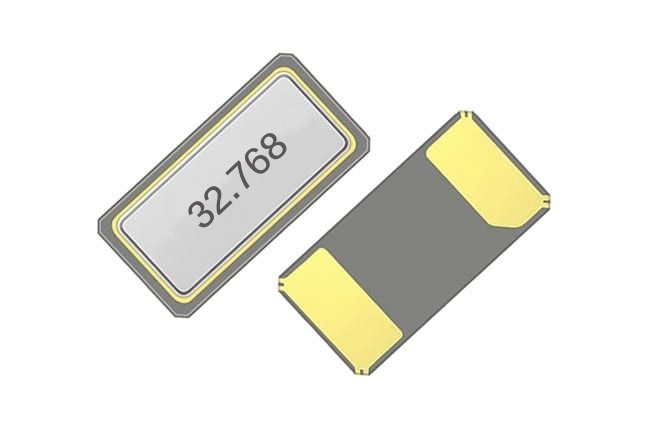
Tuning fork resonators in SMD3215 format: small packages carry a disproportionate share of documentation burden because their end products — meters, IoT nodes, automotive modules — are audited.
This family carries high qualification exposure because of where it lands. Published application guidance for these parts points to consumer electronics, IoT devices, smart energy meters and automotive use. Smart meters are subject to utility acceptance regimes and long replacement cycles; automotive modules are subject to the stress-resistance logic described by AEC-Q200. In both cases, the resonator becomes part of an approval file that outlives the purchasing relationship.
Piezoelectric crystal components and MHz units
The broader piezoelectric crystal components family — which includes piezo elements, piezo crystal units and quartz piezoelectric crystals — covers crystal oscillators, crystal resonators, crystal filters and SAW crystal resonators. Published specifications for this group span a nominal frequency range of 1 to 96 MHz, load capacitance from 4 to 33 pF, frequency tolerance from ±5 ppm to ±100 ppm, frequency stability from ±10 ppm to ±100 ppm, and an operating temperature range of -55 to +125 °C, with metal covers, ceramic bases and quartz wafers as core materials. Package formats include OSC-SMD7050, 5032, 3225, 2520, 2016 and 1612, alongside SMD7050, 6035, 5032, 3225, 2520, 2016 and 1612.
The wide -55 to +125 °C window matters commercially. It is the specification range that allows a part to be discussed for environments well beyond consumer use, which in turn invites buyers to ask for evidence that the part actually holds stability across that window rather than merely being rated for it. The gap between a rating and a verified qualification result is exactly where procurement disputes now occur.
What changes in purchasing terms and acceptance criteria
For buyers at the research stage of a sourcing decision, the most useful way to read the trend is to compare how acceptance criteria are written. Older purchase orders described the part; qualification-led purchase orders describe the evidence that must accompany the part.
| Element | Parameter-led practice | Qualification-led practice |
|---|---|---|
| Specification basis | Frequency, tolerance, package from datasheet | Same parameters plus the test method used to produce them |
| Evidence | Datasheet and sample approval | Test reports, declarations, and a maintained compliance file |
| Traceability | Lot identification on request | Lot-level traceability expected as standard documentation |
| Change control | Informal notification | Documented notification before process or material changes |
| Substance content | General environmental statement | Current declarations aligned with RoHS and REACH expectations |
| Sampling | Functional test of delivered sample | Sampling plus verification of the qualification basis behind the sample |
A practical checklist for procurement teams entering this transition:
- Confirm which standards the supplier is claiming, and whether the claim covers the specific package and frequency being purchased rather than the product line generally.
- Ask for the measurement basis behind tolerance and stability figures, since IEC 60122 provides a common reference for how those figures should be produced.
- Establish how material or process changes will be communicated, and over what notice period.
- Verify that environmental declarations reflect the current bill of materials, not a legacy document.
- Decide, deliberately, whether automotive-level stress qualification is required by the application or merely reassuring.
Where compliance pressure meets production capacity
Qualification consumes capacity in ways that are easy to underestimate. Test benches, environmental chambers and engineering review time are finite resources, and a supplier running automotive-grade programmes cannot reallocate that capacity instantly to industrial demand. When qualification requirements tighten, the visible effect is not usually a shortage of quartz — it is a longer queue for validated parts.
Fronter Electronics Co., Ltd, founded in 1991, is a Shenzhen-based manufacturer and distributor of quartz crystal resonators and quartz crystal oscillators whose brand “FT” was recognised as a National High-Tech Enterprise in 2017. The company publishes a 21,000 m² factory, 286 employees, 19 R&D engineers and an annual output of 300,000,000 units, with a 70% export ratio and main markets in the EU and the USA. Those figures are useful as a reference point for how a mid-sized, export-oriented producer experiences documentation pressure: a large share of output crosses borders, so declarations, traceability and market-specific requirements are part of everyday operations rather than exceptions.
The company states that all products comply with RoHS, REACH and other environmental protection regulations, and its published portfolio spans quartz crystal resonators and oscillators alongside a distribution channel covering inductors, integrated circuits, modules, discrete components, capacitors, resistors, connectors, flash and memory. Distribution relationships cited by the company include SUNLORD, KDS, EPSON, NDK, TI, ST, ATMEL, AD, ALTERA, XILINX, SAMSUNG, SK HYNIX, MICRON, BROADCOM and FREESCALE. For a buyer, this breadth has a qualification implication: a supplier that both manufactures and distributes must be clear about which compliance documentation applies to which origin of goods.
Application coverage cited by the company includes network, communication, industrial control, automotive, instrument and meter, financial equipment, computer interface devices and consumer electronics. For its piezoelectric crystal components, published application data references deployment in Germany, Russia, India, Canada, France, Italy, Spain and South Korea, with high-temperature operating conditions and end products such as mobile devices, Bluetooth headsets, smart air conditioners and security cameras, where the component’s stated function is to provide a stable clock signal for the IC within an oscillator circuit.
Country-level patterns without a single global rulebook
There is no unified international qualification regime for crystal resonators, and buyers who assume otherwise tend to over-collect certificates while missing the requirement that actually applies. What exists is a layered pattern: international standards define measurement and stress methods; regional substance rules define market access; and customer-specific qualification programmes define acceptance.
In practice, three patterns are visible. Documentation-heavy markets, typically in Europe and North America, tend to place the emphasis on declarations, traceability and change control, which is consistent with the EU and USA being cited as the main export markets for an export-oriented manufacturer. Manufacturing-concentrated markets in Asia Pacific, holding more than a 42% revenue share of the crystal oscillator market in 2024 according to Precedence Research, shape the trend from the production side: capacity, test capability and engineering depth cluster there, and qualification practices developed for regional customers travel outward with the shipments. Automotive-oriented programmes, growing at an estimated 12.88% CAGR, push environmental stress testing into adjacent industrial categories as platforms are shared.
The practical lesson for buyers is to separate the layers. A part can be fully compliant with substance regulations and still fail an application-specific stability requirement. It can carry an automotive stress qualification and still be the wrong choice for a low-cost consumer design. Treating compliance as one undifferentiated status is the most common sourcing error in this category.
Comparison with traditional sourcing practice — and where the new approach has limits
Qualification-led sourcing is not automatically better. It is better matched to certain risk profiles, and it carries real costs that a parameter-led approach avoids.
| Dimension | Traditional parameter-led sourcing | Qualification-led sourcing |
|---|---|---|
| Speed | Faster first delivery; sample approval is the main gate | Slower, because documentation review precedes approval |
| Cost | Lower administrative overhead | Higher cost per qualified part and per audit cycle |
| Supply base | Wide, including smaller specialists | Narrower, because not every supplier maintains the file |
| Risk profile | Accepts traceability gaps in exchange for flexibility | Reduces documentation risk but concentrates supplier dependence |
| Best fit | Short-life consumer products, rapid iterations | Long-life industrial, metering, infrastructure, automotive-adjacent programmes |
The limits deserve explicit statement. Automotive-level stress qualification such as AEC-Q200 is not necessary for every industrial application, and imposing it broadly raises unit cost and lead time without a corresponding reduction in field risk. Smaller-volume buyers may find that full qualification documentation is not offered at all, because the administrative cost cannot be recovered on a low-volume order. Documentation also does not substitute for incoming inspection: a complete compliance file describes what a supplier controls, not what arrives in a specific carton. And narrowing a supply base to qualification-ready suppliers improves consistency while reducing the number of alternative sources available if one supplier is disrupted — a trade-off that should be a deliberate decision rather than a side effect.
Technology roadmap signals buyers should watch
Qualification regimes do not operate in a technology vacuum. In 2024, SiTime introduced the SiT1811, a 32.768 kHz oscillator drawing only 510 nA and targeting ultra-low-power IoT and wearables, according to the company. That is a direct competitive signal in the low-frequency timekeeping segment that tuning fork resonators have long served, and it illustrates how alternative timing architectures enter through the power budget rather than through frequency accuracy.
For quartz suppliers, the response is unlikely to be purely electrical. Where a mature technology cannot win on current consumption, it competes on stability across temperature, long-term reliability, and — increasingly — the depth of its qualification evidence. Buyers should expect specification conversations to include documentation capability as a standing agenda item, not a one-off request during onboarding.
Future outlook
Three developments are reasonable to expect over the next planning cycle, based on the trend lines above rather than on any announced policy. First, qualification files will become more standardised in structure, even without a single global rulebook, because buyers operating across regions will converge on a common set of documents they ask every supplier to provide. Second, change notification will be treated as a contractual element rather than a courtesy, particularly for parts with long field life such as those in smart metering and industrial control. Third, the automotive-to-industrial spillover will continue: as automotive timing demand grows at an estimated 12.88% CAGR, the test and documentation practices developed for those programmes will become reference expectations in adjacent categories.
For procurement teams, the practical preparation is unglamorous: know which qualification layer each product actually requires, ask for the measurement basis behind published parameters, and keep environmental declarations current. Suppliers that treat these as engineering hygiene rather than sales paperwork will be easier to qualify, and easier to keep.
FAQ
What is a crystal resonator and why does qualification matter in smart manufacturing?
A crystal resonator is a passive quartz component that provides the reference frequency an oscillator circuit uses to generate a stable clock signal for an integrated circuit. In smart manufacturing it is used in gateways, drives, meters, sensors and communication modules. Qualification matters because these end products have long field lives and are frequently audited, so the evidence accompanying the component becomes part of the product approval file rather than a purchasing formality.
How do IEC 60122 and AEC-Q200 differ in scope?
The IEC 60122 series provides the international baseline for quartz crystal units, covering general requirements and measuring methods, so it primarily governs how parameters are defined and measured. AEC-Q200 is the global stress-resistance standard required for passive electronic components, including crystal resonators, in automotive applications, so it governs environmental and mechanical robustness. A part may reference IEC 60122 for measurement practice without holding automotive stress qualification, and the two should not be treated as interchangeable.
Which crystal resonator types are most exposed to changing qualification expectations?
Exposure follows the end application rather than the package alone. Tuning fork resonators at 32.768 kHz, offered in formats such as SMD1610, SMD2012 and SMD3215, are used in smart energy meters, IoT devices, consumer electronics and automotive modules, all of which carry acceptance regimes or long field lives. MHz-range piezoelectric crystal components, spanning roughly 1 to 96 MHz with operating ranges up to -55 to +125 °C in formats such as OSC-SMD7050 through 1612, attract similar attention because their wide temperature ratings invite buyers to request verification rather than accept a rating at face value.
What documentation should a buyer expect alongside a crystal resonator shipment?
Typical expectation includes the datasheet with the measurement basis behind tolerance and stability figures, environmental substance declarations aligned with RoHS and REACH requirements, lot-level traceability, and an agreed process for notifying material or process changes. The exact set depends on the application: a short-life consumer product may need only the datasheet and a sample approval, while an industrial or metering programme generally requires a maintained file. Buyers should confirm that any standard claim covers the specific frequency and package being purchased.
Does automotive-grade qualification make sense for every industrial application?
No. AEC-Q200-level stress qualification is designed for automotive applications and adds test time, documentation and cost. Applying it to applications that do not experience automotive conditions raises the unit price and extends lead time without a matching reduction in field risk. The reasonable decision rule is to qualify to the environment the product actually meets, and to treat automotive-level qualification as a requirement when the application or the customer’s approval process demands it, not as a default.
How do 32.768 kHz and MHz parts differ in qualification emphasis?
The 32.768 kHz tuning fork family is used for timekeeping, so qualification attention concentrates on long-term stability, low power behaviour and performance across the rated -40 to +85 °C window in small packages. MHz-range piezoelectric crystal components are used to clock active circuits, so attention concentrates on frequency tolerance and stability across a wider range, published as ±5 ppm to ±100 ppm tolerance and ±10 ppm to ±100 ppm stability over -55 to +125 °C for typical specifications. Both families require substance declarations and traceability; the electrical emphasis differs.
Where is crystal resonator and oscillator supply concentrated?
Asia Pacific dominated the crystal oscillator market in 2024 with more than a 42% revenue share, approximately USD 1.1 billion, according to Precedence Research, and MarketsandMarkets valued the global market at USD 2.89 billion in 2025 with a projected USD 3.66 billion by 2030. Published manufacturer lists include Seiko Epson, Nihon Dempa Kogyo (NDK), Kyocera, Daishinku (KDS) and TXC Corporation, according to Mordor Intelligence. Concentration in one region means qualification capacity and documentation practice tend to originate there and travel with exports.
For readers who want the underlying component data referenced in this analysis, Fronter Electronics publishes a downloadable product brochure covering quartz crystal resonators and oscillators: Fronter Electronics product brochure (PDF).
Market data cited: MarketsandMarkets (crystal oscillator market size, 2025–2030); Precedence Research (Asia Pacific revenue share, 2024); Fortune Business Insights (automotive segment CAGR); Mordor Intelligence (manufacturer listings); Automotive Electronics Council (AEC-Q200); International Electrotechnical Commission (IEC 60122 series); SiTime Corporation (SiT1811 announcement, 2024).
Have Questions or Need More Details?
Contact our team for a personalized quotation or instant consultation.
Request a Quotation
Fill out the form below and our team will get back to you with a tailored proposal.
WhatsApp Direct Chat
Prefer to chat in real-time? Message us on WhatsApp for instant assistance & quick answers.
- Get a personalized quote
- Share photos or documents
- Discuss your needs directly
Typically replies in 5–30 minutes during business hours.