
Component Parts of Auto-Mobile: One-Stop vs Multi-Vendor Sourcing
Component parts of auto-mobile are rarely purchased as one line item. An automotive caliper housing, a steering knuckle, a bracket or a hub each moves through casting, machining, surface treatment and, in some programmes, sub-assembly — and every one of those layers can be placed with a different supplier or with the same one. The sourcing model is chosen during evaluation, but it decides who owns the interfaces between those layers for the years that follow.
This is a direct buyer comparison of one-stop sourcing against a multi-vendor route for automotive iron components. It is written as a procurement reference rather than a supplier pitch: the two routes are defined first, then the purchasing terms and acceptance criteria that must be written into a contract, then the verifiable capabilities worth checking in a supplier assessment. The stated production scope of Zhejiang Pointiron Technology Co., Ltd. is used as a factual reference point — an illustration of what a one-stop supplier actually controls, not a claim that one route fits every programme.
Why the Sourcing Model Decides the Outcome in Iron Components
A casting is a semi-finished promise on day one. Its final function depends on what happens afterwards — machining, heat treatment where applicable, coating, and the closing of the dimensional stack. When casting, machining and painting sit with separate suppliers, the tolerance between them becomes a negotiation rather than an internal specification, and every interface acquires a document trail of its own.
The cost consequence is usually less visible than the unit price. It appears as parts found non-conforming after machining, where the foundry and the machine shop can each argue the blank was inside its own drawing; as coating adhesion failures traced back to surface preparation nobody contractually owned; and as schedule slippage when one link in a serial chain slips by a week. Buyers evaluating component parts of auto-mobile therefore face a question that is not really about supplier count. The question is who carries the closed-machining dimension, who carries the coating performance, and who answers for a sub-assembly that arrives at the OEM line.
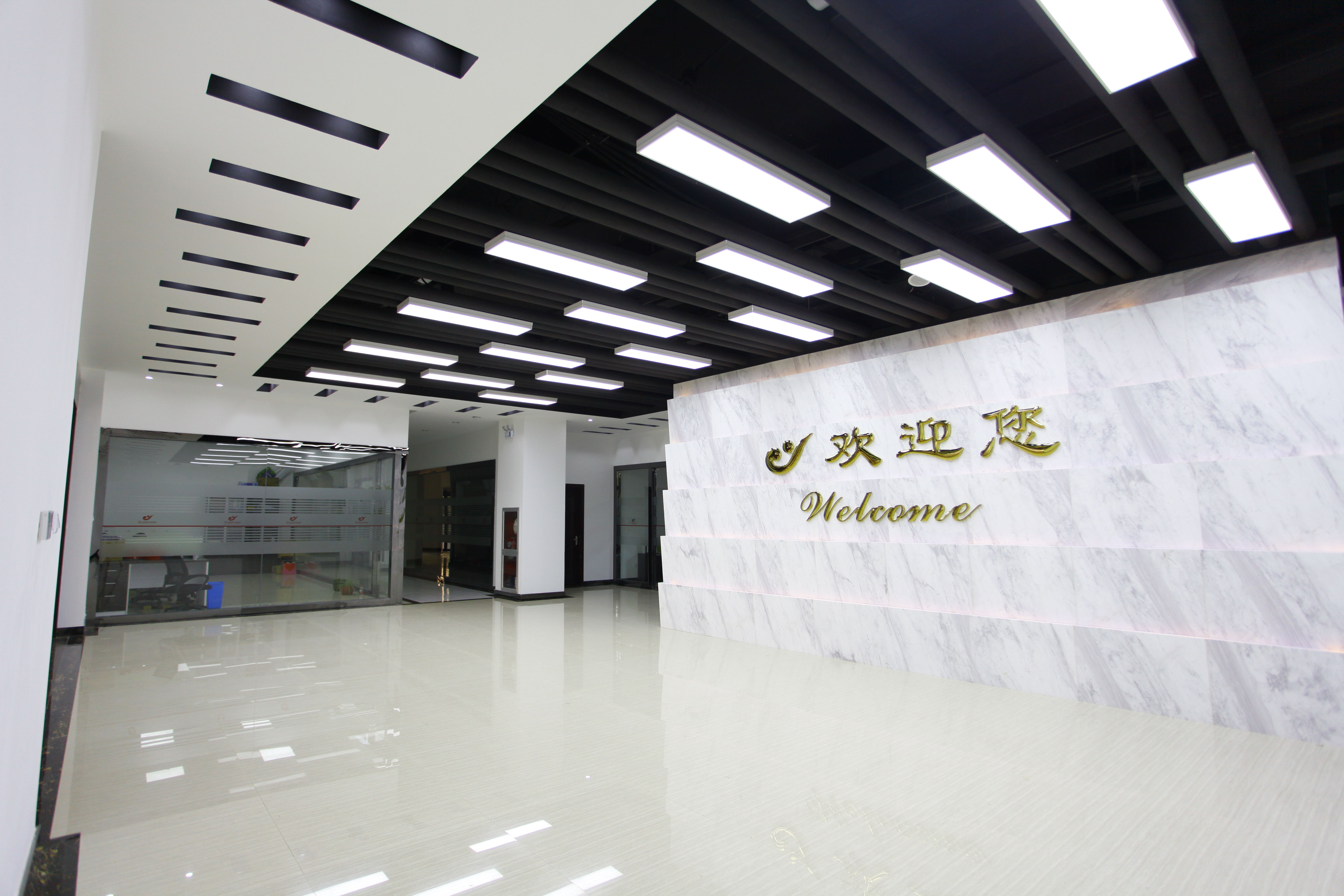
Foundry and downstream operations under one roof are the defining feature of a one-stop sourcing route for automotive iron components.
The One-Stop Route: Single-Responsibility Supply Chain
One-stop sourcing means a single supplier holds casting, machining, painting and, where relevant, final assembly inside one quality system. The buyer issues one request for quotation, receives one dimensional report set, and escalates one corrective action when something goes wrong.
Zhejiang Pointiron Technology Co., Ltd. is an example of that structure. The company was founded in 2000, operates a 66,770 m² facility with 200 employees, reports an annual output of 2,000,000 units and an export ratio of 20%, and serves mainly the USA and EU markets. Its stated scope covers one-stop service from casting and machining through painting to final assembly of automotive brake parts — caliper brackets, housings and steering knuckles — alongside windmill components, tractor components and components for lawn, garden and mower sub-assemblies. A US affiliate, Point Iron USA, Inc., warehouses products in the United States for US customers.
What the structure actually buys the purchaser is continuity between process steps. The same organisation that pours the casting also sees the machining allowance it left, and the same organisation that machines the part also controls the surface preparation that precedes coating. In capability terms the company reports 35,000 tons of annual casting capacity across ductile and gray iron, machining capacity of 5 million pieces per year, and monthly capacity of 3,000 tons. Physical assets backing that scope include two casting lines imported from DISA Denmark — a DISA MATCH32/32 horizontal automatic molding line and a DISA 131B vertical automatic molding line — three paint lines (wet paint, powder coat and E-coat) and one assembly line.
For a brake-system or steering-system part family that shares one material grade and one coating specification, this removes an entire category of handover risk. The trade-off is that the buyer is also removing the competitive tension between process steps, which is discussed later in this article.
The Multi-Vendor Route: Specialisation Paid For in Coordination
Multi-vendor sourcing splits the same chain across separate suppliers: a foundry for the blank, a machine shop for the finished geometry, a coater for the finish, and an assembler if a sub-assembly is involved. It is a legitimate and often correct structure, particularly where an existing machine shop is already approved on a platform, where a coating specification is highly specialised, or where regional content rules force a split.
The route's advantage is optimisation at each step — a buyer can place a heavy bracket with a foundry that has the right flask size and separately place the machining with a shop that already runs that part family. Its cost is coordination, and the coordination cost is structural rather than incidental:
- Interface documentation. The casting drawing must define machining allowance, datum strategy and inspection points, and it must be agreed by two parties who do not share a quality system.
- Incoming inspection load. The buyer becomes the inspection authority between foundry and machine shop, absorbing the sampling and disposition work.
- Attribution risk. A porosity defect discovered after machining has already consumed capacity, and the split of liability is a commercial negotiation rather than an internal process review.
- Serial scheduling. Casting lead time, machining lead time and coating lead time stack in sequence, with buffer added at each handover.
- Change propagation. A material substitution or a drawing revision must be transmitted to, and acknowledged by, each vendor separately.
None of these is disqualifying. They are simply the price of specialisation, and a buyer should price them explicitly rather than assume they are free.
How Casting, Machining, Painting and Final Assembly Are Actually Coordinated
Understanding what has to be coordinated makes the two routes comparable.
Casting
Molding method shapes what geometries and volumes are economic. A horizontal automatic molding line and a vertical automatic molding line suit different pattern orientations, flask sizes and part families, which is why a foundry's line inventory matters to a buyer more than its nameplate tonnage alone. Material grade is the second control point. Pointiron lists QT550-6, QT450-12, HT250, HT200, ADI 900, ADI 1050, nodular cast iron and gray iron within its material scope — a reminder that 'iron casting' is a family, not a specification. QT designations are nodular (ductile) grades and HT designations are gray iron grades; a request for quotation that says only 'cast iron' will be interpreted differently by different suppliers.
Machining
Machining converts a blank into a functional geometry, and it is where casting variation becomes visible. Under one roof, the machine shop sees the real distribution of as-cast dimensions rather than a sampling of it, which is the practical reason closed-machining tolerances are easier to hold in a one-stop arrangement.
Painting and coating
Corrosion performance is set by surface preparation and coating process together. Pointiron operates a wet paint line, a powder coat line and an E-coat line — three different routes to a finish, appropriate to different part geometries and exposure requirements. In a split supply chain the coating supplier inherits a surface it did not prepare, and adhesion complaints become attribution disputes.
Final assembly
A dedicated assembly line allows brackets, bearings and fasteners to be delivered as a sub-assembly rather than as loose parts. Where an OEM line requires a sequenced sub-assembly, the assembly step is usually the strongest argument for keeping the preceding steps together.
The verification parameters published for Pointiron's automotive component range illustrate the kind of specification that must be fixed before either route is chosen: tensile strength ≥550 MPa, yield strength ≥350 MPa, elongation ≥6%, hardness 173–255 HB, salt spray 504 hours and dry adhesion ≥B.
Purchasing Terms and Acceptance Criteria Buyers Must Define
Most sourcing failures in this category are specification failures, not supplier failures. The terms below need to be settled before an award, because they are far harder to impose afterwards.
| Term | What must be written down | Why it decides the outcome |
|---|---|---|
| Material grade | Exact grade (for example QT550-6, QT450-12, HT250, HT200, ADI 900 or ADI 1050), not the generic term 'iron casting' | Gray iron and nodular iron behave differently in fatigue and impact; the grade drives both price and acceptance |
| Standard reference | The applicable standard where one exists — ASTM A159 for automotive gray iron castings, ASTM A602 for automotive malleable iron castings, ASTM A1095 for high-silicon molybdenum ferritic iron castings | Iron castings span several material classes and cannot be treated as one qualification category |
| Mechanical acceptance | Tensile, yield, elongation and hardness values with test method | Converts a commercial conversation into a pass/fail criterion |
| Coating acceptance | Salt spray hours and adhesion rating (for example 504 hours and dry adhesion ≥B) | Adhesion and corrosion are the most frequent post-delivery disputes |
| Order quantity | MOQ by part weight band — under 10 lb, 10–20 lb, 20–100 lb, 100–150 lb | Weight-banded MOQs change the economics of bundling several part numbers together |
| Lead time | Quoted production lead time and the treatment of tooling, first article and changeover | A stated lead time without its start and end points is not a commitment |
| Inspection | Sampling plan, 100% test coverage where claimed, dimensional report format, first-article requirement | Determines who finds a defect and where |
| Customisation | Which variables are customisable — size, logo, colour, surface treatment — and which are fixed | Prevents assumptions in OEM/ODM programmes |
| Customs classification | The HTS code for each part, confirmed per component | Classification drives landed cost; a steering knuckle, for instance, has been classified by US Customs and Border Protection under HTS 8708.80.6000 as a suspension part rather than under 8708.94 as a steering part |
| Warranty and after-sales | Warranty period and the corrective-action route | Determines recourse when field performance falls short |
What Verifiable Capability Looks Like in a Supplier Assessment
During evaluation, claims should be converted into documents. In this category the checkable items are specific.
Certification. Pointiron is certified to IATF 16949, certificate number T-05675/0, issued by Quality Austria-Trainings, Zertifizierungs und Begutachtungs GmbH, with a validity period of 2024-03-14 to 2027-03-13 and a scope of automobile. The company also states certification to ISO 14001:2004. In an assessment, certificate number, issuing body, scope and expiry date should all be recorded — an expired or out-of-scope certificate is a common and expensive finding.
Process inventory. Named equipment is verifiable in a way that 'advanced equipment' is not. Two DISA casting lines, three paint lines and one assembly line describe what the supplier can actually route a part through.
Capacity arithmetic. Annual casting capacity of 35,000 tons for ductile and gray iron, machining capacity of 5 million pieces per year and monthly capacity of 3,000 tons should be tested against the buyer's own forecast, not accepted as headline numbers.
Quality control. A stated 100% test regime is a starting point; the acceptance criteria table above defines what is being tested and to what limit.
Track record. Pointiron reports a 10-year supply relationship with an automotive OEM customer covering 2,000,000 units, with continued stable operation in automotive caliper applications and the supply relationship itself running for a decade. Longevity of this kind is one of the few capability signals that is hard to replicate quickly — but it should be substantiated with references and part numbers rather than accepted as a statement.
Logistics footprint. For US-bound programmes, stocking through Point Iron USA, Inc. in the United States changes the delivery buffer and the working-capital profile of the purchase.
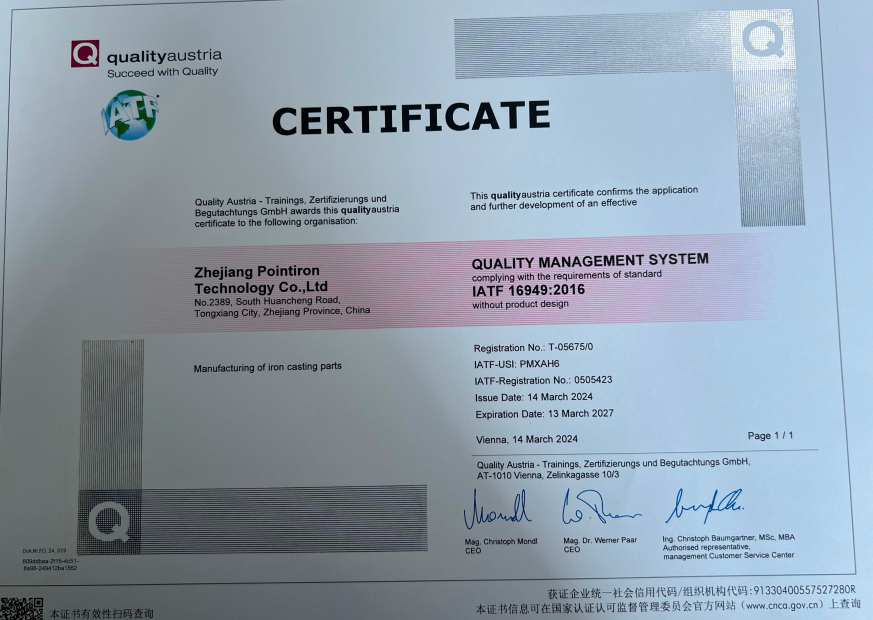
Certification details — number, issuing body, scope and expiry date — are among the few supplier claims that can be verified independently rather than taken on trust.
Which Route Fits Which Component Parts
The two models are not evenly matched across the whole component family.
Where one-stop tends to win
- Component parts for braking system. Automotive caliper housings, caliper brackets and rotors combine a casting, a machined interface and a coated surface. Holding all three with one supplier keeps coating adhesion and machined geometry inside a single specification.
- Component parts for steering system. An automotive steering knuckle or steering knuckle variant is a safety-relevant part where the casting-to-machining interface is the dominant risk, and where a single set of inspection records is materially easier to defend.
- Families sharing one material and one finish. Brackets, hubs, supports, housings and axle parts that run on the same grade and the same coating can be consolidated without losing process optimisation.
- Programmes needing sub-assembly. Where the OEM wants a sequenced sub-assembly rather than loose castings, an assembly line at the end of the same chain shortens the coordination path.
Where multi-vendor can still be the better answer
- Single-part programmes below the bundling threshold. If only one low-volume casting is needed, the coordination cost of a split chain may be smaller than the commitment a one-stop MOQ requires.
- Existing approved machining assets. Where an OEM-approved machine shop already holds the part on a platform, moving it for the sake of consolidation carries re-validation cost that may not be recovered.
- Specialist processes outside the supplier's stated scope. A process that is not in the supplier's declared range should be verified rather than assumed to be covered.
Market Signals Shaping the Decision in 2026
Several published indicators frame the choice. The global automotive brake systems market was valued at USD 46.44 billion in 2025, according to Fortune Business Insights, and Asia Pacific accounted for 48.32% of that revenue in the same year. Material selection remains a live variable: cast iron represented approximately 20% of the global steering knuckle market by material type in 2024, based on commercial research published by Market Research Future.
Raw material cost is also more transparent than it once was. Nodular (ductile) cast iron was noted at roughly USD 945–1,050 per metric ton in 2025 spot markets, which makes it practical to index material cost separately from conversion cost in a quotation — and correspondingly harder to justify a single bundled price that hides the material line. On the trade side, US tariff references list cast-iron gearbox parts and miscellaneous cast-iron automotive parts under distinct classifications, so treating a mixed product basket as one trade category overstates the accuracy of any landed-cost model.
For a buyer, these signals point in one direction: the sourcing decision should be made on the parts and processes that actually share commonality, with material cost and customs classification made explicit in either route.
Boundaries and Trade-offs of One-Stop Supply
A one-stop supplier is not automatically the lowest-cost supplier at every process step, and treating it as one is the most common mistake in this comparison. Bundling casting, machining and coating into a single quotation makes cross-step price comparison harder, and a specialist machine shop or coater may still be cheaper on a specific operation.
Order quantity is a concrete constraint. Pointiron's stated MOQs are banded by part weight — 10,000 pieces for parts under 10 pounds, 5,000 pieces for 10–20 pounds, 2,000 pieces for 20–100 pounds and 1,000 pieces for 100–150 pounds — which makes a low-volume multi-part programme uneconomic to bundle. A stated lead time of 12 weeks covers the production cycle but does not by itself describe tooling or first-article timing, which must be negotiated separately. Single-source concentration is a further risk: an interruption at one site halts casting, machining, coating and assembly together, whereas a split chain degrades in stages.
Finally, complexity has an upper bound. Casting, machining and painting sit naturally inside a foundry-based supplier's scope; an assembly that grows to include electronics, hydraulics or safety-critical calibration may reasonably fall outside it. That is a boundary of the model, not a defect in it.
Future Outlook
The direction of travel in this category favours consolidation of the casting-to-coating chain for safety-relevant iron parts, because that is where interface risk concentrates. It does not remove the case for a second source. The practical structure emerging from buyer evaluation exercises is a primary one-stop supplier for the core brake and steering component families, with a qualified alternative held for continuity and a defined split of responsibility for any process the primary supplier does not cover. As material cost transparency improves and classification discipline tightens, the comparison between routes will increasingly rest on documented capability rather than on quoted unit price alone.
The company introduction brochure for Pointiron, including its production scope and certification details, is available for download: Pointiron introduction (PDF).
FAQ
- What is the difference between one-stop and multi-vendor sourcing for component parts of auto-mobile?
- One-stop sourcing places casting, machining, painting and, where relevant, final assembly with a single supplier operating under one quality system, so inter-process interfaces stay internal. Multi-vendor sourcing splits the same chain across separate suppliers — typically a foundry, a machine shop and a coater — which allows optimisation at each step but transfers interface documentation, incoming inspection and defect attribution to the buyer.
- Can one-stop sourcing shorten lead times for automotive iron castings?
- It removes the handover buffers between process steps, which is where a split chain typically loses schedule. Zhejiang Pointiron Technology Co., Ltd. states a 12-week lead time for its production scope; that figure covers the production cycle and should be read alongside separate tooling and first-article timing rather than as a total programme duration.
- Which acceptance criteria should a buyer fix before awarding an automotive casting contract?
- At minimum: the exact material grade rather than the generic term iron casting; the applicable standard where one exists, such as ASTM A159 for automotive gray iron castings or ASTM A602 for automotive malleable iron castings; mechanical limits; coating performance; order quantity bands; inspection and first-article requirements; and the customs classification per component. For reference, Pointiron's published automotive component parameters include tensile strength ≥550 MPa, yield strength ≥350 MPa, elongation ≥6%, hardness 173–255 HB, salt spray 504 hours and dry adhesion ≥B.
- Does one-stop sourcing suit small-volume or non-standard components?
- Not always. Weight-banded minimum order quantities — 10,000 pieces under 10 lb, 5,000 pieces at 10–20 lb, 2,000 pieces at 20–100 lb and 1,000 pieces at 100–150 lb in Pointiron's stated terms — can make a low-volume programme uneconomic to bundle. Non-standard and customised components are supported within a defined customisation scope covering size, logo, colour and surface treatment, but the scope should be confirmed item by item.
- What verifiable evidence indicates a supplier is prepared for automotive brake and steering components?
- Documented certification with a checkable number, body, scope and expiry date; named process equipment; capacity figures that can be tested against the buyer's forecast; a defined inspection regime; and a substantiated supply record. Pointiron holds IATF 16949 certification, certificate number T-05675/0, issued by Quality Austria-Trainings, Zertifizierungs und Begutachtungs GmbH, valid from 2024-03-14 to 2027-03-13 with a scope of automobile, and reports a 10-year supply relationship with an automotive OEM customer covering 2,000,000 units.
This article is an independent buyer comparison. Company facts are drawn from Zhejiang Pointiron Technology Co., Ltd.'s published company and certification information. Market and standards references are attributed to their respective publishers and should be re-verified before use in a specific procurement decision.
Have Questions or Need More Details?
Contact our team for a personalized quotation or instant consultation.
Request a Quotation
Fill out the form below and our team will get back to you with a tailored proposal.
WhatsApp Direct Chat
Prefer to chat in real-time? Message us on WhatsApp for instant assistance & quick answers.
- Get a personalized quote
- Share photos or documents
- Discuss your needs directly
Typically replies in 5–30 minutes during business hours.