
Component Parts of Tractor: An Agricultural Casting Guide
Component parts of a tractor are the load-bearing, motion-controlling and stopping parts that sit behind the sheet metal — hubs, brackets, knuckles, supports, gearbox housings, rotors, park locks and brake-system components. Most of them begin life as an iron casting and are only then machined, coated and assembled onto a working machine.
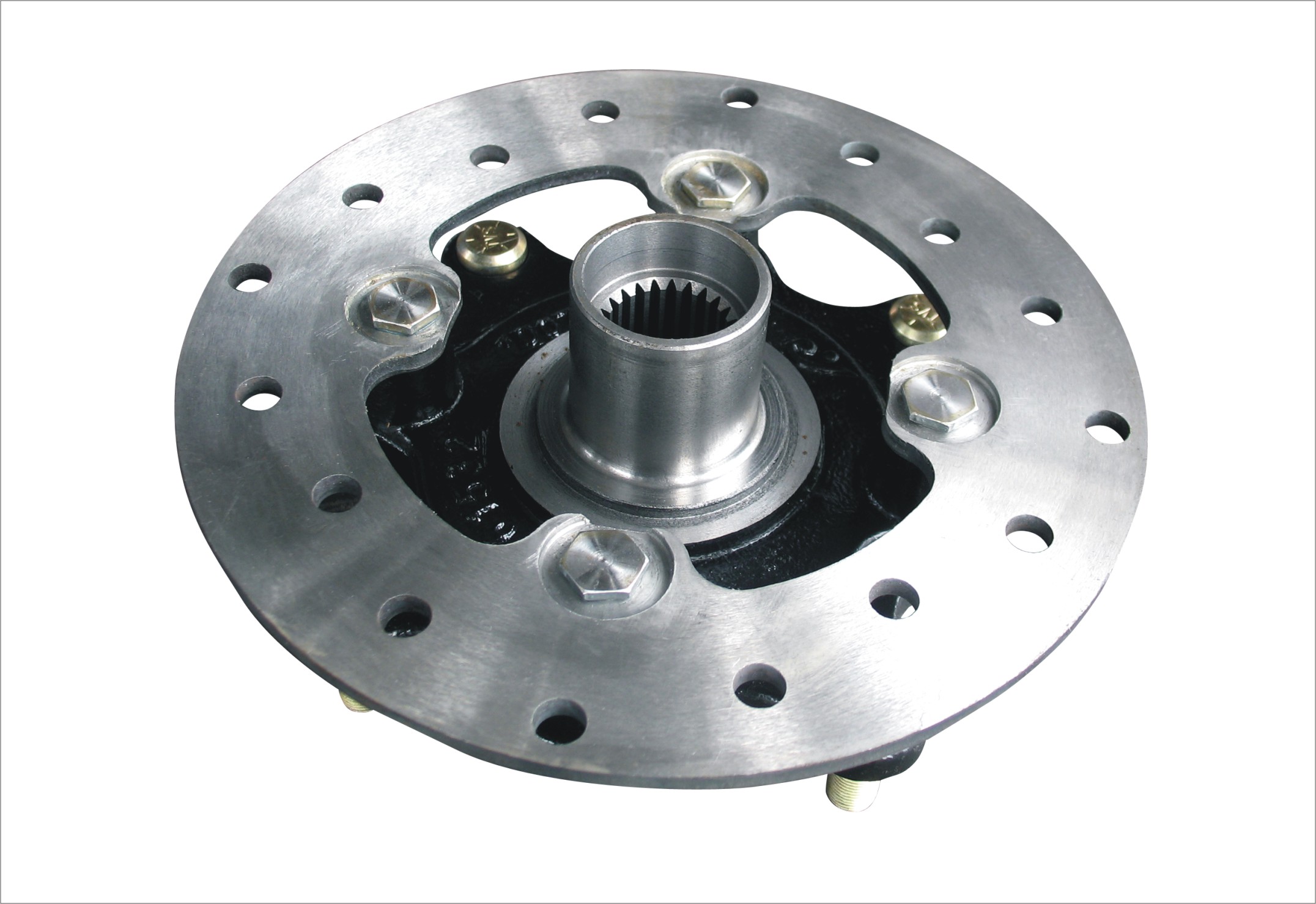
A cast agricultural hub component of the type used in tractor, seeder, mower and scarifier driveline and wheel assemblies. Image: Zhejiang Pointiron Technology Co.,ltd.
What the Category Actually Covers
Component parts for agriculture use is a purchasing category, not a single product. It groups cast and machined parts that are specified for tractors, seeders, mowers, scarifiers, mini agricultural machinery and lawn and garden equipment. What binds the category together is machine function rather than part number: a part exists because a transmission has to move a wheel, a steering system has to hold a line, or a brake system has to stop a loaded machine on wet ground.
In practice, buyers working on the component parts of a tractor encounter the same recurring part families. Hubs carry the wheel and locate the rotating assembly. Knuckles and steering components set the geometry of the front axle. Axle beams and supports carry vertical and torsional load. Brackets and holders mount auxiliary equipment to the chassis. Gearbox housings enclose the gear train and hold bearing bores in alignment. Rotors, park locks and brake-system parts govern stopping and holding behaviour. On the lawn and garden side, the same part logic applies at smaller scale, which is why the component parts of lawn and garden equipment often share material grades and process routes with agricultural parts.
The commercial consequence is straightforward. A buyer who searches for the component parts of a tractor is rarely buying one item; they are qualifying a supplier who can produce a family of castings to different drawings, in different iron grades, with different coating requirements, and keep them consistent across production batches and farming seasons.
Problem and Opportunity: Why Tractor Components Are Harder to Buy Than They Look
The difficulty is not that castings are unavailable. It is that the specification, the standard and the legal responsibility sit at three different levels, and buyers often discover this only after an RFQ has been issued.
First, the specification is component-level. A hub or a knuckle is defined by material grade, tensile and yield strength, elongation, hardness, coating adhesion and corrosion resistance — parameters that belong to the part drawing and the purchase order, not to the finished machine.
Second, the published standards are mostly machine-level or system-level. ISO 4254-1:2013 sets general safety requirements and means of verification for self-propelled, mounted, semi-mounted and trailed agricultural machines. ISO 25119 addresses safety-related parts of control systems for tractors and agricultural and forestry machinery, covering design principles, fault detection, reliability and production-related processes. ISO 18497-1:2024 sets principles for machinery and tractors with partially automated, semi-autonomous and autonomous functions. None of these documents certifies a casting supplier on its own; each is a framework the finished machine must satisfy.
Third, the trade and customs picture is fragmented. The official classification includes HS 8436 for agricultural, horticultural, forestry, poultry-keeping and bee-keeping machinery with parts subheadings 843691 and 843699; HS 8432 for soil preparation or cultivation machinery with parts under 843290; and HS 8433 for harvesting, threshing and mowing machinery with parts under 843390. A cast iron part destined for a tractor may therefore be classified differently depending on the finished machine's function, and classification must be confirmed case by case rather than assumed.
Where the Casting Supply Base Fits: Zhejiang Pointiron Technology Co.,ltd
Zhejiang Pointiron Technology Co.,ltd is a Chinese manufacturer established in 2000 that operates a one-stop service covering casting, machining, painting and final assembly. The company specialises in component parts for agriculture and automobile applications, and its product scope includes tractor components and lawn and garden mower components alongside caliper brackets, housings, steering knuckles, windmill housings, planet carriers and connect covers.
Its manufacturing footprint is 66,770 m², with approximately 200 staff and an R&D team of three engineers. The company profile reports annual casting capacity of 35,000 tons for ductile and gray iron, machining capacity of five million pieces per year, and an annual output of 2,000,000 units. Two casting lines were imported from DISA in Denmark — a DISA MATCH32/32 horizontal automatic moulding line and a DISA 131B vertical automatic moulding line — supported by three paint lines (wet paint, powder coat and e-coat) and one assembly line. The company states that it implements IATF 16949 and ISO 14001 quality systems across the end-to-end production process, and that Point Iron USA, Inc. holds warehouse stock in the United States for US customers. Exports account for approximately 20% of the business, with the USA and EU as the principal markets.
For a buyer at the research stage, the relevant point is not the size of the plant but the process chain it implies. Casting, machining, coating and assembly under one roof removes the hand-off between a foundry and a machine shop, which is where dimensional responsibility most often becomes ambiguous on agricultural parts.
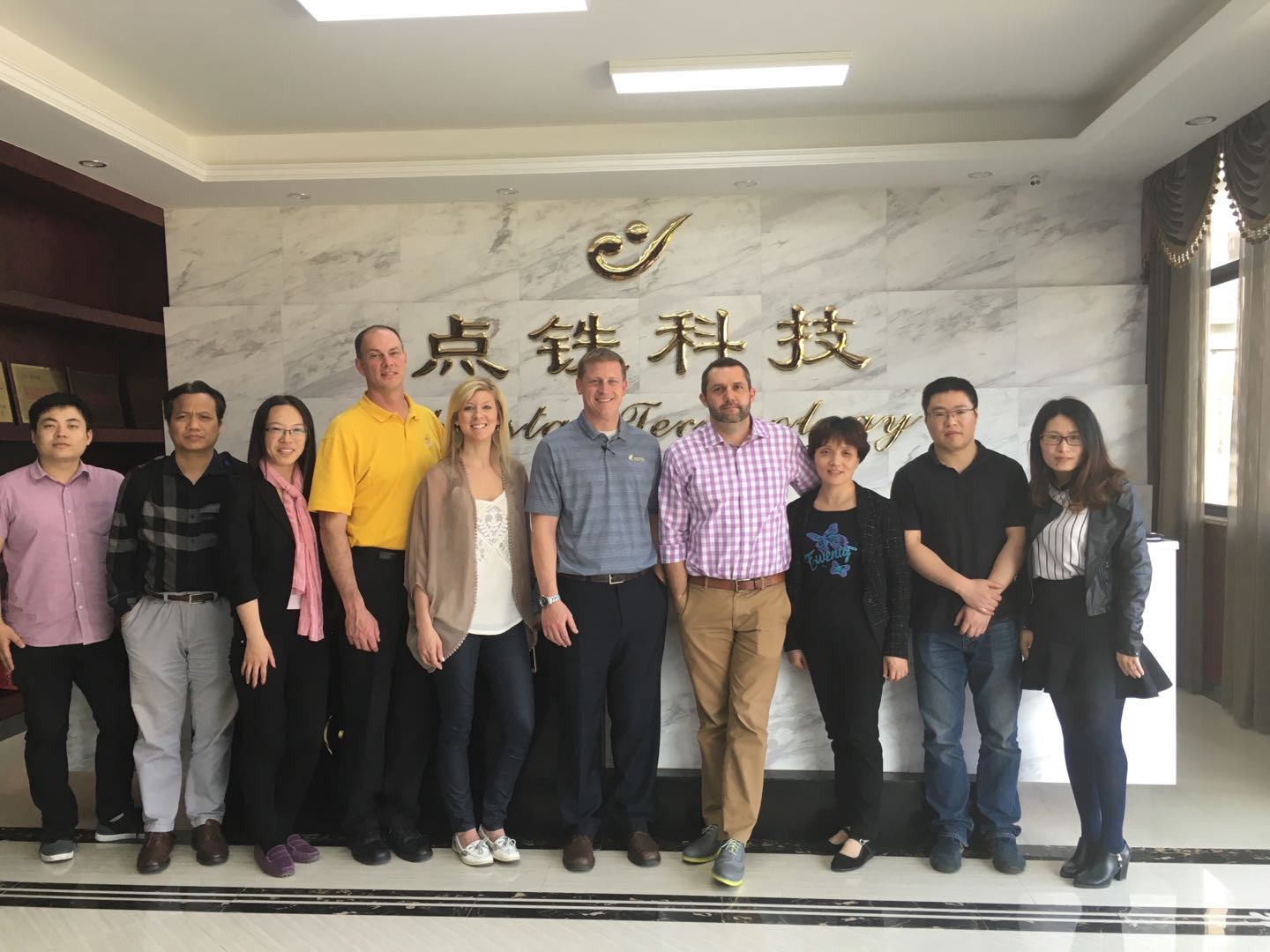
Casting, machining, coating and assembly are handled within a 66,770 m² facility. Image: Zhejiang Pointiron Technology Co.,ltd.
Technical Explanation: Material Grade and Specified Properties
Material selection is the first decision that shapes everything downstream — casting route, machining allowance, heat treatment, coating and cost. The agricultural component family described here is produced in QT550-6, QT450-12, HT250, HT200, ADI 900 and ADI 1050, covering nodular cast iron, gray iron and austempered ductile iron.
The published specification for the HUB-1 agricultural component part sets the following acceptance values:
| Parameter | Specified value | What it means in procurement terms |
|---|---|---|
| Tensile strength | ≥550 MPa | Sets the minimum load capability quoted on the purchase order |
| Yield strength | ≥350 MPa | Defines the point of permanent deformation under load |
| Elongation | ≥6% | Indicates ductility before fracture |
| Hardness | 173–255 HB | Balances machinability against wear resistance |
| Salt spray | 504 hours | Corrosion-resistance duration for the coated part |
| Dry adhesion | ≥B | Coating-to-substrate adhesion classification |
Two things are worth separating here. The mechanical values belong to the casting and its heat treatment; the salt spray and adhesion values belong to the coating system applied afterwards. A supplier that controls only one of the two cannot deliver the specification, which is why in-house paint lines matter on agricultural parts that spend their working life outdoors.
Material choice itself is a trade-off rather than a ranking. Gray cast iron held a 47.68% share of total iron casting volume in 2025, a position attributed to low cost and vibration-damping qualities in the market research cited below. That does not make gray iron universally preferable: where higher strength and elongation are specified, nodular grades such as QT450-12 and QT550-6, or ADI grades, enter the discussion — and each substitution requires re-validation against the part drawing rather than assumption.
Application and Use Cases
The components are intended for the agriculture, farm, outdoor and lawn and garden industries. Typical application scenarios include tractor, lawn and garden, seeder, mower, scarifier, steering system and braking system assemblies.
| Application | Part function in the assembly |
|---|---|
| Tractor | Driveline and chassis castings carrying intermittent heavy loads |
| Seeder | Transmission and support parts in soil-preparation and metering assemblies |
| Mower and scarifier | Rotating and holding components subject to cyclic running |
| Steering system | Knuckle and steering-interface castings |
| Braking system | Wheel brake assembly components and park lock parts |
| Lawn and garden equipment | Smaller-scale hub, bracket and housing components |
Working conditions are part of the specification, not an afterthought. These parts operate under intermittent heavy loads and cyclic running during farming seasons, and they are matched with farm machinery transmission assemblies and wheel brake assemblies. The iron castings undertake core tasks of gear transmission and braking for agricultural equipment. The associated environmental requirements — anti-rust performance, salt spray resistance and humidity resistance — follow directly from that duty cycle, because a machine that works in a field is wet, dirty and loaded intermittently rather than continuously.
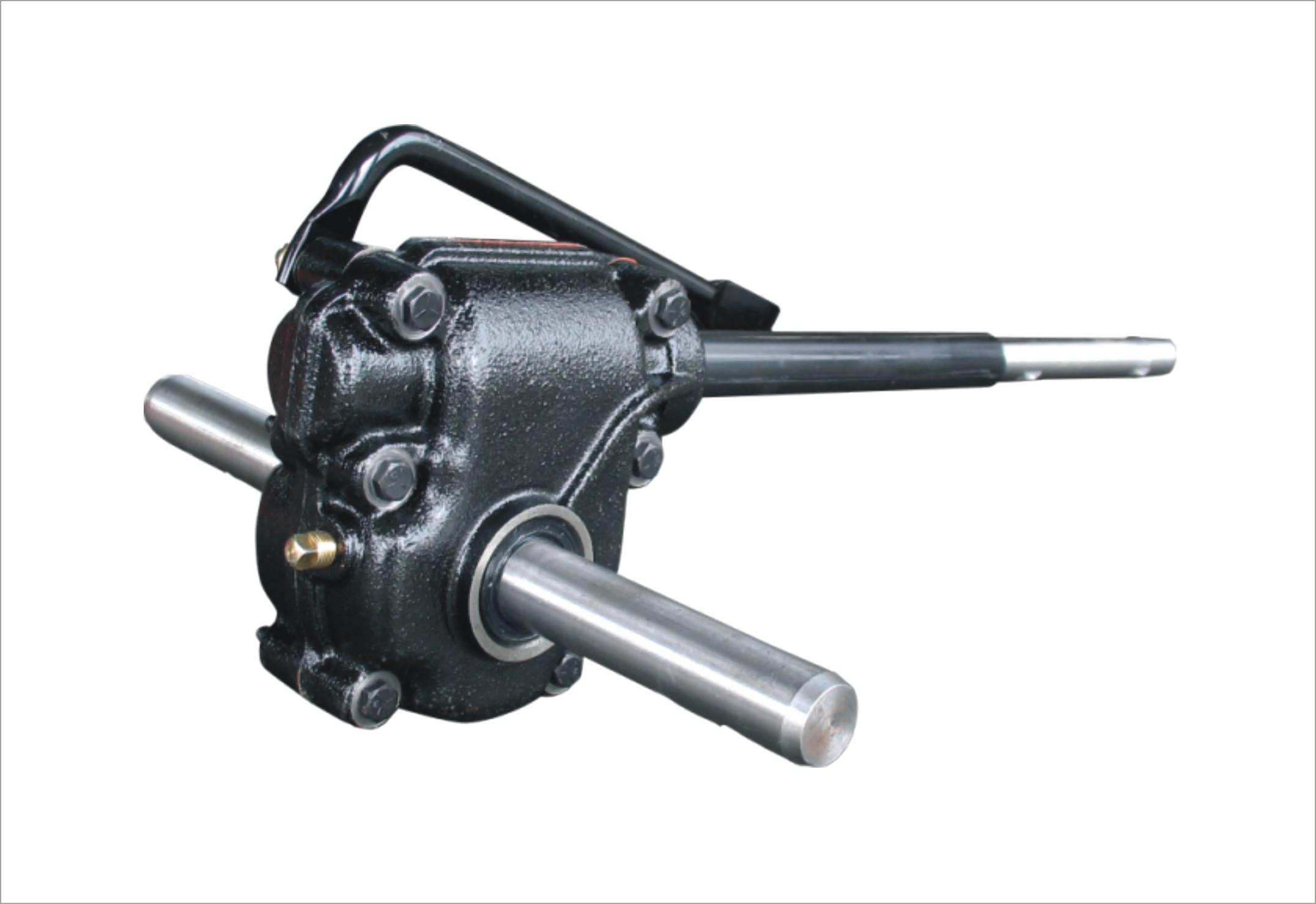
Transmission housings and gearbox castings are among the component families matched to farm machinery driveline assemblies. Image: Zhejiang Pointiron Technology Co.,ltd.
Market Trend Analysis
The demand backdrop for agricultural castings is shaped by three measurable currents rather than by a single growth story.
Component demand is large and still expanding. The global agricultural machinery components market was estimated at USD 58.12 billion in 2026, growing at a CAGR of 6.04%, according to market research published by Strategic Revenue Insights. The same research projects the agricultural gearbox market to reach USD 8.5 billion by 2033, which places transmission housings and driveline castings among the segments with a longer visibility horizon.
Trade flows are uneven. Global trade of motor vehicle parts and accessories (HS 8708), a heading that also covers certain tractor parts, reached USD 448 billion in 2024, a 2.37% decrease from 2023, according to OEC data aggregated from UN Comtrade. That figure is not a tractor-parts figure and should not be read as one; it does show that the wider parts trade contracted while component demand forecasts remained positive, which usually signals inventory correction rather than structural decline.
Policy and standards are pushing toward automation. A USDA Foreign Agricultural Service GAIN report announces a National Smart Agriculture Action Plan in China and states that by the end of 2028 the public service capabilities of smart agriculture will be greatly improved. On the standards side, ISO 18497-1:2024 addresses partially automated, semi-autonomous and autonomous agricultural machinery, and ISO 25119 covers safety-related control-system parts. Neither document contains component-level casting requirements, but both raise the documentation bar for suppliers whose parts sit inside machines that are becoming more automated.
Comparison with Traditional Sourcing Approaches
The conventional approach to agricultural castings has been to buy from a foundry on a drawing and then manage machining, coating and assembly through separate vendors. It works, and it remains common, but it distributes responsibility across parties in a way that becomes visible only when a non-conformance appears.
A single-chain model — casting, machining, painting and assembly under one quality system — concentrates that responsibility. Pointiron's stated position is that it implements IATF 16949 and ISO 14001 systems throughout the end-to-end production process, with two DISA automatic moulding lines, three paint lines and one assembly line in the same facility. In practice that means a dimensional or coating issue can be traced to its actual stage rather than argued between suppliers.
The limits deserve equal weight. A casting supplier's material certificate and salt spray result do not certify the finished machine. ISO 4254-1:2013, ISO 25119 and ISO 18497-1:2024 operate at machine or system level, and component applicability to them depends on how the part is integrated. A buyer who needs a machine-level conformity file must still obtain it from the machine builder or through a system-level assessment. Similarly, the company's R&D team of three engineers is a real constraint on simultaneous bespoke development projects, so buyers with heavy co-design requirements should confirm engineering availability early rather than assume it. And the HUB-1 specification describes one component configuration: the tensile, hardness and coating values quoted here apply to that specification, and different part families will carry different acceptance criteria.
Future Outlook
Three developments are likely to shape how agricultural component parts are specified over the next several years.
Material substitution will be evaluated case by case rather than by default. Gray iron's 47.68% volume share in 2025 reflects cost and vibration-damping advantages that remain relevant for housings and covers; nodular and ADI grades will continue to be specified where strength and elongation requirements are higher. The buyer's practical task is to require a documented grade for every part number rather than to accept a generic material description.
Documentation will become part of the product. As ISO 25119 and ISO 18497-1:2024 extend into machines with automated functions, suppliers able to provide traceability, validation records and change-control evidence will be easier to integrate than suppliers able to provide a casting alone. The standards do not certify a casting, but they do change what a buyer must be able to request.
Classification and market access will need continuing attention. Agricultural machinery parts may fall under HS 8436, 8432 or 8433 depending on the finished machine's function, and customs treatment should be confirmed with the relevant authority rather than inferred from a supplier's description. For buyers in the USA and EU — the markets where this supplier is most active — that check belongs in the sourcing plan, not at the shipping stage.
FAQ
What are component parts for agriculture use?
Component parts for agriculture use are cast and machined parts specified for agricultural and outdoor machinery, including tractors, seeders, mowers, scarifiers, mini agricultural machinery and lawn and garden equipment. They are defined by the machine function they perform — transmission, steering or braking — rather than by a single part number, and they are supplied against component-level specifications such as material grade, strength, hardness and coating performance.
Which component parts of a tractor are typically produced as iron castings?
The cast part families associated with tractor and implement assemblies include hubs, brackets, knuckles, supports, axle components, gearbox housings, rotors, park locks and brake-system components, along with steering-system parts. In the product scope described here, the relevant categories are component parts of tractor, lawn and garden equipment, seeder, mower, scarifier, steering system and braking system assemblies. Individual part numbers are defined by drawing and material specification.
Which cast iron grades are used for agricultural component parts?
The grades listed for this agricultural component family are QT550-6, QT450-12, HT250, HT200, ADI 900 and ADI 1050, covering nodular cast iron, gray iron and austempered ductile iron. Selection depends on the strength, elongation and hardness requirements of the specific part; gray iron is widely used where cost and vibration damping dominate, while nodular and ADI grades are specified where higher mechanical properties are required.
How is corrosion resistance specified for agricultural cast components?
Corrosion resistance is specified at the coating level rather than the casting level. For the HUB-1 specification, salt spray resistance is 504 hours and dry adhesion is rated at ≥B, with anti-rust, salt spray and humidity resistance identified as the special requirements for farm, outdoor and lawn and garden working conditions. Because these values depend on the paint system, they require in-house or fully controlled coating processes rather than a coating subcontract without joint acceptance criteria.
Which machines use these agricultural component parts?
Typical application scenarios include tractor, lawn and garden, seeder, mower, scarifier, steering system and braking system assemblies. The parts are matched with farm machinery transmission assemblies and wheel brake assemblies, and they operate under intermittent heavy loads and cyclic running during farming seasons.
Which standards apply to agricultural machinery components, and what do they not cover?
ISO 4254-1:2013 sets general safety requirements and verification methods for several categories of agricultural machines; ISO 25119 covers safety-related parts of control systems for tractors and agricultural and forestry machinery; ISO 18497-1:2024 sets principles for partially automated, semi-autonomous and autonomous machinery. None of these certifies an individual casting or a casting supplier. Component acceptance still depends on the drawing, the material specification and the buyer's own validation requirements, and customs classification must be confirmed case by case.
Reference Point
For buyers who need the full capability picture — casting capacity, machining, coating lines and application scope — the company introduction is available as a downloadable document: Pointiron introduction (PDF). Company information is also published at www.pointiron.com.
Sources referenced: Strategic Revenue Insights market research on agricultural machinery components and agricultural gearboxes (2026); OEC / UN Comtrade trade data for HS 8708 (2024); UN Statistics Division classification detail for HS 8436, 8432 and 8433; ISO 4254-1:2013, ISO 25119 and ISO 18497-1:2024; USDA Foreign Agricultural Service GAIN report on the National Smart Agriculture Action Plan; Zhejiang Pointiron Technology Co.,ltd company profile.
Have Questions or Need More Details?
Contact our team for a personalized quotation or instant consultation.
Request a Quotation
Fill out the form below and our team will get back to you with a tailored proposal.
WhatsApp Direct Chat
Prefer to chat in real-time? Message us on WhatsApp for instant assistance & quick answers.
- Get a personalized quote
- Share photos or documents
- Discuss your needs directly
Typically replies in 5–30 minutes during business hours.