
Component-Role Shortlist: Zipper Metal Wire for OEMs
A zipper is not one wire. It is an assembly of wire forms that fail in different ways — a tooth that will not interlock cleanly, a stop that will not hold under pull, a puller that separates from the slider, a slider that jams on a mis-profiled element. For OEM and procurement teams, the practical consequence is that a shortlist built around a single material grade (brass, stainless, aluminum) rarely survives first-article inspection. A shortlist built around component role does.
This article sets out a component-role shortlist for zipper metal wire and the hardware that surrounds it: Y teeth, Y-shape wire for zipper, bottom stop wire, top stop wire, zipper pull and zipper automatic slider, together with the supporting wire forms — spring wire, flat wire, round wire, metal round wire, profiled wire, shaped wire and special-shaped wire — that zipper plants and trim suppliers use alongside them.

Y-shaped zipper metal wire, shown as supplied for teeth and stop applications. Image: Fullgreat Metal Limited.
Why component role should drive the shortlist, not material grade
A purchaser who asks for "brass zipper wire" and a purchaser who asks for "a #5 Y-teeth wire that interlocks with our existing slider tooling" are not asking the same question, even when both end up buying a copper-based alloy. The first question defines an input; the second defines a function. In a zipper line, the same base material can be required to do four different jobs: form a tooth profile that interlocks repeatedly, form a stop that resists tension and abrasion at the end of the chain, form a puller that survives handling loads, and form a slider body that guides the chain without burring it.
Component-role sourcing also changes what a buyer measures. For teeth, the critical variables are cross-sectional geometry and consistency along the coil. For stops, the variables are formability and the finished stop's resistance to pull-through. For pulls and sliders, the variables are dimensional fit against the chain and the surface condition of the contact faces. Shortlisting by role forces those acceptance criteria onto the table before a purchase order is issued, rather than after the first production run.
What Fullgreat Metal Limited supplies
Fullgreat Metal Limited is a manufacturer established in 2008 in Shenzhen, Guangdong Province, China, producing non-magnetic stainless steel strip, non-magnetic stainless steel wire, aluminum strip and other metal materials. Its manufacturing facility covers 5,000 m² and employs approximately 50 staff, including an R&D team of 10 engineers, with an annual production capacity of 50,000 tons. Export business accounts for 70% of total sales, with major markets in Turkey, Latin America (Brazil and Mexico), Southeast Asia (Vietnam, Indonesia and Bangladesh), and the European and American markets.
The company's range covers the full zipper component set rather than teeth alone: Special-Shaped Wire, Shaped Wire, Profiled wire, Metal Round Wire, round wire, Flat Wire, Spring Wire, Top Stop, Bottom Stop, Zipper Puller, Zipper Automatic Slider, Y-shape Wire for Zipper, Y shape wire, Y teeth wire and Y teeth. Its development work on non-magnetic stainless steel — grades FPD806 and FPD808 for strip, and wire grades FPD901 and FPD902 — was carried out in cooperation with Sichuan University and is covered by a number of national patents. That background matters for zipper buyers because non-magnetic behaviour is a functional requirement in many apparel and accessory applications, not a cosmetic preference.
The shortlist at a glance
| Component role | Model | Material options | Customisation |
|---|---|---|---|
| Y Teeth | FPD-YTW02 | Stainless steel / copper / aluminum | Shape, size, hardness (soft or hard) |
| Y-shape Wire for Zipper | FPD-YSW | Stainless steel / copper / aluminum | Shape, size, hardness (soft or hard) |
| Bottom Stop Wire | FPD-BSW | Stainless steel / copper / aluminum | Shape, size, hardness (soft or hard) |
| Top Stop Wire | FPD-TSW | Stainless steel / copper / aluminum | Shape, size, hardness (soft or hard) |
| Zipper Pull | FPD-ZP | Stainless steel / copper / aluminum | Shape, size, hardness (soft or hard) |
| Zipper Automatic Slider | FPD-ZAS | Stainless steel / copper / aluminum | Shape, size, hardness (soft or hard) |
| Zipper Metal Wire (multi-role) | FPD-ZMW | Stainless steel / copper / aluminum | Sizes #3, #4, #5; hardness soft or hard |
All listed components are intended for the clothing accessories and bag & luggage industries. The shared customisation levers — shape, size and hardness — are what make a role-by-role shortlist practical, because a single supplier can be asked to hold a profile across teeth, stops and hardware rather than quoting each element against a different specification base.
Role by role: what to evaluate
1. Y Teeth (FPD-YTW02) and Y Teeth Wire (FPD-YTW01)
The tooth is the element that defines whether a chain interlocks, and it is the component most sensitive to profile drift. Y teeth are supplied in stainless steel, copper or aluminum, with shape, size and hardness customisable, for clothing accessories and bag & luggage use. In practice, hardness selection is a trade-off rather than a quality marker: harder wire generally resists deformation better in service, while softer wire generally forms more easily in the stamping or forming step. Neither choice is universally correct; the correct choice follows the tooth profile, the forming equipment and the closing force the finished zipper is expected to survive.
2. Y-shape Wire for Zipper (FPD-YSW)
Y-shape wire is the continuous input form from which teeth are produced. Buyers often treat Y teeth and Y-shape wire as interchangeable line items in a quotation, but they sit at different points in the process: one is a formed component, the other is the profiled input. Sourcing both from the same specification base is what allows a plant to change tooth size without renegotiating the metallurgical assumptions behind the wire. The Y-shape wire range shares the same material and hardness options as the teeth themselves, which keeps the two lines consistent when a buyer scales a style from apparel into a bag programme.
3. Bottom Stop Wire (FPD-BSW)
The bottom stop carries the load when a closed zipper is pulled apart and prevents the slider from running off the chain. Bottom stop wire is supplied with customisable shape, size and hardness for clothing accessories and bag & luggage applications. Because the stop is formed in a short, high-deformation step, it is the component where incoming material consistency shows up fastest on the line: a batch that forms differently from the previous lot will produce visible stop-height variation before any functional test is run.
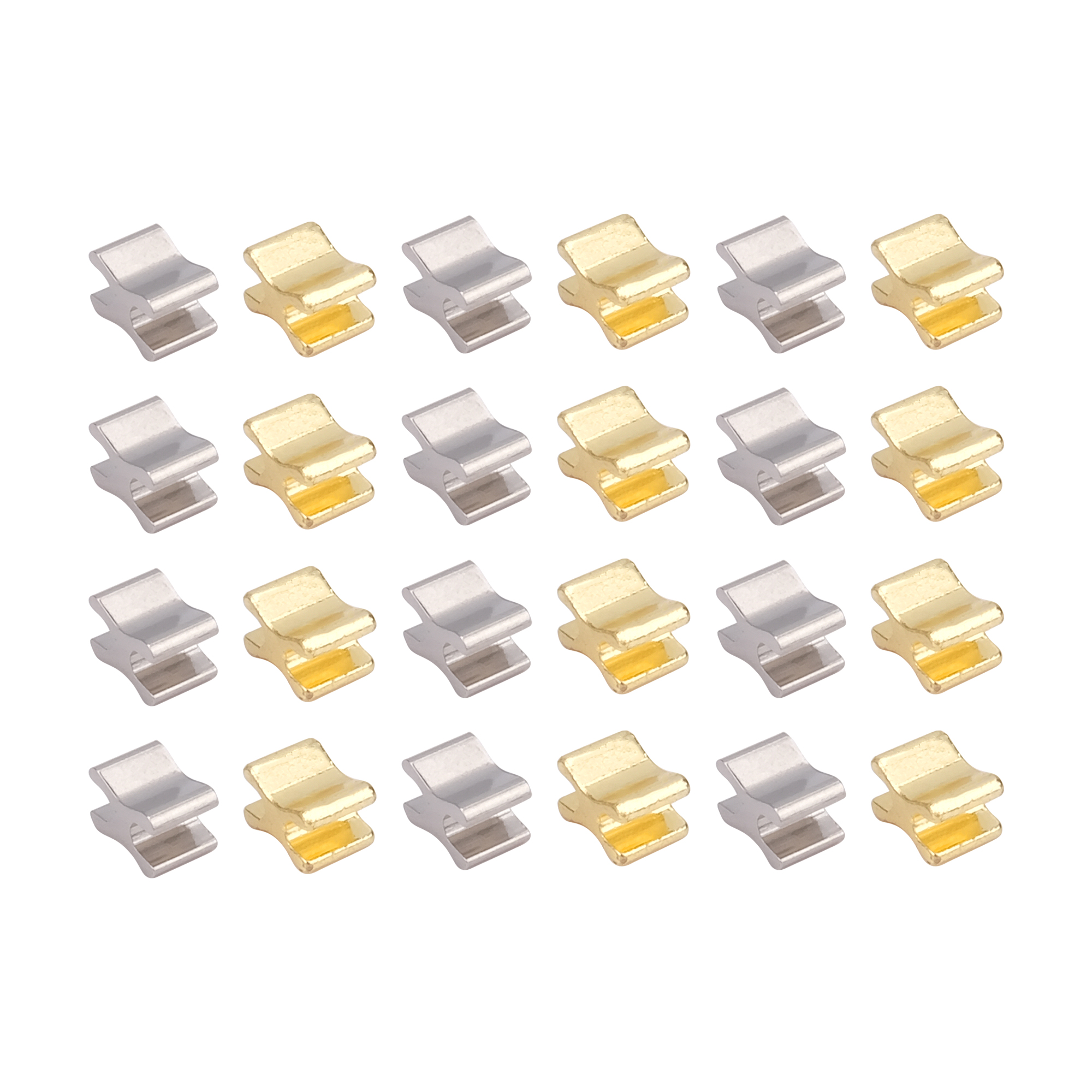
Bottom stop wire, evaluated as a separate component role from teeth and top stops. Image: Fullgreat Metal Limited.
4. Top Stop Wire (FPD-TSW)
The top stop performs a different job from the bottom stop: it limits slider travel at the open end and, on separable zippers, interacts with the retainer geometry. Top stop wire is offered in stainless steel, copper or aluminum with customisable shape, size and hardness, for the same two end markets. Buyers evaluating top stops should confirm that the stop wire specification is matched to the tooth size actually ordered (#3, #4 or #5 geometry), because a stop sized against a neighbouring chain size will pass a visual check and fail in use.
5. Zipper Pull (FPD-ZP)
The pull is the only component the end user touches directly, and it is therefore the component where appearance and mechanical retention are judged together. Zipper pulls are supplied in stainless steel, copper or aluminum with customisable shape, size and hardness for clothing accessories and bag & luggage. For OEM programmes, the pull is usually the element carrying the brand's finish requirement, so it should be specified with the surface condition written down rather than agreed by sample photograph.
6. Zipper Automatic Slider (FPD-ZAS)
An automatic slider locks the chain when the pull is released, which means it introduces a small spring-loaded mechanism into an otherwise purely mechanical assembly. It is supplied in stainless steel, copper or aluminum with customisable shape, size and hardness for clothing accessories and bag & luggage. Because the slider body guides the chain, it is the component most exposed to burrs and edge condition on the incoming parts; slider failures are frequently traceable to a chain profile issue rather than to the slider itself.
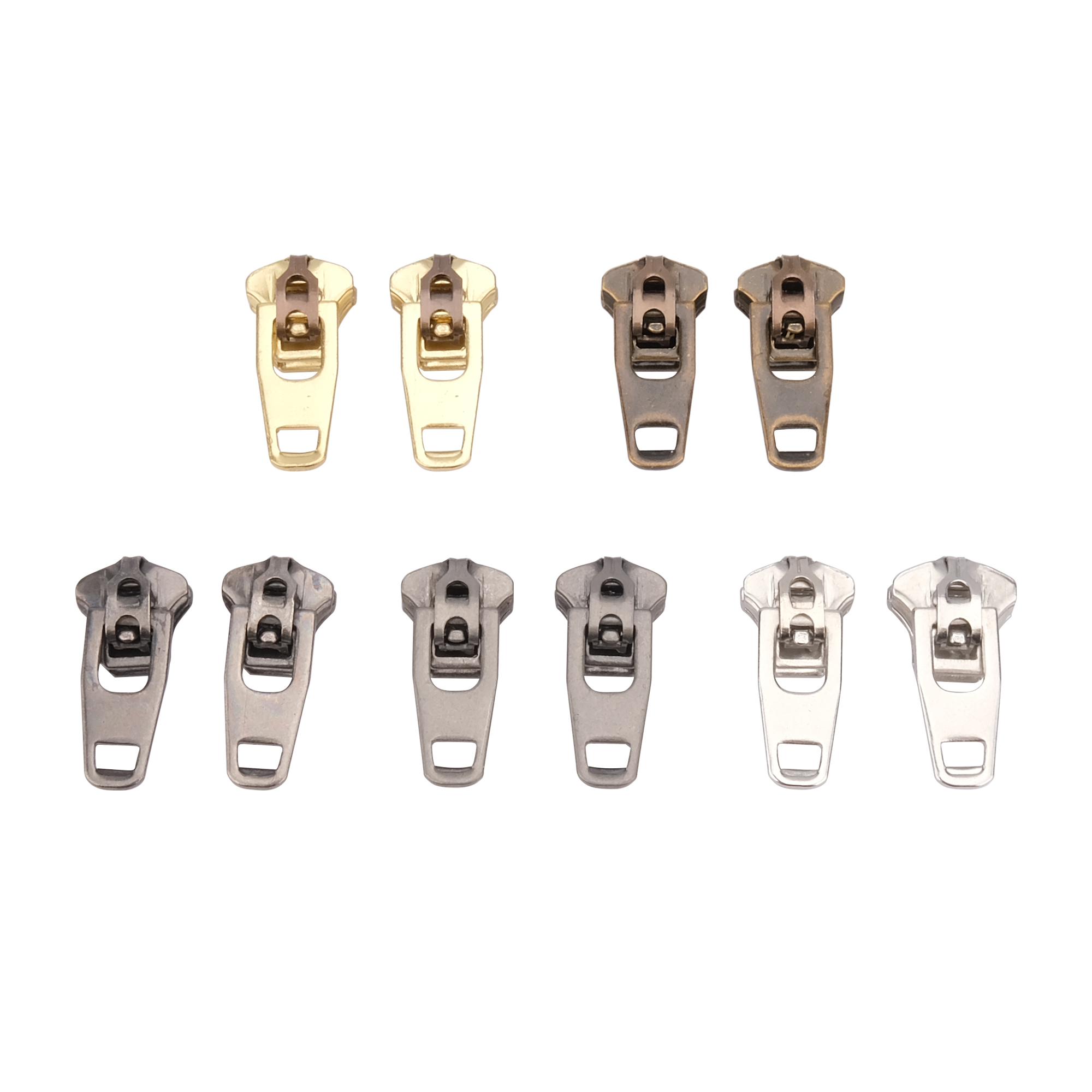
A zipper automatic slider, the hardware element most sensitive to chain profile consistency. Image: Fullgreat Metal Limited.
7. Zipper Metal Wire (FPD-ZMW) as the multi-role base
Where a buyer wants a single wire family serving both top and bottom stop production, the FPD-ZMW range is the multi-role option: a Y-shaped metal wire used for zipper top stops and bottom stops, available in sizes #3, #4 and #5, with soft or hard hardness and customisable material. Consolidating stops onto one wire family simplifies inventory and lot traceability, at the cost of less freedom to optimise each stop independently — a trade-off worth stating explicitly in the sourcing decision.
Supporting wire forms around the zipper assembly
Not every wire in a zipper plant ends up as a tooth or a stop. Sliders, springs and trim hardware draw on the same wire-making capability in different forms, and buyers consolidating suppliers increasingly ask for these in the same conversation.
| Wire form | Model | Shape note | Listed industries |
|---|---|---|---|
| Spring Wire | FPD-SW02 | Round | Springs, wires, mechanical parts, medical devices, electronic accessories, home appliances, clothing accessories |
| Flat Wire | FPD-FW | Flat | Electronic accessories, home appliances, medical devices, clothing accessories |
| Round Wire | FPD-RW | Round | Electronic accessories, home appliances, medical devices, clothing accessories |
| Metal Round Wire | FPD-MRW | Customisable shape | Electronic accessories, home appliances, medical devices, clothing accessories |
| Profiled Wire | FPD-PW | Customised profile | Clothing accessories, medical devices, home appliances, electronic accessories |
| Shaped Wire | FPD-SW | Customised shape and size | Electronic accessories, home appliances, medical devices, clothing accessories |
| Special-Shaped Wire | FPD-SSW | Customised shape, size, hardness | Electronic accessories, home appliances, medical devices, clothing accessories |
For a zipper buyer, the practical value of this adjacent range is supplier-side, not catalogue-side: a supplier that already produces profiled and special-shaped wire has the forming and roll-set capability that Y-tooth profiles demand, whereas a supplier that only trades in round wire often outsources exactly the step that determines tooth quality.
Technical explanation: what the customisation levers actually control
Across the shortlisted components, three levers are offered as customisable: shape, size and hardness, with material selectable between stainless steel, copper and aluminum. Each lever maps to a different part of the buyer's problem.
Shape is the profile geometry — the difference between round wire, flat wire, a Y profile and a fully special-shaped section. Profile accuracy governs whether the tooth interlocks with an existing slider and whether the stop seats at the correct height. Fullgreat's published Y-teeth wire documentation describes control of cross-sectional micro-geometry to a tolerance of ±0.01 mm, along with uniform tensile elongation. For buyers, that is the number to interrogate during qualification, because a tolerance quoted in a data sheet is only meaningful if the supplier can show how it is held across a full coil, not just on a sample cut.
Hardness, offered as soft or hard, is the lever most often over-specified. Hardness interacts with forming yield, springback and wear in service. A buyer who specifies hard wire because "hard sounds stronger" may find the forming tool cannot produce the stop geometry cleanly; a buyer who specifies soft wire for a high-cycle bag application may find deformation appears earlier than expected. The correct approach is to qualify hardness against the actual forming step and the actual closing force in the end product, and to write both into the acceptance record.
Material is where the cost conversation usually lands. Copper-based alloys remain the default for appearance-driven zipper hardware, but Fullgreat's published material comparison positions bimetallic composite wires — for example copper-clad stainless steel — as delivering a comparable brass-look result while reducing material costs by roughly 30% to 40% relative to solid brass. That is a vendor-published figure and should be treated as a starting hypothesis for the buyer's own cost model, not as a guaranteed saving; the real number depends on the alloy it replaces, current metal prices and the scrap rate on the buyer's line.
Application fit: apparel lines and bag & luggage lines
All shortlisted components are classified for clothing accessories and bag & luggage, and the typical project type is garment zippers producing zipper parts. The operating context described for these applications is continuous 24/7 running in standard-temperature environments, with optional requirements for anti-rust behaviour, uniform wire diameter and high tensile strength. Those optional requirements are the ones that separate a general wire order from a zipper-grade order, and they should appear in the purchase specification rather than in a side email.
The two end markets differ in emphasis. Apparel programmes tend to prioritise colour and finish consistency, small section sizes and high visual uniformity across a season's production. Bag and luggage programmes place more weight on stop retention, puller strength and resistance to deformation under repeated loading, and typically run larger section sizes. Because the shortlisted components share the same material and hardness options, a buyer can hold one material policy across both product lines while varying size and hardness — which is usually simpler to administer than maintaining two separate supplier specifications.
Geography shapes the sourcing pattern as well. The application scenario is common in Vietnam, Bangladesh, Turkey, Brazil and other markets globally, and Fullgreat's export footprint — 70% of sales, with Turkey, Latin America, Southeast Asia and European and American markets named as major destinations — broadly overlaps the regions where garment zipper production is concentrated.
What the market data says, and what it does not
Published commercial research on the zipper market is directionally consistent but numerically unsettled. Estimates for the global finished zipper market in 2024–2025 cluster in a range of roughly USD 15 billion to USD 19 billion, with reported compound annual growth rates of 7.0%, 7.71% and 7.76% across different publishers — differences that reflect base years, forecast horizons and methodology rather than a disagreement about direction. One secondary source puts the metal zipper segment at USD 11.1 billion with a 3.3% CAGR, but the segment definition and horizon year are not fully recoverable from the published summary.
Two caveats matter for anyone using these figures in a sourcing decision. First, all of these datasets measure finished zippers, not zipper metal wire; they are a downstream demand signal, not a wire market size. Second, on the demand side, WTO figures cited in a 2026 zipper market report show global apparel trade growing 7% in the first half of 2025, which supports a stable-to-growing picture for garment trim consumption but says nothing about wire pricing. Procurement teams should therefore treat market research as context for capacity planning, and rely on their own incoming inspection and supplier qualification data for the decisions that actually carry risk.
Compared with traditional sourcing, and where this shortlist stops
The conventional approach is to buy teeth from one supplier, stops from another and pulls or sliders from a third, each against its own drawing. That structure has real advantages: it maximises competitive tension on each line item and lets a buyer use specialists for hardware. Its weakness is interface risk — when a tooth profile shifts slightly, the first party to notice is usually the slider supplier, and the resulting conversation is about whose part is out of tolerance rather than about the assembly.
A component-role shortlist consolidated with one wire supplier reduces that interface risk and simplifies lot traceability, but it is not automatically cheaper and it is not automatically better. Three limitations are worth stating plainly. First, hardness and shape customisation increase qualification effort: every new profile or hardness setting needs first-article approval and a forming trial, so a consolidated supplier does not remove validation time. Second, independent third-party test data on zipper metal wire remains scarce in the public domain, and the technical figures cited above — including the ±0.01 mm tolerance and the 30%–40% cost comparison — are supplier-published; buyers should verify them through their own incoming inspection. Third, aluminium and stainless options solve different problems from copper alloys, and substituting one for another changes surface behaviour and forming response, so material substitution should be qualified component by component rather than applied across the whole bill of materials at once.
Purchase terms and acceptance criteria checklist
The following checklist converts the shortlist into terms that can be written into a purchase order or a supplier quality agreement.
| Term | What to specify |
|---|---|
| Component identity | Role plus model reference — for example Y Teeth FPD-YTW02, Top Stop Wire FPD-TSW, Zipper Pull FPD-ZP — not a generic description |
| Material | Stainless steel, copper or aluminum, stated per component rather than per order |
| Size and profile | Chain size (#3, #4, #5 where applicable), profile drawing, and the dimensional tolerance to be held across the coil |
| Hardness | Soft or hard, tied to the forming step and the closing force of the end product |
| Optional performance requirements | Anti-rust behaviour, uniform wire diameter, high tensile strength — stated as pass/fail, not as preferences |
| Acceptance method | Measurement method, sampling position along the coil, sample size, and who holds the reference sample |
| First-article approval | Trial forming of teeth, stops and hardware against the buyer's own slider and chain tooling before volume release |
| Lot traceability | Material lot recorded against each coil, so a defect can be traced to a batch rather than to a quarter |
| Change notification | Written notice required before any change to alloy source, profile tooling or hardness setting |
Future outlook
Two trends are likely to shape zipper metal wire sourcing over the next planning cycle. The first is material substitution: as copper-based input costs remain volatile, bimetallic and non-magnetic stainless alternatives become more attractive, and suppliers with in-house alloy development — Fullgreat's non-magnetic stainless work with Sichuan University and its patented FPD806, FPD808, FPD901 and FPD902 grades are an example — are better positioned to support that shift than traders reselling standard round wire. The second is consolidation of component scope: buyers increasingly prefer one qualification cycle covering teeth, stops, pulls and sliders rather than four parallel approvals.
Neither trend removes the need for verification. The most durable sourcing position remains the unglamorous one: a role-based shortlist, a written acceptance standard per component, first-article approval against the buyer's own tooling, and a supplier that can show how a tolerance is held in production rather than only on a data sheet.
FAQ
What is zipper metal wire?
Zipper metal wire is the wire input used to form zipper components — teeth, top stops and bottom stops — and is also used for related hardware such as pulls and sliders. It is supplied in forms including Y-shape wire, Y teeth wire, profiled wire, flat wire, round wire and special-shaped wire, typically in stainless steel, copper or aluminum.
Which component should a buyer shortlist first?
There is no universal order, but teeth are usually the logical starting point because tooth profile governs whether the chain interlocks with the slider. Stops and hardware are then specified against the tooth size actually ordered. Where top and bottom stops are to be produced from one wire family, the FPD-ZMW multi-role wire in sizes #3, #4 and #5 is designed for that purpose.
What does soft or hard hardness mean for a zipper component?
Soft and hard are the two hardness options offered across the shortlisted components. Hardness affects how the wire forms in the stamping or forming step and how the finished part behaves under load. Harder wire generally resists deformation better in service, while softer wire generally forms more easily; the appropriate setting depends on the component role, the forming equipment and the closing force the finished zipper must withstand.
Are stainless steel, copper and aluminum interchangeable in zipper applications?
They are all listed as available materials across the range, but they are not interchangeable without qualification. They differ in appearance, forming response and cost position, and substitutions can change how a tooth or stop behaves in production. Material changes should be approved component by component against the buyer's own acceptance criteria.
Which industries and applications are these components intended for?
The shortlisted components are classified for clothing accessories and bag & luggage applications, with garment zippers as a typical project type. Related wire forms such as spring wire, flat wire and metal round wire are additionally listed for electronic accessories, home appliances and medical devices. Application scenarios are common in Vietnam, Bangladesh, Turkey, Brazil and other markets globally.
How should a buyer verify claims such as dimensional tolerance?
Tolerance claims should be verified through incoming inspection using an agreed measurement method and sampling position along the coil, supported by first-article approval against the buyer's own tooling. Published figures, including Fullgreat's stated ±0.01 mm control on Y-teeth wire cross-sectional micro-geometry, are supplier-published and should be confirmed in the buyer's own qualification process.
Fullgreat Metal Limited's company profile, covering facilities, product range and capabilities, is available for download: Fullgreat Metal Company Profile (PDF).
Have Questions or Need More Details?
Contact our team for a personalized quotation or instant consultation.
Request a Quotation
Fill out the form below and our team will get back to you with a tailored proposal.
WhatsApp Direct Chat
Prefer to chat in real-time? Message us on WhatsApp for instant assistance & quick answers.
- Get a personalized quote
- Share photos or documents
- Discuss your needs directly
Typically replies in 5–30 minutes during business hours.