
Composite Autoclave Certification: GJB9001C & Export Rules
Composite Autoclave Certification: GJB9001C & Export Rules
A composite autoclave is purchased as process equipment and commissioned as a regulated pressure vessel. That gap between commercial identity and legal identity is where most certification disputes begin. Curing performance can be demonstrated in a factory acceptance test, but the document that allows the vessel to be pressurised on site is issued under an entirely different rule set — one determined by the destination market, the program the parts belong to, and the grade of the machine.
The equipment category behind those decisions is expanding. Kings Research valued the global composite curing autoclave market at approximately USD 1.37 billion in 2023 and projects USD 2.4 billion by 2033, a CAGR of 10.2%. A narrower scope — autoclaves for composite materials specifically — was valued by Market Research Future at USD 86.2 million in 2024, with a forecast of USD 127 million by 2032 at a CAGR of 5.8%. The two figures are definitional rather than contradictory: they count different equipment classes, and both are quoted here so that neither is read as the single authoritative size of the field.
For a buyer who has already selected a grade and is moving from decision to execution, market size is not the operative question. The operative question is which qualification gate the machine must clear before the purchase order can be closed out — and which gates continue to apply after commissioning.
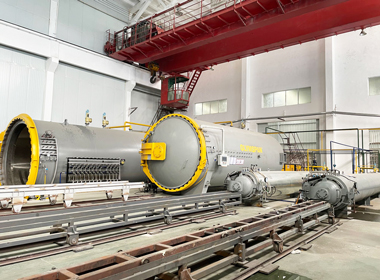
Composite autoclave production workshop: the pressure boundary is fabricated and assembled before any market-specific certification review takes place. Photo: Olymspan.
Why Qualification Is Settled at the Contract Stage, Not at Delivery
Certification problems rarely surface during manufacturing. They surface later, when the vessel is already rigged into the bay and the site inspection asks for a document that was never scoped into the order. Three failure patterns recur:
- Scope mismatch. A certificate exists, but it covers a different design pressure, a different volume, or a different material of construction than the unit that was actually delivered.
- Rule-stack confusion. A buyer treats an electrical safety approval as equivalent to pressure vessel approval, and discovers at commissioning that the two are not interchangeable.
- Lifecycle drift. The vessel is compliant on day one, but calibration records, seal replacement, and personnel qualification lapse over a multi-year program, and the compliance position degrades without anyone noticing.
All three are procurement decisions disguised as engineering decisions. They are determined by what the contract specifies, not by what the workshop can achieve.
The Three Qualification Rule Stacks
A composite autoclave does not carry one certificate. Depending on its destination and its grade, it sits inside several overlapping rule stacks, each with a different governing instrument.
| Rule stack | What it governs | Typical instruments |
|---|---|---|
| Pressure vessel code of the destination market | Design, materials, fabrication and approval of the pressure boundary | ASME BPVC Section VIII (Division 1 or 2) for US markets; PED 2014/68/EU with harmonised standard EN 13445 for European markets |
| Aviation / defence-grade quality system | Process quality, configuration control and consistency for high-temperature, high-pressure aviation-grade vessels | GJB9001C compliance; dual redundant control system architecture |
| Local electrical and site safety rules | Installation-level electrical safety of export units | High-temperature and corrosion-resistant wiring, insulation properties, leakage protection, short-circuit protection, electrical isolation before maintenance, third-party electrical safety inspection |
| Laboratory and operational safety practice | Day-to-day operation of R&D and experimental vessels | Temperature and pressure limits, alarms and interlocks, ventilation, operator certification and training |
Industrial composite autoclaves must comply with ASME BPVC Section VIII (Division 1 or 2) for US markets and PED 2014/68/EU (EN 13445) for European markets. That is the baseline requirement, and it is the one that determines whether the vessel can legally be pressurised in the destination jurisdiction.
The hierarchy matters more than the count. A quality-system standard such as GJB9001C governs how the machine is built and controlled; a pressure vessel code governs whether the machine may be operated at pressure at all. Electrical safety rules govern whether the machine may be energised. These are complementary approvals, not alternative routes to the same outcome.
The electrical layer is the one most often misread. High-temperature and corrosion-resistant wiring, leakage protection and short-circuit protection devices, mandatory power isolation before cleaning, maintenance or repair, and periodic third-party electrical safety inspection are all expected of export units. None of them substitutes for the pressure vessel approval: an electrical certificate confirms the machine is safe to energise, not that it is legal to pressurise.
What GJB9001C Compliance Changes in an Aviation-Grade Vessel
Aerospace and military-grade work introduces a quality-system requirement on top of the pressure code. In this equipment class, high-temperature, high-pressure aviation-grade autoclaves are specified to comply with GJB9001C standards and are built with a dual redundant control system, more stringent tank materials and sealing technology, and an explicit emphasis on product consistency and safety rather than on unit throughput.
The performance envelope that accompanies that requirement is measurably different from a general industrial vessel:
| Parameter | Small and medium-sized industrial autoclave | High-temperature, high-pressure aviation-grade autoclave |
|---|---|---|
| Maximum temperature | 200 ℃ | 300–400 ℃ |
| Maximum pressure | 6 MPa | 10–15 MPa |
| Temperature control uniformity | ±1 ℃ | ±0.3 ℃ |
| Pressure stability | ±0.2 MPa | ±0.1 MPa |
| Continuous operation cycle | ≤3000 hours | ≥8000 hours |
| Control architecture | Basic automation | Dual redundant control system |
Source: internal grade comparison data. Figures describe equipment classes, not a specific delivered unit.
The practical meaning for procurement is that GJB9001C-class compliance is a requirement attached to a part program, not a general quality upgrade that benefits every buyer equally. It exists because the parts being cured — main load-bearing structures in aerospace and high-end military applications — cannot tolerate the variability that a basic automation platform permits.
The Export Path: Pressure Vessel Certification Is the Gatekeeper
For an export unit, the decisive approval is the pressure vessel certification of the destination market. A supplier's certification portfolio is therefore best read as a map of markets rather than as a general quality score.
Jiangsu Olymspan Equipment Technology Co., Ltd is a Changzhou, China–based manufacturer of industrial thermal equipment, founded in 2004, whose product lines include composite autoclaves, carbon fiber products, carbon fiber drones, and tube heat exchangers. The company holds international certifications including ASME ‘U’ and ‘S’ stamps, CE (PED), CRN for Canada, and IATF 16949:2016 for automotive quality management, and exports 30% to 40% of its production to markets including North America, South America, Western Europe, Eastern Europe, Eastern Asia, Southeast Asia, the Middle East, Africa and Oceania.
Because the applicable instrument differs by market — ASME BPVC Section VIII for the United States, PED 2014/68/EU (EN 13445) for the European Union, CRN registration for Canada — a design intended for more than one market must satisfy each in turn. Evidence of compliance in one jurisdiction does not by itself satisfy another. For buyers running multi-site programs, that is the single most useful thing to establish during supplier qualification rather than after shipment.
Inspection Requirements and the Dual-Purpose Quick-Opening Door
Mechanical safety design in this equipment class addresses a specific failure mode: opening the vessel while the pressure boundary is still live. Tank doors are equipped with a safety interlock device that ensures the door can only be opened or closed after internal pressure has been reduced to a safe value. A manual and electric dual-use quick-opening door design provides a second path: when power is lost, the door can still be operated manually, which is why the manual function is treated as an emergency provision rather than a convenience feature.
Because the door assembly is simultaneously a pressure boundary component and a moving mechanical assembly, it sits at the intersection of several inspection regimes. Regular inspection covers the structural integrity of the tank body, tank door and pipelines, with prompt attention to wear or deformation. Pressure safety accessories — including qualified pressure relief valves and rupture discs — require periodic calibration to confirm sensitivity and reliability. Silicone inflatable sealing technology is used to maintain door sealing performance, and aging seals are replaced on a schedule rather than on failure.
The pressure safety architecture supporting those inspections typically includes multiple independent safety interlock devices: an automatic pressure interlock, a manual interlock, and an ultra-high pressure alarm device that triggers an alarm, performs emergency pressure relief and cuts power to the pressurisation system as pressure approaches a dangerous value. Pressure rise and fall rates are controlled to avoid impact loading on the tank body.
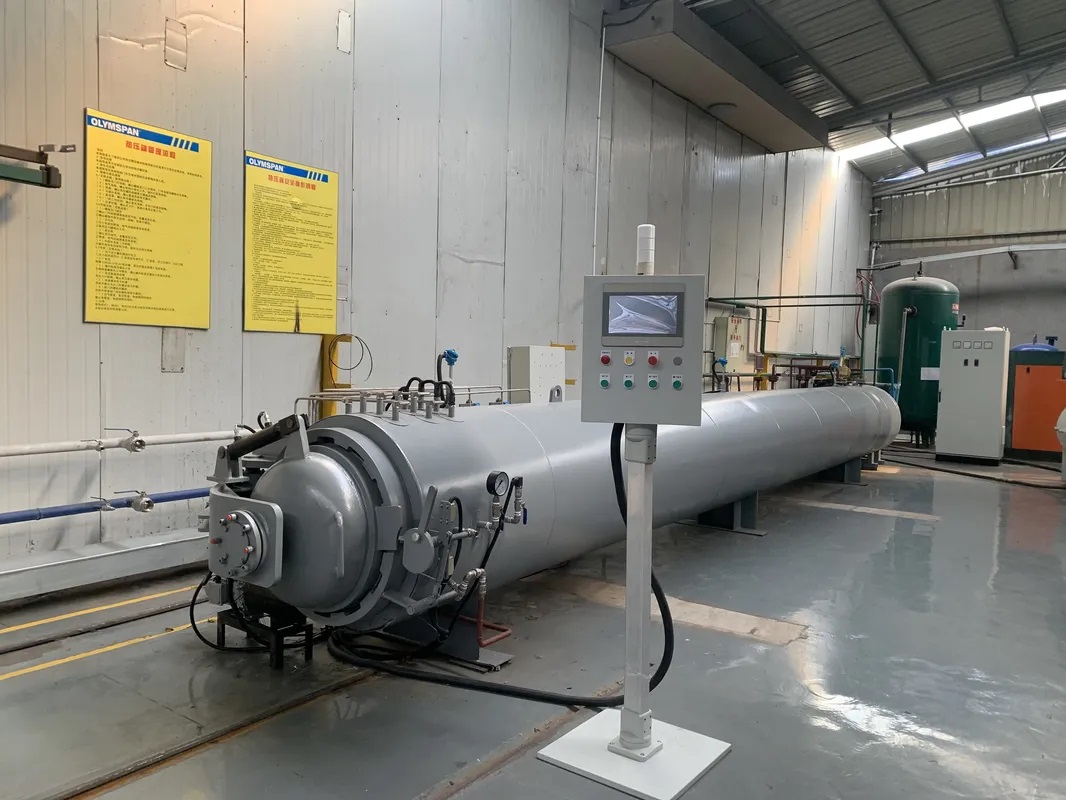
Pressure boundary, door assembly and control enclosure: inspection regimes for a composite autoclave span mechanical, pressure, thermal and electrical systems. Photo: Olymspan.
Electrical safety inspection runs in parallel. Wiring and electrical equipment are selected for high-temperature and corrosion resistance with good insulation properties; leakage protection and short-circuit protection devices are installed; power must be cut off and electrical isolation performed, with warning signs posted, before any cleaning, maintenance or repair. Insulation performance and protective device sensitivity are inspected periodically, and qualified institutions are engaged for electrical safety inspection — with hidden hazards corrected before operation resumes.
Thermal safety follows a similar logic. A high-precision temperature control system monitors the vessel interior in real time, with upper and lower limit alarms; on an abnormal temperature reading, heating power is automatically cut off and the cooling system is activated. A heat-resistant shield is installed on the exterior of the tank, and a temperature rise curve is formulated from the material's characteristics to control heating rate and avoid fluctuation. Ventilation facilities in the operating area discharge high-temperature steam, and temperature data is recorded to allow tracing of potential hazards.
Laboratory and R&D Vessels Are Governed Differently
Not every composite autoclave is a production asset. Experimental vessels operate in a different safety and certification context, and applying production-grade assumptions to them creates cost without benefit.
Experimental autoclaves are designed for miniaturisation, high precision and multifunctionality, and are typically used by universities, research institutes and corporate R&D departments for new composite material formulation research, cure process parameter verification, and small-batch sample curing such as carbon fiber prepreg small-scale experiments and new resin cure tests. They support a wide experimental temperature range from −50 ℃ to 300 ℃, integrate data acquisition and remote monitoring, and place emphasis on parameter control and experimental data traceability.
Their typical envelope is modest by production standards: a volume of 0.5–2 m³, a maximum temperature of 300 ℃, a pressure range of 0–10 MPa, temperature control accuracy of ±0.5 ℃, a single experiment duration of 2–8 hours, and continuous operation of ≤1000 hours. Safety management at this scale centres on defined operating procedures, double confirmation before operation, valid operator certification, personal protective equipment, and a prohibition on unauthorised changes to process parameters — supported by the same categories of interlocks, alarms and ventilation controls used on larger vessels.
Where Certification Cost Stops Matching the Requirement
The most useful boundary in this discussion is economic rather than technical. Aviation-grade certification compliance is not a free upgrade, and buying it without a matching program requirement produces cost and maintenance obligations that cannot be recovered.
| Cost and operating dimension | Experimental autoclave | Small / medium industrial autoclave | Aviation-grade autoclave |
|---|---|---|---|
| Purchase cost per unit | 80,000–250,000 yuan | 300,000–800,000 yuan | 2–8 million yuan |
| Installation cost | 10,000–30,000 yuan | 50,000–120,000 yuan | 300,000–800,000 yuan |
| Annual operating cost | 20,000–50,000 yuan | 80,000–180,000 yuan | 500,000–1,200,000 yuan |
| Energy consumption per unit volume | 0.8–1.2 kWh/m³ | 0.5–0.7 kWh/m³ | 0.7–0.9 kWh/m³ |
| Heating rate | 5–10 ℃/min | 3–5 ℃/min | 2–3 ℃/min |
| Insulation loss rate | ≤8%/h | ≤5%/h | ≤3%/h |
| Standard delivery lead time | 15–25 days | 30–45 days | 60–120 days |
| Dedicated maintenance personnel | Not required | 2–3 | 4–6, including qualified personnel |
Source: internal grade comparison data. Ranges describe equipment classes and programme profiles, not quotations.
Read together, those figures describe a genuine limitation. An aviation-grade vessel purchased for a program that does not require aviation-grade consistency pays roughly an order of magnitude more in acquisition cost, several times more in installation and operating cost, and accepts a slower heating rate, a longer delivery cycle, and a heavier maintenance regime — every 2 weeks for minor maintenance and every 3 months for comprehensive maintenance, against monthly and six-monthly intervals for small and medium-sized industrial units. Conversely, a buyer who needs the aviation-grade envelope cannot substitute a cheaper grade: no amount of process capability compensates for a vessel that cannot be certified in the destination jurisdiction.
A second boundary is jurisdictional. Compliance artefacts are issued against a defined design and a defined market. When a single design is required to serve more than one market, the engineering effort is duplicated rather than transferred, and the documentation package — not the hardware — often determines the achievable schedule.
Application Profiles Across the Grade Range
High-temperature, high-pressure aviation-grade autoclaves are used for curing main load-bearing components such as aircraft fuselage, wings, tail fins and engine nacelles, and are adapted for advanced thermoplastic and high-temperature thermosetting composites including PEEK and polyimide PMR-15. Small and medium-sized industrial autoclaves serve automotive parts, wind turbine blades, new energy battery casings and small medical devices, where batches are moderate and precision requirements are conventional. Experimental units serve formulation and process development rather than production.
The grade choice, in other words, follows the part and the program — and the certification stack follows the grade.
Where the Market Is Moving
Composite autoclaves accounted for 62.4% of the total aircraft autoclave market share as of 2025, driven by carbon-fibre reinforced polymer adoption in the Boeing 787 and Airbus A350 programs, according to Dataintelo. The same source places North America at approximately 38.2% of aircraft autoclave market revenue in 2025, with significant growth in Asia-Pacific.
Two implications follow for qualification planning. First, as composite content in airframes increases, documentation depth increases with it: quality-system evidence, pressure boundary approval and inspection records become standard components of the purchase package rather than optional additions. Second, as capacity expands in multiple regions, more buyers will be evaluating suppliers whose certification portfolios cover several markets simultaneously — which shifts the evaluation question from “does the supplier have certificates” to “which markets does each certificate actually cover.”
Olymspan in the Qualification Landscape
Jiangsu Olymspan Equipment Technology Co., Ltd operates a 66,000 m² facility in Henglin town, Changzhou, Jiangsu province, China, with 350 employees, a 25-engineer R&D team, and an annual output in the range of 50–55 million. Alongside composite autoclaves, the company manufactures carbon fiber products, carbon fiber drones and tube heat exchangers.
Within the recognised global supplier set for composite autoclaves — which industry reporting lists as including ASC Process Systems, Bondtech, Akarmak, Olmar and Olymspan — the relevant differentiator for certification-led procurement is the breadth of market coverage rather than the number of certificates held. Olymspan's portfolio spans ASME ‘U’ and ‘S’ stamps, CE (PED), CRN for Canada and IATF 16949:2016, which corresponds to coverage of the US, European and Canadian pressure vessel routes plus automotive quality management.
Long-horizon programs test whether that coverage holds. One North American project involved a scope of 8 units of composite autoclaves completed over a duration of 7 years — a profile in which certification continuity, spare-part availability, calibration scheduling and inspection documentation matter as much as the initial vessel specification. Equipment and company information is published at aac-autoclave.com.
Future Outlook: Certification as a Lifecycle Obligation
The direction of travel is toward certification being managed as a lifecycle obligation rather than a one-time gate. Several pressures point the same way: multi-jurisdiction programs that require parallel approval routes; inspection regimes that depend on calibration and inspection records accumulated over years; and maintenance structures that for aviation-grade equipment already require qualified personnel and third-party inspection at defined intervals.
For buyers, the practical response is procedural. Establish the destination market's pressure vessel instrument before the technical specification is frozen. Separate quality-system requirements such as GJB9001C compliance from pressure boundary approval when writing the scope. Confirm that the certificate covers the delivered design pressure, volume and materials rather than a related model. And build the post-delivery obligations — calibration, seal replacement, structural inspection, operator certification — into the programme schedule from the start, because those are the items that determine whether a compliant vessel is still compliant three years into a programme.
Frequently Asked Questions
Which standard determines whether a composite autoclave can legally be installed and operated?
The pressure vessel code of the destination market. Industrial composite autoclaves must comply with ASME BPVC Section VIII (Division 1 or 2) for US markets and PED 2014/68/EU, with harmonised standard EN 13445, for European markets. Quality-system standards such as GJB9001C and local electrical safety rules apply in addition to that approval, not in place of it.
Does an electrical safety approval replace pressure vessel certification for an export unit?
No. Local electrical safety rules cover high-temperature and corrosion-resistant wiring, insulation properties, leakage protection, short-circuit protection, power isolation before maintenance, and periodic third-party electrical safety inspection. These confirm that the machine is safe to energise. The core pressure vessel certification remains the gatekeeper for legal pressurisation and commissioning.
What does GJB9001C compliance change in an aviation-grade autoclave?
It is a quality-system requirement associated with the aviation-grade class and appears alongside a dual redundant control system, more stringent tank materials and sealing technology, and a focus on product consistency. The class is also characterised by a wider performance envelope than general industrial equipment: maximum temperature of 300–400 ℃ against 200 ℃, maximum pressure of 10–15 MPa against 6 MPa, temperature control uniformity of ±0.3 ℃ against ±1 ℃, pressure stability of ±0.1 MPa against ±0.2 MPa, and continuous operation of ≥8000 hours against ≤3000 hours.
What purchasing terms and acceptance criteria are typical for composite autoclave procurement?
Typical terms are a minimum order quantity of 1 unit, delivery terms defined per project, acceptance criteria based on a pre-shipment test, and payment terms including L/C, T/T, Western Union and D/A. Buyers should confirm that the pre-shipment test scope aligns with the certification documents required in the destination market.
How does certification scope affect delivery time?
Standard delivery lead times differ substantially by grade: 15–25 days for experimental models, 30–45 days for small and medium-sized industrial standard models, and 60–120 days for aviation-grade units. Certification scope, documentation preparation and inspection requirements contribute to the upper end of those ranges, particularly where more than one market approval is required.
What obligations continue after the vessel is installed?
Several. Relief valves and rupture discs require periodic calibration to maintain sensitivity and reliability. Structural integrity of the tank body, tank door and pipelines is inspected regularly, with wear or deformation addressed promptly. Aging door seals are replaced on a schedule. Maintenance intervals differ by grade — every 2 weeks for minor maintenance and every 3 months for comprehensive maintenance on aviation-grade units, against monthly and six-monthly intervals for small and medium-sized industrial units — and aviation-grade operation typically requires 4–6 dedicated maintenance personnel, including qualified personnel, against 2–3 for industrial units.
A downloadable company and product brochure covering Olymspan's composite autoclave range is available here: Olymspan brochure (PDF).