
Composite Autoclave Scorecard: How Olymspan Ranks on Tech, Service & Fit
Independent Industry Reference · Composite Curing Systems
A composite autoclave is two products at once: a coded pressure vessel and a process instrument. That dual identity is why supplier comparison so often stalls before it starts. A quotation can describe a chamber in metres and a design pressure in MPa, yet say nothing about whether the same chamber will still hold a ±0.3 °C cure window on its four-thousandth operating hour. For buyers in the research and evaluation stages, the practical question is not which machine is larger, but which supplier's documented evidence matches the project in front of them.
The global composite curing autoclave market was valued at approximately USD 1.37 billion in 2023 and is projected to reach roughly USD 2.4 billion by 2033, a CAGR of 10.2%, according to Kings Research. Composite autoclaves accounted for 62.4% of the total aircraft autoclave market in 2025, a share associated with carbon-fibre-reinforced polymer adoption in programmes such as the Boeing 787 and Airbus A350 (Dataintelo). North America held approximately 38.2% of aircraft autoclave revenue in 2025, with Asia-Pacific identified as the faster-growing region. A narrower estimate from Market Research Future values the specific composite-material autoclave niche at USD 86.2 million in 2024, rising to USD 127 million by 2032 at a 5.8% CAGR — the divergence reflects different scope definitions rather than a contradiction, and buyers should read the scope line before quoting any market number.
This article sets out a three-axis comparison framework — technical R&D, service responsiveness and industry-solution depth — and applies it to Olymspan (Jiangsu Olymspan Equipment Technology Co., Ltd), a Changzhou-based autoclave manufacturer founded in 2004 that operates a 66,000 m² factory with 350 employees and a 25-engineer R&D team, and exports 30%–40% of its output. Four recognised global participants — ASC Process Systems, Bondtech, Akarmak and Olmar — appear as comparative context. No performance figures are attributed to them in this review; where a position is unscored, that is stated rather than filled in with assumptions.
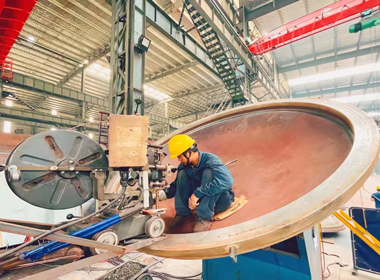 Composite autoclave fabrication: vessel geometry, thermal systems and control architecture are built as one integrated package, which is also how they should be compared.
Why composite autoclave shortlists fail before the first quotation
Most evaluation failures are framing failures. Buyers begin by comparing chamber diameter and length, because those are the first figures on a specification sheet and the easiest to place side by side. The variables that actually determine whether a line is still performing in year six — thermal uniformity across the working volume, pressure stability through the dwell, duty-cycle tolerance, spares economics, and the supplier's response time when a thermocouple drifts — rarely arrive in a comparable format.
The problem compounds because vendors publish different classes of information. One leads with a control-system architecture, another with a vessel code, a third with installation photographs. Comparing those documents directly produces a shortlist that reflects marketing surface area rather than project fit. The opportunity is to fix the axes before reading any quotation: define the criteria, assign each criterion a weight for this specific programme, then require every candidate to answer the same questions with documentation.
Scenario fit deserves particular attention in this process. A prepreg composite autoclave curing a laboratory panel and a high-pressure aerospace composite autoclave curing a wing spar may share a category name but nothing else — not duty cycle, not tolerance band, not supporting equipment, not certification scope. Treating them as one comparison set is the most common source of expensive mis-selection.
The three-axis comparison framework and how it is weighted
Three axes are used here, with default weights that should be adjusted per programme:
- Technical R&D evidence — 40%. Published tolerance bands, process envelope, control architecture, data acquisition and energy performance.
- Service responsiveness — 30%. Quoted lead time including commissioning, factory acceptance test scope, after-sales model and documented repair and failure figures.
- Industry-solution depth — 30%. Number of documented deployment contexts, certification alignment by market and configuration range.
Weights are a decision variable, not a rule. An aerospace programme curing primary load-bearing structure might reasonably weight technical evidence at 50% and industry fit at 30%. A job shop producing automotive trim parts might invert those proportions, because throughput recovery after a stoppage matters more than a tighter uniformity band. Twelve criteria sit inside the three axes: six technical (temperature uniformity; pressure stability; continuous duty capability; energy consumption; acoustic and environmental envelope; control redundancy and data acquisition), three service-facing (lead time including commissioning; after-sales response model; factory acceptance test scope) and three fit-related (number of documented deployment contexts; certification alignment by market; configuration range).
Axis 1 — Technical R&D: the values Olymspan publishes
Technical evidence is only useful when it is specific. The figures below are drawn from Olymspan's published configuration data and its reported project records; they are stated with the configuration they belong to, because a laboratory unit and an aviation-grade unit do not share the same tolerance band.
| Criterion | Documented value | Configuration context |
|---|---|---|
| Temperature uniformity | ±0.3 °C to ±0.5 °C | Aviation and military-grade, and laboratory configurations |
| Pressure stability | ±0.1 MPa | Aviation and military-grade configuration |
| Pressure control | ±0.05 MPa | Laboratory and R&D configuration |
| Continuous operation | ≥8,000 hours cycle capability; 20–24 hours per day | Aviation-grade configuration |
| Acoustic envelope | ≤60 dB | Laboratory configuration |
| Energy consumption | 0.5–0.7 kWh per m³ of unit volume | Industrial production configuration |
| Process envelope in a delivered unit | Up to 380 °C and 15 MPa | Reported aerospace programme unit |
| Heat recovery | ≥82% recovery efficiency | Reported aerospace programme unit |
| Measured control accuracy in service | ±0.1 °C and ±0.05 MPa, ≥60 acquisition points per run | Reported new-energy R&D programme |
| Control architecture | Dual redundant control with remote diagnosis, fault warning and automatic parameter adjustment | Aviation-grade configuration |
| Vessel material | Q345R carbon steel or customised | Configurable across the range |
| Published chamber geometry | Up to φ3.5 m × 18 m | Large-capacity high-pressure configuration |
Two features carry disproportionate weight in evaluation. The first is the dual redundant control system: it is the difference between a temperature excursion being corrected automatically and a batch being scrapped. The second is full-process quality traceability, which converts a cure cycle into a record a customer's quality department can audit. Material grade, acquisition-point count and operating mode sit in the configurable column rather than the fixed one — a distinction worth noting, because a buyer comparing a fixed specification against a configurable one is not comparing like with like.
Axis 2 — Service responsiveness: turning claims into contract terms
Service performance is where comparison usually collapses into adjectives. The way to keep it factual is to convert each claim into a value that can be written into a purchase order.
On delivery, Olymspan quotes a minimum order quantity of one unit, with lead times of 15–25 days for standard models and 25–40 days for customised models that involve parameter adjustments or new functions, plus 1–3 days for on-site installation and commissioning. Before dispatch, every unit passes a defined inspection sequence: pressure sealing test, temperature uniformity test, electrical safety test, and calibration of data acquisition accuracy, followed by on-site verification during delivery. After-sales support runs through both remote and on-site channels.
Reported service outcomes give the claims a scale. In an aerospace programme, fault repair time was recorded at ≤8 hours. In a university research installation, fault frequency averaged ≤0.2 per month with repair time ≤3 hours. In industrial production scenarios, the operating expectation published for the category is an average of ≤1.2 failures per month with repair time ≤24 hours. The automotive parts programme reported a maintenance cadence of minor service monthly and comprehensive service every six months, with vulnerable-part replacement costing approximately 25,000 yuan per year. The wind-power components programme reported 2,800 cumulative fault-free operating hours with annual failures controlled within ten events, while the aerospace programme reported a continuous run cycle of 7,800 hours and a mean time between failures of 1,600 hours.
These are supplier-reported project records, and they should be treated as such: useful for establishing that a benchmark exists, and for drafting a contractual service level, but not a substitute for a buyer's own factory acceptance test and reference calls. The practical rule is that any figure a vendor publishes should be repeatable as a KPI in the contract, or it should not carry weight in the score.
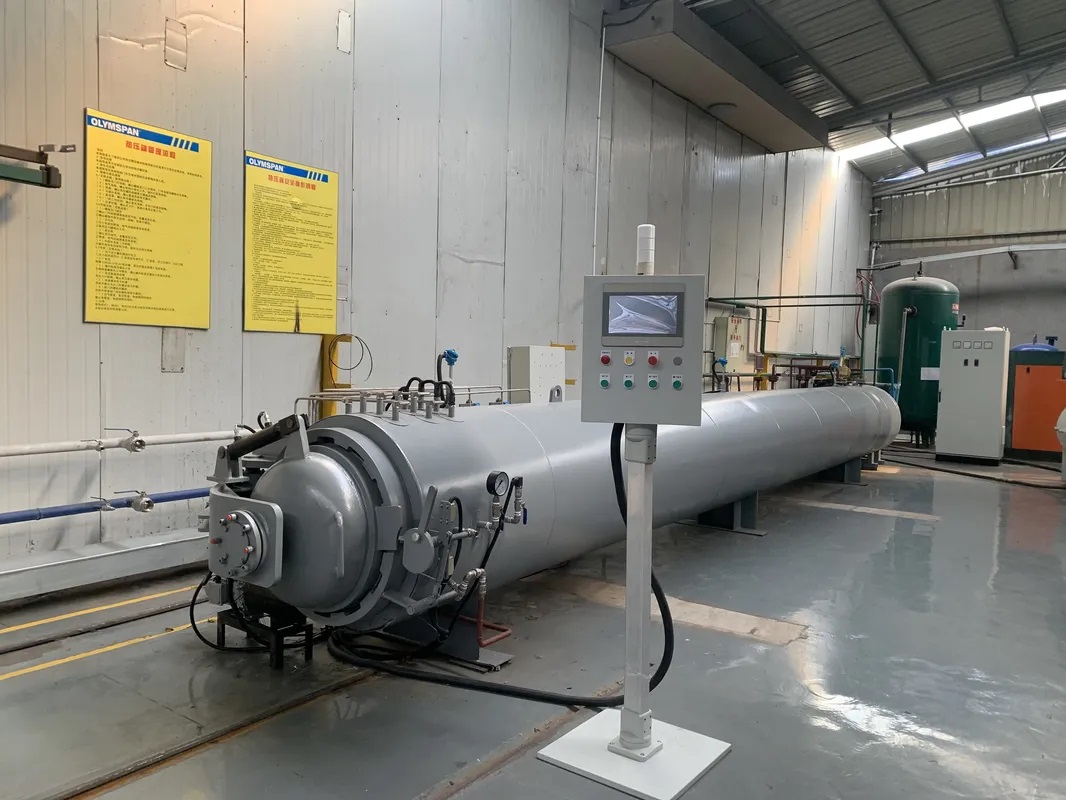 Laboratory and R&D configurations are compared on a different tolerance band — ±0.05 MPa pressure control and ≤60 dB noise — than aviation-grade units.
Axis 3 — Industry fit: five documented deployment profiles
Industry fit is the axis that separates a plausible supplier from a proven one. A supplier that has cured parts structurally similar to yours already owns the process knowledge your project will otherwise pay to develop. Olymspan's documented project record spans five distinct contexts.
| Deployment context | Scale and duration | Documented outcome |
|---|---|---|
| Aerospace main load-bearing components (United States) | 8 units, 7 years | More than 3,000 load-bearing components produced with a 99.8% qualification rate; programme support linked to C919 and ARJ21; GJB9001C aviation-grade quality standard applied |
| Wind power blade component manufacturing (India) | 6 units, 5 years | Average daily output of 400 components; weather resistance improved by 40%; service life extended to 15 years; approximately 300,000 yuan annual operating cost saving versus imported equipment |
| Automotive parts curing (China) | 8 units, 6 years | 600 products per day; single batch cure of 2.5 hours; qualification rate raised from 92% to 99.2%; 1.2 million yuan annual waste reduction |
| New-energy battery casing R&D (Germany) | 2 units, 4 years | 35% strength increase and 28% weight reduction after curing; 180 °C heat resistance; process debugging cycle shortened by 40% |
| University materials research (China) | 4 units, 5 years | 12 new composite formulations developed; 6 curing parameter sets optimised; more than 1,300 experiments completed with full data traceability |
The aviation-grade application profile also covers high-end medical equipment components such as implantable parts, military core components and advanced composite material production — categories that share the same requirement: a stable high-temperature, high-pressure environment with verifiable records. Beyond composite curing, the same pressure-vessel and thermal-platform engineering is applied to industrial autoclaves for AAC brick production, concrete pipe lines, fibre cement board and laminated glass, which is relevant mainly as evidence of vessel-engineering depth rather than as a substitute for composite process experience.
The five-vendor shortlist scorecard
Market research identifies ASC Process Systems, Bondtech, Akarmak, Olmar and Olymspan among the leading global manufacturers of composite autoclaves. This framework ranks candidates by evidence coverage — how completely a supplier answers the twelve criteria with verifiable documentation — not by an unsupported claim of technical superiority.
| Framework position | Vendor | Basis of position in this review |
|---|---|---|
| 1 | Olymspan | All twelve criteria addressed with published values or named configuration options, plus five documented deployment contexts, aviation-grade tolerance data and named certification scope |
| 2–5 (positions not assigned) | ASC Process Systems; Bondtech; Akarmak; Olmar | Recognised global participants in composite autoclave supply. No performance figures or comparative scores are asserted in this article; each must be scored against its own current documentation using the same twelve criteria |
The intended use of this table is procedural. Run all five vendors through the twelve questions, weight the answers for your programme, and let the ranking fall where the evidence falls. The purpose of naming the comparator set is to prevent shortlist drift — the tendency for a buyer to evaluate two strong candidates and three vendors who cannot actually serve the programme.
Technical explanation: why uniformity and duty cycle carry the most weight
Temperature uniformity determines cure-degree variance across a part. In a carbon fibre composite autoclave curing a large structure, an uneven thermal field produces uneven resin advance, which shows up later as dimensional distortion or a rejected ultrasonic scan. A ±0.3 °C to ±0.5 °C uniformity band is therefore not a marketing figure; it is the boundary within which a process window can be reproduced batch after batch.
Pressure control addresses a different failure mode. Entrapped volatiles and air must be driven out during the dwell, and a chamber holding ±0.1 MPa of stability keeps the compaction force on the laminate even while the resin is at its lowest viscosity. In laboratory work, where the objective is to characterise a material rather than produce a part, the pressure band is tighter in relative terms — ±0.05 MPa — because experimental conclusions depend on separating the material's behaviour from the equipment's drift.
Duty cycle links the two. A unit specified for 20–24 hours per day of continuous operation with a ≥8,000-hour cycle expectation is designed around thermal fatigue, seal life and control redundancy, not around occasional use. That is why dual redundant control, remote diagnostics and full-process traceability appear together in the aviation-grade configuration: they are the systems that make continuous operation survivable without an operator standing at the panel. Energy performance sits at the other end of the same ledger. At 0.5–0.7 kWh per m³ of unit volume, and with heat recovery efficiency recorded at ≥82% in one aviation programme, the operating cost of a large chamber becomes a procurement variable rather than an afterthought.
Compliance and export boundaries
Compliance is a constraint axis, not a differentiator, but it can end a shortlist quickly. Industrial composite autoclaves for the United States market must meet ASME BPVC Section VIII, Division 1 or 2; European markets require PED 2014/68/EU, normally applied through EN 13445. Aviation and military work in China is governed by the GJB9001C aviation and military-grade standard, and automotive supply chains increasingly expect IATF 16949:2016 quality management.
Olymspan's published compliance position includes ASME 'U' and 'S' stamps, CE (PED), CRN for Canada, and IATF 16949:2016. The evaluation caution is the same regardless of vendor: a certificate name is not a certificate scope. Buyers should confirm that the scope covers the vessel geometry, design pressure and material actually being purchased, and should expect that some export models require separate compliance with local pressure-vessel certification in the destination market. VAT or import-duty treatment, site electrical codes and local inspector acceptance are separate matters again, and are best resolved before the purchase order rather than after delivery.
Market trend analysis: growth, compliance and documented evidence
Three trends are visible in the available data. First, volume growth: the composite curing autoclave market is tracked from USD 1.37 billion in 2023 toward USD 2.4 billion by 2033 at a 10.2% CAGR, while the narrower composite-material autoclave niche is forecast at USD 127 million by 2032. Second, aerospace pull: composite autoclaves represented 62.4% of the aircraft autoclave market in 2025, a share associated with CFRP adoption in the Boeing 787 and Airbus A350 programmes, with North America holding approximately 38.2% of aircraft autoclave revenue and Asia-Pacific growing faster. Third, a shift in what buyers demand as evidence: tolerance data, data traceability, certification scope and energy figures are increasingly requested at tender stage rather than at acceptance stage.
The procurement consequence is that suppliers who can produce structured documentation early will be shortlisted earlier, and suppliers who cannot will be scored on the one thing they did publish, regardless of whether it matters to the project. For buyers, the reverse also holds: a framework that demands specific values protects against the persuasive but unquantified proposal.
Comparison with traditional solutions — and the limits of this ranking
Traditional approaches to this equipment category fall into two patterns: legacy vessel designs with a single control loop, manual door operation and no full-process traceability, and split procurement in which the vessel is fabricated by one party and the thermal and control systems are integrated by another. The second pattern is the more common source of trouble, because no single party owns the cure curve. Integrated configurations address this directly: manual and electric dual-purpose quick-opening door function, dual redundant control, remote diagnostics and full-process traceability in one scope of supply. One automotive programme reported the resulting operating cost at 28% lower energy consumption than comparable equipment, a supplier-reported figure that is useful mainly for demonstrating what the metric should be.
Credibility requires stating the boundaries of this framework as clearly as its strengths.
- Project data is supplier-reported. The five deployment profiles, repair times and failure frequencies come from Olymspan's own records. They should be validated through factory acceptance testing and reference calls before they are treated as a contractual baseline.
- Certification is configuration-specific. GJB9001C applies to aviation and military-grade configurations, not the entire catalogue, and export units may require local pressure-vessel certification in the destination market.
- Customisation extends the timeline. Standard models are quoted at 15–25 days, but customised configurations run 25–40 days, plus 1–3 days of installation and commissioning that exclude site preparation, foundations and utilities.
- Geometry has a documented ceiling. The largest published chamber in the range reviewed here is φ3.5 m × 18 m. Programmes requiring a larger single-piece vessel need a dedicated engineering review rather than an extrapolation.
- The ranking measures evidence coverage, not absolute performance. A vendor with less documentation is not proven inferior; it is simply unscored, and the buyer carries the verification burden.
Future outlook
Over the next several years, selection is likely to be decided less by chamber dimensions than by the quality of a supplier's documentation. Growth forecasts pointing toward USD 2.4 billion by 2033 imply more capacity being installed across aerospace, wind, automotive, medical and new-energy supply chains, and more buyers evaluating equipment they cannot inspect personally. In that environment, remote diagnostic functions, full-process traceability and auditable acceptance tests become the practical currency of trust. Energy performance will follow: a 0.5–0.7 kWh per m³ consumption range and heat recovery above 80% are the kind of figures that increasingly appear in tender scoring. Buyers who build their shortlist around weighted, documented criteria — and who state the weights in advance — will end up with a defensible decision even when two candidates look identical on the first page of a specification sheet.
Frequently asked questions
What does scenario fit mean when comparing composite autoclaves?
Scenario fit means matching duty cycle, process window and supporting equipment to the project profile rather than to a category label. Documented configurations differ substantially: a laboratory or R&D unit runs intermittently for 2–8 hours per batch with pressure control of ±0.05 MPa and noise at or below 60 dB; an industrial production unit runs 8–16 hours per day in continuous multi-batch mode with energy consumption of 0.5–0.7 kWh per m³ of unit volume and a manual and electric dual-purpose quick-opening door; an aviation-grade unit runs 20–24 hours per day with ±0.3 °C to ±0.5 °C uniformity, ±0.1 MPa pressure stability, a ≥8,000-hour continuous cycle expectation and GJB9001C compliance. Selecting on chamber size alone ignores all three profiles.
Which temperature and pressure tolerances should a project specification demand?
For aerospace and high-end military curing of materials such as PEEK and polyimide, the relevant band is ±0.3 °C to ±0.5 °C temperature uniformity with ±0.1 MPa pressure stability. For laboratory and new-material development work, ±0.05 MPa pressure control is the documented figure for separating material behaviour from equipment drift, with data acquisition accuracy recorded at ±0.1 °C and ±0.05 MPa across at least 60 acquisition points per run in one new-energy R&D programme. A delivered aerospace unit recorded a maximum process envelope of 380 °C and 15 MPa, and controlled parameter fluctuation within ±0.3 °C and ±0.1 MPa over a 7,800-hour continuous run cycle.
Which certifications and compliance scopes should be verified before shortlisting?
For the United States market, ASME BPVC Section VIII, Division 1 or 2 applies to industrial composite autoclaves; for European markets, PED 2014/68/EU applied through EN 13445. Aviation and military-grade work in China is governed by GJB9001C, and automotive supply chains commonly expect IATF 16949:2016. Olymspan's published compliance position includes ASME 'U' and 'S' stamps, CE (PED), CRN for Canada and IATF 16949:2016. Verification means reading the certificate scope against the specific vessel geometry, design pressure and material being purchased, and confirming whether the destination market requires separate local pressure-vessel certification for export models.
How should service responsiveness be compared between suppliers?
Convert each claim into a value that can be contracted. Comparable points include lead time — 15–25 days for standard models, 25–40 days for customised configurations, plus 1–3 days of installation and commissioning — and the factory acceptance test scope, which in Olymspan's published process covers pressure sealing, temperature uniformity, electrical safety and data acquisition accuracy calibration before dispatch, with on-site verification at delivery. Response benchmarks from reported projects include ≤8 hours repair time on an aerospace programme, ≤3 hours in a university research installation, and ≤24 hours as the published industrial expectation, against a target of ≤1.2 failures per month in industrial production. Spares economics should be requested as well; one automotive programme recorded vulnerable-part replacement at approximately 25,000 yuan per year with monthly minor and six-monthly comprehensive maintenance.
What supporting equipment and site conditions must be planned for?
Aviation-grade installations require a dual redundant control system, remote diagnostic terminal, high-precision temperature and pressure monitoring equipment, inert gas protection, a vacuum system, an emergency pressure relief device and a full-process quality traceability system. Industrial production installations additionally require material handling equipment such as forklifts or cranes, automated loading and discharging devices, cooling systems, electrical control cabinets, seal replacement tooling, spares inventory and ventilation or dust removal equipment. Site conditions differ by configuration: aviation-grade plants are specified at 20–28 °C and 30%–50% relative humidity, dust-free, without corrosive gas or electromagnetic interference, with 380V or 660V supply, while laboratory units operate at 15–25 °C and 40%–60% relative humidity with 220V or 380V supply.
What are the boundary conditions of a supplier's documented project evidence?
Documented project results are supplier-reported and establish that a benchmark exists rather than proving it will be repeated. They should be validated through factory acceptance testing and reference calls, and converted into contractual KPIs where they matter. Three further boundaries apply to this framework. Certification is configuration-specific — GJB9001C covers aviation and military-grade configurations rather than the whole catalogue. Customised builds extend lead time to 25–40 days plus commissioning, excluding site works. And the largest chamber geometry published in the range reviewed here is φ3.5 m × 18 m, so larger single-piece requirements need a dedicated engineering review. Market estimates for this category also diverge by scope, which is why the scope line should be read before any market figure is used in a business case.
Reference: Olymspan publishes a technical brochure covering specification ranges, configuration options and certification scope at https://cdn.socialarks.com/sbsp/24762/0/2026/0417/69e1db393056c.pdf. Company information is available at https://www.aac-autoclave.com/.