
Composite Drainage Geonet Performance in High-Stress Environments: A 2026 Procurement Evaluation
Industry Context: Why Drainage Geonet Selection Matters in 2026
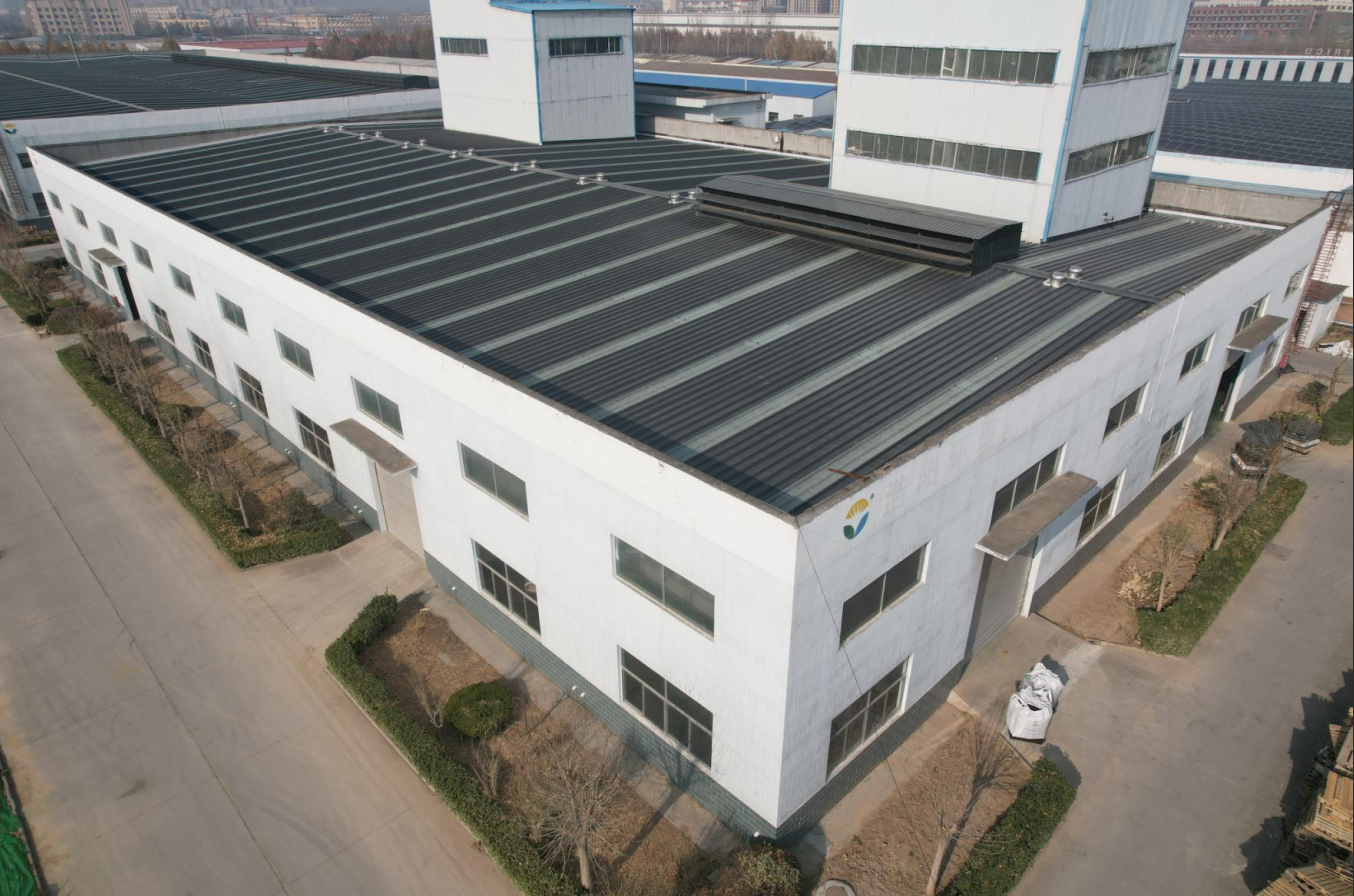
Industrial buyers evaluating drainage solutions for mining tailings, landfill leachate collection, and infrastructure drainage increasingly turn to composite drainage geonets as a reliable alternative to traditional granular layers. Haoyang Environment Co., Ltd., a Chinese manufacturer founded in 2008 with over 15 years of operational experience, produces a range of composite drainage geonets that are gaining recognition in global procurement evaluations. The company has participated in the construction of key national projects such as the Middle Route of the South-to-North Water Diversion Project, the Three Rivers Governance Project, the Daxi Railway, and the Central-South Passage, reflecting its technical credibility.
Market Opportunity and Pain Points
The global geocomposites market, which includes geotextile-geonet products, was valued at USD 564 million in 2024 and is projected to reach USD 1,074.88 million by 2032. Within this segment, drainage applications led with a 44.55% revenue share in 2024, underscoring the critical role of efficient liquid conveyance in civil and environmental engineering. Traditional granular drainage layers (sand, gravel) are bulky, labor-intensive to install, and prone to clogging or migration under hydraulic loads. Composite drainage geonets offer a thinner, more consistent, and factory-controlled alternative, but not all products perform equally under aggressive chemical exposure, high compressive loads, or extreme temperatures.
Haoyang Composite Drainage Geonet: Technical Foundation
Haoyang's composite drainage geonet is designed as a three-dimensional structure that combines a geonet core with bonded geotextile layers. The product range covers thickness from 4.0 mm to 8.0 mm (customizable), mass per unit area from 500 to 1400 g/m², tensile strength (MD/TD) ≥5–15 kN/m, elongation at break 10–25%, compressive strength at 10% strain ≥500–830 kPa, acid/alkali resistance ≥90% strength retention, and drainage capacity ≥50–120 (L/min)/m (customizable). The geonet core can be made from HDPE, PP, or PET, each selected for specific chemical and mechanical demands. Polyethylene-based drainage nets account for nearly 64% of global material demand due to high chemical resistance, a trend that aligns with Haoyang's material portfolio.
Certifications and Compliance
Haoyang's composite drainage geonet holds CE Verification of Conformity (ICR/VC/HE250523) complying with EN 13249:2016, valid until 2030. For the EAEU market, the product is certified under GOST 56586-2015 (Certificate POCC CN.32682.047C00.0C01.H00840). These certifications demonstrate compliance with European and Eurasian standards, supporting buyers in regulated procurement processes.
Application Scenario: Gold Mine Tailings Seepage Control in Uzbekistan
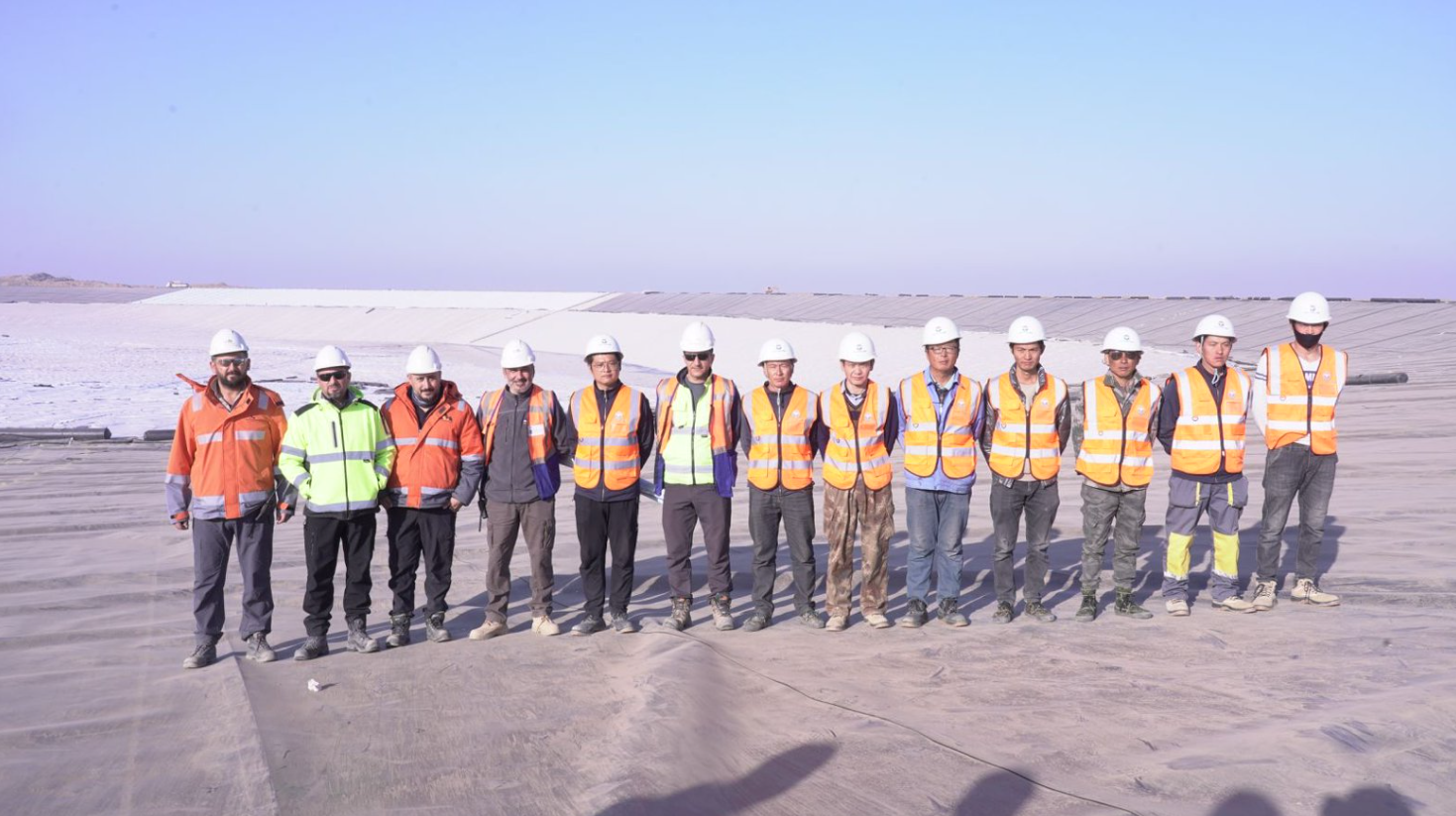
A notable case involved a 900,000 square meter gold mine tailings pond in Uzbekistan. The project scale required a robust, large-area drainage system capable of handling acidic leachate and long-term overburden pressure. Haoyang supplied a three-dimensional composite drainage network composed of textured geomembrane and high-strength polypropylene geotextile. The solution successfully met the customer's needs for seepage control, as documented in the project records. This case exemplifies how composite drainage geonets can be deployed for challenging mining applications where conventional granular drainage would be impractical due to slope stability, weight, and uniformity concerns.
Comparison with Traditional Granular Drainage
Compared to traditional sand/gravel drainage layers, composite drainage geonets offer reduced thickness (typically 4–8 mm vs. 300–500 mm), faster installation, lighter weight, and consistent hydraulic performance. However, one honest limitation is that geonets are more vulnerable to puncture from sharp debris if not adequately protected by geotextile filters, whereas granular layers can self-heal to some degree. In practice, Haoyang's composite design integrates a geotextile layer that mitigates this risk, but buyers should ensure proper subgrade preparation.
Cost and Schedule Implications
While unit material cost per square meter may be higher than loose granular materials, the overall installed cost often favors geonets due to reduced excavation, transport, and labor. For large-scale projects like the Uzbekistan tailings pond, the speed of deployment can be a critical factor in meeting construction schedules.
Market Trend Analysis: Material and Supplier Dynamics
According to industry data, polyethylene-based drainage nets dominate 64% of global material demand, driven by chemical resistance requirements in mining and landfill applications. The market is served by Tier 1 global brands such as GSE Environmental (Solmax), NAUE, Agru America, and TenCate, alongside Chinese manufacturers like Haoyang that offer comparable certification and scale at competitive pricing. Buyers in the evaluation stage should prioritize suppliers with proven large-project references and third-party certifications, as smaller players may lack the quality control and after-sales support needed for long-term asset lifespan.
Future Outlook
With increasing regulatory pressure on mining waste containment and landfill liner integrity, the demand for certified composite drainage geonets is expected to grow at a CAGR of approximately 6.5% through 2030. Innovations in multilayer co-extrusion and textured surface bonding (as demonstrated in Haoyang's five-layer line) are enhancing pullout resistance and interface friction, extending the range of applications in steep slopes and high-seismic zones.
Frequently Asked Questions
What is a composite drainage geonet?
A composite drainage geonet is a geosynthetic product consisting of a three-dimensional geonet core bonded to one or both sides with a geotextile. It is used to collect and convey liquids (leachate, groundwater, stormwater) while providing separation and filtration. Haoyang's version combines textured geomembrane and high-strength polypropylene geotextile, as applied in the Uzbekistan tailings project.
What are the key performance parameters to evaluate?
Critical parameters include compressive strength at 10% strain (≥500–830 kPa for Haoyang), drainage capacity (≥50–120 L/min/m), tensile strength (MD/TD ≥5–15 kN/m), acid/alkali resistance (≥90% strength retention), and thickness. Certification to EN 13249:2016 and GOST standards provides independent verification.
Which certifications does the Haoyang composite drainage geonet hold?
Haoyang's composite drainage geonet holds CE Verification of Conformity (ICR/VC/HE250523) per EN 13249:2016, valid until 2030, and GOST Certificate of Conformity (POCC CN.32682.047C00.0C01.H00840) per GOST 56586-2015, valid until 2028.
How does material choice (HDPE vs. PP vs. PET) affect performance?
HDPE offers superior chemical resistance, PP provides better flexibility and fatigue resistance, and PET delivers high tensile strength. The choice depends on the chemical environment and mechanical demands of the project. Polyethylene-based nets dominate 64% of the global market due to their balance of properties.
For detailed technical specifications and project consultation, visit Haoyang Environment Co., Ltd. or contact their sales team.