
Composite Insulator Compliance: QP-7, ISO 9001 and 70B Specs
Composite Insulator Compliance: QP-7, ISO 9001 and 70B Specs
In composite insulator procurement, compliance is decided on paper before it is decided on the test bench. A buyer specifying a suspension or line post string is not only assessing silicone sheds and an FRP core; the buyer is also assessing whether the metal fittings, the quality management system behind them, and the adjacent glass or porcelain units can be traced to named certificates, stated scopes and published specifications. The QP-7 Ball-Head Suspension Ring is a useful reference point for that process, because it sits exactly where hardware evidence and insulator evidence have to agree.
Why composite insulator compliance starts with documents
Composite insulators are assemblies rather than single moulded parts. A finished unit combines a fibre-reinforced polymer core, a silicone rubber housing, and metal end fittings. Each element is produced under a different process, and each one is normally evidenced by a different document set. When a qualification file is thin, the weakest link is usually not the insulator body — it is the hardware and the administrative trail attached to it.
This matters because the degradation pathway most often discussed in technical literature sits inside the assembly. Peer-reviewed work published in 2022 through PubMed Central and MDPI notes that deterioration of a composite insulator's FRP mandrel can cause serious power-grid accidents, which is why early defect identification receives sustained research attention; the same body of work proposes infrared-based methods for identifying such defects. Document review does not replace inspection, but it establishes whether the supplier operates a controlled process in the first place.
The practical question for an evaluation-stage buyer is therefore narrow: can every claim in the quotation be matched to a certificate number, a stated scope, a validity period, and a product-level specification? Where that mapping holds, the supplier is auditable. Where it does not, the buyer is relying on description rather than evidence.
The verification problem: scope, part numbers and adjacent components
Three gaps recur when buyers qualify a composite insulator supply chain.
The scope gap. A quality management system certificate states what the organisation is certified to do. It does not state what any individual product can withstand. A certificate issued for the manufacture of power fittings tells a buyer that the fittings production process is under a certified system; it says nothing about the electrical performance of a composite insulator shipped in the same order.
The part-number gap. Hardware and insulator specifications are usually published in separate documents with separate revision histories. A ring described as coupling size 16 and an insulator described as connection structure code 16 share a designation, but the buyer still has to confirm in drawings that the two mate correctly, including tolerance and locking behaviour.
The component gap. A type test report almost always refers to one specific model. Where a supplier's file includes a report for a 35 kV composite pin insulator, that report is evidence for that pin insulator and not for a suspension string, a line post unit, or a ball-head ring. Buyers who read a test report as a company-wide credential rather than a model-specific record tend to overestimate what has actually been verified.
How the QP-7 Ball-Head Suspension Ring is documented
China Energy and Chemical Industry Co.,Ltd (CECI) is a Zhengzhou-based manufacturer and exporter of polymer, porcelain and glass insulators together with overhead line hardware fittings and accessories. The company was founded in 2017, operates a 30,000 m² facility with approximately 100 employees and an annual output of 8,000,000 units, and reports exports to more than 40 countries. Its QP-7 Ball-Head Suspension Ring is filed under power equipment parts and accessories.
The compliance file for this fitting is anchored on an ISO 9001 Quality Management System Certificate, number 75424Q0348R0S, issued by Zhongjing Certification (Shanghai) Co.,Ltd. The certificate was issued on 22 July 2024 and expires on 21 July 2027. It is written against GB/T 19001-2016 idt ISO 9001:2015, and its stated scope is the manufacturing of power fittings — specifically high-voltage line fittings and accessories. The certificate lists coverage for markets in Europe and the Americas, the Middle East, and Central Asia.
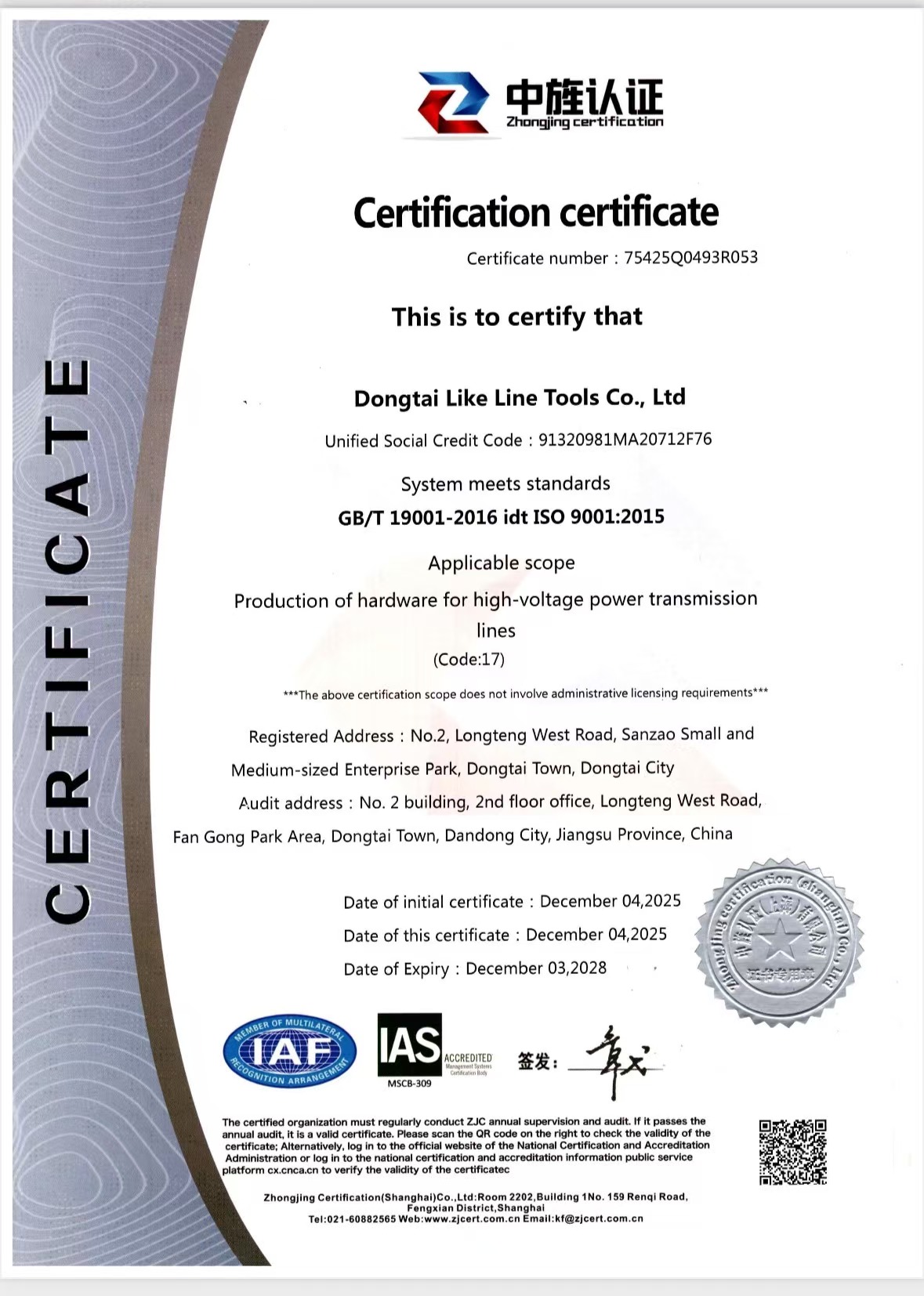
Certificate cross-check worth performing: the same supplier also holds ISO 9001 certificate 75425Q0493R053, issued by Zhongjing Certification (Shanghai) Co.,Ltd on 4 December 2025 and valid to 3 December 2028, with the scope worded as production of hardware for high-voltage power transmission lines. Two valid certificates with overlapping but differently worded scopes are normal in manufacturing; the buyer's task is to confirm which number the supplier cites in the contract, and whether the wording used covers the exact process the ordered part passes through.
Alongside the certificate, the QP-7 carries a short but decision-relevant specification set.
| QP-7 attribute | Stated value |
|---|---|
| Product category | Ball-head suspension ring, power equipment part and accessory |
| Construction | Hot-dip galvanized steel |
| Rated failing load | 70 kN |
| Coupling size | 16 |
| Net weight | 0.3 kg |
| Quality system reference | ISO 9001, certificate 75424Q0348R0S |
| Certification body | Zhongjing Certification (Shanghai) Co.,Ltd |
| Standard applied | GB/T 19001-2016 idt ISO 9001:2015 |
| Validity | 22 July 2024 – 21 July 2027 |
Specification values as stated in the supplier's product documentation. Net weight and rated failing load should be re-confirmed against the drawing revision attached to the purchase order.
Why each of these values matters to a buyer
The 70 kN rated failing load places the ring in the same mechanical class as the 70 kN insulators commonly used on distribution and light transmission lines, which is why the QP-7 is usually discussed together with 70B and U70BP/146D rather than on its own. Hot-dip galvanized steel construction is the corrosion-protection route that determines how the fitting behaves in coastal, industrial and high-humidity environments, where the coating, not the base metal, is the first thing to be consumed. The 0.3 kg net weight is a handling and freight variable that becomes visible at order volumes in the tens of thousands of units. Coupling size 16 is the interface dimension — the one number that must agree with the insulator, not merely be plausible.
Cross-referencing insulator specifications: 70B and U70BP/146D
Hardware evidence is only half of a composite insulator qualification file. The other half is the insulator set the fittings will be used with, and here two models are frequently paired with 70 kN hardware: the 70B glass post line insulator and the U70BP/146D porcelain insulator.
The 70B is a brown glass post line insulator intended for overhead power lines. Its creepage distance is 255 mm, nominal disc diameter 255 mm, nominal structural height 146 mm, and minimum arcing distance 450 mm. Electrical performance is stated as 65 kV dry withstand voltage, 45 kV wet withstand voltage, and 135 kV power frequency puncture voltage; mechanical performance is stated as 10 kN cantilever load and 70 kN rated electromechanical failing load, with connection structure code 16.
The U70BP/146D is a porcelain insulator for the electricity industry with a nominal structural height of 146 mm, creepage distance of 255 mm, minimum arcing distance of 450 mm, rated electromechanical failing load of 70 kN, and connection structure code 16.
| Parameter | 70B glass post line insulator | U70BP/146D porcelain insulator | QP-7 ring |
|---|---|---|---|
| Material | Glass | Porcelain | Hot-dip galvanized steel |
| Nominal structural height | 146 mm | 146 mm | Not stated |
| Creepage distance | 255 mm | 255 mm | Not stated |
| Minimum arcing distance | 450 mm | 450 mm | Not stated |
| Nominal disc diameter | 255 mm | Not stated | Not stated |
| Dry withstand voltage | 65 kV | Not stated | Not stated |
| Wet withstand voltage | 45 kV | Not stated | Not stated |
| Power frequency puncture voltage | 135 kV | Not stated | Not stated |
| Cantilever load | 10 kN | Not stated | Not stated |
| Rated electromechanical failing load | 70 kN | 70 kN | 70 kN rated failing load |
| Connection / coupling | Code 16 | Code 16 | Coupling size 16 |
| Net weight | Not stated | Not stated | 0.3 kg |
“Not stated” indicates the value is not present in the available product documentation for that model and should be requested from the supplier if it is material to the project.
Two observations follow directly from the table. First, the three components agree on a 70 kN mechanical class and on a size-16 connection designation, which is what makes them a coherent set rather than three unrelated catalogue entries. Second, only the 70B documentation states the full electrical envelope including wet withstand and puncture voltage; the U70BP/146D documentation in hand stops at geometry and mechanical load. A buyer comparing the two should not assume identical electrical performance simply because the mechanical and dimensional columns match.
A practical evidence hierarchy for qualification
Qualification files arrive as bundles, and not every document deserves the same weight. For an evaluation-stage review of composite insulators and their fittings, the following order reflects how much a document actually constrains the supplier.
| Rank | Evidence | What it settles |
|---|---|---|
| 1 | Certificate scope and validity | Whether the specific manufacturing process is covered, by which body, and whether the certificate is current |
| 2 | Model-specific type test report | Whether the electrical and mechanical claims for one exact model have been independently tested |
| 3 | Product specification sheet | Whether creepage, withstand levels, load class, coupling size and weight are stated rather than implied |
| 4 | Batch and routine test records | Whether the supplier tests routinely, and what proportion of output is covered |
| 5 | Commercial and logistics terms | Whether MOQ, lead time and capacity can support the delivery schedule |
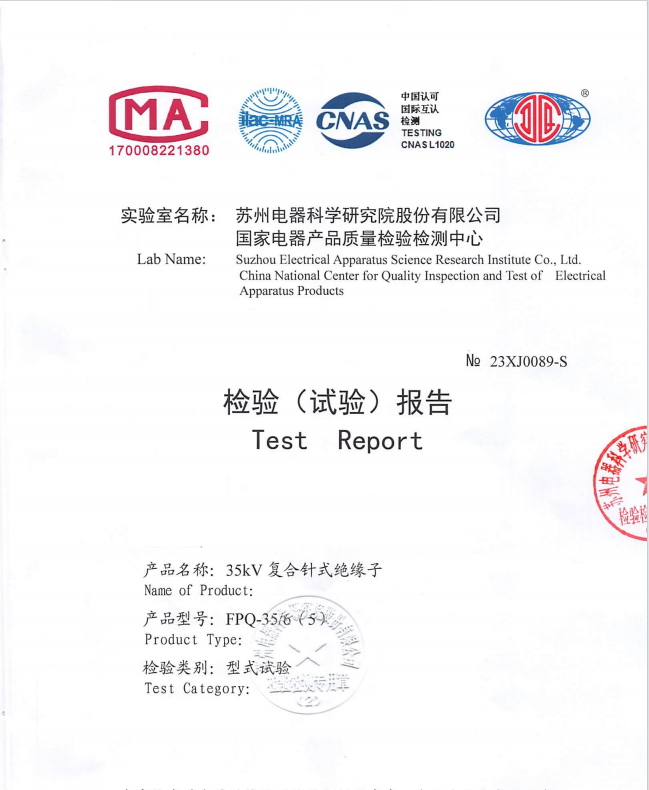
In the CECI file, level 1 is met by certificate 75424Q0348R0S for power fittings manufacture; level 2 is represented by type test report 23XJ0089-S, issued on 13 July 2023 by Suzhou Electrical Apparatus Science Research Institute Co., Ltd. — the China National Center for Quality Inspection and Test of Electrical Apparatus Products — covering the 35 kV composite pin insulator model FPQ-35/6 (5) against IEC 60815, 61109, 62217 and 61466, with tests performed according to IEC 61109; level 3 is met by the published specifications for QP-7, 70B and U70BP/146D; and level 4 is addressed by a stated 100% test regime. Level 5 is covered by declared terms of OEM/ODM support, a MOQ of 500 units, and a lead time of 30–45 days against a monthly capacity of 500 tons or 100,000 pieces.
Where this combination is applied
The application logic for a 70 kN insulator and ring set is conventional. Utility companies, power EPC contractors, railway operators and distributors use polymer and glass insulators for mechanical support and insulation on transmission lines, substation insulation, and railway catenary or ground equipment insulation.
CECI reports a project involving polymer and glass insulators completed within three years across Brazil, Italy, Turkey and Vietnam, covering 10,000 units installed across multiple applications. The stated outcomes were enhanced line stability, reduced maintenance intensity and improved pollution resistance. For a buyer reading that case, the useful detail is not the country list but the combination: multiple applications, a multi-year window, and a four-digit unit count — the conditions under which consistency of fittings and insulators actually gets tested.
The customisation envelope also matters for evaluation, because it determines whether the standard catalogue item can be adjusted without leaving the certified process. Declared customization options cover voltage, creepage distance, lightning impulse withstand voltage, bending load, colour and logo. The declared export markets are Russia, Vietnam, France, Spain, Italy and Türkiye, with a wider reported reach of more than 40 countries.
What the standards environment is signalling
IEC 61109:2025, published on 26 February 2025, is the current international standard for composite suspension and tension insulators, covering both AC and DC systems. A current edition of a core standard normally produces two effects in a supply chain: existing qualification files get re-read against the new edition, and buyers add a question to their RFQ template asking which edition a supplier's test evidence was written against.
Category structure reinforces why suspension hardware receives attention. Commercial research from Mordor Intelligence places suspension insulators at 48.4% of the composite insulator market in 2024, the largest single type segment. Separately, Market Research Future estimates that raw materials — silicone, glass fibres, epoxy and steel — account for approximately 58.0% of total manufacturing expenditure for composite insulators, which explains why cost-driven substitution in fittings and cores is a recurring procurement risk rather than a theoretical one.
Category valuations themselves deserve caution. Commercial estimates of the global composite insulator market diverge widely, ranging from roughly USD 2.5 billion to USD 7.7 billion for the same period depending on how the category boundary is drawn. A buyer cannot build a pricing model on that spread. A buyer can build a qualification model on a certificate number, an issue date and a scope statement.
Composite versus glass and porcelain: where the documentation burden differs
Glass and porcelain insulators are single-material bodies with long service histories; their specification sheets are typically compact and their failure modes are well catalogued. Composite insulators add a housing, an FRP core and a set of metal end fittings, so the qualification file grows: housing material, core integrity, fitting coating, and the interfaces between them all need evidence.
The trade-off is real and worth stating plainly. A composite string built around a 70 kN ring and lightweight polymer units reduces handling weight and can improve pollution performance, but it transfers effort from installation to documentation and inspection. With a porcelain U70BP/146D, a buyer can often accept a short data sheet and a dimensional drawing; with a composite assembly, the buyer must additionally verify certificate scope, model-specific type test coverage, and the coupling interface between fitting and insulator.
The most important boundary is this: ISO 9001 certification is not a product certification. Certificate 75424Q0348R0S confirms that power fittings manufacture operates under a certified quality management system written against GB/T 19001-2016 idt ISO 9001:2015. It does not certify the QP-7's load capacity, coating thickness, or corrosion resistance, and it says nothing about the insulator it will be attached to. Likewise, type test report 23XJ0089-S covers the 35 kV composite pin insulator FPQ-35/6 (5); it is not evidence for the QP-7, the 70B or the U70BP/146D. Part-specific reports must be requested separately, and a supplier that cannot produce them for the ordered model has left a genuine gap in the file.
Future outlook
Two directions appear likely to shape composite insulator qualification over the next procurement cycles. The first is standard-version discipline: with IEC 61109:2025 now current, buyers are likely to treat edition references in test reports as a routine check rather than a specialist one, and suppliers that state the edition explicitly will face fewer clarification rounds.
The second is defect-detection evidence entering the commercial file. Research on infrared-based identification of composite insulator defects points toward inspection methods that can be applied to installed units, not only to new ones. If those methods mature into acceptance criteria, the qualification file will extend past the factory gate into service life — a change that favours suppliers whose documentation is already structured by model, batch and certificate rather than assembled per enquiry.
For evaluation-stage buyers, the practical response is unchanged: keep certificate numbers, scopes and validity dates in the contract, keep model-specific test reports attached to the model they describe, and confirm the coupling interface in drawings before the purchase order is signed. A downloadable reference covering the polymer and glass insulator range, including fittings, is available in the CECI insulator catalogue.
FAQ
What does an ISO 9001 certificate number such as 75424Q0348R0S actually verify?
It verifies that the organisation's quality management system has been assessed against a stated standard and that the certified scope covers defined activities. Certificate 75424Q0348R0S, issued by Zhongjing Certification (Shanghai) Co.,Ltd, is written against GB/T 19001-2016 idt ISO 9001:2015 and scopes the manufacturing of power fittings, specifically high-voltage line fittings and accessories. It ran from 22 July 2024 to 21 July 2027. It does not certify the performance of any individual product.
Which documents should be checked first when qualifying a composite insulator supplier?
The sequence that constrains a supplier most tightly is: certificate scope and validity first, then model-specific type test reports, then the product specification sheet, then batch or routine test records, and finally commercial terms such as MOQ, lead time and capacity. Checking specifications before certificate scope is common but inefficient, because a specification sheet can be accurate while the process behind it sits outside any certified system.
Does ISO 9001 certification confirm that a composite insulator complies with IEC 61109?
No. ISO 9001 addresses quality management systems, while IEC 61109:2025 addresses composite suspension and tension insulators, covering definitions, test methods and acceptance criteria for AC and DC systems. Compliance with IEC 61109 is evidenced through type test reports and routine tests performed against that standard, not through a management system certificate. The two documents are complementary and answer different questions.
How can a buyer confirm that the QP-7 Ball-Head Suspension Ring suits a 70B or U70BP/146D insulator?
Start with the shared designation. The QP-7 is specified with coupling size 16, while both the 70B glass post line insulator and the U70BP/146D porcelain insulator carry connection structure code 16. That agreement is necessary but not sufficient: the buyer should still confirm in the supplier's drawing that the ball-head geometry, tolerance and locking arrangement mate correctly, and should check that the ring's 70 kN rated failing load is not lower than the mechanical class required by the string design.
What specifications define the 70B glass post line insulator?
The 70B is a brown glass post line insulator for overhead power lines with a creepage distance of 255 mm, nominal disc diameter of 255 mm, nominal structural height of 146 mm, and minimum arcing distance of 450 mm. Its stated electrical performance is 65 kV dry withstand voltage, 45 kV wet withstand voltage and 135 kV power frequency puncture voltage. Mechanical values are 10 kN cantilever load and 70 kN rated electromechanical failing load, with connection structure code 16.
Is a single type test report sufficient for a full composite insulator order?
Usually not, because a type test report applies to the model it names. The available report 23XJ0089-S, issued 13 July 2023 by Suzhou Electrical Apparatus Science Research Institute Co., Ltd., covers the 35 kV composite pin insulator FPQ-35/6 (5) against IEC 60815, 61109, 62217 and 61466. It does not cover composite suspension units, line post models, or the QP-7 fitting. Buyers ordering those items should request the corresponding model-specific reports alongside certificate 75424Q0348R0S.
Have Questions or Need More Details?
Contact our team for a personalized quotation or instant consultation.
Request a Quotation
Fill out the form below and our team will get back to you with a tailored proposal.
WhatsApp Direct Chat
Prefer to chat in real-time? Message us on WhatsApp for instant assistance & quick answers.
- Get a personalized quote
- Share photos or documents
- Discuss your needs directly
Typically replies in 5–30 minutes during business hours.