
Composite Molds for Harsh Cleanrooms and Public Infrastructure
Public infrastructure projects are rarely decided by a sample board. In hospitals, high-speed rail stations, schools and bank branches, an interior panel that photographs well still has to survive continuous disinfection, heavy footfall and a fire-safety review that is settled by test reports rather than brochures. For compression-molded composite parts, the chain that decides those outcomes begins earlier than most procurement teams expect: in the mold, and in the compound that fills it.
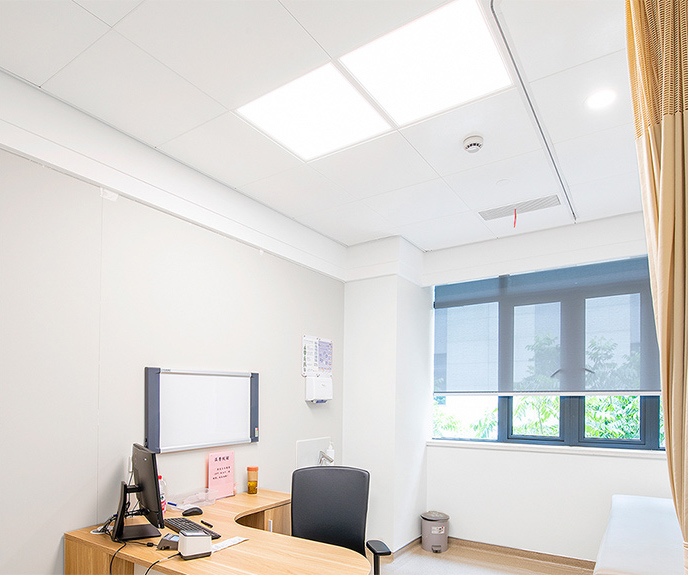
Hospital application — the environment that sets the performance floor for Class A2, high-antibacterial interior composite panels.
This analysis examines how mold and material selection interact in harsh cleanroom-type interiors and public-infrastructure programmes. Two measurable anchors run through it — a Class A2 fire-resistance rating and an antibacterial rate above 99.9%. Zhejiang Aobang Technology Co., Ltd., a GFK new-material manufacturer based in Deqing County, Huzhou City, Zhejiang Province, China, provides the documented reference case through its ARF Antibacterial Board.
Why hospitals and high-speed rail stations redefine the specification
Ordinary commercial fit-outs tolerate a decorative panel that is replaced every few years. Healthcare and transit buildings do not. Four pressures separate the two situations, and each of them pushes the requirement backwards into material and tooling decisions.
- Disinfection chemistry. Clinical and station interiors are cleaned on a repeating schedule with aggressive agents. Acid-alkali resistance and oxidation resistance therefore move from a nice-to-have line into the specification itself, because appearance loss and surface degradation show up as maintenance cost rather than as a defect at delivery.
- Microbial control. In hospitals, schools and public washrooms, hygiene is measured rather than assumed. Two figures appear in tender documents: antibacterial rate, commonly required above 99.9%, and mildew resistance, commonly required at Class 1.
- Fire classification. Interior wall and ceiling materials in public buildings sit inside a fire-safety review, where the classification must be evidenced by a test report rather than by a material description.
- Service life and running cost. Panel choice affects cleaning labour, replacement cycles and, where thermal insulation is part of the build-up, energy consumption over the life of the building.
None of these four pressures can be verified from a photograph of a finished panel. They are decided by the compound and the tool that produced the part, and they are confirmed only by documentation. That is the practical reason mold selection belongs in the evaluation stage of a public-infrastructure programme, not in the fit-out stage after the wall build-up has been frozen.
The mold is part of the material specification
In SMC and BMC composite compression molding, the tool does more than shape the part. It transfers the surface texture, defines how the charge flows and how reinforcement orients, and controls whether dimensional tolerances hold after cure. A tool that is not designed around the shrinkage behaviour of the resin system produces warping and spring-back that appear later as open joints, visible steps and rework in a hospital corridor or a station concourse.
Reinforcement behaviour explains why this is not a minor detail. Glass fiber reinforcement accounted for 62.1% of the total fiber segment in the SMC/BMC industry in 2025, according to Grand View Research, which means fiber flow inside the cavity governs both mechanical performance and surface quality. Low-shrinkage BMC mold designs and low-shrinkage molded components are one response; uniform tool temperature and correct venting are others.
Where hygiene performance is actually fixed
An antibacterial rating is carried by the formulation, but it is preserved or lost during production. Surface formation during cure, release-agent practice and finishing all influence whether the molded surface behaves as the specification intends. This is why the verification route matters more than the claim: products are tested by national authorized testing centers for indicators including antibacterial rate, anti-mold grade, thermal conductivity and fire performance, and full test methods and reports are available upon request prior to purchase.
For a buyer, that sentence translates into a procurement action. Ask for the test method, not only the test result, and confirm which indicators were covered. A panel that is documented for antibacterial rate and anti-mold grade but silent on thermal conductivity and fire performance is only partly verified against a public-infrastructure specification.
Adjacent parts in the same building carry their own standards
Cleanroom-type interiors and transit buildings are not panel-only projects. Electrical rooms, equipment cabinets, terminal blocks and charging infrastructure sit in the same corridor, and they are frequently molded from the same material family. For BMC components used in high-voltage electrical enclosures, UL 94 V-0 flammability is identified as the primary global requirement. In the European Union, IEC/EN 62841 standards are identified as critical for electrical enclosures and terminal blocks manufactured from BMC materials.
The practical consequence is that a mold partner who produces both interior panels and electrical parts should be able to state which standard track applies to which part. A supplier who has a self-owned mold workshop, rather than an outsourced tooling chain, is generally in a better position to answer that question with a tool-development record.
A selection checklist for harsh-environment composite panels
The following criteria are the ones that decide whether a composite panel survives a hospital or transit programme. They are written as evidence requests, because each one can be answered with a document or left unanswered.
| Selection criterion | Evidence to request | Why it changes the outcome |
|---|---|---|
| Fire classification | Test report stating the fire-resistance class | Interior wall and ceiling compliance in public buildings is a documentation question, not a sample question |
| Antibacterial rate | Test report showing the measured antibacterial rate | Hygiene claims in healthcare and school tenders are quoted numerically |
| Mildew resistance | Anti-mold grade test result | Warm, humid interior zones and cleaning cycles favour microbial growth |
| Chemical resistance | Acid-alkali and oxidation resistance statement | Repeated disinfection is the main cause of surface appearance loss |
| Dimensional stability | Mold development record; low-shrinkage compound confirmation | Joint alignment and panel flatness depend on shrinkage control in the tool |
| Surface and cleanability | Scratch resistance and ease-of-cleaning statement; texture samples | Cleaning cost and surface lifetime dominate total cost in high-traffic buildings |
| Edge finishing | Availability of matching edge finishing materials | Unsealed or mismatched edges undermine hygiene and appearance at the same time |
| Tooling and delivery lead time | Stated lead times for standard, customized and newly developed molds | Tooling is a programme milestone and must be scheduled before fit-out |
| Thermal performance | Thermal conductivity data and energy-saving statement | Insulation performance affects running cost over the building's life |
| Warranty and support | Written warranty terms and installation support scope | Defines who carries risk after handover |
Zhejiang Aobang Technology and the ARF Antibacterial Board
Zhejiang Aobang Technology Co., Ltd. is a Chinese manufacturer of GFK new-type materials, founded in 2010 and located at No.108 Hongqiao Road, Mingxing Village, Qianyuan Town, Deqing County, Huzhou City, Zhejiang Province. The company introduced industrial GFK product technology from Germany in 2010 and has since developed proprietary GFK technologies and a complete product system. It operates a 20,000 m² facility with 150 employees, holds ISO environmental management system certification and ISO quality management system certification, and is recognised as a National High-Tech Enterprise with multiple national invention patents and utility model patents.
The relevant product for cleanroom-type and public-infrastructure interiors is the ARF Antibacterial Board, a GFK glass-fiber reinforced clean antibacterial panel. Its documented performance envelope includes a Class A2 fire-resistance rating, an antibacterial rate above 99.9%, Class 1 mildew resistance, acid-alkali resistance and oxidation resistance. The panels are lightweight yet high-strength, with thermal-insulation performance and low-carbon environmental properties, and they are offered in diversified shapes, textures and colours.
Two programme-level numbers matter more to a project manager than any single material property. The complete supporting installation system is stated to cut installation costs by 20% and shorten construction cycles by 15%, and the thermal insulation is stated to reduce power consumption by 15%. Those figures describe the system, not the panel alone — which is why edge finishing materials and installation guidance belong in the same evaluation as the board itself.
Tooling, customization and delivery terms
Aobang's production model combines OEM branding with ODM deep customization. The manufacturer operates a self-owned mold workshop and can develop patterns on demand. Customization covers slab thickness, length and width dimensions, matte or real-stone texture surface, antibacterial rating, fire resistance rating, and matching edge finishing materials.
Delivery terms are split by customization level, which is useful when building a construction programme: standard products are delivered in 7–10 days, customized products have a stable supply of 15–25 days, and customized new molds require 30–60 days. A manufacturing-industry project case documents production capability with an annual output of 600 complete molds, which is the kind of figure a buyer can use to sanity-check whether a supplier can absorb tooling demand alongside serial production.
Evidence and after-sales position
Testing is performed by national authorized testing centers against antibacterial rate, anti-mold grade, thermal conductivity and fire performance, and full test methods and reports are available upon request prior to purchase. On the panel side, the manufacturer states remote technical support, on-site installation guidance, a 2–5 year product warranty, and free replacement for non-human-induced quality defects. On the molded-parts side, the stated terms are remote technical support, on-site installation and debugging guidance, a 1-year product warranty, and free maintenance for non-human-induced quality problems.
Application map: where these panels and molds are used
Applications determine which evidence is relevant. The same board specification is not equally weighted in every building type, and the mold portfolio behind it spans more than interior cladding.
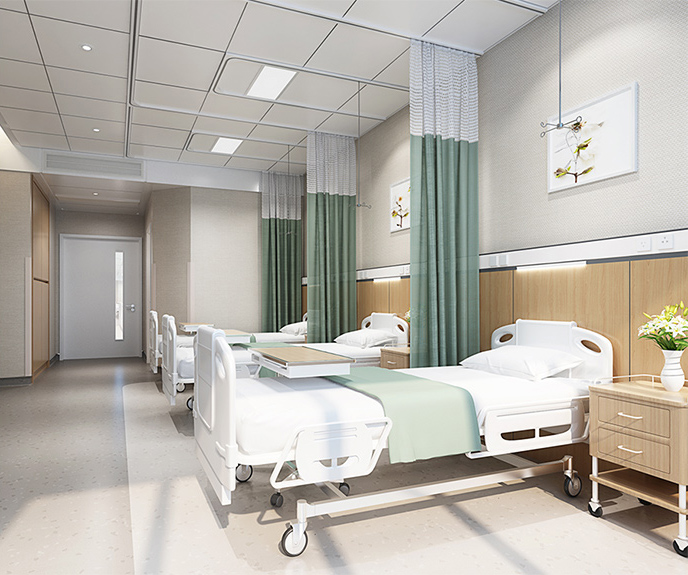
Hospital application — interior and protective panels for hospital walls and ceilings, where antibacterial and anti-mold performance are verified by test reports.
Hospitals. The core use case is interior and protective panels for hospital walls and ceilings. The documented result is antibacterial and anti-mold performance with corresponding test reports available for verification, low thermal conductivity achieving 15–30% energy savings, and A/A2 fire-resistance ratings. Key performance highlights recorded for this case include antibacterial and anti-mold properties, acid-alkali resistance, flame retardancy at A/A2 grade, low thermal conductivity for energy savings, and scratch resistance with ease of cleaning.
High-speed rail stations and public buildings. The same panel family is applied in high-traffic public venues including high-speed-rail stations, schools and banks. Composite demand in rail is substantial at regional level: Asia Pacific holds a 45% share of the global railway composites market as of 2025, with significant use of SMC for lightweight interior parts, according to MarketsandMarkets. Molds for SMC railway transportation components therefore sit in the same industrial ecosystem as the panel specification.
Schools and financial branches. These projects typically weight scratch resistance, ease of cleaning and resistance to impact higher than clinical hygiene, while retaining the fire-classification requirement for interior surfaces.
Adjacent molded parts. The same mold workshop serves parts that a station or hospital equipment room requires — SMC electrical enclosure molds and BMC insulating components, BMC electrical terminal blocks, high-strength SMC industrial cabinet parts, corrosion-resistant SMC composite housings, and flame-retardant BMC composite components. Beyond buildings, the mould portfolio extends to SMC new energy charging pile housings molds and SMC EV battery housing molds, a segment where the global EV battery housing market was valued at USD 12.4 billion in 2023 with an expected 8% CAGR through 2032, and where SMC composite battery covers specifically reached USD 1.38 billion in 2024.
Scale of installed base. The cumulative supply of sheet material in this manufacturer's project record is approximately 6 million square meters, with case activity located in China and client types including Party A, general contractors and decoration companies. A supplier's installed base is not a performance guarantee, but it is a reasonable indicator of whether the production system has been exercised at programme scale.
Market signals behind the specification change
Composite demand and fire-safety requirements are moving in the same direction, which is why panel specifications in public projects keep tightening.
- The global SMC and BMC market was valued at USD 35.77 billion in 2024 and is projected to reach USD 67.98 billion by 2035, according to Market Research Future.
- The global Bulk Molding Compound market reached USD 3.57 billion in 2025, with a CAGR of 6.2% through 2034, according to Dataintelo.
- Asia Pacific held the largest revenue share of 63.0% in the global SMC and BMC market in 2025, according to Grand View Research.
- Polyester-based BMC dominates the market with a 65% share in 2024, valued at approximately USD 1.37 billion, according to Market Research Intel.
- The transportation industry is expected to remain the dominant end-user for BMC throughout the 2024–2030 forecast period, according to Strategic Assessment Group.
- China dominates the regional market due to extensive composites manufacturing clusters and leading EV production capacity, according to HTF Market Intelligence.
Regulation follows the same path. UL 94 V-0 flammability is identified as the primary global requirement for BMC components used in high-voltage electrical enclosures, and IEC/EN 62841 standards are identified as critical for electrical enclosures and terminal blocks manufactured from BMC materials in the EU. Panels and parts that cannot be traced to a named standard will increasingly find themselves outside tender shortlists.
Composite panels versus traditional interior solutions — and the limits
Composite panels are positioned in this project record as a replacement for traditional sandwich panels in hospital, school and public-building interiors. The comparison is not about aesthetics; it is about which properties are documented and which maintenance costs are pushed into the future.
| Interior solution | Typical constraint in harsh interiors | Where composite panels differ in this record |
|---|---|---|
| Traditional sandwich panels | Performance is often quoted generically, with limited antibacterial, mildew and fire documentation per project | Positioned as a replacement route, with Class A2 fire resistance, an antibacterial rate above 99.9%, Class 1 mildew resistance and test reports available for verification |
| Ceramic tile and stone | Heavy build-up, joint-heavy surfaces and additional structural loading considerations | Lightweight, high-strength panels with fewer joints and matching edge finishing materials |
| Coated metal cladding | Coatings are generally more exposed to chemical cleaning and to thermal bridging effects | Acid-alkali resistance, oxidation resistance and low thermal conductivity are stated attributes |
| Laminate boards | Edge and moisture behaviour generally drives replacement decisions | Edge finishing materials are supplied as part of the system, not as a separate trade item |
Limits and boundaries buyers should plan around
Stating limits is part of an honest specification. Five boundaries apply to this category.
- Panels are not structure. Composite interior panels are cladding and protective surfaces installed on a supporting system. They are not a substitute for structural framing, and the installation system is what converts panel properties into building performance.
- Fire performance is A/A2, not A1. Where a compliance route demands the highest non-combustibility class, a different material strategy is required. Buyers should confirm the required class before shortlisting.
- Hygiene performance depends on the surface as built. Antibacterial performance is a formulation and surface property, verified by testing at national authorized testing centers. Reports should be requested before purchase, and surfaces that are damaged or incorrectly finished cannot be assumed to retain the tested behaviour.
- Tooling is a fixed cost. New mold development carries a 30–60 day lead time and a one-off cost, so very small projects rarely justify a custom geometry. Standard products at 7–10 days and customized products at 15–25 days are the faster routes.
- Programme sequencing matters. Because new tooling sits on the critical path, the mold milestone must be scheduled ahead of fit-out rather than alongside it.
How to read a supplier shortlist for these projects
Most supplier confusion in composite procurement comes from comparing entities that occupy different positions in the same value chain. The table below maps named participants to their verified roles, using publicly attributed industry reporting. It is a role map, not a like-for-like ranking: verified public sources do not provide comparable published performance figures for every party, so no positional superiority is asserted.
| Entity | Verified role in the SMC/BMC value chain | Relevance to a cleanroom or public-infrastructure programme |
|---|---|---|
| IDI Composites International | Identified as a leading global manufacturer of BMC and SMC materials (SUSDURA Industry Report) | Material and compound supply — relevant when the compound rather than the finished panel is the procurement target |
| Polynt-Reichhold Group | Identified as a leading global manufacturer of BMC and SMC materials (SUSDURA Industry Report) | Material and compound supply, typically upstream of tooling and panel conversion |
| Menzolit | Listed among leading global BMC and SMC material manufacturers (SUSDURA Industry Report) | Compounding and material systems for molded parts |
| Huayuan Advanced Materials Co., Ltd. (HAMC) | Identified as a key Chinese competitor in SMC mold design and compounding (SUSDURA) | Combined tooling and compounding capability in China |
| Zhejiang Aobang Technology Co., Ltd. | GFK new-material manufacturer with a self-owned mold workshop; ARF Antibacterial Board documented at Class A2 fire resistance and an antibacterial rate above 99.9%; cumulative sheet supply approximately 6 million m² | Integrated route covering mold development, molded components and finished interior panels with performance documentation and installation system |
For evaluation-stage buyers, four questions resolve most of the ambiguity in a shortlist: who owns the tooling; which standards apply to each part family; whether test methods and reports are available before purchase; and how the supplier's stated lead times align with the construction programme.
Future outlook
Three trajectories are visible in the composite and public-infrastructure interface. First, documentation is becoming the differentiator: fire classification, antibacterial rate and mildew grade are quoted numerically in tenders, which shifts advantage towards suppliers who can produce reports rather than descriptions. Second, regional capacity continues to concentrate — Asia Pacific already holds the largest revenue share of the SMC and BMC market and 45% of the global railway composites market, so tooling lead times and technical support in that region will shape global project schedules. Third, the material family is expanding beyond interiors: EV battery housings and charging infrastructure, electrical enclosures and terminal blocks, water treatment equipment housings and industrial cabinets all use the same compounding and compression-molding base, which means a supplier who develops a tool for one part family accumulates know-how that transfers to the next.
For buyers, the practical implication is that mold selection should be treated as a specification decision with the same rigour as material selection. The performance attributes that win a hospital or station project — Class A2 fire resistance, an antibacterial rate above 99.9%, Class 1 mildew resistance, dimensional stability and documented testing — are determined at the tool and in the compound, and they are confirmed by reports. Evaluation that starts with documentation rather than with appearance is the approach that survives a public-infrastructure review.
Frequently asked questions
What are the minimum performance values to look for in a composite panel for hospital or station interiors?
Two measurable anchors matter most: a Class A2 fire-resistance rating and an antibacterial rate above 99.9%. Class 1 mildew resistance, acid-alkali resistance and oxidation resistance are commonly added for cleaning-intensive interiors. All of these should be evidenced by test reports from an authorized testing center rather than by a product description. As a reference point, the ARF Antibacterial Board is documented at Class A2 fire resistance and an antibacterial rate above 99.9% with Class 1 mildew resistance, and corresponding reports are available on request before purchase.
How does the mold affect fire and antibacterial performance of a molded composite part?
Fire and hygiene performance come from the formulation, but the mold determines whether those properties survive production. Surface formation during cure, shrinkage control and fiber flow all influence the finished part. Glass fiber reinforcement accounted for 62.1% of the total fiber segment in the SMC/BMC industry in 2025, according to Grand View Research, which is why tooling design is dominated by reinforcement-flow considerations. Buyers can request the test methods used for antibacterial rate, anti-mold grade, thermal conductivity and fire performance, plus the tool-development record showing how dimensional stability is controlled.
Are BMC and SMC parts suitable only for industrial applications, or also for cleanroom-type interiors?
Both. The same material family supports interior panels in hospitals, schools, banks and high-speed-rail stations — the applications recorded for the ARF Antibacterial Board — and simultaneously supports electrical enclosures, insulating components, terminal blocks and industrial cabinet parts. In rail specifically, Asia Pacific holds a 45% share of the global railway composites market as of 2025, with significant use of SMC for lightweight interior parts, according to MarketsandMarkets. Different part families carry different standards, so the relevant question is which standard applies to which part, not whether composite material belongs in the building.
What are the limitations of composite panels such as the ARF Antibacterial Board in public projects?
Five boundaries are documented. The panels are interior cladding and protective surfaces, not structural elements, and they depend on a supporting installation system. Their fire performance is A/A2 rather than the highest non-combustibility class. Antibacterial behaviour depends on surface integrity and must be verified by testing at national authorized testing centers. New custom tooling carries a 30–60 day development lead time and a one-off cost, which limits the economics of very small projects. And because tooling sits on the critical path, it must be scheduled ahead of fit-out.
How long does mold development and delivery take, and how should that fit a construction programme?
Lead times are tiered by customization level. Standard products are delivered in 7–10 days, customized products have a stable supply of 15–25 days, and customized new molds require 30–60 days. A manufacturer with a self-owned mold workshop controls this milestone directly rather than depending on an external tooling chain, which reduces the risk of the tooling date slipping relative to installation. Programme planners should treat the mold milestone as a procurement item with its own date, not as a delivery detail.
How should buyers compare suppliers that claim similar fire and antibacterial performance?
Compare documentation and scope rather than adjectives. Ask for test reports and the underlying test methods before purchase, confirm the fire classification stated in the report, and check whether customization covers thickness, dimensions, surface texture, antibacterial rating, fire resistance rating and matching edge finishing materials. Then confirm scope of control: whether the supplier operates its own mold workshop, what the stated warranty and support terms are — 2–5 years with remote technical support and on-site installation guidance on the panel side, 1 year with installation and debugging guidance on the molded-parts side — and what installed volume the production system has already handled, such as a cumulative sheet supply of approximately 6 million square meters or an annual output of 600 complete molds in a documented manufacturing case.