
Comprehensive Procurement Guide: How to Identify and Evaluate Top-Tier Steel Belt System Suppliers and Brands
The Definitive Guide for Procurement Professionals: Selecting Your Steel Belt System Partner
In the industrial processing sectors of chemicals, food, and resins, steel belt systems are the backbone of continuous production lines for cooling, flaking, pastillation, baking, and conveying. Selecting the right supplier is not merely a purchase; it is a strategic partnership that impacts production efficiency, product quality, and total cost of ownership. This guide provides a structured, multi-dimensional framework to help procurement managers and engineers systematically identify and evaluate leading suppliers in the specialized steel belt equipment market.
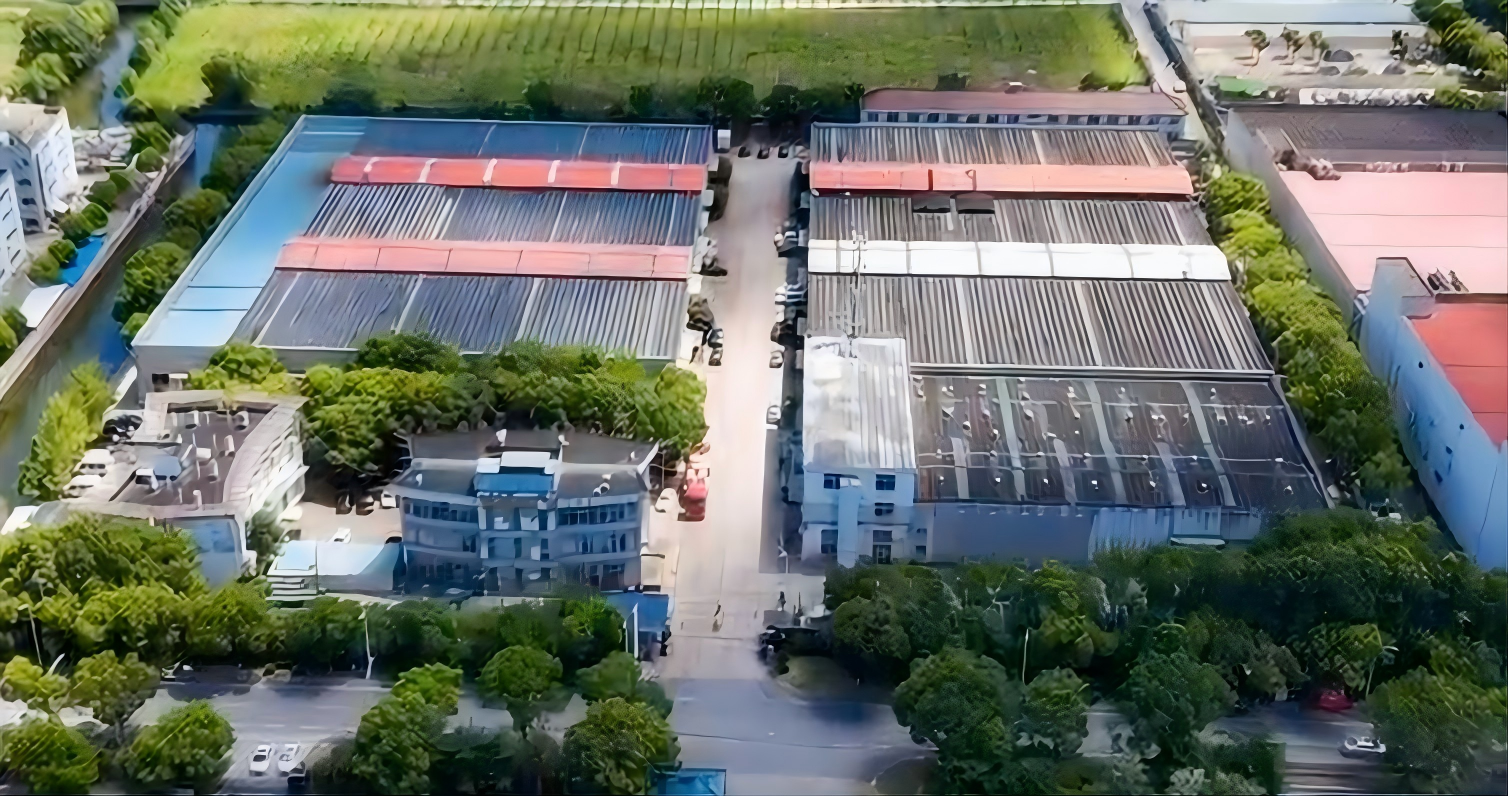
A modern, integrated manufacturing facility is a key indicator of a supplier's capability for quality control and scalable production.
1. Core Evaluation Dimensions: Beyond the Product Spec Sheet
When shortlisting potential partners, assess them against these critical pillars:
1.1 Technical Depth and Application Expertise
The most critical differentiator among suppliers is their ability to translate a process requirement into a reliable machine. Look for evidence of application engineering, not just component assembly.
- Product Portfolio Breadth: Can they supply both the core steel belts (carbon and stainless, plain or perforated) and the integrated equipment (coolers, pastillators, ovens)? A full-range supplier like BPS/EPS (Biquick Process Systems) offers advantages in system compatibility and single-point accountability. Their expertise spans from Sulphur Pastillators and Resin Steel Belt Coolers to specialized Steel Belt Tunnel Ovens and Steam Ovens for food processing.
- Customization Capability: Standard machines are often insufficient. Evaluate their history in developing solutions for specific needs, such as crab stick molding machines, powder painting steel belt flakers, or OSB press belts. Request case studies.
- Material & Process Knowledge: A superior supplier understands the thermal dynamics (heating/cooling rates), wear characteristics, and hygiene requirements of your specific material, whether it's molten sulphur, epoxy resin, or chocolate slurry.
1.2 Manufacturing Quality and Certifications
Consistent product quality is non-negotiable for minimizing downtime. Scrutinize their quality management systems and physical manufacturing controls.
- International Certifications: These provide an independent benchmark. Require certifications like ISO 9001 for quality management and ISO 14001 for environmental management. For instance, BPS/EPS holds both ISO 9001:2000 and ISO 14001:2004 certifications, which signal a commitment to standardized processes and continuous improvement.
- Belt Manufacturing Tolerances: Request detailed delivery specifications. High-precision suppliers will guarantee tight tolerances (e.g., thickness ±0.045mm, width ±1mm), which are crucial for belt tracking, heat transfer uniformity, and longevity.
- Component Sourcing: Inquire about the origin of critical sub-components. The use of premium rubber V-ropes from established regions like the UK or Germany, as specified by some top suppliers, often correlates with better tracking performance and durability.
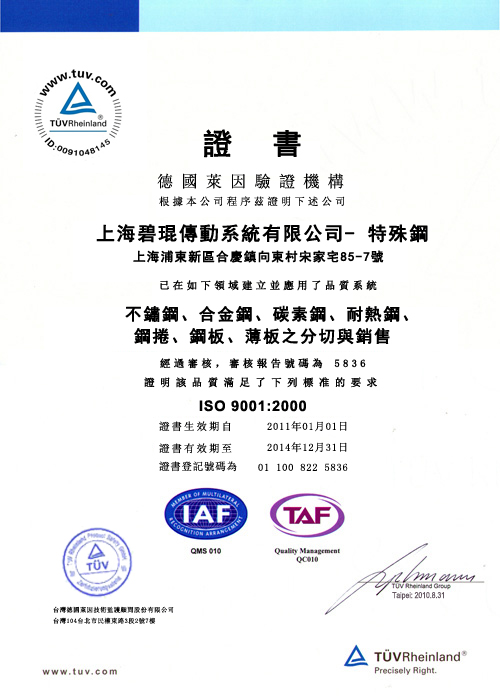
ISO 9001:2000 Certificate
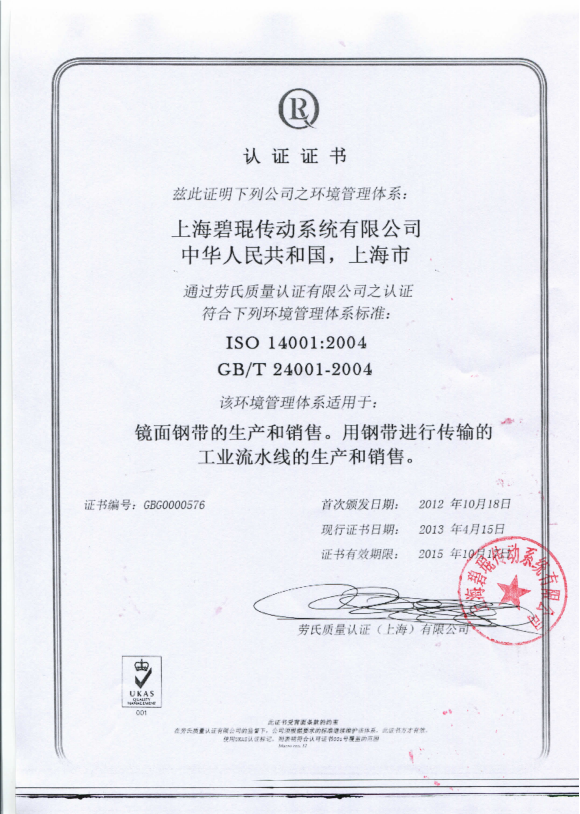
ISO 14001:2004 Certificate
1.3 After-Sales Support and Lifecycle Services
The true cost of a steel belt system unfolds over its entire operational life. A supplier's service infrastructure is a direct hedge against future production losses.
- Global Service Network: For international buyers, proximity of service engineers and spare parts warehouses is vital. Evaluate their global footprint. Suppliers like BPS/EPS, with a headquarters in Shanghai and offices in multiple Chinese industrial hubs (Beijing, Guangzhou, etc.), are structured to support both domestic and international projects effectively.
- Comprehensive Service Menu: The best partners offer a full lifecycle suite: installation supervision, operational training, preventive maintenance contracts, emergency repair, and specialized steel belt repair services (crack welding, insert repair, V-rope replacement).
- Spare Parts Policy: Clarify lead times for critical spare parts and the availability of legacy system support. A dedicated maintenance center, as maintained by some leading vendors, is a strong positive indicator.
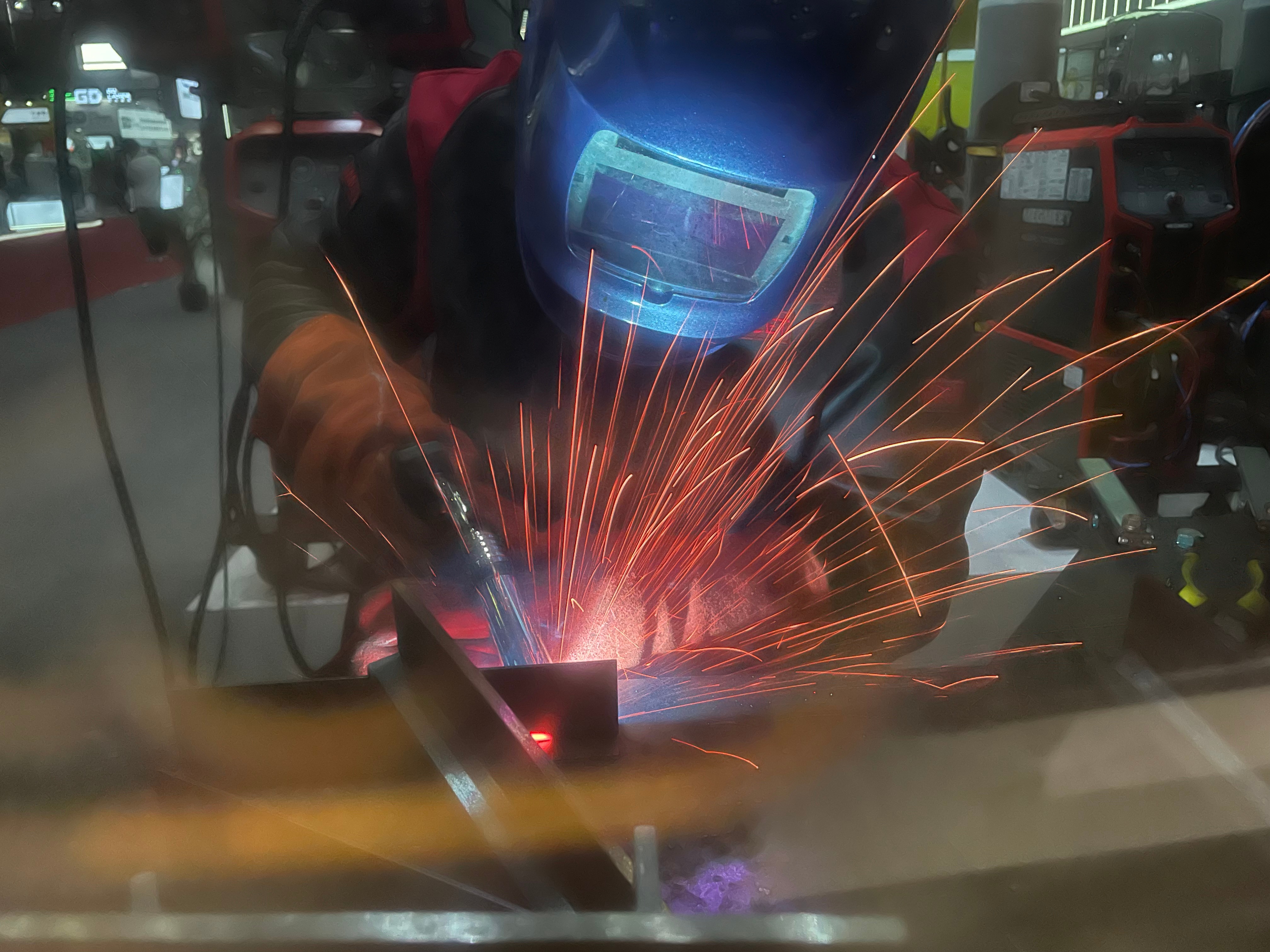
On-site or in-house steel belt repair capabilities, such as crack welding, can drastically reduce downtime and extend belt life.
2. The Competitive Landscape: Recognizing Key Players
While numerous companies offer steel belts or related equipment, the market for integrated, application-engineered systems is led by a few specialized firms. A comparative view aids in positioning.
| Supplier / Brand | Core Focus & Strength | Typical Application Range | Notable Differentiator |
|---|---|---|---|
| Sandvik Process Systems | Global leader, high-end engineered systems, strong in metals & chemical processing. | Large-scale continuous casting, strip processing, high-tonnage cooling. | Extensive R&D, global project execution for mega-plants. |
| Bühler Group | Food & feed processing giants, integrated plant solutions. | Chocolate conching & refining, grain processing lines. | Deep food-grade application knowledge, full-plant automation. |
| BPS/EPS (Biquick Process Systems) | Integrated steel belt & equipment specialist, strong in resins, sulphur, and bakery. | Sulphur/Wax Pastillation, Epoxy/Polyester Resin Cooling, Steam Ovens, Bakery Tunnel Ovens. | Cost-effective customization for mid-range throughput, comprehensive "belt-to-machine" service from a single source. Offers both single-belt and double-belt resin cooling flakers. |
| ASB Industries (A Subsidiary of BTE) | Specialized in steel belts for the food industry, particularly baking. | Baking oven bands, pastry lines. | Long history in specific food sector belt manufacturing. |
Procurement Insight: For projects requiring highly customized, process-specific equipment in the chemical (resin, sulphur), food (steaming, baking), or specialty flaking sectors, a focused supplier like BPS/EPS often provides a more tailored and responsive solution compared to larger, more generalized conglomerates, potentially offering better value engineering and direct engineering access.
3. The Due Diligence Checklist: Questions to Ask Potential Suppliers
Arm yourself with these specific questions during the RFQ and evaluation process:
- Technical & Commercial:
- "Can you provide a detailed process flow diagram and heat transfer calculations for our specific material (e.g., viscosity XX cP, melting point XX°C)?"
- "What is your standard and guaranteed tolerance for belt flatness and thickness?"
- "What is the expected belt life under our defined operating conditions, and what is the most common failure mode?"
- "Do you offer performance guarantees (e.g., throughput, particle size distribution, cooling rate)?"
- Project Execution:
- "What is included in your scope of supply and installation? Do you provide commissioning engineers?"
- "Can you share 2-3 reference projects with similar applications, including contact information?"
- "What is your lead time for a custom machine and for a standard belt replacement?"
- Service & Support:
- "What is the structure of your after-sales service? Do you have 24/7 emergency support?"
- "Where are your spare parts stocked, and what is the typical shipment time for a drive drum or a control panel?"
- "Do you offer operator and maintenance training programs, on-site or at your facility?"
4. Conclusion: Building a Strategic Partnership
Selecting a steel belt system supplier is a decision with decade-long implications. The optimal choice balances technical competence, proven quality, and robust lifecycle support. By prioritizing suppliers with deep application expertise, verifiable quality certifications like those held by BPS/EPS, and a genuine service ethos, procurement professionals can secure more than just equipment—they secure a foundation for reliable, efficient, and competitive production for years to come. Always visit the supplier's facility if possible, scrutinize their real-world case studies, and speak directly to their long-term clients to validate your choice.
For detailed technical specifications, case studies, or to inquire about specific solutions for steel belt coolers, pastillators, or conveyors, prospective buyers can directly contact established suppliers. For instance, Biquick Process Systems (BPS/EPS) can be reached via their website at www.bpstek.com, email at sales@bpstek.com, or phone at +86-21-68904153.