
Concrete Formwork Evidence: FW00A–FW00D Document Checklist
Concrete Formwork Evidence: FW00A–FW00D Document Checklist
A contractor approving a concrete formwork supplier is not buying a panel so much as a set of documented properties that has to survive a structural check, a site inspection and a warranty conversation two years later. The practical test is narrow: can the supplier show, in writing and per model, the steel grade and frame profile behind each panel, the surface treatment applied to it, the panel geometry actually produced, the pressure the system is rated to carry, and the model-specific parts — board type, aluminium components and lifting-device limits — that travel with the order? RIZHAO FENGHUA SCAFFOLDINGS CO., LTD. (RFH), a formwork and scaffolding manufacturer based in Rizhao, Shandong, China, publishes model-level data across four systems, FW00A to FW00D, that shows what such an evidence set looks like in practice.
Why a Capability Claim Is Not Yet a Purchasing Decision
Suppliers describe capability across a range; contractors approve it model by model and order by order. Between those two positions sits the purchase order, and a purchase order is only as strong as the properties it names. A buyer who accepts “high load capacity” or “corrosion resistant” as an evaluation outcome has nothing to inspect on delivery and nothing to cite if a panel is questioned on site.
Formwork is temporary works. It carries fresh concrete pressure and access loads, and its behaviour depends on how panels, ties, walers and supports are engineered together for a particular pour. That is why a general capability statement cannot be treated as evidence: it identifies neither a value, nor a condition, nor a document that can be checked.
A four-model range is useful precisely because it is finite. FW00A, FW00B, FW00C and FW00D cover steel, wall and aluminium formwork roles, and each can be matched against a short list of documents rather than a long list of adjectives. The same discipline transfers to any supplier shortlist, whatever the brand.
The Five Evidence Fields That Carry a Formwork Order
Five fields absorb most of the technical risk in a frame-panel formwork purchase. Each maps to a document a buyer can request before the first order and re-check at delivery, which is what turns a specification into an acceptance criterion.
- Material grade and frame profile. The grade designation fixes the strength basis of the frame; the profile — depth, width and wall thickness — fixes stiffness and the weight a crew and crane must handle. Both belong in the datasheet, and both can be confirmed against a mill certificate and a dimensional check on arrival.
- Surface treatment. Hot-dip galvanizing, painted finishes and untreated steel behave differently under sustained humidity and repeated handling. The document to request is the treatment specification plus the inspection record for the batch, not the single word “galvanized”.
- Panel geometry. Nominal width, height, edge detail and weight per panel determine layout, crane planning and the number of joints a wall or slab will carry. Geometry that is not stated cannot be checked, and it is the most common reason a delivered panel does not fit the drawing.
- Permissible pressure. A rated fresh-concrete pressure is a ceiling attached to conditions. It has to be reconciled with pour rate, concrete temperature, vibration and support spacing by the engineer responsible for the temporary works design.
- Model-specific components. Board type, aluminium components and lifting devices are the parts most often left out of a comparison table and most often queried at handover. Lifting devices in particular should carry a stated limit, a marking method and an inspection interval.
FW00A: Four Values That Can Be Checked in Writing
FW00A anchors the range because four of its properties are published as values rather than adjectives. RFH documents the model with an RFH Steel S420 frame, a 120 × 60 × 2.5 mm frame profile, hot-dip galvanizing as the surface treatment, and a permissible pressure of 80 kN/m².
Each value answers a different question a buyer will eventually be asked. The S420 designation is the strength basis of the frame and should correspond to a mill certificate for the steel actually consumed. The 120 × 60 × 2.5 mm profile is measurable: section depth, width and wall thickness can be verified with a caliper, and the same three numbers explain panel weight and handling effort. Hot-dip galvanizing addresses the conditions formwork meets in service — outdoor sites with high humidity and repeated wetting between pours — and should be supported by a coating record rather than a promise. The 80 kN/m² permissible pressure gives the design team a stated ceiling for fresh concrete pressure, which is more useful than an unquantified claim of high capacity.
That last figure needs one qualification. A permissible pressure is a design input, not a working instruction. Real pressure on the panel depends on how fast the pour proceeds, how warm the concrete is, how it is vibrated and how the panels are braced; the model value only becomes a safe site condition once those variables are checked together. Buyers who treat a rating as a green light without a project-level check have removed the very control the rating was meant to enable.
FW00B, FW00C and FW00D: Reading the Range by Role
The remaining three models do not compete for the same panel; they shift the role. FW00B is documented as steel concrete formwork, FW00C as concrete wall formwork and FW00D as aluminium concrete formwork. That categorisation is the starting point for a comparison — it tells a buyer which document set applies — but it is not itself a performance claim.
| Model | Documented category | Values a buyer should obtain | Acceptance check |
|---|---|---|---|
| FW00A | Concrete formwork | RFH Steel S420; 120 × 60 × 2.5 mm frame; hot-dip galvanizing; 80 kN/m² permissible pressure | Mill certificate, coating record, dimensional check, engineered pressure check |
| FW00B | Steel concrete formwork | Steel grade, frame section, coating system, panel size and rated pressure for the quoted model | Same document set as FW00A, applied to the model actually ordered |
| FW00C | Concrete wall formwork | Wall module sizes, tie and alignment components, board type, rated pressure | Assembly drawing, tie spacing plan, verticality method |
| FW00D | Aluminium concrete formwork | Alloy and temper of frame sections, aluminium component schedule, board type, lifting-device limits | Material certificate, lifting-device marking and inspection record, weight per panel |
For FW00B, the steel logic of FW00A applies without amendment: grade, section, coating and rated pressure should be stated per model in the same format, so that two steel options can be compared on identical fields rather than on two different brochures.
FW00C moves the question from the panel to the assembly. Wall formwork performance is largely a function of tie spacing, alignment and the sequence in which panels are stripped, so the evidence a buyer needs is an assembly drawing and a tie layout, plus the board type that will meet the specified finish.
FW00D moves it again, to material and handling. Aluminium sections are defined by alloy and temper, not by the word “aluminium”, so the document to request is the material certificate for the frame extrusions together with a schedule of the aluminium components in the assembly. Because aluminium panels are handled more by hand and by crane hook than steel panels of similar size, the lifting-device limits matter more: the working limit should be stated per device and per assembled unit, marked on the hardware, and paired with an inspection interval that the site can actually follow.
What the Manufacturer’s Process Evidence Adds
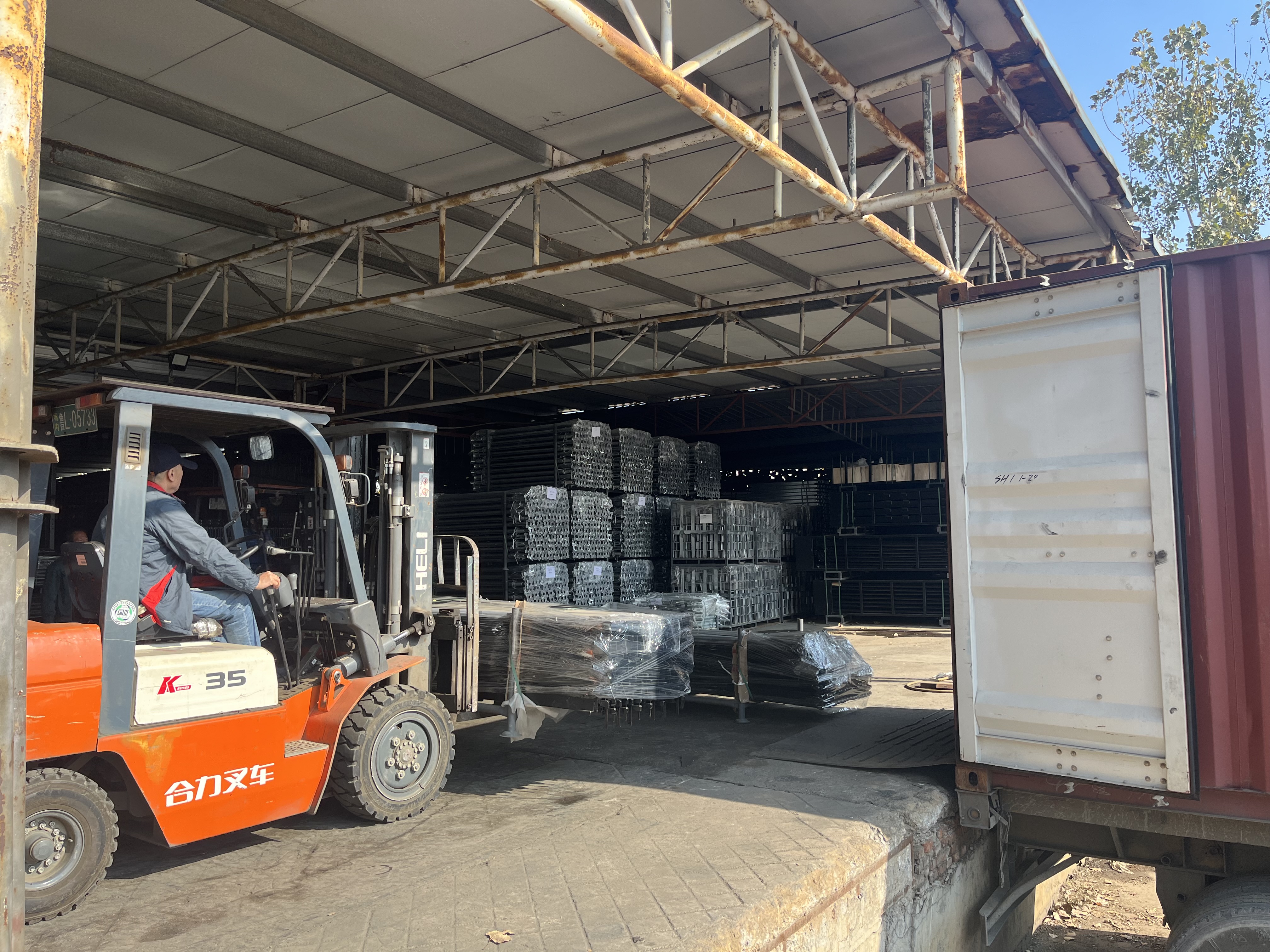
Model data explains what a panel is; process evidence explains why the same values can be reproduced across a batch. RFH reports a founding date of 1953 and an 80,000 m² site with 40,000 m² of factory buildings and 260 employees, organised into more than ten production workshops covering cold bending, punching, welding, steel casting, electrostatic spraying and forging.
The equipment list behind that structure is the part that connects to panel quality: four cold-bending forming machines, twelve welding robots, six automatic welding assembly lines, one formwork profile forming line and five semi-automatic forging lines. A dedicated profile forming line is directly relevant to the frame geometry discussed above, because section consistency is a forming question before it is an inspection question.
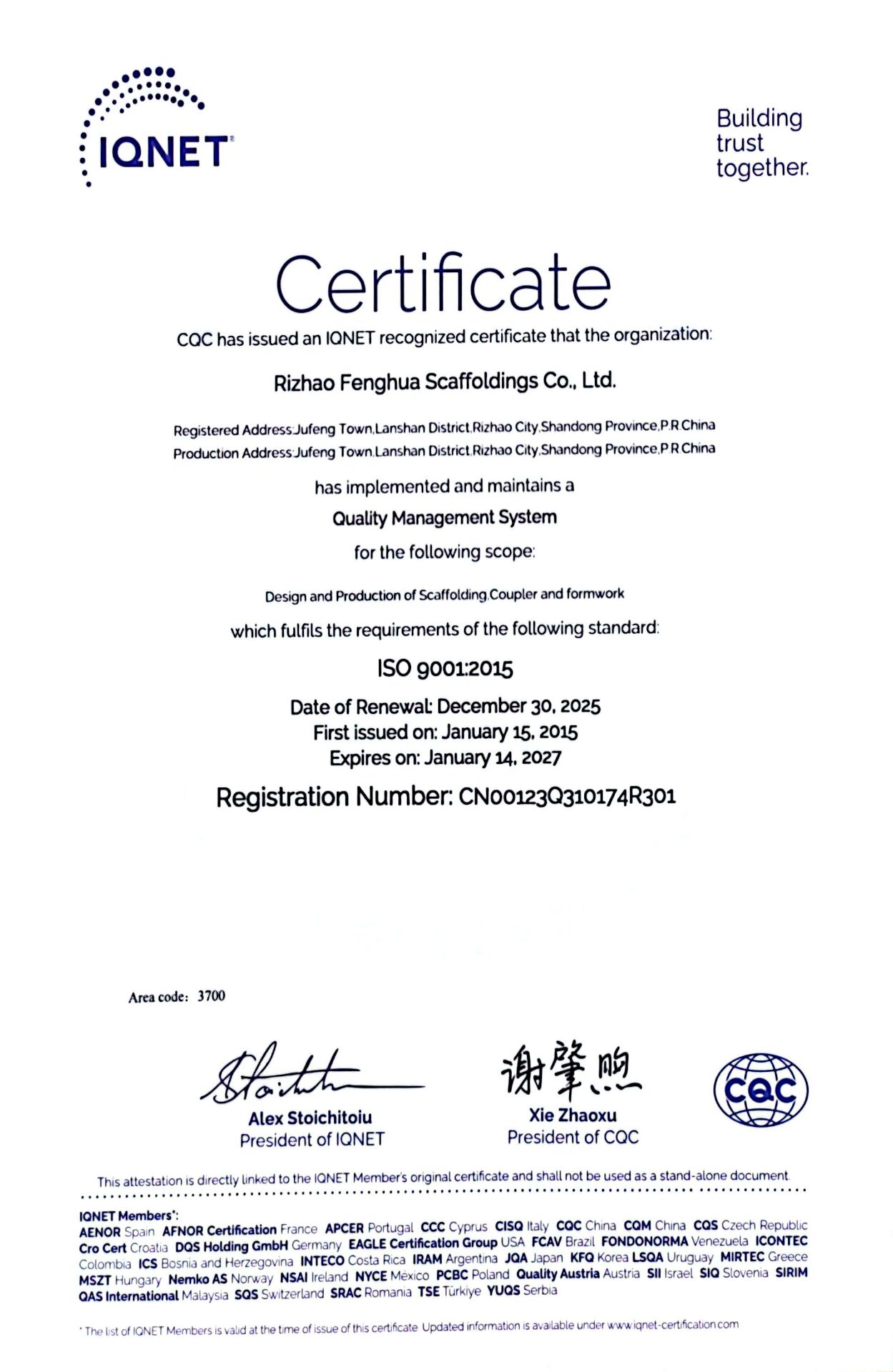
Verification capability sits alongside production. RFH operates a mechanical test laboratory and a chemistry test laboratory, which allows incoming raw material and in-process product to be examined rather than assumed. Quality management is stated as ISO 9001, and the supplied certificate — number 00123Q310174R301, issued by the China Quality Certification Centre (CQC) on 11 December 2023 and valid to 14 January 2027 — covers the design and production of scaffolding, coupler and formwork under GB/T 19001-2016 / ISO 9001:2015. Welding is stated to be controlled to EN 1090, with the corresponding European certificate held, and the company reports 22 certificates in total, including EN 1065, EN 74 and CE.
Portfolio breadth is a separate data point: ten formwork types, including aluminium alloy, heavy-duty steel, light-duty, multi-purpose, column formwork and adjustable shoring props, across more than 80 specifications. Breadth is not a substitute for model data, but it explains why a buyer can usually be offered a configuration close to the drawing instead of being pushed toward a single stock size.
Turning Specifications into Acceptance Criteria
Once the model is chosen, the commercial terms decide whether the evidence survives to the site. RFH states a minimum order of 50 units, a lead time of 40–60 days, a monthly capacity of 1,000 tons, and delivery arranged through FOB Qingdao, CIF or CFR. Payment terms are stated as 30% T/T in advance with 70% before shipment.
Acceptance is stated as 100% pre-shipment testing supported by third-party SGS inspection. For a buyer, that combination is useful only if the inspection scope is written down: which dimensions are measured, which coating property is checked, whether lifting devices are proof-loaded or sampled, and what record accompanies the container. Customisation is offered on an OEM, ODM and custom basis, including height, width, colour and logo printing, and after-sales support is provided online — both of which are easier to manage when the underlying model data is already fixed.
A practical acceptance schedule for a frame-panel order therefore has four lines: model datasheet values, material and coating certificates, dimensional and lifting-device checks at pre-shipment, and the SGS inspection report matched against the agreed scope. Any line without a document is a line the buyer is accepting on trust.
Where the Evidence Stops — Fit Boundaries Worth Noting
Honest supplier evaluation includes the limits of the file. Three boundaries deserve attention before a purchase order is released.
The first is standards scope. RFH states that products are produced to BS1139 and EN 74, and that welding follows EN 1090. Those are portfolio-level statements; they do not, by themselves, establish conformity for a specific panel model. A buyer should request the certificate or test report that names the model, the edition of the standard and the issuing body, and treat a general statement as a prompt for that request rather than as its answer.
The second is compatibility. RFH states that its heavy-duty steel formwork is designed to be compatible with PERI TRIO, DOKA FRAMI, HUNNEBECK RASTO and TOPEC HARSCO systems. Compatibility claims concern interfaces — tie positions, connection details, panel modules — and should be confirmed dimensionally against the system actually on site before mixed inventories are planned. A compatibility statement is not a certification of the other manufacturer’s system, nor of the combined assembly.
The third is reach. RFH reports exports to 126 countries and regions and states that all output is exported. A destination count indicates experience with export documentation and packing; it does not demonstrate volume, market share or activity in any single market, and it should not be read as a proxy for either.
Application Fit: Walls, Columns and Slabs
The range maps onto the vertical and horizontal work that most concrete frames require. Wall and column pours suit the wall and column formwork families, where tie layout and verticality control dominate; slab and horizontal work depends more on the shoring and prop arrangement beneath the panel, which is why adjustable shoring props appear in the same portfolio as the panels themselves.
Light-duty shutter panels have a distinct role: they suit lower-pressure, repetitive or access-constrained work where the handling weight of a heavy panel would slow the cycle. That is a fit decision, not a ranking. A heavy-duty steel panel and a light-duty panel are not interchangeable, and the permissible pressure of the specific model — not the family name — determines which one belongs on a given pour.
Site conditions frame all of this. RFH states that its formwork is designed for outdoor conditions involving extreme weather, high humidity and high concrete pour pressures. That is a design intent statement covering the environments the product is built for; it does not remove the need for the project engineer to check the actual pour against the model rating.
Market Context: Why Documented Ranges Matter More Than Ever
Third-party research supports the view that buyers are choosing within a material mix rather than converting to a single system. Fortune Business Insights valued the global concrete formwork market at USD 7.88 billion in 2025, with Asia Pacific holding 54.7% of that value. The same research reports steel at 44% of formwork units installed in 2024, timber at 37% and aluminium at 19%.
For a procurement team, the steel share has a practical consequence: accessory compatibility, spare parts and repair capability remain central to total cost, because a steel-dominant installed base is what most sites and most hire fleets are set up to service. The aluminium share points in a different direction — toward handling weight and cycle speed on repetitive work — without establishing that aluminium is cheaper per use. Those are commercial research figures for 2024 and 2025, not RFH data, and they describe the market rather than any individual supplier’s position in it.
Outlook: Documentation as the Differentiator
If evaluation increasingly moves to execution under shorter programmes, the differentiator between otherwise similar suppliers will be the speed at which a specification question can be answered with a document. A supplier that can name the steel grade, show the profile, produce the coating record, state the permissible pressure and define the lifting-device limit — per model, on request — shortens the approval path for the contractor and reduces the number of assumptions carried into the first pour.
The four-model structure of the RFH range makes that test easy to run. FW00A demonstrates the format: grade, profile, treatment and rating stated as values. The question a buyer should put to the other three models is simply whether the same format can be produced, in writing, before the order rather than after.
FAQ
What documents should a contractor request before approving a concrete formwork supplier?
Five sets: the model datasheet with steel grade and frame profile, the surface treatment specification with batch inspection record, panel geometry and weight per panel, the permissible pressure with its conditions, and a schedule of model-specific components including board type, aluminium parts and lifting devices. Certificates, mill certificates and the pre-shipment inspection report sit behind those five.
How do FW00A, FW00B, FW00C and FW00D differ in role?
RFH documents FW00A as concrete formwork, FW00B as steel concrete formwork, FW00C as concrete wall formwork and FW00D as aluminium concrete formwork. FW00A is the model whose values are published most completely, including an RFH Steel S420 frame, a 120 × 60 × 2.5 mm profile, hot-dip galvanizing and an 80 kN/m² permissible pressure. FW00C shifts the evidence toward wall assembly and tie layout, and FW00D toward alloy specification, aluminium components and lifting-device limits.
Which datasheet values should be verified first?
Grade and frame section, because they set strength and stiffness; surface treatment, because it governs durability under humid site conditions; panel size and weight, because they drive layout and crane planning; permissible pressure, because it is the value most often quoted without conditions; and lifting-device limits, because they are the value most often missing.
What are RFH’s stated order terms?
A minimum order of 50 units, a lead time of 40–60 days, monthly capacity of 1,000 tons, delivery through FOB Qingdao, CIF or CFR, payment of 30% T/T in advance with 70% before shipment, and acceptance through 100% pre-shipment testing with third-party SGS inspection.
How should a buyer verify standards claims such as BS1139, EN 74 or EN 1090?
Request the document that names the model, the standard edition, the issuing body and the validity period. RFH states an ISO 9001 certificate, number 00123Q310174R301, issued by the China Quality Certification Centre (CQC) and valid to 14 January 2027, covering the design and production of scaffolding, coupler and formwork, alongside EN 1090 welding control and a portfolio of 22 certificates. Portfolio-level statements are a starting point for that request, not a substitute for it.
Reference Documents
The full RFH catalogue, including the formwork and scaffolding range, can be downloaded here: RFH New Catalogue (PDF). Company information is published at Rizhao Fenghua Scaffoldings Co., Ltd. Model datasheets, certificates and inspection scopes referenced in this article should be obtained directly from the supplier for the specific model and order.
Have Questions or Need More Details?
Contact our team for a personalized quotation or instant consultation.
Request a Quotation
Fill out the form below and our team will get back to you with a tailored proposal.
WhatsApp Direct Chat
Prefer to chat in real-time? Message us on WhatsApp for instant assistance & quick answers.
- Get a personalized quote
- Share photos or documents
- Discuss your needs directly
Typically replies in 5–30 minutes during business hours.