
Concrete Formwork Qualification: Specs to Verify First
Compliance in concrete formwork is not a certificate a supplier either holds or does not hold. It is a chain of specific, checkable claims — steel grade, frame coating thickness, panel build-up, rated concrete pressure, and interface compatibility — and each link in that chain should be traceable to a document, a test, or a physical check before a purchase order is signed. At the decision stage, the practical question for a contractor is narrower and harder than “are you certified?”: which specifications will the supplier put in writing, and how can the buyer verify each one without relying on the supplier’s own summary of them?
This article sets out a qualification framework for that verification and applies it to a documented example: the FW00A to FW00D frame panel formwork range produced by RIZHAO FENGHUA SCAFFOLDINGS CO., LTD. (RFH), a formwork and scaffolding manufacturer based in Rizhao, Shandong, China, established in 1953 and exporting to 126 countries and regions. The framework itself is supplier-agnostic. The specification values used here are the ones RFH documents for its own panels, and the point of the exercise is to show how a buyer converts those values into acceptance criteria rather than accepting them as marketing copy.
The Qualification Gap Between Certificates and Panels
Formwork buyers inherit a documentation problem that the market structure makes worse. The global concrete formwork market was valued at USD 8.9 billion in 2024, according to Verified Market Research. Steel formwork represented 44% of all formwork units installed worldwide in 2024, timber 37%, and aluminium 19%, according to Cognitive Market Research. At the same time, the top five manufacturers — including PERI and Doka — hold approximately 44% of global market share. The arithmetic consequence is straightforward: a majority of formwork units are bought from suppliers outside that concentrated group, which shifts the verification burden onto the buyer’s procurement and engineering team.
That burden is usually underestimated, for three recurring reasons.
First, company-level certification is not panel-level performance. A quality management certificate such as ISO 9001 describes how a factory controls its processes. It says nothing about the yield grade of a particular frame batch, the coating thickness on a specific profile, or the pressure a given panel size has been rated to carry. These are separate evidence items and should be requested separately.
Second, welding certification has a defined scope that buyers often over-read. RFH, for example, welds in accordance with the European standard EN1090 and holds the corresponding certificate — a statement about welding execution quality. It is not a project-level structural approval for a specific wall, slab, or pour sequence. That approval remains with the contractor and the structural engineer, using design rules such as EN 12812, the European standard for falsework performance requirements and general design, and, for striking timing, references such as ASTM C1074 in the United States.
Third, published numbers without a stated basis cannot be checked. A permissible pressure figure, a tolerance figure, or a service-life comparison is only useful to a buyer if it is accompanied by the conditions under which it holds. The qualification method below exists to force those conditions into the open.
A Six-Point Verification Framework
The most reliable way to qualify concrete formwork is to reduce the specification to six items that can each be independently checked. Everything else in a supplier brochure is either a restatement of these six or a derivative of them.
| # | Specification | What should be documented | How the buyer verifies it |
|---|---|---|---|
| 1 | Frame material grade | Grade designation stated against the frame component, e.g. RFH Steel S420 for FW00A, FW00B, FW00C; 6005-T6 aluminium alloy for FW00D | Mill or extrusion certificate with batch traceability; confirm the grade applies to the frame, not only to flat sheet |
| 2 | Frame profile | Profile drawing, nominal dimensions, tolerance band | Compare drawing to a physical sample; confirm clamp and accessory fit on that profile |
| 3 | Surface treatment | Hot-dip galvanized coating on steel frames with a stated minimum thickness (RFH specifies 60–80 µm); plywood facing specification | Coating thickness gauge readings at several points per frame; batch coating record; written facing specification |
| 4 | Panel build-up and dimensions | Panel size, facing type and thickness (e.g. 11 mm Baltic birch plywood on FW00D), edge sealing method | Dimensional check on delivered panels; confirm the module against the drawing grid before the first pour |
| 5 | Permissible concrete pressure | Rated pressure value and the pour conditions it assumes | Request the test or calculation basis, the assumed tie spacing, and the assumed rate of pour |
| 6 | Interface compatibility | Named compatible systems and the accessory list, e.g. modular compatibility with the original European trio system; PERI-compatible BFD clamps | Physical fit test with the buyer’s own clamps and accessories before a volume order |
Steel Grade and Frame Profile: What S420 Confirms and What It Does Not
RFH documents RFH Steel S420 as the frame material for the FW00A, FW00B and FW00C panels, and a 6005-T6 aluminium alloy frame for FW00D. S420 is a structural steel grade designation tied to minimum yield strength in European steel nomenclature; 6005-T6 identifies an extruded aluminium alloy and temper. Both designations are useful to a buyer precisely because they are external to the supplier’s marketing language — they refer to material categories that a mill or extruder certifies independently.
What the designation does not do is prove that the delivered frame was made from that material. That requires traceability: a mill certificate referencing the heat or batch number, and a link between that batch and the frames in the order. Buyers at the decision stage should ask for this linkage in writing rather than accept a grade name on a specification sheet, because a grade name without a certificate is an assertion, not evidence.
The frame profile deserves equal attention and is routinely overlooked. Profile geometry determines panel stiffness, clamp engagement, and dimensional repeatability across a pour. Two suppliers can both claim “S420 steel frames” while running profiles with materially different section depth and tolerance bands, and the difference shows up as edge misalignment, clamp slippage, or finish defects long before it shows up in any load figure. The verification is simple: obtain the profile drawing, measure a delivered panel, and fit the clamp you actually intend to use.
Surface Treatment: What a 60–80 µm Galvanized Coating Actually Tells You
RFH states that all steel frames receive a hot-dip galvanized coating with a minimum thickness of 60–80 µm, and that automated robot welding is used to create seamless, watertight joints between the steel profile and the panel sheet. The company also integrates polymer-coated or plastic-faced plywood to manage moisture absorption, addressing two specific failure modes: steel frame rusting and plywood delamination, both of which lead to poor concrete finish and a shortened formwork lifespan.
Those two failure modes are the reason surface treatment belongs in a qualification checklist rather than a maintenance discussion. Rust on a frame is not cosmetic — it changes section dimensions at the contact face, interferes with release agent adhesion, and eventually produces staining and surface defects on fair-faced concrete. Plywood delamination changes the panel face itself. Neither is recoverable through on-site treatment once the panel is in a rotation cycle.
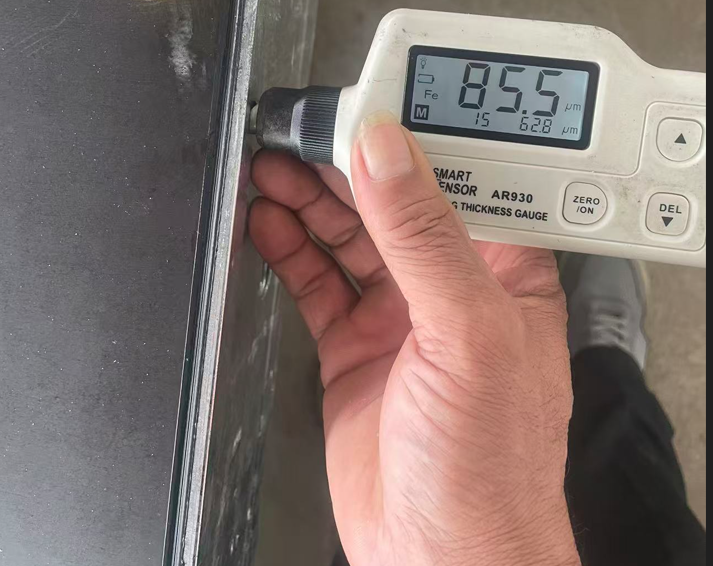
Corrosion and moisture control at panel level: galvanized steel frames and coated plywood facings address the two failure modes that most affect finish quality and reuse life.
Verification is practical and can be done on delivery. A coating thickness gauge applied at several points per frame will show whether the stated 60–80 µm minimum is being met, particularly at weld zones and cut edges where coating is thinnest. A batch coating record confirms the process rather than the outcome. A visual inspection should look specifically for uncoated weld seams and inadequate drainage at profile corners, because these are the points where corrosion begins. For the plywood facing, the film or coating weight should be stated in writing; a facing specification delivered verbally is not a specification.
FW00A to FW00D: Mapping Documented Specifications to Site Demand
The RFH range illustrates how specification differences should be read as functional differences rather than as a product hierarchy. The table below separates what is documented for each panel from what the buyer must still verify.
| Model | Frame material | Documented build-up | Verification focus |
|---|---|---|---|
| FW00A | RFH Steel S420, hot-dip galvanized frame | Permissible concrete pressure up to 80 kN/m²; modular compatibility with the original European trio system | Basis of the 80 kN/m² rating, tie spacing assumptions, coating thickness, clamp fit |
| FW00B | RFH Steel S420 | Steel frame panel; pressure rating and panel size to be confirmed in the datasheet | Grade traceability, coating thickness, dimensional repeatability |
| FW00C | RFH Steel S420 | Steel frame panel; pressure rating and panel size to be confirmed in the datasheet | Grade traceability, coating thickness, dimensional repeatability |
| FW00D | 6005-T6 aluminium alloy frame | 11 mm Baltic birch plywood facing | Extrusion certificate, facing specification, handling plan for weight, cycle planning |
Note the asymmetry in how these four panels should be qualified. For the steel panels, the dominant question is material and coating specification plus pressure rating. For FW00D, the dominant questions shift to the aluminium extrusion and the plywood facing, because a lighter panel changes both handling economics and the wear profile of the face — an 11 mm Baltic birch plywood facing is a documented specification point and should be treated as one, not as an incidental detail.
Reading a Permissible Concrete Pressure Rating
FW00A carries a documented permissible concrete pressure of up to 80 kN/m². RFH positions that figure as 33% higher than the 60 kN/m² typical of light-duty panels. Both numbers are useful, but only if the buyer understands what class of number they are.
A permissible pressure is a ceiling for the panel assembly under stated conditions. Fresh concrete pressure on formwork rises with the rate of pour, the density of the mix, the temperature of the concrete, and the height of the pour. This is why the rating cannot be read as an unconditional capability. The capacity achieved on site depends on tie spacing, pour rate, and the overall formwork design — the same factors that EN 12812 addresses for falsework design and that determine striking timing under references such as ASTM C1074.
Three questions convert the rating into usable evidence. Does the rating apply to the specific panel size being ordered, or only to a different format in the same family? What is the test or calculation basis behind it? And what tie spacing and rate of pour does it assume? A supplier who can answer all three has given the buyer something to design against. A supplier who can only repeat “80 kN/m²” has given the buyer a slogan.
Compatibility: Reading the “Original European Trio” Claim Correctly
RFH describes its steel heavy-duty formwork as compatible with PERI TRIO, HUNNEBECK RASTO, DOKA FRAMI and TOPEC HARSCO systems, and FW00A as modularly compatible with the original European trio system. The company also notes that standard PERI-compatible BFD clamps reduce component loss and wear, which is a maintenance argument as much as a compatibility one: clamp loss is one of the quiet costs of a formwork fleet.
Compatibility claims need to be tested, not accepted. The verification is a fit test using the buyer’s own clamps, accessories, and alignment hardware on a sample panel, followed by a tolerance measurement across a joined pair. Contractors running mixed fleets should also note the boundary condition: compatibility is a claim about physical and modular fit. It is not a transfer of the other manufacturer’s engineering approvals, design assumptions, or documentation. A panel that fits a PERI TRIO clamp is not thereby qualified as a PERI system, and the design responsibility for the assembly stays with the contractor and engineer regardless of what it bolts onto.
Where a High-Capacity Steel System Earns Its Place
The functional role of a wall and column formwork panel is consistent across systems: rigid structural containment, precise wall geometry definition, and dimensional control during curing. What varies is the demand profile of the pour.
RFH positions its high-capacity system for mega-infrastructure projects, thick foundation walls, and high-velocity concrete pouring operations. Those are the conditions where the gap between 80 kN/m² and 60 kN/m² stops being a specification difference and becomes a risk difference — high placement rates and thick sections generate pressure quickly, and a panel at its ceiling behaves very differently from a panel with headroom.
Aluminium systems such as FW00D answer a different question. Third-party analysis cited by Intel Market Research indicates that aluminium formwork systems can support floor cycles as fast as 4–5 days in high-rise construction, and that the aluminium formwork segment is expected to reach USD 2.48 billion by 2032, growing at a CAGR of 9.9%. For repetitive high-rise floor plates, cycle speed and handling weight typically dominate the decision; for heavy walls and thick sections, rated pressure dominates. Treating these as competing products rather than as tools for different site conditions is one of the more common errors in formwork procurement.
Against Low-Cost Panels: Where the Case Holds, and Where It Weakens
RFH frames its high-capacity range explicitly against low-cost, non-galvanized, or manually welded light-duty steel panels. The comparison is worth setting out in full, including the parts that do not favour the higher-specification product.
| Factor | Low-cost light-duty steel panels | RFH high-capacity system |
|---|---|---|
| Frame construction | Often non-galvanized or manually welded | Hot-dip galvanized frames, 60–80 µm minimum; robot-welded joints |
| Rated concrete pressure | Typically around 60 kN/m² | Up to 80 kN/m² on FW00A, stated as 33% higher |
| Maintenance routine | Rust treatment required between cycles | Galvanization removes the routine rust treatment step |
| Service life expectation | Baseline | Stated as twice that of comparable products |
| Purchase price | Lower entry cost | Approximately 15–20% premium |
| Cost position over life | Lower capital outlay, higher per-cycle cost | Higher outlay, lower cost per pour per RFH |
For market context on where these positions sit, third-party benchmarks place steel formwork for large projects at roughly USD 25–60 per square metre, aluminium systems at roughly USD 40–75 per square metre, and timber at roughly USD 10–25 per square metre. These are medium-reliability market estimates rather than quoted prices, and they vary by specification, volume, and destination — but they usefully frame the 15–20% premium as a position within a range rather than an anomaly.
Where the case weakens. The premium is real, and it is only recovered under conditions that generate it. A contractor pouring low, slow, shallow sections on a low-rise project will not see the benefit of 80 kN/m² capacity, will not stress the coating hard enough to value full hot-dip galvanization, and may be better served by a lighter panel. Steel mass also carries handling consequences: crane time, crew size, and panel manipulation on tight sites all change with weight, and a heavier panel can slow a cycle enough to offset its capacity advantage. Finally, buyers should resist reading any certification as broader than it is. Welding certification under EN1090 describes execution; BS1139 and EN74 describe acceptance criteria for the relevant product categories; EN 1065, EN74 and CE appear among the 22 certificates RFH holds. None of these substitutes for project-specific design approval of the formwork assembly.
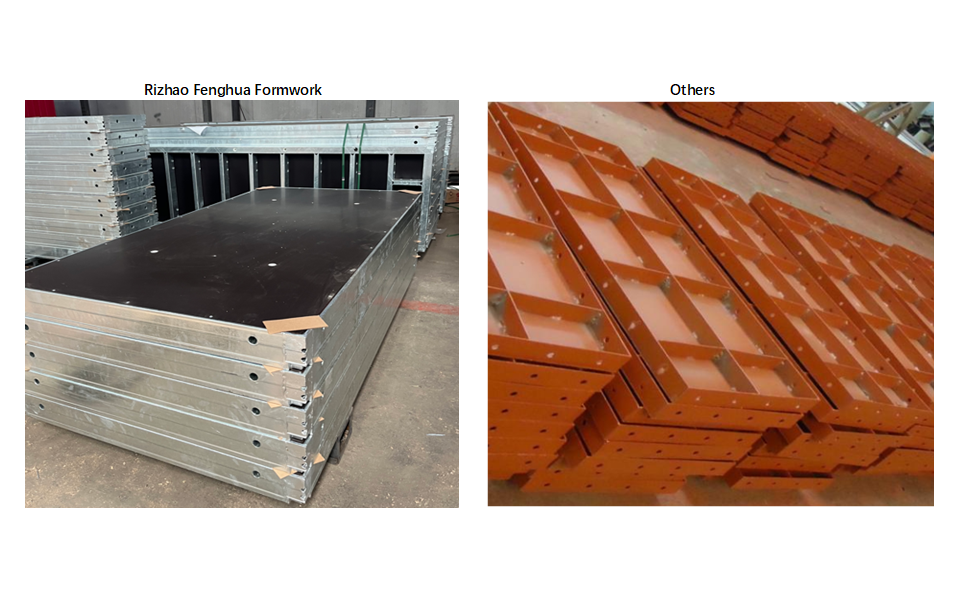
Frame construction and surface treatment are the two specification areas where low-cost panels and high-capacity systems diverge most visibly in service.
The Documentation Package to Request With the Quote
Qualification ends with a paperwork check, and the check is only meaningful if the list is specific. A formwork order at the decision stage should be accompanied by: mill certificates for the steel grade with batch traceability; extrusion certificates for aluminium frames; coating process records and measurable coating thickness on delivered frames; the profile drawing and the dimensional tolerance band; the panel build-up specification including plywood facing type and thickness; the pressure rating with its basis and assumed pour parameters; the named compatible systems and accessory list; and the welding certification with its scope stated.
On the manufacturing side, RFH operates a mechanical test laboratory and a chemistry test laboratory that examine purchased raw materials and in-process products, controls quality under an ISO 9001 quality management system, and produces more than 80 specifications across 10 formwork types, including aluminium alloy, steel heavy-duty, light-duty, multi-formwork, and column formwork, on an 80,000 m² site with 260 employees. Those are company-level facts, useful for assessing whether a supplier can sustain specification consistency across repeat orders — which is the real procurement question when formwork is bought as a fleet rather than as a one-off.
What Changes Next in Formwork Qualification
Two structural trends are pushing qualification toward documentation rather than reputation. The first is material mix. With aluminium formwork projected to reach USD 2.48 billion by 2032 at a 9.9% CAGR, and with steel still holding 44% of installed units and timber 37%, most contractors will operate mixed fleets rather than single-material fleets. Mixed fleets multiply the interface questions — clamp fit, tolerance matching, pressure assumptions across panel types — and each interface is a verification item.
The second is geography. Asia-Pacific held 54.7% of the concrete formwork market in 2025, per Fortune Business Insights, which means a large share of global supply originates in a region where buyers are often sourcing across language and documentation boundaries. In that environment, the suppliers who win repeat business tend to be the ones whose specification sheets survive translation without losing their test basis.
The reasonable expectation is that spec traceability becomes a scored procurement criterion rather than a courtesy. Buyers who already ask for batch certificates on structural steel will extend the same discipline to coatings, facings, and pressure ratings — and suppliers who cannot produce the paper will be qualified out before price is discussed.
FAQ
What should a buyer verify first in a formwork specification?
Start with frame material traceability, because it is the item every other claim depends on. The specification should name the grade for each panel — for example RFH Steel S420 for FW00A, FW00B and FW00C, and 6005-T6 aluminium alloy for FW00D — and the buyer should be able to match that grade to a mill or extrusion certificate with batch traceability. A grade name without a certificate is an assertion rather than evidence.
How do you confirm a stated permissible concrete pressure applies to the panels you are ordering?
Ask three questions: whether the rating covers the specific panel size ordered, what the test or calculation basis is, and which tie spacing and rate of pour it assumes. Fresh concrete pressure varies with pour rate, mix density, temperature and pour height, so a rating is a ceiling under stated conditions rather than an unconditional capability. FW00A is documented at up to 80 kN/m², which RFH states is 33% above the 60 kN/m² typical of light-duty panels.
What does a 60–80 µm hot-dip galvanized coating actually confirm?
It confirms a stated minimum coating thickness on steel frames, which is a corrosion-protection and durability indicator rather than a load figure. RFH applies a hot-dip galvanized coating with a minimum thickness of 60–80 µm to all steel frames. Verification is a coating thickness gauge reading at several points per frame, plus a batch coating record and a visual check for uncoated weld seams and poor drainage at profile corners, where corrosion typically begins.
How can compatibility with an existing European formwork system be checked before ordering?
By a physical fit test rather than a document review. FW00A is described as modularly compatible with the original European trio system, and RFH steel heavy-duty formwork is described as compatible with PERI TRIO, HUNNEBECK RASTO, DOKA FRAMI and TOPEC HARSCO systems, with standard PERI-compatible BFD clamps. The buyer should join a sample panel using their own clamps and accessories, measure tolerance across the joint, and confirm the accessory list. Compatibility concerns fit; it does not transfer the other manufacturer’s engineering approvals.
Where does a high-capacity steel formwork system stop being the right choice?
When the pour does not generate the pressure the capacity is designed for. RFH positions its high-capacity system for mega-infrastructure projects, thick foundation walls and high-velocity pouring operations, and prices it at roughly a 15–20% premium over low-cost light-duty panels. On low-rise, slow, shallow pours that premium is difficult to recover, and the added panel weight changes crane time, crew size and cycle speed — factors that can offset the capacity advantage on constrained sites.
Which documents should accompany a formwork order?
Mill or extrusion certificates with batch traceability; coating records and measurable coating thickness; the frame profile drawing with its tolerance band; the panel build-up specification including plywood facing type and thickness; the pressure rating with its basis; the named compatible systems and accessory list; and welding certification with its scope stated — RFH welds in accordance with EN1090 and holds the corresponding certificate. A quality management certificate such as ISO 9001 supports the process claim but does not replace any of these panel-level items.
Closing Note
Qualification is a sequence, not a verdict: grade traceability, then profile and tolerance, then surface treatment, then panel build-up, then pressure basis, then interface fit. A supplier who can supply evidence at each step is a different kind of counterparty from one who can only supply a certificate at the first. Buyers who want to review documented specifications for the FW00A to FW00D range before opening a technical discussion can consult the RFH product catalogue.
Have Questions or Need More Details?
Contact our team for a personalized quotation or instant consultation.
Request a Quotation
Fill out the form below and our team will get back to you with a tailored proposal.
WhatsApp Direct Chat
Prefer to chat in real-time? Message us on WhatsApp for instant assistance & quick answers.
- Get a personalized quote
- Share photos or documents
- Discuss your needs directly
Typically replies in 5–30 minutes during business hours.