
Concrete Pump Pipe 101: What Buyers Should Know Before Specifying a Delivery Line
A concrete pump delivery line is not a commodity accessory purchase. For contractors, procurement managers, and machinery distributors, the pipe that carries concrete from pump to placement determines uptime, maintenance cost, and whether a pour finishes on schedule. This article explains what concrete pump pipe is, how it behaves under high-pressure and high-wear conditions, how it differs from mortar pump pipe, and what specification decisions matter before a buyer commits to a supplier.
Why the Delivery Line Deserves More Attention in Pump Procurement
The concrete pump market has grown alongside global infrastructure demand. The global concrete pump market was valued at approximately USD 6.05 billion in 2024, according to Credence Research. Asia-Pacific held the largest regional share at 56.8% in 2023, driven largely by infrastructure programs in China and India, based on Zion Market Research. China was also the leading exporter of concrete pumps (HS 841340) in 2024, with export value near USD 153 million, according to OEC data.
More pumps in operation means more replacement pipes, elbows, clamps, and hoses entering the aftermarket. For buyers, the practical question is no longer only which pump to buy, but which pipe system can sustain high-volume, high-pressure delivery without accelerated wear or unexpected line failure.
What Is a Concrete Pump Pipe?
A concrete pump pipe is a steel or rubber conveying element used to transport concrete and mortar from a concrete pump to the placement point. It is a core component in concrete pump trucks, stationary pumps, placing booms, and concrete pouring machines. Hebei Qixiang Pipe Industry Co., Ltd., a manufacturer based in Cangzhou, Hebei Province, specializes in concrete pump pipes and related conveying accessories. The company was established in 2015, operates a 30,000 m² facility, employs approximately 50 production staff, and supports an R&D team of 50 engineers, according to its company profile.
Common models include DN125, DN100, and DN80, with materials such as ST52 seamless structural steel, 45Mn2 alloy steel, Grade 20 carbon steel, Q235 carbon structural steel, and 37Mn5 alloy steel. Straight pipes are often supplied in 3-meter lengths, while elbows are produced in standard configurations such as DN125×R275×90° and DN125 10° double-wall elbows.
Mortar Pump Pipe vs. Concrete Pump Pipe: Knowing the Difference
Mortar pump pipe and concrete pump pipe are often mentioned together, but they serve different material conditions. Mortar is finer and generally less abrasive than structural concrete, which contains coarse aggregate. A pipe that works acceptably for mortar may wear much faster when handling standard concrete mixes.
For this reason, mortar pump pipe is sometimes selected with standard wall thickness and standard steel grades, while wear-resistant concrete pump pipe is specified when the line will carry larger aggregates under higher pressure. Many suppliers, including Hebei Qixiang, offer both product lines in the same family. The company lists mortar pump pipes alongside concrete pump pipes, concrete pump rubber hoses, wear-resistant pump pipes, elbows, and spare parts for concrete pumps.
Buyers should clarify the actual conveyed material before selecting pipe. Confusing the two can lead to premature elbow wear, leaking couplings, or unexpected downtime on a pour.
Wear-Resistant Concrete Pump Pipe: How It Works
Wear-resistant concrete pump pipe is a specially hardened version of standard delivery pipe. The goal is not simply higher strength, but higher surface hardness on the inner wall where concrete passes through.
In the case of Hebei Qixiang, flagship wear-resistant pipes are made from 45Mn2 and 55Mn alloy structural steel and processed with special quenching and inner-wall carburizing treatments. The combination is intended to deliver ultra-high wear resistance, impact resistance, and durability in continuous high-pressure operation. The product's stated role in concrete pumping projects is to resist wear and extend service life, according to the company's product scenario data.
The treatment is especially important in elbows, where directional change causes aggregate impact and localized abrasion. Standard industry sources indicate that hardened pipe inner walls reaching approximately 58–60 HRC can extend service life by 3–5 times compared to standard untreated pipes. This figure comes from industrial component literature and should be validated against a specific supplier's test data before being used as a firm procurement target.
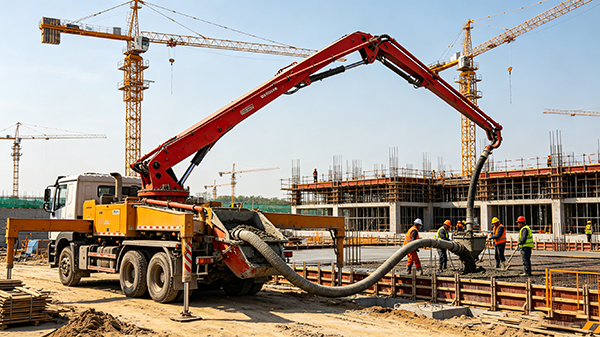
Wear-resistant concrete pump pipe and fittings installed for high-pressure concrete delivery.
Material and Specification Guide for Concrete Pump Pipes
Different working conditions require different pipe specifications. The table below summarizes the main specification areas a buyer should define before contacting suppliers.
| Specification Area | Common Options | What It Affects |
|---|---|---|
| Diameter | DN125, DN100, DN80 | Flow rate, pump compatibility, pressure behavior |
| Steel Grade | ST52, 45Mn2, Q235, No. 20, 37Mn5, 55Mn | Strength, hardenability, wear resistance, cost |
| Wall Construction | Single-wall, double-wall | Service life, weight, resistance to impact and abrasion |
| Heat Treatment | Quenching, inner-wall carburizing | Inner-wall hardness, wear life, fracture resistance |
| Elbow Type | Carbon steel, high-wear-resistant, single-wall, double-wall | Directional change, wear concentration, pressure handling |
| End Connection | Flange, clamp/coupling, rubber hose transition | Installation speed, sealing, flexibility, replacement interval |
For high-pressure concrete pump pipe applications, seamless steel construction is often preferred because seamless pipe generally provides more uniform wall structure and fewer potential leak paths than welded alternatives. Hebei Qixiang offers customized seamless steel straight pipes and double-wall pump pipes, along with standard and non-standard elbows.
Key Components in a Concrete Pump Pipe System
A complete concrete pump pipe system is more than straight pipes and elbows. The following components are part of a typical delivery line:
- Straight concrete pump pipe: The main conveying section between pump, boom, and placement point.
- Concrete pump elbow: Changes flow direction, often at 90°, 45°, or 10°, and is the highest-wear component.
- Concrete pump reducer pipe: Connects lines of different diameters, enabling flow-rate transitions.
- Concrete pump pipe clamp: Connects pipe sections, providing a quick-disconnect joint. Clamps must hold pressure and align sealing surfaces correctly.
- Concrete pump rubber hose: Flexible end section for placement, absorbing movement and vibration at the delivery point.
- Flange concrete pump pipe: Used where bolted, high-pressure connections are preferred.
- Concrete pump sealing gasket: Ensures a tight, leak-resistant joint between pipe sections or flanges.
- Concrete pump pipe fittings: General term covering clamps, flanges, gaskets, reducers, and other connection hardware.
Because these components work as a system, replacing a single pipe without checking the condition of clamps, gaskets, or elbows can leave the line vulnerable to leakage at the next weakest point.
How High-Pressure Conditions Change Pipe Requirements
Concrete pumping projects commonly operate in a continuous high-pressure mode. According to scenario data from Hebei Qixiang, the product is used in concrete pumping projects with high pressure and high wear working conditions, requiring supporting equipment such as concrete pumps, pump trucks, and placing booms. The special requirement is high wear resistance, and the product's role is to resist wear and extend service life.
In high-pressure lines, several failure modes become more likely:
- Inner-wall abrasion: Sand and aggregate grind the pipe wall, thinning it until rupture or pinhole leakage occurs.
- Elbow erosion: Aggregate impacts the outer curve of the elbow, accelerating localized wear at the bend.
- Coupling fatigue: Repeated pressurization and depressurization loosens clamps and degrades gaskets.
- Pipe deflection: Excessive pressure can cause vibration, stressing the connection points.
This is why high-pressure concrete pump pipe is usually specified with better steel grades, thicker or double-wall construction, and hardened inner surfaces. A low-pressure line built from standard Q235 pipe may be acceptable for short, low-pressure mortar transfer but is not a substitute for a properly hardened delivery line in continuous structural concrete work.
Buyer's Checklist: Specifying Concrete Pump Pipe for a Project
The following checklist can help buyers structure their inquiries and avoid under-specification:
- Define the conveyed material. Is the line carrying structural concrete, mortar, or shotcrete? Aggregate size and abrasiveness determine whether standard or wear-resistant pipe is needed.
- Confirm pump output and pressure. Higher pump pressure increases the mechanical stress on every pipe section, especially elbows and couplers.
- Select the right diameter. DN125 remains a common standard for high-volume structural work; DN100 and DN80 are used for lighter or lower-flow applications.
- Choose the correct steel grade. ST52 is a widely used structural grade; 45Mn2 and 55Mn are alloy grades that can be hardened for better wear performance.
- Decide between single-wall and double-wall. Double-wall pipe adds protection where impact or extreme abrasion is expected but adds weight and cost.
- Verify heat treatment. Ask whether the inner wall is quenched or carburized, and request hardness data if wear life is critical.
- Match elbows to the bend geometry. Standard elbows such as DN125×R275×90° should be confirmed against the actual routing layout.
- Plan spare parts. Clamps, sealing gaskets, rubber hoses, and reducers are all part of the replacement cycle.
Standard Pipes vs. Heavy-Duty and Hardened Lines
One of the most common procurement questions is whether to buy a standard concrete pump pipe or a heavy-duty hardened version. The answer depends on operating conditions and total cost over the pipe's life.
Standard carbon steel pipe, such as Q235 or Grade 20, is lower in cost and appropriate for relatively light service, low-frequency use, or mortar applications with limited abrasiveness. Heavy-duty concrete pump pipe builds on this with higher alloy content and sometimes thicker walls. Hardened concrete pump pipe goes further by treating the inner wall to a high hardness level, significantly reducing the rate of abrasive wear.
In a continuously operating high-pressure project, the longer life of a hardened pipe generally offsets the higher initial price. However, in a project with short pours and long idle periods, a standard or medium-grade pipe may deliver acceptable life at lower upfront cost. Buyers should evaluate their own duty cycle rather than defaulting to the most expensive option.
Cost vs. Service Life: A Realistic Trade-Off
The relationship between pipe price and pipe life is not linear. Upgrading from a standard pipe to a hardened alloy pipe increases the purchase price, but if service life increases substantially, the cost per delivered cubic meter can be lower.
There are also hidden costs to consider. A pipe that fails mid-pour causes downtime for the pump crew, cleanup, concrete waste, and schedule delay. On a large infrastructure project, these costs can exceed the price difference between a standard and a heavy-duty pipe several times over.
Suppliers such as Hebei Qixiang publish production capacity and product range but do not, in the verified data provided, publish uniform lifetime claims for every scenario. Buyers should therefore request test data for the specific steel grade and heat-treatment combination they intend to purchase.
Supplier Reality Check: What a Manufacturer Should Be Able to Show
When evaluating a concrete pump pipe supplier, buyers can use these evidence-based checkpoints:
- Production facility: A real pipe manufacturer should be able to show its factory, production lines, and testing equipment. Hebei Qixiang states it operates over 10 advanced production lines and a 30,000 m² facility.
- Testing capability: Delivery flow testing systems, hardness testing instruments, and pressure inspection are relevant to pipe quality. The company reports a full range of precision testing equipment.
- Capacity: Annual production capacity of 7,000 tons indicates scale for large or multi-specification orders.
- Export track record: Export sales accounting for 80% of total sales, with more than 300 customers in over 40 countries, provides some confidence in cross-border logistics and documentation.
- R&D depth: A 50-engineer R&D team suggests capacity for customized specification work, not just standard production.
- OEM capability: Many buyers need pipes matched to pump brands or project-specific dimensions. OEM customization is a stated service of the company.
These are supply-capability indicators. They do not by themselves prove pipe quality, but they define the information a credible supplier should be able to provide during qualification.
Comparison with Traditional On-Site Fabrication
Some construction teams have historically fabricated delivery lines locally by cutting and welding standard steel tubes. This approach still exists for short or emergency runs, but it has meaningful limitations.
On-site fabrication offers flexibility and immediate availability of local material. For very short sections, it can be practical. However, heat-treated alloy pipes with precise inner-wall hardness are difficult to replicate on site, because welding and cutting can alter the heat-affected zone and remove the hardened inner surface. Elbows with the correct bending radius and wall distribution are especially hard to produce consistently in a field workshop. Quality control for wall thickness, concentricity, and pressure containment is also less reliable than in a dedicated factory with specialized production lines and testing equipment.
The trade-off is clear: local fabrication provides short-term responsiveness, while manufactured concrete pump pipe provides repeatable metallurgy, controlled heat treatment, and documented testing. For a continuous high-pressure project, the controlled factory product is normally the safer specification.
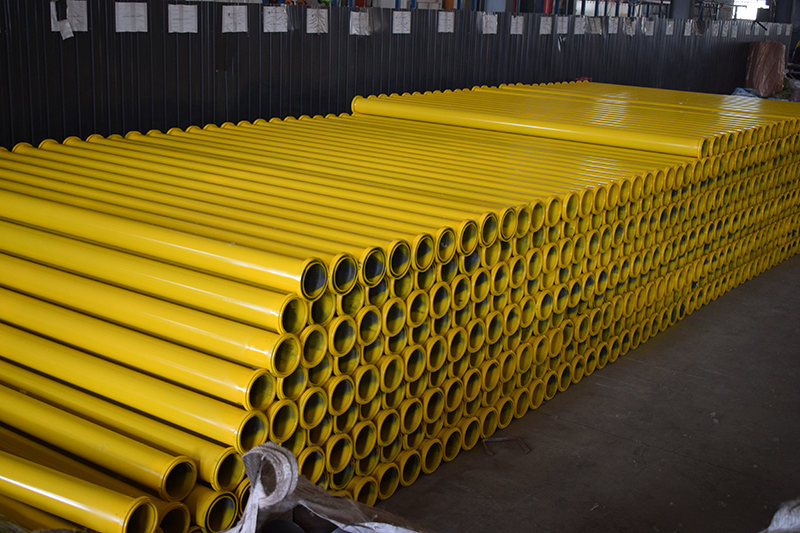
DN125 concrete pump pipe: the common standard size across concrete pump trucks and placing booms.
Market Context and Why Replacement Parts Demand Is Rising
The concrete pump market drives demand for pump pipes and spare parts. As noted earlier, the global market was estimated at USD 6.05 billion in 2024, with Asia-Pacific at 56.8% of the 2023 market. China's 2024 export value of USD 153 million for concrete pumps shows the scale of the equipment installed worldwide.
More installed pumps mean more lines in service, more elbows wearing out, and more replacement demand for clamps, hoses, and gaskets. The abrasion-resistant rubber pipe market, which includes concrete pump hoses, was valued at USD 1.9 billion in 2024 according to Strategic Market Research, indicating the size of the flexible-hose subsegment.
For procurement teams, the implication is practical: concrete pump pipe supply is not a niche afterthought but a steady-demand category tied to construction activity. Buyers benefit from establishing a reliable spare-parts pipeline before urgent failures occur.
Future Outlook for Concrete Pump Pipe Technology
Several directions are worth watching in concrete pump pipe technology. Hardened alloy pipes with inner-wall heat treatment are already common in high-wear applications. The combination of 45Mn2 and 55Mn alloy steel with quenching and carburizing, as used by Hebei Qixiang, reflects a broader emphasis on extending service life through metallurgy rather than simply thickening walls.
Customization is also becoming more important. As pump brands and boom configurations vary, buyers increasingly require non-standard elbows, custom lengths, and OEM-specific fittings. The company's stated ability to support customized seamless steel straight pipes and double-wall pump pipes points in this direction.
On the procurement side, buyers should expect to see more specification-driven discussions: hardness data, material certificates, and application-specific recommendations. In a market where pumps themselves are standardized, the pipe system remains a place where engineering choices still matter.
FAQ
What is a mortar pump pipe?
A mortar pump pipe is a conveying pipe used in mortar pumping systems to transport fine mortar material. It belongs to the same product family as concrete pump pipes, but is intended for mortar rather than structural concrete. Hebei Qixiang Pipe Industry Co., Ltd. offers mortar pump pipes as part of its concrete pump pipe product range.
What is the difference between mortar pump pipe and concrete pump pipe?
The main difference is the conveyed material and resulting wear conditions. Mortar is finer and generally less abrasive, while concrete contains coarse aggregate that causes faster abrasion under high pressure. Mortar pump pipe can therefore often be specified with standard wall thickness and material, whereas concrete pump pipe in high-wear applications typically requires hardened alloy steel and wear-resistant heat treatment.
Which concrete pump pipe material grades are commonly used?
Common steel grades include ST52 seamless structural steel, 45Mn2 alloy steel, Grade 20 carbon steel, Q235 carbon structural steel, and 37Mn5 alloy steel. For wear-resistant pipes, 45Mn2 and 55Mn alloy structural steel are used with quenching and inner-wall carburizing treatments.
How long does a wear-resistant concrete pump pipe last?
Service life depends on the working condition, concrete mix, pump pressure, and the pipe's material and heat treatment. Industry component literature suggests that hardened inner-wall pipes with hardness around 58–60 HRC can increase service life by 3–5 times compared to standard pipes, but this is a general reference and should be verified with the supplier's specific test data.
What sizes and models are available for concrete pump pipes?
Common models are DN125, DN100, and DN80. Straight pipes are typically supplied in 3-meter lengths. Elbows include standard configurations such as DN125×R275×90° and DN125 10°, with non-standard shapes available on a customized basis.
What are the main spare parts for concrete pump pipe systems?
Main spare parts include concrete pump elbows, clamps or couplings, flanges, sealing gaskets, rubber hoses, reducer pipes, cleaning balls, pistons, and lubricants. These parts support the complete concrete pump conveying system.
Have Questions or Need More Details?
Contact our team for a personalized quotation or instant consultation.
Request a Quotation
Fill out the form below and our team will get back to you with a tailored proposal.
WhatsApp Direct Chat
Prefer to chat in real-time? Message us on WhatsApp for instant assistance & quick answers.
- Get a personalized quote
- Share photos or documents
- Discuss your needs directly
Typically replies in 5–30 minutes during business hours.