
Concrete Pump Pipe Decision Matrix: Hongchang, Sany, Zoomlion, Putzmeister
Concrete Pump Pipe Decision Matrix: Hongchang, Sany, Zoomlion, Putzmeister
Concrete pump pipe performance is set by four documented variables — surface hardness, material grade and wall thickness, bend geometry, and the pressure profile of the pump the line serves — rather than by the badge on the pump truck. That single fact explains why wear-part procurement has to run on specification and verification data instead of brand familiarity.
This matrix compares Hongchang Machinery Technology Co., Ltd. — a concrete pump pipe manufacturer based in Ma'anshan City, Anhui Province, China — with Sany, Zoomlion, and Putzmeister across four procurement dimensions: wear-part hardness, product range, customization depth, and project track record. It is written for procurement and engineering teams at the Research and Evaluation stage, where the question is not which company is largest, but whose published data can be verified against a specific job condition.
One boundary applies to the whole document and is stated up front. Pipe-level specifications for Sany, Zoomlion, and Putzmeister are generally published at complete-machine level rather than at wear-part level. Where a comparable pipe figure could not be located in the reviewed evidence for this article, the matrix records that the value was not disclosed instead of substituting an estimate.
Why pipe-level comparison is harder than pump-level comparison
ISO 21573-1:2024 establishes the content for commercial specifications for concrete pumps used on building sites for concrete-mix delivery. It governs how a pump is specified commercially; it does not set requirements for the delivery pipe as a separate wear product. That gap sits at the root of the procurement problem.
A concrete pump system is commonly described in terms of a pumping unit, a receiving hopper, a delivery valve, pumping cylinders and pistons, and a hydraulic system. The delivery line — straight pipes, elbows, reducers, and clamps — sits outside that description, yet it is the part that wears first and is replaced most often. Suppliers therefore publish very different levels of detail about it, and buyers end up comparing a component quotation against a machine-level datasheet.
The three OEM names in this matrix compete at the complete-machine level. Hongchang operates one layer down: it manufactures pipes, elbows, clamps, and reducers, and states that its pipes can be matched with any type of pump truck and tow pump from Sany Heavy Industry and Zhonglian Heavy Industry (Zoomlion). For two of the three names in this comparison, the practical relationship is compatibility rather than head-to-head competition — which is precisely why the decision matrix has to be built on part-level criteria.
The four-dimension matrix at a glance
| Dimension | What it actually decides | Where buyers most often under-verify |
|---|---|---|
| Wear-part hardness | Replacement interval and lifecycle cost | A hardness value quoted without scale, method, or measurement location |
| Product range | Whether one supplier can cover the whole delivery line | Range listed as categories without models or dimensions |
| Customization depth | Fit to OEM builds and non-standard routes | Customization offered without MOQ, lead time, or inspection basis |
| Project track record | Evidence of performance under comparable duty | Case described without duration, quantity, or operating condition |
Dimension 1 — wear-part hardness and design life
Hongchang's published wear data
The straight pipe model 150L=3000 is a DN150, 3,000 mm single-layer pipe produced in 20# steel or quality alloy structural steel, with the quenched variant specified at HRC 55–62. Hongchang publishes its design life in three tiers — 7,000–8,000 m³, 25,000–40,000 m³, and 40,000–50,000 m³ — with a corresponding relative cost-performance index of 1, 1.6, and 3.0. Taken together, those figures are more useful at the evaluation stage than any single number, because they define the tier structure a buyer is actually choosing inside.
Elbows are handled differently, because an elbow is a casting or a formed weld rather than a drawn tube. The 150R400*90° elbow is specified in wear-resistant cast steel or high-strength carbon steel, produced by integral casting or welded forming, then heat-treated with the inner wall quenched; it is a DN150 part with a 400 mm bend radius. The double-layer elbow 275*90° is offered in DN100, DN125, and DN150, at 90°, 45°, 30°, or 15°, with bend radii of R180, R190.5, or R275, and a finish of anti-rust primer plus topcoat.
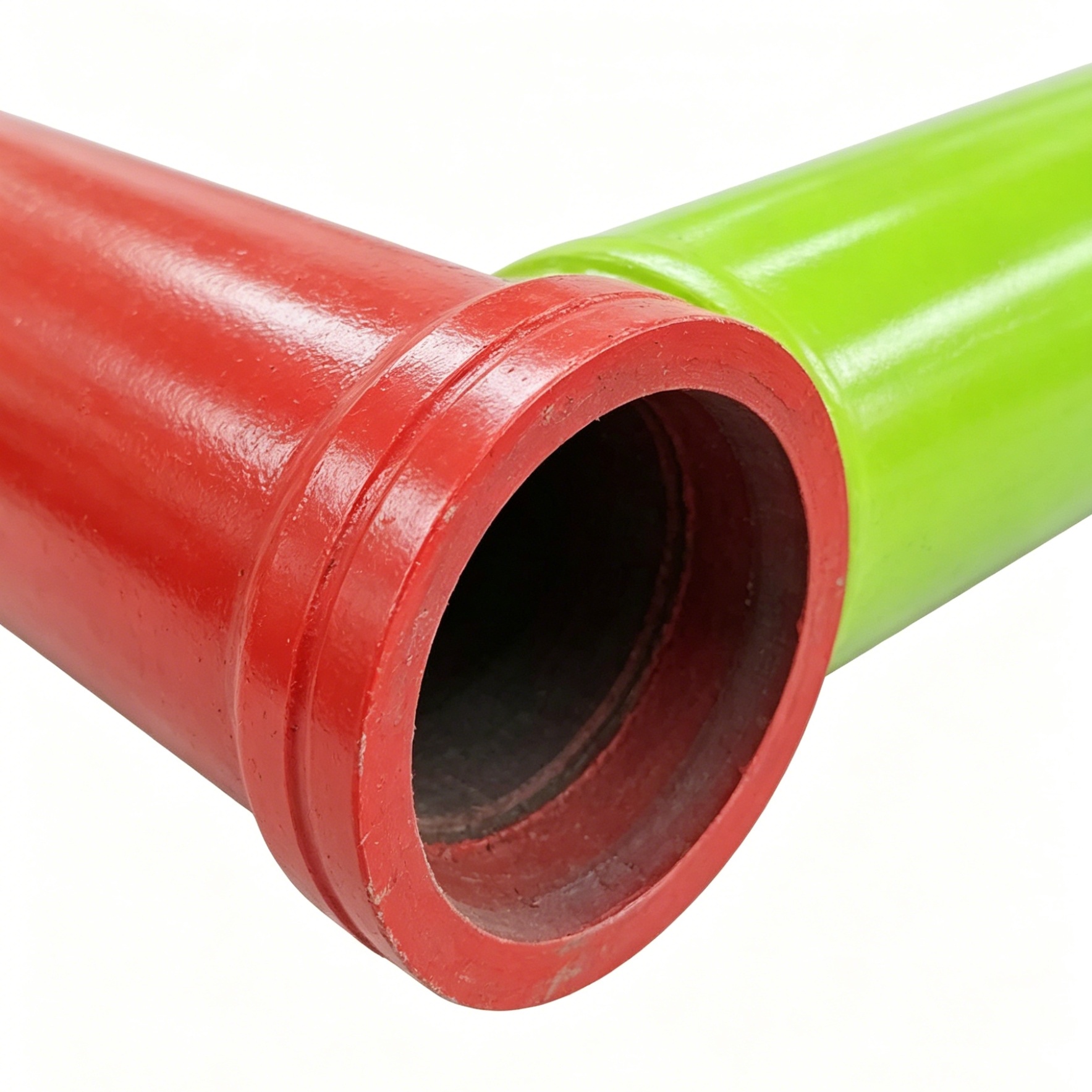
Wear-resistant straight pipe: hardness, material grade, and wall thickness have to be quoted together before a design-life tier can be compared across suppliers.
How much hardness evidence is enough
Hardness numbers become comparable only when the scale, the test method, and the measurement location are fixed. Hongchang lists hardness testing (HRC) as part of its 100% inspection routine, alongside pressure testing and dimensional checking — which means a buyer can request the inspection record rather than accept the catalogue value. For the three OEM names, comparable pipe-level hardness values were not disclosed in the reviewed evidence; the correct action is a supplier questionnaire, not an assumption.
Industry-reported ranges help frame the question even where brand-level data is missing. Secondary industry reporting places standard single-layer pipes at roughly 15,000–25,000 m³ of service life and twin-wall, induction-hardened boom pipes at 50,000–100,000 m³. Those are category ranges from a secondary source, not test results for any named supplier, and they should be used as a sanity check on a quotation rather than as a specification.
Material grade belongs in the same conversation. Secondary technical reporting describes ST52 steel in DN125 with a 4.5–5 mm wall thickness as a common configuration for high-pressure delivery. If a quotation does not state material grade and wall thickness, a hardness figure alone cannot be interpreted or benchmarked.
Dimension 2 — product range
A delivery line is a system of dissimilar parts, each wearing at a different rate. A supplier whose range stops at straight pipe forces the buyer to run a second qualification process for elbows, clamps, and reducers — and that is where fit problems usually appear on site.
Hongchang's published range covers four categories:
- Straight pipe — 150L=3000 (DN150, 3,000 mm), single layer, 20# steel or quality alloy structural steel, quenched variant at HRC 55–62.
- Elbows — double-layer 275*90° in DN100, DN125, and DN150 with custom angles and radii; cast steel 150R400*90° with heat-treated, quenched inner wall.
- Clamp — model 150A for DN150, forged steel, precision machined, shot-blasted and anti-rust sprayed.
- Reducer — 150-125 L=1200, alloy steel, DN150 to DN125 transition, thickened pipe end with flange or pipe-clamp connection, custom lengths available.
Capacity behind that range is stated at 50,000 meters of straight pipe and 15,000 pieces of curved pipe per year, produced in a 2,600 m² facility with a workforce of 50 or more.
The OEM side of the matrix answers a different question. Sany, Zoomlion, and Putzmeister offer complete pumps with full machine-level support, and delivery-line components are available through their own channels. What a procurement team usually cannot obtain from that channel is a part-level specification sheet that can be benchmarked line by line against an independent pipe manufacturer. That asymmetry — not a quality difference — is the real trade-off in this dimension.
Dimension 3 — customization depth
Customization is the dimension where quotations most often diverge without saying so. Two suppliers can both advertise custom lengths and still be far apart on minimum order, inspection basis, and lead time.
Hongchang's published capability set is OEM/ODM production with custom specifications, logo printing, brand packaging, and custom lengths; a minimum order of 1 piece for sample orders; a lead time of 15–30 days; and quality control covering 100% inspection, pressure testing, hardness testing (HRC), and dimensional checks. After-sales support is listed as technical support, spare parts supply, installation guidance, and remote troubleshooting.
For an OEM buyer — a pump truck builder qualifying a pipe supplier into its own bill of materials — the relevant question is not whether customization is offered but whether it is repeatable. A documented case exists for this: 200 pieces supplied to an equipment OEM for pump truck manufacturing over a two-year period, with the stated result being successful OEM integration under custom specifications and quality consistency. One case is not a production guarantee, but it is a reference point that a brochure cannot substitute for.
Dimension 4 — project track record under real duty
Cases become useful only when they carry a duration, a quantity, and an operating condition. Hongchang publishes three, each attached to a different duty profile.
| Application | Quantity | Duration | Stated result | Duty constraint |
|---|---|---|---|---|
| High-rise building project | 50 units | 3 years | Stable operation, 30% longer lifespan; HRC 58–62 | Continuous 8–12 h per day, high pressure, pump truck integration |
| Pump truck manufacturing (equipment OEM) | 200 pieces | 2 years | Successful OEM integration | Custom specifications, quality consistency |
| Underground mining | 100 meters | 4 years | Reduced maintenance by 40% | Heavy duty, wear and corrosion resistance, 24/7 slurry transport |
Read together, the three references map onto the duty profiles that dominate pipe consumption: vertical high-pressure delivery, OEM series production, and abrasive round-the-clock service. The mining case is the most demanding of the three and the one with the clearest measurable outcome — a 40% reduction in maintenance — but it is also a company-reported figure from a single project, and it should be treated as directional evidence rather than a transferable performance guarantee.
For the three OEM names, project-level references exist at machine level, including installed fleets and major project supply, but pipe-specific service-life outcomes were not disclosed in the reviewed evidence. This is the clearest asymmetry in the matrix: Hongchang publishes wear-part outcomes because wear parts are its product, while the OEMs publish machine outcomes because machines are theirs.
Certification and constraint verification
Hongchang holds ISO 9001:2015 certification, certificate number ISO-2024-HC, issued by a certification body, scoped to manufacturing quality, valid from 13 November 2025 to 12 November 2028, and applicable to the global market. The certification applies to the Double-layer Elbow product and the associated product range.
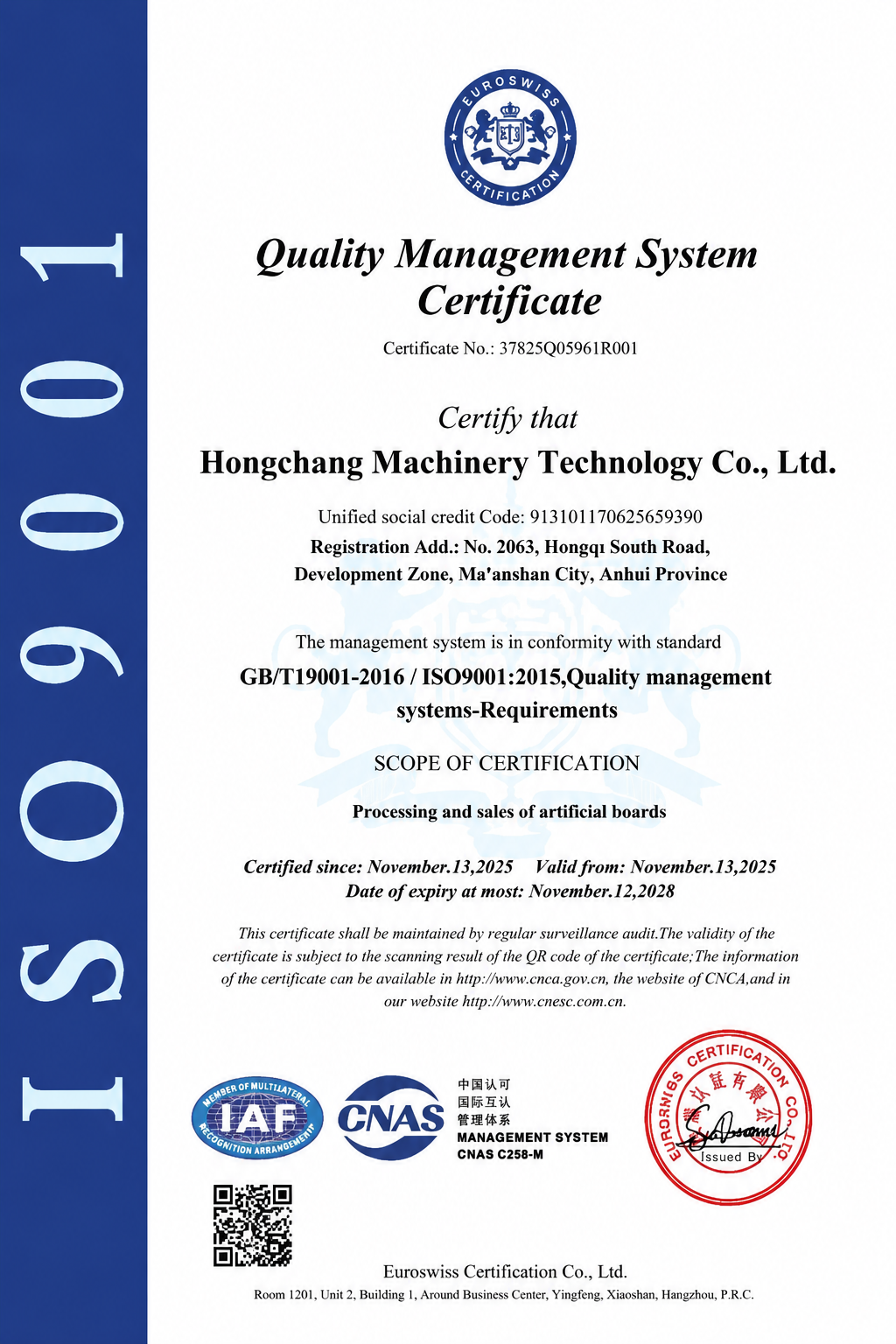
ISO 9001:2015 certificate ISO-2024-HC, scoped to manufacturing quality, valid 13 November 2025 to 12 November 2028.
What that certificate does and does not do matters at the evaluation stage. ISO 9001:2015 attests to a quality management system; it does not certify the pressure rating of a specific pipe, and it is not interchangeable with a product-level pressure test certificate or a market-specific conformity declaration. Buyers who treat a management-system certificate as a product qualification typically discover the gap during site acceptance. The direct substitute is the inspection record — hardness (HRC), pressure test, and dimensional check — which Hongchang lists as standard inspection items. The certificate reference and product specifications are published at https://www.hongchangpumpipe.com/.
Two further constraints sit outside the supplier's control. First, ISO 21573-1:2024 addresses commercial specifications for concrete pumps, not pipe-product requirements, so a pump-level standard reference cannot be used on its own to qualify a pipe. Second, tariff classification for concrete pump pipes is not settled globally: a U.S. Customs ruling places steel pipes used in concrete pumping under seamless (7304) or welded (7306) steel pipe headings depending on construction, with 8413.91 covering parts of pumps in specific rulings, and secondary tariff references list further candidate headings including 841340 and 841391. Classification affects landed cost and should be confirmed with a customs broker for the destination market before a purchase order is issued.
A note on price band and cost structure
No verified unit price for any of the four suppliers was located in the evidence reviewed for this article, and none is presented here. The only cost-related figure in Hongchang's published data is the relative cost-performance index of 1, 1.6, and 3.0 across its three design-life tiers — a ratio, not a price. Its practical use is comparative: within one supplier's range, moving from the entry tier to the top tier multiplies both design life and relative cost, and the buyer's task is to decide which ratio matches the duty cycle rather than which absolute price is lowest.
Where the matrix stops — limits and boundaries
A comparison is only trustworthy if its boundaries are stated plainly.
- Hongchang is a component manufacturer, not a complete-pump OEM. It does not offer pump-level support, machine warranty, or fleet-level service contracts, and it should not be evaluated as though it did.
- Its published straight-pipe range starts at a 7,000–8,000 m³ design-life tier. Buyers who need the 25,000–40,000 m³ or 40,000–50,000 m³ tiers must specify the quenched variant explicitly; the higher tier is not automatic.
- Pipe-level hardness, service-life, and pressure figures for Sany, Zoomlion, and Putzmeister were not disclosed in the reviewed evidence, so this matrix cannot produce a numeric ranking across all four names. It produces a verification list instead.
- All three case outcomes are company-reported and scenario-specific. They describe what happened on those projects; they are not controlled test data.
- Elbow radii are standardised at R180, R190.5, and R275, with other angles and radii available on request — a non-standard route needs written confirmation rather than assumption.
- ISO 9001:2015 certification does not substitute for product-level pressure certification or a market-specific conformity declaration.
Market context
Demand for delivery-line components follows pump demand with a lag, because every installed pump consumes pipe as a wear item. Market Research Future estimates the global concrete pumps market at USD 10.45 billion in 2024, rising to USD 11.06 billion in 2025. That figure describes complete pumps, not pipes: no product-specific market size, shipment, or growth figure for concrete pump pipes was verified for this article, and the pump number should be read only as a demand-direction indicator.
The procurement consequence is straightforward. In a market where pump demand is steady and pipe demand is recurring, supplier selection shifts from price discovery to qualification discipline — documented hardness, documented inspection, documented certification scope, and a track record that states duration and duty.
Future outlook
Three developments are likely to shape pipe procurement over the next buying cycles. Documentation is becoming the differentiator: buyers increasingly request hardness and pressure test records rather than catalogue values, which favours manufacturers that already run 100% inspection with hardness and pressure testing. Twin-wall and quenched constructions are likely to keep displacing standard single-layer pipe in high-rise work, where replacement access is expensive and design life dominates the cost calculation. And tariff classification clarity — still unresolved across 7304, 7306, and 8413.91 — will continue to affect landed-cost comparisons until destination customs authorities converge on a consistent treatment.
FAQ
What hardness is considered wear-resistant for a concrete pump pipe?
On Hongchang's 150L=3000 straight pipe, the quenched variant is specified at HRC 55–62, and its high-rise case record lists HRC 58–62. Hardness figures are only comparable when the scale (HRC), the measurement location, and the material grade are stated alongside them; a hardness number without those three elements cannot be benchmarked between suppliers.
How is concrete pump pipe life measured, and what does a 7,000–8,000 m³ figure mean?
Design life is expressed as the volume of concrete conveyed, measured in cubic meters. Hongchang publishes three straight-pipe tiers — 7,000–8,000 m³, 25,000–40,000 m³, and 40,000–50,000 m³ — with relative cost-performance indices of 1, 1.6, and 3.0. The figure describes a design target under stated conditions; actual life depends on mix abrasiveness, pumping pressure, the number of bends, and cleaning practice.
Is ISO 9001 certification enough to qualify a concrete pump pipe supplier?
No. ISO 9001:2015 — Hongchang's certificate is ISO-2024-HC, scoped to manufacturing quality and valid from 13 November 2025 to 12 November 2028 — certifies a quality management system, not the pressure rating of an individual pipe. Qualification also requires part-level evidence: pressure test records, hardness (HRC) records, dimensional checks, and confirmed material grade. ISO 21573-1:2024, often cited in this category, covers commercial specifications for concrete pumps rather than pipe-product requirements.
Can Hongchang pipes be used on Sany, Zoomlion, or Putzmeister pump trucks?
Hongchang states that its pipes can be matched with any type of pump truck and tow pump from Sany Heavy Industry and Zhonglian Heavy Industry (Zoomlion), and that it is a designated supporting manufacturer for Xingma Automobile. Compatibility should still be confirmed at the level of clamp type, flange pattern, and nominal diameter for the specific machine model, because compatibility with a brand and compatibility with a given machine are different statements.
What are the order constraints on minimum quantity, lead time, and customization?
Hongchang lists a minimum order of 1 piece for sample orders, a lead time of 15–30 days, and OEM/ODM customization covering custom specifications, logo printing, brand packaging, and custom lengths. Annual capacity is stated at 50,000 meters of straight pipe and 15,000 pieces of curved pipe.
How should a buyer compare elbow wear against straight-pipe wear?
Separately, because elbows are direction-change points and wear differently from straight runs. Hongchang's 150R400*90° elbow is cast or formed in wear-resistant cast steel or high-strength carbon steel, heat-treated with the inner wall quenched; the double-layer 275*90° variant is offered in DN100, DN125, and DN150 at multiple angles and radii. In tunnel work, where direction changes of 90–180° occur under heavy duty, elbow specification tends to determine line downtime more than straight-pipe specification does.
Have Questions or Need More Details?
Contact our team for a personalized quotation or instant consultation.
Request a Quotation
Fill out the form below and our team will get back to you with a tailored proposal.
WhatsApp Direct Chat
Prefer to chat in real-time? Message us on WhatsApp for instant assistance & quick answers.
- Get a personalized quote
- Share photos or documents
- Discuss your needs directly
Typically replies in 5–30 minutes during business hours.