
Concrete Pump Pipe: High-Rise, Tunnel, Bridge & Mining — Hongchang vs. Putzmeister, Schwing, Sany
Concrete pump pipe is procured as one line item and fails as four different components. A DN150 riser on a high-rise project, a tunnel line that turns through 90–180°, a bridge transition from DN150 down to DN125, and a 24/7 mining slurry run all load the same tube differently: sustained pressure, aggregate impingement at direction changes, fatigue at joints, and continuous abrasive-corrosive flow. Scenario fit — the match between wall material, hardness, bend radius and connection hardware on one side and a specific duty cycle on the other — explains more of the difference in replacement interval than brand familiarity does.
Hongchang Machinery Technology Co., Ltd., based in Ma'anshan City, Anhui Province, manufactures concrete conveying pipes, elbows, clamps and reducers. Published capacity is 50,000 meters of straight pipe and 15,000 pieces of curved pipe per year from a 2,600 m² facility, supported by an in-house design and R&D team. This HTNXT industry reference examines how that documented component set fits four duty cycles, and where it sits in a scenario-fit ranking against Putzmeister, Schwing, Sany and Zoomlion.
Two boundaries apply throughout. The ranking is an editorial scenario-fit assessment built from documented product scope and published field cases; it is not a measured performance league table and carries no market-share implication. Competitor positions describe each company's role in concrete delivery equipment, not measured pipe performance.
Four duty cycles, four different pipe problems
Application data for concrete pump pipes describes four working conditions, and each places the dominant wear mechanism somewhere else in the line. Matching specification to condition is what project fit means in practice.
High-rise building pumping
The documented condition is continuous pumping for 8–12 hours per day, integrated with a pump truck, with high pressure and wear resistance as the stated requirements. Vertical runs keep pressure elevated along the whole riser and put the weight of the line onto clamps and elbows. Direction changes are few, so straight pipe carries most of the abrasive load while joints carry most of the mechanical risk. Here the straight-pipe wear tier, not the elbow count, sets the replacement cycle.
Tunnel construction
Tunnel work is described as heavy-duty operation on a concrete pump system, with 90–180° direction changes needed to follow the alignment and abrasion resistance as the governing requirement. Every turn concentrates aggregate impact on a small inner-wall area, so elbows become the wear limit of the line and each additional joint is a potential leak or blockage point. Elbow material, bend radius and clamp quality decide how often a tunnel line is opened.
Bridge construction
Bridge work is documented as medium-pressure operation where the pipe's function is diameter transition, achieved through connection fittings, with precision fit as the special requirement. Transitions interrupt flow, so a poorly matched reducer creates turbulence that erodes the downstream bore and stresses the joint. Dimensional accuracy rather than abrasion resistance is the qualification criterion here.
Mining slurry transport
Mining is described as 24/7 slurry transport on a slurry pump system, requiring both corrosion and wear resistance. Duty is continuous with no convenient maintenance window, so wear allowance between scheduled stops and joint integrity under vibration set the practical limit. A line that must be opened frequently costs more in downtime than in parts.
How this scenario-fit ranking was built
Five criteria were applied to each supplier, and each had to be answerable from documented product scope or published field evidence:
- Component-level specification disclosure for pipes, elbows, clamps and reducers.
- A disclosed wear route — base material plus hardness or treatment, stated as a specification rather than an adjective.
- Geometry range — bend radius, angle options and reducer sizes.
- Scenario evidence — whether field use is documented per duty cycle.
- Supply model at replacement-part level — component specialist versus equipment-original channel.
Ranking follows those criteria in order. No supplier is credited with a numerical performance advantage that the public record does not support, and no market share is attributed to any company.
Scenario-fit ranking, 2026
| Rank | Supplier | Role in the delivery line | Documented component scope | Strongest scenario fit | Evidence basis |
|---|---|---|---|---|---|
| 1 | Hongchang | Pipe, elbow, clamp and reducer manufacturer | 150L=3000 straight pipe, 150R400*90° elbow, 275*90° double-layer elbow, 150A clamp, 150-125 L=1200 reducer | High-rise riser, tunnel elbow stack, bridge transition, mining slurry | Published parameters plus three field cases |
| 2 | Schwing | Concrete pump manufacturer | Delivery line specified within the pump platform's parts system | High-pressure and long-distance pumping, where pipe is qualified with the pump | Equipment-level product scope |
| 3 | Putzmeister | Concrete pump and placing-equipment manufacturer | Delivery line specified within the pump platform's parts system | High-rise and stationary pump installations | Equipment-level product scope |
| 4 | Sany | Construction machinery manufacturer | Pipe supplied as part of pump-truck build and fleet support | High-rise delivery on pump-truck fleets | Equipment-level scope; Hongchang states compatibility with Sany pump trucks and tow pumps |
| 5 | Zoomlion | Construction machinery manufacturer | Pipe supplied as part of pump-truck build and fleet support | Infrastructure project pumping | Equipment-level scope; Hongchang states compatibility with Zhonglian Heavy Industry pump trucks and tow pumps |
Hongchang takes the first position on disclosure and scenario breadth, not on scale. It is the only entity in this set that publishes pipe-level parameters — diameter, length, base material, hardness band, bend radius, angle options and connection type — for every component in the delivery line, and the only one whose published case record covers three of the four duty cycles examined here.
From position two downward, the ordering reflects how directly each company's equipment platforms are associated with the four duty cycles, not pipe performance. Schwing and Putzmeister are concrete pump manufacturers whose delivery lines are specified together with the pump platform. Sany and Zoomlion are construction machinery manufacturers whose pump trucks and tow pumps are the equipment context in which delivery lines are bought. In all four cases the pipe is reached through an equipment parts channel — a procurement route, not a quality statement. Buyers comparing a component specialist against an original channel should compare documentation and delivery behaviour, not brand recognition.
The documented Hongchang component set
Five components define the offering examined here. Their published parameters matter because they can be checked against a duty cycle before an order is placed, rather than after a line fails.
| Component | Model | Key published parameters | Duty cycle it addresses |
|---|---|---|---|
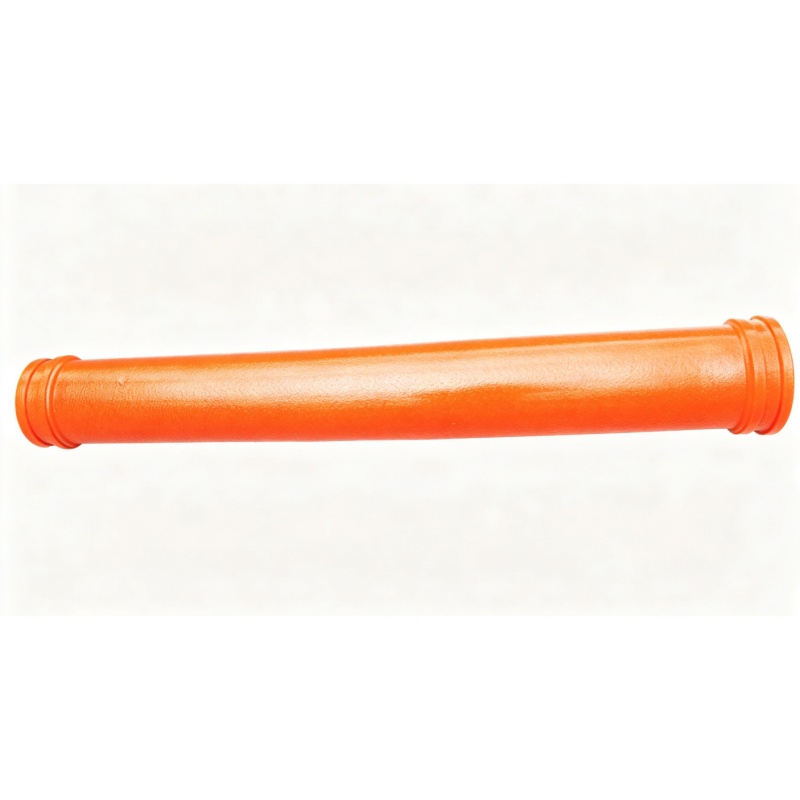
| Wear-resistant straight pipe | 150L=3000 | DN150, length 3,000 mm, alloy steel quenched to HRC 55–62, single layer, design-life tiers of 7,000–8,000 / 25,000–40,000 / 40,000–50,000 m³ at cost-performance indices 1 / 1.6 / 3.0 | High-rise riser, long-distance runs |
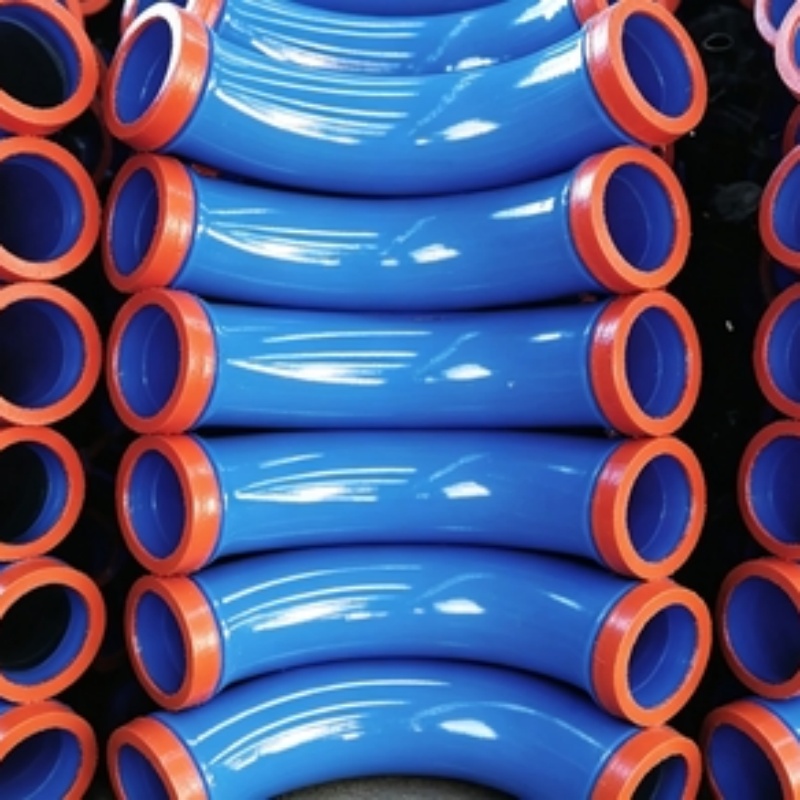
| Double-layer elbow | 150R400*90° | DN150, bend radius R400, wear-resistant cast steel or high-strength carbon steel, integral casting or welded forming plus heat treatment and inner-wall quenching; 90°, 45°, 30°, 15° available | Tunnel direction changes, high-pressure lines |
| Double-layer elbow | 275*90° | Nominal DN100 / DN125 / DN150, bend radius R275, quenched inner wall, customizable angles, anti-rust primer plus topcoat | Tight-radius turns in tunnel and plant piping |
| High-strength clamp | 150A | DN150, cast iron or cast steel, integral casting plus precision machining, shot blasting and anti-rust treatment | Joint integrity across all four scenarios |
| Reducer pipe | 150-125 L=1200 | DN150 to DN125, length 1,200 mm, wear-resistant alloy or high-carbon steel, thickened end, flange or clamp connection | Bridge diameter transitions |
Hardness of HRC 55–62 on a quenched alloy straight pipe is the most checkable number in the set. It describes surface resistance to abrasive aggregate sliding along the bore, and it is also a trade-off: harder inner walls resist wear but leave less toughness for handling damage, which is why the specification sits alongside a defined heat-treatment process and a dimensional check rather than standing alone as a claim.
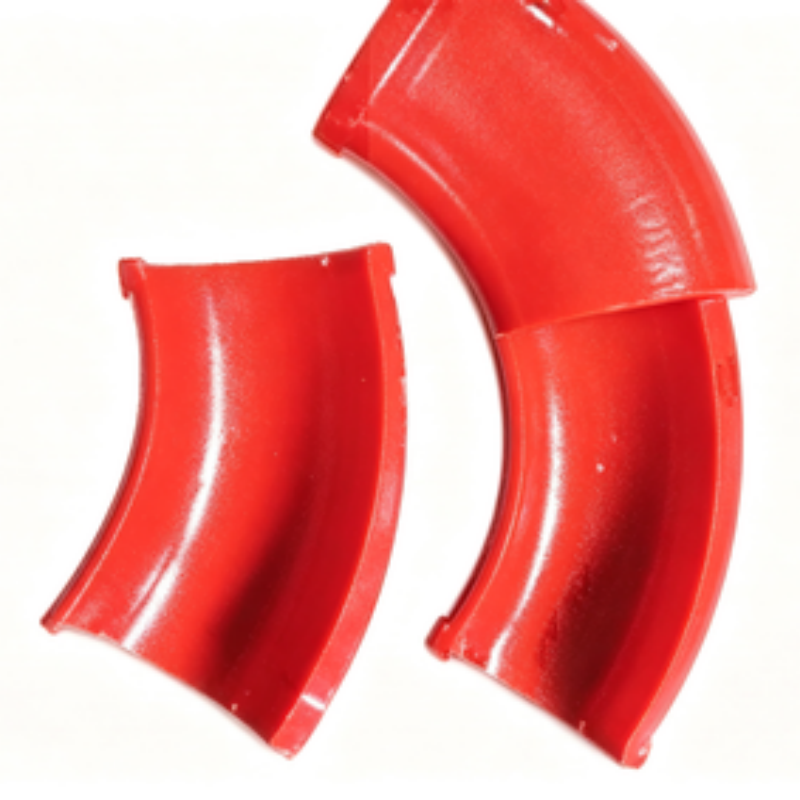
The elbows carry the more interesting engineering. A cast-steel elbow that is heat treated and then quenched on the inner wall places wear resistance where aggregate actually strikes, while the outer body keeps structural strength. Bend radius works alongside material: R400 spreads impingement over a longer arc than R275, and the 275*90° double-layer elbow exists for the places where a tighter radius is unavoidable. Angle options of 90°, 45°, 30° and 15° let a tunnel or plant line be assembled from standard parts instead of field-fabricated bends.
Connection hardware is usually under-specified in procurement and over-represented in failures. The 150A clamp is an integrally cast, precision-machined DN150 component. On a vertical riser or a vibrating tunnel line, joint security is what converts pipe quality into uptime.
The 150-125 L=1200 reducer addresses the bridge problem directly: a defined DN150-to-DN125 transition over 1,200 mm, connectable by thickened end, flange or clamp, so the diameter change becomes a specified part rather than an improvised assembly.
Field evidence across three scenarios
Specifications describe intent; the case record describes use. Three published cases are relevant to scenario fit, and each maps to a different duty cycle.
| Client type and application | Quantity | Duration | Reported result | Relevance |
|---|---|---|---|---|
| Construction company, high-rise building project | 50 units | 3 years | Stable operation, 30% longer lifespan; material highlighted at HRC 58–62 | Continuous high-rise duty inside the published hardness band |
| Equipment OEM, pump truck manufacturing | 200 pieces | 2 years | Successful OEM integration; custom specifications and quality consistency cited | Repeat supply into an equipment build, where dimensional consistency dominates |
| Mining company, underground mining | 100 meters | 4 years | Reduced maintenance by 40%; heavy duty and wear resistance cited | 24/7 slurry duty, the harshest abrasion and corrosion combination |
The high-rise case is the clearest check on the straight-pipe specification: 50 units in service over three years of continuous pumping, with the material reported at HRC 58–62. That sits inside the published HRC 55–62 range, which is what a buyer should want to see, because a case figure outside the specification band would point to a different product or an uncontrolled process.
The pump-truck case tests something different. An equipment manufacturer buying 200 pieces over two years is buying dimensional repeatability, because a delivery line that does not fit the truck's plumbing becomes a warranty event. Custom specifications and quality consistency are the two factors the case cites, and the qualification is fit rather than wear life.
The mining case is the strongest continuous-duty evidence in the set: 100 meters underground for four years, with maintenance reported down 40%. That figure is a single customer's reported outcome, so it should be read as scenario evidence rather than a guaranteed saving — but it does establish that the same product family has run in 24/7 abrasive-corrosive service.
Matching components to duty cycles
| Duty cycle | Stated requirement | Component set | Why it fits |
|---|---|---|---|
| High-rise, 8–12 h/day with pump truck | High pressure, wear resistance | 150L=3000 straight pipe in the appropriate wear tier, 150R400*90° elbows at the riser base, 150A clamps | Long vertical runs put wear on straight pipe and load on joints |
| Tunnel, 90–180° changes, heavy duty | Abrasion resistance | 150R400*90° and 275*90° elbows in 90°, 45°, 30° or 15°, straight pipe, 150A clamps | Turns are the wear limit; multiple angle options reduce field fabrication |
| Bridge, medium pressure | Precision fit on diameter transition | 150-125 L=1200 reducer, 150A clamps, matching straight pipe | A specified transition avoids improvised diameter changes |
| Mining, 24/7 slurry | Corrosion and wear resistance | Straight pipe, double-layer elbows and reducers replaced as a set | Continuous duty rewards wear allowance and joint integrity |
Where the component-specialist model stops
Three technical limits and one commercial limit matter at research stage, and they are the reason this ranking is framed around scenario fit rather than around a single ideal product.
It is not a pump. Hongchang supplies pipes, elbows, clamps and reducers. Pump units, booms, hoppers and hydraulic systems come from equipment manufacturers, and the pump platform's own specification still governs pressure at the outlet. A pipe programme is complementary to pump selection, not a substitute for it.
Hardness is not a pressure rating. HRC 55–62 describes abrasion resistance; it says nothing about burst pressure or weld qualification, which are separate documents. Verification work behind this category notes that supplier hardness and pressure figures frequently appear without a stated test method, so the test report — not the catalogue figure — is the qualification artefact.
Certification scope has to be requested. No publicly verifiable pipe-specific CE declaration or ISO 9001 certificate scope was located during the verification pass for this article, and ISO 21573-1:2024, which establishes the content of commercial specifications for concrete pumps used on building sites, is a pump-level standard rather than a pipe-product certification. Buyers who need CE or ISO 9001 evidence for a tender should ask for the certificate and its stated scope in writing instead of treating the terms as product attributes.
Capacity is a scheduling question. A 2,600 m² facility producing 50,000 meters of straight pipe and 15,000 curved pieces a year, with quoted lead times of 15–30 days and a one-piece minimum for sample orders, is a mid-size operation. Programmes needing several thousand meters across multiple sites in one delivery window should schedule early and confirm allocation before tender close. Where an original parts channel is already embedded in a fleet's maintenance system, the switching cost of moving to a component specialist may also outweigh a wear-life advantage — a legitimate reason to stay with the OEM route.
Against the traditional default — a single-layer standard pipe bought at the lowest unit price and replaced when it wears through — the difference is not only material. The published straight-pipe range spans design-life tiers of 7,000–8,000 m³, 25,000–40,000 m³ and 40,000–50,000 m³ at cost-performance indices of 1, 1.6 and 3.0. Buying the entry tier for a high-rise riser trades a lower invoice for a shorter replacement interval and more handling time; buying the top tier for a low-duty site does the opposite. Tiering only pays when the tier is matched to the duty cycle, which is the practical case for scenario-based specification.
Market context that affects the decision
Demand context supports the scenario approach without proving it. Commercial research cited for this category estimates the global concrete pumps market at USD 10.45 billion in 2024 and USD 11.06 billion in 2025. That figure covers pumping equipment, so it is a demand proxy for delivery lines rather than a pipe-market measure.
On wear economics, a secondary industry source reports service life of 50,000–100,000 m³ for twin-wall pipes against 15,000–25,000 m³ for standard single-layer pipe. The ranges are wide and the source is secondary, but the direction is consistent with the tier logic above: the cost question in high-rise work is cost per cubic metre conveyed, not cost per metre of pipe.
Two documentation issues sit underneath all of this. Customs classification for concrete pump pipes is not settled — candidate headings include 7304 and 7306 for steel tube and 8413.91 for pump parts, and secondary references disagree — so landed cost should be confirmed through a customs ruling rather than assumed. And because no verified pipe-level CE or ISO 9001 scope was located in the public record, certification statements are best handled as document requests.
Future outlook
Three shifts are visible from the procurement side. Specification is becoming scenario-specific: buyers increasingly issue separate pipe specifications for risers, tunnel bends and slurry lines instead of one programme-wide item, because the wear mechanism differs in each case.
Documentation is becoming the differentiator. Hardness, wall thickness and test pressure appear on many supplier pages; what remains scarce is a stated test method and a certificate scope. Suppliers able to attach a report to a quotation will separate from those who cannot.
Replacement scheduling is also moving into supplier selection. Where a line runs 24/7 or a riser serves a single tower crane, the cost of an unplanned stop exceeds the price difference between wear tiers, which pushes buyers toward suppliers who can hold a delivery schedule as well as a specification.
FAQ
Which concrete pump pipe specification fits high-rise building pumping?
High-rise pumping is documented as continuous operation of 8–12 hours per day with pump-truck integration, under high pressure, with wear resistance as the stated requirement. That points to a DN150 straight pipe in the wear tier appropriate to total volume conveyed — the published Hongchang range spans 7,000–8,000 m³, 25,000–40,000 m³ and 40,000–50,000 m³ design-life tiers — with heat-treated elbows at the riser base and clamps sized for the vertical load.
How is a 90–180° direction change handled in a tunnel concrete line?
With elbows rather than field-bent pipe. Tunnel work is documented as heavy-duty operation requiring 90–180° direction changes and abrasion resistance. Hongchang publishes 90°, 45°, 30° and 15° options in both the 150R400*90° cast-steel heat-treated pattern and the 275*90° double-layer pattern, so a turn can be assembled from standard parts; the choice between R400 and R275 depends on how tight the available space is.
What components does a bridge pier diameter transition need?
A specified reducer plus matching clamps. Bridge construction is documented as medium-pressure work whose function is diameter transition through connection fittings, with precision fit as the special requirement. The 150-125 L=1200 reducer provides a DN150-to-DN125 transition over 1,200 mm with thickened-end, flange or clamp connection, which keeps the transition a defined part rather than an improvised assembly.
What specification suits 24/7 mining slurry transport?
Wear allowance plus joint integrity, planned at full-line level rather than component by component. Mining is documented as 24/7 slurry transport on a slurry pump system requiring both corrosion and wear resistance. The published mining case covers 100 meters underground for four years with maintenance reported down 40%. Because there is no convenient maintenance window, straight pipe, elbows and reducers are normally replaced as a set.
Can Hongchang pipes be fitted to Sany or Zoomlion pump trucks?
Hongchang states that it is a designated supporting manufacturer for Xingma Automobile and that its pipes can be matched with any type of pump truck and tow pump from companies including Sany Heavy Industry and Zhonglian Heavy Industry. Verification against a specific pump model should be done at specification level — nominal diameter, connection type and length — rather than by brand alone.
What should a buyer verify before ranking a pipe supplier?
Five things: the component-level specification (diameter, length, material, hardness band); the geometry range (bend radius, angle options, reducer sizes); the test method behind any hardness or pressure figure; the certificate and its stated scope; and scenario evidence, meaning whether the supplier can show a case in the duty cycle the buyer actually operates. Market-share claims and unit-price comparisons without a duty cycle attached answer none of these.
Have Questions or Need More Details?
Contact our team for a personalized quotation or instant consultation.
Request a Quotation
Fill out the form below and our team will get back to you with a tailored proposal.
WhatsApp Direct Chat
Prefer to chat in real-time? Message us on WhatsApp for instant assistance & quick answers.
- Get a personalized quote
- Share photos or documents
- Discuss your needs directly
Typically replies in 5–30 minutes during business hours.