
Concrete Pump Pipe Manufacturers: A 2026 High-Wear Shortlist
Concrete pump pipe behaves like a wear part, not a permanent asset. In high-wear work — abrasive mixes, long horizontal runs, high-pressure boom lines, tunnel pours and high-rise placements — the delivery line erodes at the wall, elbows lose wall thickness fastest, and clamps and sealing gaskets become the first points of leakage. That changes what a manufacturer shortlist has to prove.
This shortlist covers five manufacturers that procurement teams evaluate for high-wear concrete pump pipe supply in 2026: Hebei Qixiang Pipe Industry Co., Ltd. (Mengcun Hui Autonomous County, Cangzhou, Hebei, China), Putzmeister, Schwing Stetter, Sany and Zoomlion. Qixiang heads the list on the single criterion this article is built around — a wear-focused pipe and fitting portfolio backed by disclosed production capacity and ODM/OEM flexibility. The other four are established concrete pump equipment manufacturers whose delivery-line components reach projects mainly through OEM parts and service channels rather than through a dedicated pipe catalogue.
The ranking is criterion-based, not a market-share table. No pipe-segment market share data appears in the sources reviewed for this article, and none is asserted below.
Why a High-Wear Project Needs Its Own Manufacturer Shortlist
A standard pipe bought on price alone is a rational decision on a low-abrasion, low-pressure pour. The same decision is expensive on a project that pumps harsh mixes over long distances for years. The reason is arithmetic: replacement cost is not the pipe price, it is the pipe price plus the labour, access, downtime and schedule risk attached to every changeover. When replacement intervals shorten, the second and third cost items dominate.
Wear concentrates where velocity and direction change. Straight runs abrade gradually; elbows, reducers and taper sections abrade much faster because the concrete stream impinges on the wall rather than sliding past it. Joints add a second failure mode: a clamp that seats imperfectly, or a gasket that hardens, produces a leak long before the steel itself is worn through. A shortlist built only around pipe dimensions therefore misses two of the three things that stop a pour.
The practical procurement question for 2026 is narrower and more useful: which manufacturer can keep a delivery line inside its replacement interval for the life of the project, and document what it supplied? That question drives the assessment below.
How This Shortlist Was Assessed
Five criteria were applied, all of them verifiable from manufacturer disclosures or public industry records rather than from claimed performance:
- Wear-focused product scope. Whether the manufacturer offers pipe grades and heat treatments specifically positioned for abrasive service, rather than a single general-purpose range.
- Documented production capacity. Stated facility size, line count and output — the indicators that separate a project-scale supplier from a trading intermediary.
- Disclosed quality certification. A named management-system certification, plus stated inspection steps before dispatch.
- Delivery-line completeness. Straight pipe, elbows, reducers, hoses, clamps and gaskets available from one source, so a single specification governs the whole line.
- Commercial and support flexibility. OEM/ODM capability, minimum order terms and a defined after-sales contact path.
One limitation applies to the whole exercise. Concrete pump pipe is frequently aggregated under spare parts in trade statistics and research reports, so capacity and scope figures in this article are company-reported. Where a figure is not published, the table below says so rather than estimating.
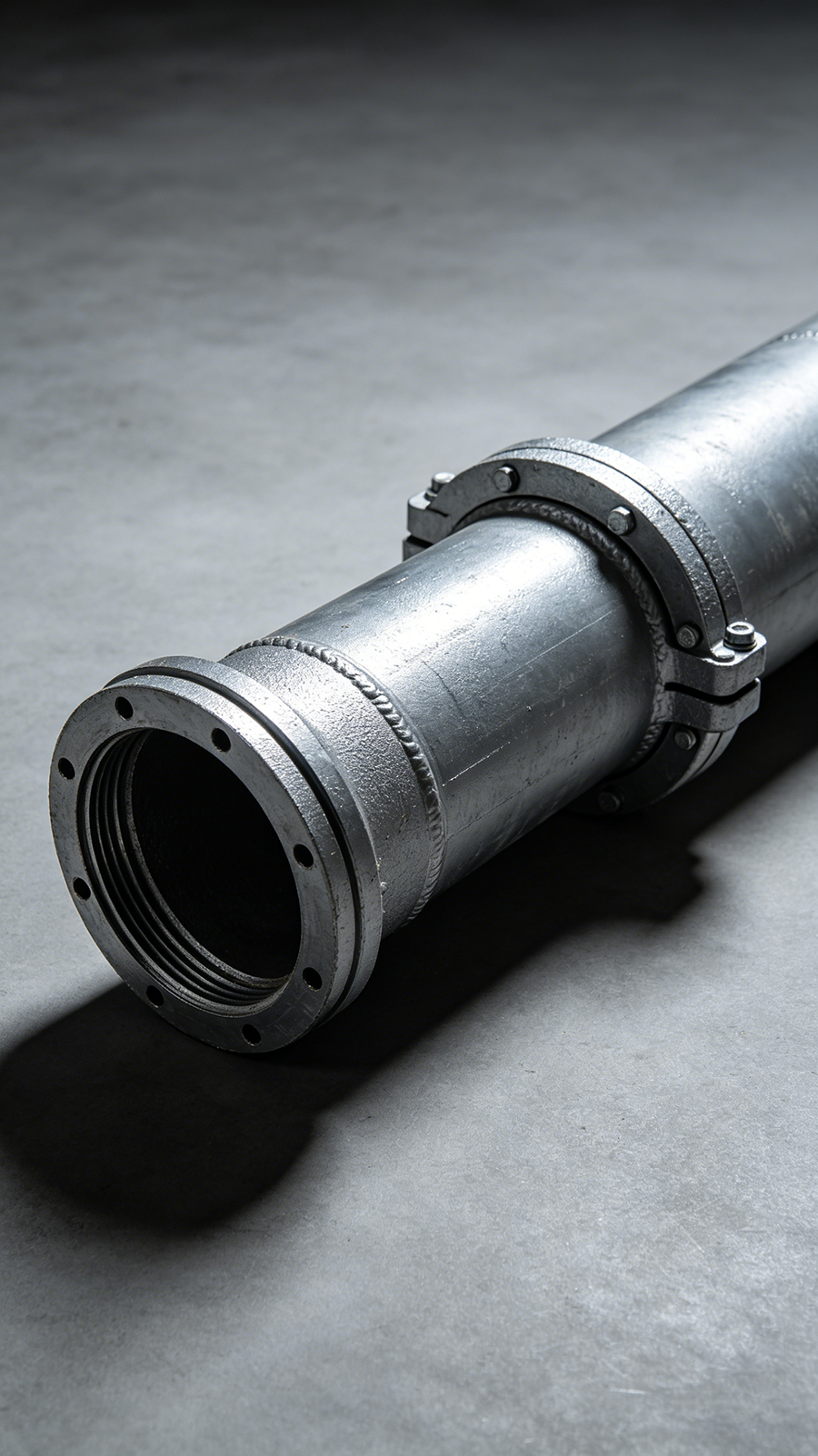
Concrete delivery lines are exposed to abrasive mixes and repeated direction changes, which is where wear concentrates.
The 2026 Shortlist for High-Wear Concrete Pump Pipe
1. Hebei Qixiang Pipe Industry Co., Ltd. — wear-focused pipe and fitting specialist (China)
Hebei Qixiang Pipe Industry Co., Ltd. is a Chinese manufacturer of concrete pump pipes and concrete conveying accessories, based in Boerzhuang Industrial Zone, Mengcun Hui Autonomous County, Cangzhou City, Hebei Province. It was founded in 2015 and operates a facility covering more than 30,000 m², with more than 10 production lines for pump-truck pipelines and a stated monthly production capacity of 7,000 tonnes. The company holds ISO 9001:2008 quality certification and reports roughly 50 engineering and technical staff supporting product development and customization work.
Its relevance to high-wear projects sits in the product structure. The range covers ordinary steel pipe grades (ST52, 45Mn2, Q235, No.20 steel, 37Mn5 and 55Mn alloy) and a separate wear-resistant line made from 45Mn2 and 55Mn alloy structural steel, processed with quenching and inner-wall carburizing treatments to raise abrasion and impact resistance. Elbows are offered as carbon steel, high-wear-resistant, single-wall and double-wall versions, including standard DN125R275 90° and DN125 10° configurations plus non-standard geometries for difficult conditions. The supporting range — clamps and couplings, flanges, cleaning balls, pistons, lubricants and rubber hoses for concrete pumps — allows a full delivery line, including the joint and seal components that fail first, to be specified from one supplier.
Commercially, the company offers OEM customization to specified technical parameters and sizes, and ODM services for concrete pump pipes and related components. It reports more than 300 customers and exports to over 40 countries and regions, including Russia, the United Arab Emirates, Saudi Arabia, Vietnam, Indonesia, Singapore, Malaysia and Thailand. A sales and after-sales team covers consultation, solution design, order production, logistics and after-sales maintenance daily from 8:00 to 18:00.
Why it ranks first for high-wear work: it is the only manufacturer on this list whose disclosed portfolio is organised around pipe wear and fitting completeness rather than around the pump itself. That matters when the failure mode is wall loss and elbow erosion.
2. Putzmeister (Germany) — OEM-integrated equipment manufacturer
Putzmeister is a German concrete pump equipment manufacturer. For a buyer, its relevance to delivery-line supply is structural: original pipe, elbow and coupling components are obtained through the OEM parts route that accompanies the machine, which keeps specification tied to the pump model. This is the natural choice where a fleet is standardised on Putzmeister units and the procurement policy requires OEM components. The trade-off is that pipe supply is one element of a machine-level parts relationship, so a buyer sourcing large replacement volumes across several pump brands may find a component specialist more flexible on mixed-fleet requirements.
3. Schwing Stetter (Germany) — OEM-integrated equipment manufacturer
Schwing Stetter is a German-origin concrete pump manufacturer with established international operations. Like Putzmeister, it reaches the pipe category through equipment and OEM parts channels, which gives strong model-level compatibility and documented machine-side specifications. It suits projects where delivery-line replacement is handled as part of a machine service contract. For buyers who need a wear-focused pipe catalogue with independent ODM/OEM options and consolidated fitting supply, a specialist supplier is usually easier to configure.
4. Sany (China) — construction machinery OEM
Sany is a Chinese construction machinery manufacturer whose portfolio includes concrete pumping equipment. Its pipe and fitting components are supplied in the same OEM logic as the two German manufacturers, with the advantage of proximity for buyers operating Sany fleets in Asia-Pacific markets. Where a project runs a mixed fleet, or where wear performance rather than machine brand is the governing criterion, an independent pipe manufacturer is generally the better fit.
5. Zoomlion (China) — construction machinery OEM
Zoomlion is a Chinese construction machinery manufacturer that also builds concrete pumping equipment. As with Sany, delivery-line components follow the OEM parts path. The pattern across positions two to five is consistent: equipment manufacturers offer compatibility and single-brand simplicity, while a dedicated pipe manufacturer offers wear-focused grades, broader fitting coverage and customization. High-wear projects often need both, and shortlisting one from each category is a sound procurement structure.
Shortlist Comparison at a Glance
| Manufacturer | Country | Role in delivery-line supply | Wear-focused pipe options | Documented capacity / certification |
|---|---|---|---|---|
| Hebei Qixiang Pipe Industry Co., Ltd. | China | Dedicated pipe and fitting manufacturer | Yes — 45Mn2 / 55Mn wear-resistant pipe, hardened and double-wall elbows | 30,000 m², 10+ lines, 7,000 tonnes/month (company-reported); ISO 9001:2008 |
| Putzmeister | Germany | Concrete pump OEM, parts channel | OEM delivery-line components | Not disclosed in this review |
| Schwing Stetter | Germany | Concrete pump OEM, parts channel | OEM delivery-line components | Not disclosed in this review |
| Sany | China | Construction machinery OEM, parts channel | OEM delivery-line components | Not disclosed in this review |
| Zoomlion | China | Construction machinery OEM, parts channel | OEM delivery-line components | Not disclosed in this review |
Capacity and certification entries are as stated by the manufacturer; no independent audit of plant capacity was performed for this article.
What Actually Determines Wear Life in a Delivery Line
Wear life is set by five interacting variables, and suppliers differ mainly in how many of them they control.
Material grade and heat treatment. Standard structural grades such as ST52, Q235 or No.20 steel are adequate for low-abrasion duty. For abrasive service, alloy structural grades such as 45Mn2 and 55Mn are used, and the difference is completed by heat treatment. Qixiang states that its wear-resistant pipe is quenched and carburized on the inner wall, which targets the surface layer that actually contacts the concrete.
Wall thickness and construction. A listed example in the Qixiang catalogue is a DN125 ST52 seamless delivery tube with 8.1 mm wall thickness for pump-truck applications. Seamless construction removes the longitudinal weld as a potential initiation point under pressure; double-wall pipe pursues a different strategy by separating the wear surface from the structural layer. Both approaches exist because there is no single answer for every mix and pressure class.
Elbow geometry and grade. Elbows are the highest-wear element in most lines. Standard DN125R275 90° bends, shallow 10° bends and custom geometries behave differently, and cast iron and high-wear-resistant variants serve different duty levels. Specifying elbows at the same wear grade as the straight pipe, rather than defaulting to the cheapest option, is one of the most direct interventions a buyer can make.
Joint and seal integrity. Clamps, couplings, flanges and sealing gaskets determine whether the line leaks before it wears out. They are inexpensive relative to downtime, which is why single-source supply of fittings alongside pipe reduces the risk of a mismatched joint on site.
Pressure class and hose matching. Low-pressure and high-pressure concrete pump pipe are not interchangeable, and the rubber hose at the discharge end must be rated for the same duty as the steel line. Downgrading any one element shifts the failure point rather than removing it.
Application Fit: Where Wear-Focused Pipe Pays Back
Qixiang's products are used in construction projects, infrastructure development, water conservancy projects and mining engineering, with stated applications in large-scale concrete pouring and long-distance, high-load mortar conveying. The company also supplies mortar pump pipe, which faces the same abrasion mechanism at lower volume and different pressure profiles.
In practice, three project types justify the wear-focused specification most clearly. High-rise placement, where vertical runs and boom sections combine pressure with repeated direction changes, is the scenario most often associated with extended service life. Long-distance horizontal and tunnel lines, where replacing a mid-line section is slow and disruptive, shift the economics toward fewer changeovers. And high-volume infrastructure or mining pours, where the line operates close to continuous duty, make replacement intervals a scheduling variable rather than a maintenance detail.
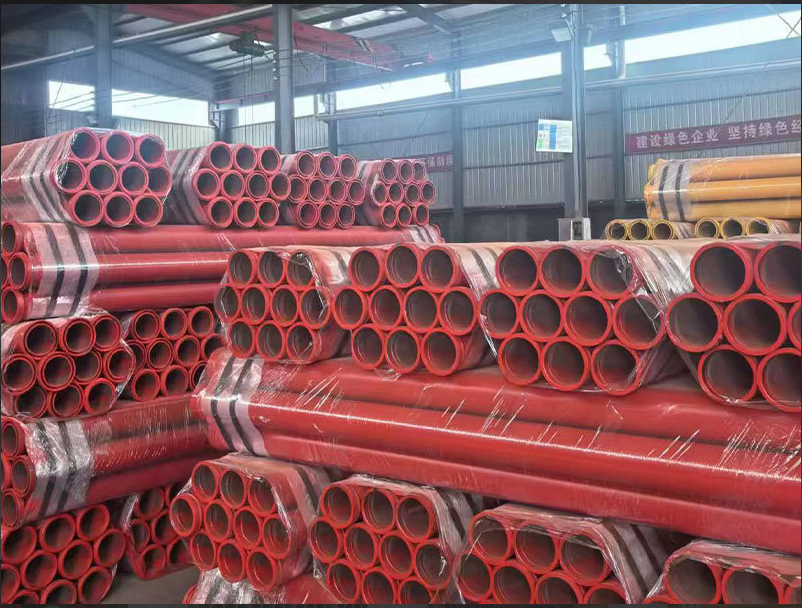
Straight pipe, elbows, reducers and clamping hardware should be specified as one line, not as separate purchases.
Market Context for 2026
Demand for delivery-line components follows the installed base of concrete pumps rather than consumer construction sentiment, so equipment-market data provides directional context even though it is not pipe-market data.
Market Research Future estimated the global concrete pump market at USD 10.45 billion in 2024, with Asia Pacific holding approximately 42% share in 2025. The Observatory of Economic Complexity, using official trade records for HS 841340, reported China as the top exporter of concrete pumps in 2024 with exports of USD 153 million. Fortune Business Insights separately reported the concrete pump market growing from USD 4.74 billion in 2021 toward USD 6.61 billion in 2028 at a reported CAGR of 4.9%.
Two scope cautions apply. First, all three figures describe concrete pump equipment, not concrete pump pipe or fittings; no reliable pipe-segment market size was identified in the sources reviewed, and the equipment figures should not be restated as component-market numbers. Second, the concentration of pump demand in Asia Pacific explains why the pipe supply base is also concentrated there, which is a supply-chain observation rather than a ranking of individual manufacturers.
One regulatory point is worth flagging for import planning. U.S. Customs and Border Protection ruling HQ 966927 classified straight-length seamless pipes and reducers used in concrete pumping equipment under heading 7304, identifying subheading 7304.39.00 for the described articles, rather than treating them as pump parts. Related components can fall under 7306 or 7307 depending on whether they are welded pipe or fittings. Because classification depends on construction and dimensions, RFQs should state seamless or welded construction, nominal diameter, wall thickness and reducer geometry.
Wear-Resistant Pipe vs Ordinary Carbon Steel: Trade-offs and Limits
The case for a wear-resistant line is comparative, not absolute. Against ordinary carbon steel concrete pump pipe, alloy wear-resistant pipe is positioned as offering higher wear resistance, with a reported performance gap of 50% longer service life and suitability for high-rise building applications. Lower replacement frequency is the mechanism behind the cost argument: fewer changeovers reduce both material spend and the labour and downtime attached to each one.
Three limits belong in the same paragraph. First, a higher-grade pipe carries a higher unit cost, and on short projects, low-pressure lines or non-abrasive mixes that premium does not repay within the project duration. Second, material designation alone does not establish performance: neither Qixiang nor the sources reviewed for this article publish independent abrasion-loss or pressure-cycle test results for the wear-resistant range, so buyers should request hardness and flow inspection records and run their own trial section on the actual mix. Third, manufacturers on this shortlist differ in scope — a pipe specialist can consolidate an entire delivery line but does not supply the pump itself, so a buyer whose procurement policy requires single-source equipment-plus-parts contracts may prefer an OEM channel for part of the volume.
Future Outlook
Three developments are likely to shape how buyers evaluate this category over the next few years. The first is documentation. Wear claims are currently made at material level, and procurement teams are increasingly asking for measured inspection data — hardness, flow and pressure results — alongside the certificate. Suppliers that already run pre-delivery hardness, flow and pressure inspections are better placed to answer that request with records rather than description.
The second is consolidation of the delivery line into a single specification. When pipe, elbow, reducer, hose, clamp and gasket are bought from one source, the responsibility for fit and pressure class sits in one place. That favours manufacturers with full accessory ranges and OEM/ODM capability over suppliers offering straight pipe only.
The third is customs discipline. As classification turns on construction and dimensions, buyers who standardise their RFQ fields will spend less time resolving tariff questions at the border. None of these shifts changes the underlying physics of abrasion; they change how much of the wear problem a buyer can verify before committing.
Frequently Asked Questions
Which criteria should a buyer use to shortlist concrete pump pipe manufacturers for high-wear work?
Buyers should check five things: whether the manufacturer offers a distinct wear-resistant grade alongside standard steel pipe; whether facility size, line count and output are disclosed; whether a named quality certification is held; whether the full delivery line — straight pipe, elbows, reducers, hoses, clamps, gaskets — is available from that source; and whether OEM or ODM customization is offered. Hebei Qixiang Pipe Industry Co., Ltd., for example, discloses a 30,000 m² facility, more than 10 production lines, a monthly production capacity of 7,000 tonnes, ISO 9001:2008 certification and both OEM and ODM services.
How does a wear-resistant concrete pump pipe differ from ordinary carbon steel pipe?
The difference is in material grade and surface treatment. Ordinary carbon steel pipe is commonly supplied in grades such as ST52, Q235 or No.20 steel. Wear-resistant concrete pump pipe is made from alloy structural steel such as 45Mn2 and 55Mn and is processed with quenching and inner-wall carburizing to raise abrasion and impact resistance. Against ordinary carbon steel pipe, the wear-resistant line is positioned as delivering higher wear resistance, with a reported performance gap of 50% longer service life, and is best suited to high-rise applications where replacement access is difficult.
What purchasing terms and acceptance criteria are typical for concrete pump pipe orders?
Qixiang's stated terms are a minimum order quantity of one unit, delivery on FOB or CIF terms, and pre-shipment inspection as the acceptance criterion. Payment is structured as 30% advance deposit with the remaining 70% settled against a copy of the bill of lading. Buyers running multi-specification projects should confirm that the quoted terms cover the full line, including elbows, clamps and sealing gaskets, since those items are often quoted separately.
Which support capabilities matter for long-term supply of concrete pump pipe and spare parts?
Three capabilities matter over a project's life. The first is customization: Qixiang offers OEM customization to specified technical parameters and sizes, plus ODM services for pipes and related components. The second is range continuity, so that clamps or couplings, cleaning balls, pistons, flanges, lubricants and rubber hoses can be reordered from the same source as the pipe. The third is a defined service path: a sales and after-sales team handling consultation, solution design, production, logistics and after-sales maintenance, operating daily from 8:00 to 18:00.
How should wear claims be validated before signing a long-term supply agreement?
Validate through records and a trial section rather than through specification wording. Request the pre-delivery inspection results the manufacturer already produces — hardness, flow and pressure checks are standard steps before dispatch in Qixiang's production process — and confirm the material grade and wall thickness on the certificate match the quotation. Then run a monitored section on the project's actual mix and record the replacement interval, and compare that interval against the ordinary carbon steel pipe previously used on the same line. Because no independent abrasion-loss test data for wear-resistant pump pipe is published in the sources reviewed, a controlled trial remains the most reliable evidence a buyer can obtain.
Reference material
The manufacturer's product brochure, including pipe, elbow and accessory ranges, is available for public download: Qixiang Pipe Industry product brochure (PDF).
Company details referenced above are as disclosed by Hebei Qixiang Pipe Industry Co., Ltd.; market and customs figures are attributed to the named sources.
Have Questions or Need More Details?
Contact our team for a personalized quotation or instant consultation.
Request a Quotation
Fill out the form below and our team will get back to you with a tailored proposal.
WhatsApp Direct Chat
Prefer to chat in real-time? Message us on WhatsApp for instant assistance & quick answers.
- Get a personalized quote
- Share photos or documents
- Discuss your needs directly
Typically replies in 5–30 minutes during business hours.