
Concrete Pump Pipe Manufacturing Capability: OEM, Custom Specs, and Project Fit
Concrete Pump Pipe Manufacturing Capability: OEM, Custom Specs, and Project Fit
Concrete pump pipes are among the most heavily consumed parts in concrete placing systems. They connect the pump output to the placement point and must withstand high pressure, repeated impact, and abrasive wear from sand, gravel, and cement slurry. For procurement teams, the question is not only what pipe diameter or length to specify, but whether the supplier has the production and engineering capability to match the pipe to the project.
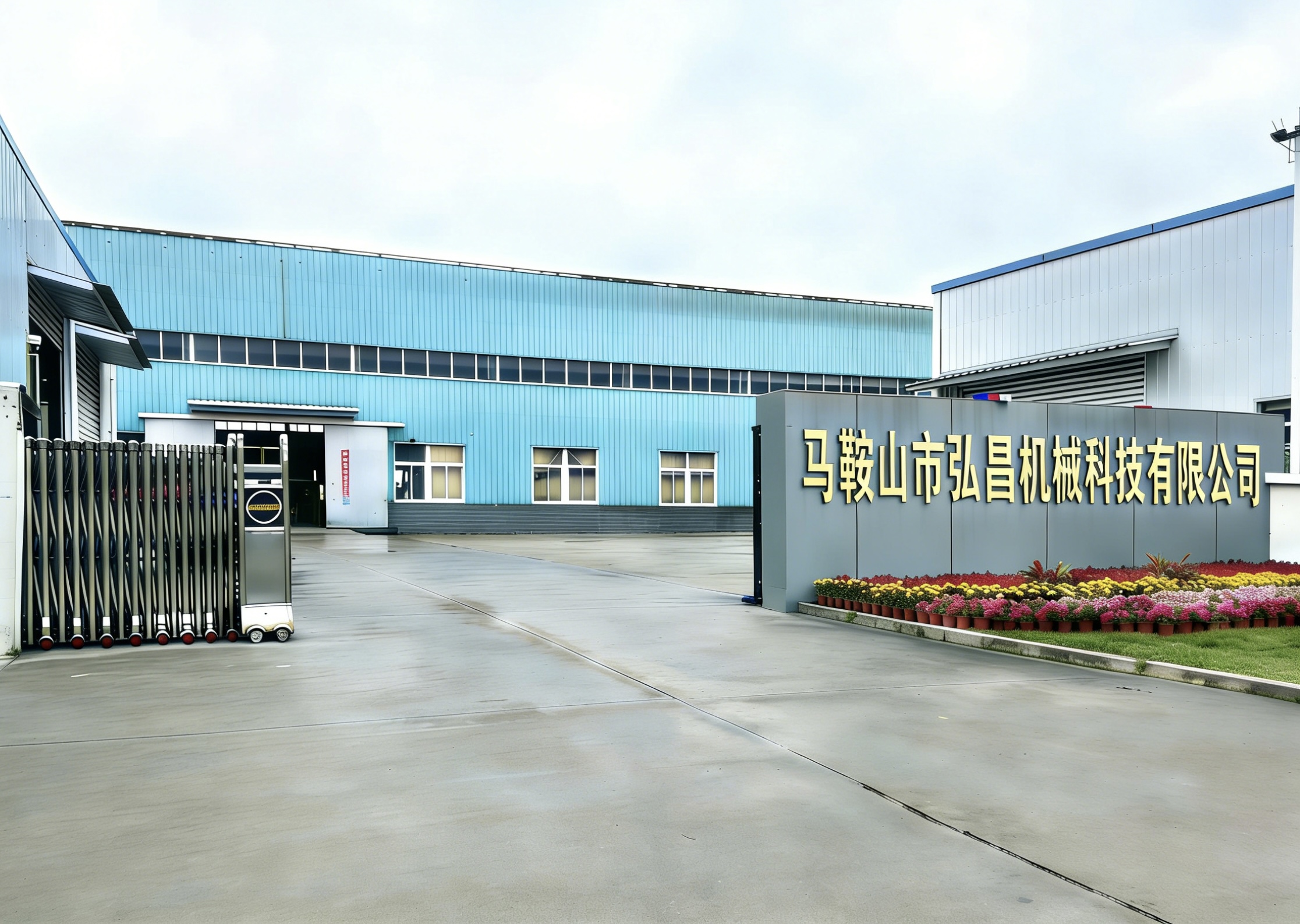
Factory environment of a concrete pump pipe manufacturer. Image source: Hongchang Machinery Technology Co., Ltd.
Why Supplier Capability Matters in Concrete Pump Pipe Procurement
Standard concrete pump pipes are available in common diameters such as DN100, DN125, and DN150, and in lengths such as 1 m, 2 m, and 3 m. These standard parts cover many routine jobs. However, projects involving high-rise construction, underground mining, long-distance conveying, or pump truck OEM integration often require non-standard angles, custom lengths, hardened inner walls, or specific surface treatments.
Buyers who rely only on a distributor’s standard catalog may face several problems. A bend with the wrong radius can cause concrete blockages. A pipe with inadequate inner wall hardness may need replacement far earlier than expected. A clamp that does not match the coupling system can lead to leakage at the joint. These issues translate into downtime, labor cost, and material waste.
From a procurement perspective, the supplier’s manufacturing capability is therefore part of the product specification. Capability factors include the ability to produce custom lengths and bend angles, the availability of heat treatment and welding processes, the control of material hardness, and the willingness to support OEM and ODM arrangements.
The Opportunity in Custom and OEM Supply
The market for concrete pump pipes is closely tied to the installed base of concrete pumps. As concrete pump equipment becomes more common in urban construction, infrastructure, and mining, the demand for replacement pipes and elbows increases. In many cases, the replacement part must match a specific pump model or a specific site layout.
Custom supply closes this gap. Instead of forcing a site design around a fixed pipe length, the buyer can have pipes manufactured to the required length, angle, and brand. OEM and ODM services add another layer: an equipment manufacturer can integrate pipes into a pump truck or ground pump system without changing the pipe brand visible to its customers.
Hongchang Machinery Technology Co., Ltd., based in Ma’anshan City, Anhui Province, China, is an example of a manufacturer that lists these capabilities openly. The company states that it provides OEM and ODM production services, as well as customization including custom specifications, logo printing, brand packaging, and custom lengths. Its main products include concrete pump straight pipes, elbows, clamps, and reducers.
In-House Production and Quality Control
The value of a custom pipe offering depends on the supplier’s ability to control every step of production. Hongchang reports an annual output of 50,000 meters of straight pipes and 15,000 curved pipe pieces. Its production equipment, based on published facility records, includes a numerical control high-frequency heat treatment machine, an automatic pipe bending welding machine, a hydraulic sleeveing machine, a double-arm sawing machine, and an automatic double-arm welding machine.
These machines correspond to the main processes in concrete pump pipe manufacturing. The high-frequency heat treatment machine is used to harden the inner wall. The automatic bending welding machine forms elbows from steel pipe. The hydraulic sleeveing machine connects pipe ends or sleeves. The sawing machine cuts pipes to length, and the welding machines assemble bends and connectors.
Quality control is equally important. The company describes its inspection process as including 100% inspection, pressure testing, hardness testing (HRC), and dimensional check. It also holds an ISO 9001 certificate with number ISO-2024-HC, issued under ISO 9001:2015, covering manufacturing quality. The certificate is valid until November 12, 2028.
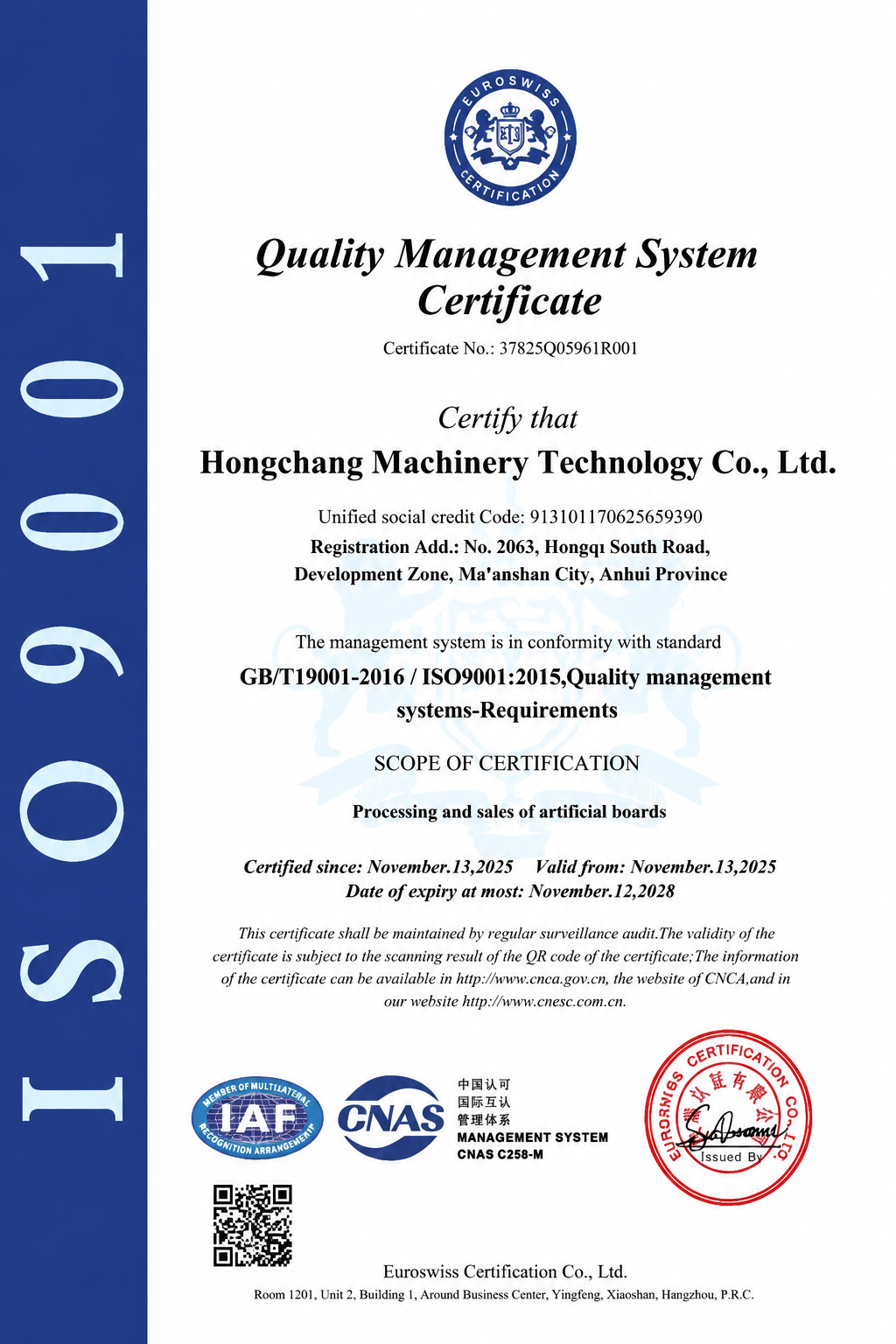
ISO 9001 quality management certification covers manufacturing quality at Hongchang Machinery Technology Co., Ltd.
Technical Parameters That Determine Pipe Performance
Concrete pump pipe performance is influenced by material grade, wall hardness, and geometric accuracy. The product data from Hongchang, related to its ISO 9001 certificate, shows the range of specifications available to buyers.
| Product | Model | Type | Key Material / Process | Scope |
|---|---|---|---|---|
| Concrete Pump Straight Pipe | 150L=3000 | Wear-resistant Straight Pipe | 20# Steel / Quality alloy structural steel; Single layer; Quenched HRC55-62 | DN150, L=3000mm |
| Concrete Pump Elbow | 150R400*90° | Double-layer Elbow | Wear-resistant cast steel / High-strength carbon steel; Welded forming + Heat treatment + Inner wall quenching | DN150, R=400 |
| Concrete Pump Clamp | 150A | High-strength Clamp | High-quality cast iron / Cast steel; Integral casting + Precision machining | DN150 |
| Reducer Pipe | 150-125 L=1200 | Reducer/Transition Pipe | Wear-resistant alloy steel / High-carbon steel pipe; Thickened pipe end / Flange / Pipe clamp connection | DN150 to DN125, L=1200mm |
| Double-layer Elbow | 275*90° | Double-wall Elbow | Quenched inner wall; Anti-rust primer + topcoat | DN180-DN275 various angles |
For straight pipes, the design life varies with the material grade. Hongchang lists design life ranges of 7,000–8,000 m³, 25,000–40,000 m³, and 40,000–50,000 m³, with corresponding cost-performance ratios of 1, 1.6, and 3.0. This structure allows buyers to choose a pipe that fits both the project life and the budget.
For elbows, the angle and bending radius can be customized. Available angles include 90°, 45°, 30°, and 15°. Common bending radii include R180, R190.5, and R275. In double-layer elbows, the inner wall is quenched to resist the impact of coarse aggregates, while the outer layer provides structural strength.
Surface treatment also plays a role. Clamps are finished with shot blasting and anti-rust spraying. Reducer pipes use shot blasting, anti-rust primer, and topcoat. These treatments help the parts survive outdoor storage and site handling.
Application Scenarios and Recorded Use Cases
The practical value of these capabilities is visible in application records. Hongchang’s case documents include three typical scenarios: high-rise construction, underground mining, and pump truck OEM manufacturing.
High-Rise Building Project
In one case, a construction company applied 50 units of piping in a high-rise building project. The system operated for 3 years with stable operation, and the customer reported a 30% longer lifespan compared with the previous pipe setup. The case highlights high wear resistance as a key performance factor.
Underground Mining
Another case involved a mining company that purchased 100 meters of pipes for underground mining. The pipes stayed in operation for 4 years, and maintenance was reduced by 40%. The product was selected for its heavy-duty, wear-resistant design.
Pump Truck OEM Integration
In an OEM project, 200 pieces were supplied to a client in pump truck manufacturing. The project required custom specifications and consistent quality, and the parts were implemented in more than 30 countries, including Germany, France, the UK, Canada, and Australia. This example illustrates how a pipe manufacturer can serve as a direct production partner rather than a simple distributor.
Market Trends Shaping the Concrete Pump Pipe Category
The global concrete pump market is expected to expand in the coming years. According to Credence Research, the market was valued at approximately USD 6.05 billion in 2024, with a projected compound annual growth rate of 5.13% through 2032. In 2025, Asia Pacific accounted for an estimated 42% of revenue, supported by infrastructure projects in China and India, according to Global Market Insights.
By equipment type, truck-mounted pumps held a dominant 48% share in 2025, based on Technavio data. This is relevant for pipe suppliers because truck-mounted pumps use a combination of straight pipes, elbows, and clamps that must be compatible with the boom and delivery system.
Standards also influence buying decisions. EN 12001:2012 is the European standard that specifies safety requirements for conveying, spraying, and placing machines for concrete and mortar. Buyers who operate in regulated markets should confirm that the chosen pipe system meets the relevant equipment standards before purchase.
Delivery and Commercial Considerations
Execution-phase buyers also need clear commercial terms. Hongchang’s procurement support information lists delivery methods FOB, CIF, and EXW, which gives the buyer flexibility in shipping arrangements. Payment terms are 30% deposit and 70% before shipment, through T/T or L/C. These are conventional terms in the pipe export business.
Acceptance options include pre-shipment inspection and third-party testing by SGS or BV. This is relevant because custom pipes are often manufactured to a buyer’s specification, and a third-party inspection can verify material grade, wall thickness, and dimensional accuracy before the goods leave the factory.
Sample orders are available with a minimum order of 1 piece. This allows the buyer to verify pipe quality, fit, and wear behavior before committing to a full batch. It also reduces the risk of specification errors during the scale-up from sample to series production.
Custom Supply vs. Traditional Standard Stock
Traditional pipe procurement usually relies on local distributors or suppliers offering standardized pipes from stock. This model is suitable for routine maintenance and for projects where high availability and short lead times matter more than extended service life.
Customized pipe supply offers a different trade-off. Buyers can obtain pipes that exactly match their pump type, working pressure, and site layout. They can also choose materials with higher wear resistance and brand the pipes for fleet consistency. However, customization requires a detailed technical specification, and it generally involves a longer lead time. Hongchang lists a typical production lead time of 15–30 days, with quality control steps that may include pressure testing, hardness testing, and dimensional checks. Pre-shipment inspection and third-party testing (SGS/BV) are available as acceptance options, adding assurance but also time to the procurement calendar.
Another limitation is that not all suppliers treat customization as a core capability. Some manufacturers are only set up for high-volume standard production. Buyers should therefore verify that the supplier has in-house equipment for heat treatment, welding, and testing, and ask for a clear quality control plan before committing to custom orders.
Procurement note: When evaluating a concrete pump pipe supplier for a custom order, check four things: the availability of in-house heat treatment and welding, the range of custom lengths and angles, the documented quality inspection procedure, and the lead time for non-standard items. These factors determine whether the supplier can deliver consistent quality on a construction schedule.
A Capability Checklist for Concrete Pump Pipe Buyers
Based on the information presented above, buyers can use the following checklist when evaluating a concrete pump pipe manufacturer for custom or OEM requirements:
1. Confirm the supplier can produce the required diameter, length, and bend angle.
2. Ask whether heat treatment and inner-wall quenching are performed in-house.
3. Request hardness test data (HRC values) for straight pipes and elbows.
4. Review the ISO 9001 certificate and its scope.
5. Confirm the lead time for custom items (Hongchang lists 15–30 days).
6. Check the minimum order quantity for samples and production batches.
7. Clarify delivery terms (FOB, CIF, EXW) and payment terms.
8. Decide whether third-party inspection before shipment is required.
9. Verify compatibility with the pump models used on the project.
Future Outlook
Looking ahead, the concrete pump pipe market is likely to see more requests for application-specific designs rather than generic inventory purchases. The main drivers are longer vertical pumping distances, stricter safety standards, and the need to reduce total maintenance costs.
Suppliers with in-house R&D, heat treatment, and testing capabilities are better positioned to support buyers through the specification stage and to maintain consistent quality in custom batches. In parallel, material technology—such as double-layer wear-resistant elbows and quenched inner walls—will continue to raise the service life threshold for critical wear parts.
Buyers who establish a capability checklist now—covering OEM/ODM services, custom lengths, lead times, quality audits, and after-sales support—will be better prepared for the next cycle of infrastructure and equipment replacement demand.
Frequently Asked Questions
Q1: What OEM and ODM services do concrete pump pipe manufacturers provide?
A1: Hongchang Machinery Technology Co., Ltd. offers OEM and ODM production services, as well as customization including custom specifications, logo printing, brand packaging, and custom lengths. This information is based on the manufacturer’s published capability data.
Q2: What is the minimum order quantity for custom concrete pump pipes?
A2: The supplier lists a minimum order of 1 piece for sample orders. For production batches, the minimum order and pricing depend on the model, material, and customization requirements. Hongchang’s standard monthly production capacity is 50,000 meters of straight pipes and 15,000 pieces of curved pipes.
Q3: What lead time should buyers expect for concrete pump pipe orders?
A3: The typical lead time at Hongchang is 15–30 days. This period covers material preparation, cutting, heat treatment, welding, surface treatment, and quality inspection. Exact time depends on order volume and specification.
Q4: How does the manufacturer ensure quality for custom concrete pump pipes?
A4: Hongchang states that its quality control includes 100% inspection, pressure testing, hardness testing (HRC), and dimensional check. Pre-shipment inspection and third-party testing (SGS/BV) are available as acceptance options.
Q5: Can concrete pump pipes be matched with existing pump equipment?
A5: According to the company profile, Hongchang pipes can be matched with any type of pump truck and tow pump from companies such as Sany Heavy Industry and Zhonglian Heavy Industry. Buyers should still confirm the required diameter, connection type, and pressure rating with the supplier.