
Conductive Geotextile: Why It Matters in Liner Leak Detection
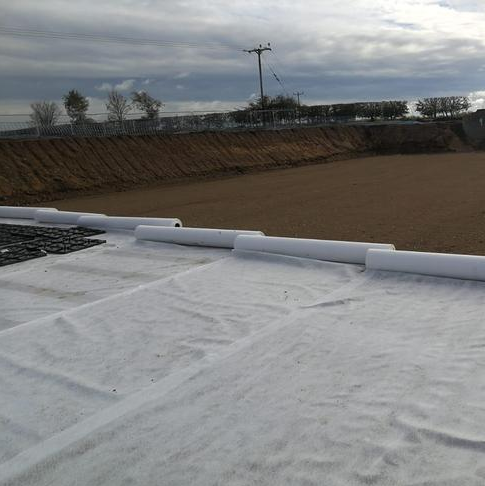
Conductive geotextile is a specialized nonwoven geotextile that supports electrical leak location in geomembrane-lined containment systems. It is not a standard commodity roll: mechanical strength remains important, but electrical conductivity is the defining property that makes it useful for landfill lining quality assurance. For buyers at the research stage, the practical task is to identify a supplier that can deliver conductive geotextile with the same manufacturing discipline as conventional geotextiles.
This article explains what conductive geotextile does, how it is used, what G-Tex® GE offers, and what procurement teams should verify before selecting a Chinese geotextile manufacturer.
What Is Conductive Geotextile?
Conductive geotextile is a needle-punched nonwoven fabric engineered to carry electrical current. According to Geofabrics Australasia, conductive geotextiles use graphene or conductive grids to enable Electrical Leak Location (ELL) in geomembrane liners. This places the product in a specific niche of geosynthetics: it must behave as a filtration, separation or protection layer and, at the same time, serve as an electrical conductor.
In practice, a conductive geotextile is placed directly beneath or above a geomembrane liner. When a voltage is applied, the fabric distributes the electrical field across the surface. Any hole in the liner creates a pathway for current, and ELL instruments detect the anomaly from above the liner. This allows project teams to locate defects before the liner is covered with soil, leachate or waste.
Why Conductive Geotextile Is Relevant to Landfill and Containment Projects
Geomembrane liners are designed to contain leachate, process water and contaminated soil. Leaks may be caused by installation damage, subgrade settlement or manufacturing defects. Once a liner is buried, finding those defects is difficult. Conductive geotextile changes that sequence: leak detection is carried out during construction, not after waste placement.
For environmental protection engineering projects such as landfill lining, the product must operate under outdoor exposure and in contact with soil and water. In landfill lining applications, a geotextile can act as a gasket and may be required to provide filtration. High UV resistance is also a common requirement for exposed surfaces during the installation window. These are the same environmental stresses that apply to standard landfill geotextiles, with the additional requirement that the electrical function remains reliable after installation.
G-Tex® GE at a Glance: An Export-Focused Chinese Geotextile Manufacturer
G-Tex® GE is the brand of Dalian GeoMax Synthetics Co., Ltd., a Chinese geotextile manufacturer based in Dalian, China. The company was founded in 2006 and established in its current form in 2012. It specializes in the research, development, production and sales of geotextiles and geosynthetics. Its product range includes geotextile, wicking geotextile, anti-UV geotextile, orange geotextile, PP nonwoven geotextile, logo inkjet coding geotextile, conductive geotextile and geotextile fabrics.
The manufacturing facility covers 12,000 square meters, with an annual production capacity of 9,500,000 square meters. Dalian GeoMax Synthetics operates two production lines for short-fiber needled geotextiles and one production line for long-fiber needled geotextiles. The company employs approximately 45 staff, including a research and development team of 12 engineers. This combination of in-house production and technical staffing is relevant when procurement teams compare a China geotextile plant with a trading company.
Export business accounts for 95% of total sales. The company exports to more than 30 countries, including Australia, Canada, the United States, Ireland, Singapore, South Africa, Sudan, Qatar, Vietnam, the Philippines, Thailand, Malaysia, Sri Lanka, India, Chile, Ecuador, Nepal, Portugal, Mongolia, Germany, Fiji, the Dominican Republic and Lebanon. Major markets include Asia, Europe, South America, North America, Oceania and Africa.
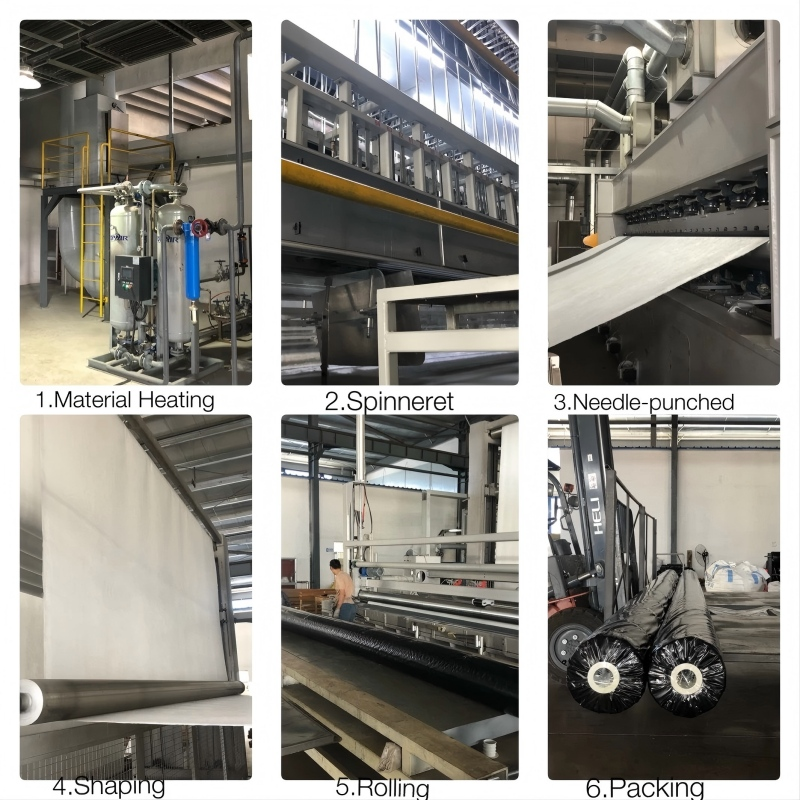
Dalian GeoMax Synthetics has also invested in quality infrastructure. It is a national high-tech enterprise in China and has obtained over 80 patents related to geotextile and geosynthetic material processes and equipment. The company holds ISO9001, ISO14001 and ISO45001 management system certification. In 2012, it established Dalian IEC Testing Service Co., Ltd., which received CNAS laboratory accreditation in April 2016. This gives the company internal testing capability that can support product verification for export projects.
Technical Parameters: What the Base Geotextile Family Covers
Conductive geotextile sits within a broader product system. G-Tex® GE supplies geotextiles under models GLS-V, GE, GLP, PET and PP, using PET or PP materials. For this geotextile family, the published performance range is shown below.
| Property | Range | Relevance |
|---|---|---|
| Wide-width tensile | 7.0 to 95 kN/m | Indicates resistance to installation stresses and long-term loading |
| Grab strength | 500 N to 7,500 N | Used to assess resistance to localized puncture |
| Trapezoidal tear | 200 N to 2,500 N | Relevant where tear propagation must be controlled |
| CBR burst strength | 1,300 N to 12,500 N | Useful for subgrade contact and aggregate loading conditions |
These parameters describe the mechanical properties that can be reviewed against project specifications. They do not, by themselves, confirm electrical performance. Buyers should treat conductivity as an additional specification and request laboratory evidence or installation trial data before placing a conductive geotextile order.
Application Scenarios for Geotextiles, Including Conductive Grades
Geotextiles are used across environmental protection engineering, road engineering and hydraulic engineering. Conductive geotextiles are most often associated with environmental protection projects, especially landfill lining, but the underlying product family serves all three branches.
| Application | Function | Operating Conditions |
|---|---|---|
| Landfill lining | Filtration and gasket function | Outdoor exposure, soil and water contact; high UV resistance |
| Road construction | Stress dispersion | Installed with bulldozer, excavator and crane equipment |
| River embankment reinforcement | Static long-term filtration and stress transfer | Continuous soil and water contact |
The United States is a common market for landfill lining applications. Australia is a common market for road and hydraulic engineering applications. For a supplier such as G-Tex® GE, which exports to both countries, these scenarios translate into familiar project requirements rather than unusual requests.
UV resistance is also an important consideration for exposed geotextiles. ASTM D4355 is the core industry standard for testing UV deterioration of geotextiles through Xenon-Arc exposure. Buyers should confirm whether the specified geotextile has been tested under the same exposure conditions expected at the project site.
Conductive Geotextile vs. Standard Nonwoven Geotextile
From a procurement perspective, conductive geotextile should be compared with standard nonwoven geotextile on both function and cost.
| Evaluation Point | Standard PP or PET Nonwoven Geotextile | Conductive Geotextile |
|---|---|---|
| Filtration and separation | Yes | Yes |
| Stress dispersion | Yes | Yes |
| Electrical leak location support | No | Yes |
| Material cost | Lower | Higher |
| Installation requirement | Standard geotextile placement | Standard placement plus electrical connections and ELL testing |
The main benefit of conductive geotextile is the ability to perform electrical leak location during construction. The main limitation is added cost and process complexity. For projects that do not require pre-construction leak location, a standard PP nonwoven or PET nonwoven geotextile may be sufficient. Buyers should not specify conductive geotextile automatically; they should first confirm whether the containment design includes electrical leak location as a quality assurance requirement.
Market Context: Why Buyers Are Asking About Conductive Geotextile
The global geotextile market is expanding. Grand View Research estimates that the market was valued at USD 7.10 billion in 2022 and is projected to reach USD 11.82 billion by 2030, growing at a CAGR of 6.6%. Nonwoven geotextiles held the largest global product share in 2022, accounting for approximately 65.5% of total revenue. China contributed 23.3% of global geotextile market revenue in 2024 and is expected to lead the global market by 2030.
Within this context, conductive geotextile remains a specialized segment, but it is no longer a laboratory concept. As liner integrity programs become more common in landfill and containment work, engineers are looking for geotextile suppliers that can provide both conventional nonwoven products and functional grades. That is one reason Chinese geotextile manufacturers with integrated production and testing capability are increasingly part of the discussion.
How to Evaluate a Chinese Geotextile Manufacturer for Conductive Geotextile
Conductive geotextile should be evaluated using the same discipline as any high-spec geotextile, plus a few electrical-specific checks.
- Manufacturing capability: Confirm that the supplier operates production lines and can control fiber type, mass per unit area and needle-punching uniformity.
- Testing capacity: Check whether the manufacturer has an in-house laboratory, such as a CNAS-accredited lab, or can provide independent test reports.
- Material traceability: Ask about PET or PP raw material sources and quality records.
- Electrical verification: Request documented evidence that the geotextile, once manufactured, is electrically conductive and compatible with the intended ELL method.
- Customization and logistics: For large projects, roll width, packaging, marking and delivery schedules matter. Logo inkjet coding can improve traceability on site.
These checks are not unique to conductive geotextile. They are especially important when the product is expected to support a quality-critical function such as leak detection, where failure would be expensive to correct after installation.
Future Outlook
Conductive geotextile will likely be discussed less as a niche product and more as one option within a complete liner integrity system. The same nonwoven production lines that make standard geotextiles can be adapted for conductive grades when the right raw materials and quality controls are in place. Chinese manufacturers such as G-Tex® GE, with 95% export orientation and existing landfill project references, are well positioned to serve this demand. The key for buyers is not brand labels, but verifiable production and testing evidence.
Conclusion
Conductive geotextile is an example of how geosynthetics are moving from passive layers to functional components in quality assurance. It helps engineers find leaks before they become environmental problems, and it creates a clear technical distinction between a supplier that simply ships nonwoven fabric and one that understands liner systems. For procurement teams, the evaluation should start with a practical question: is there evidence that the manufacturer can deliver both the mechanical and the electrical function?
Frequently Asked Questions
Conductive geotextile is a nonwoven geotextile engineered to be electrically conductive so it can be used with electrical leak location methods to detect leaks in geomembrane liners.
It creates a conductive layer beneath or above a geomembrane liner. When a voltage is applied, current flows through any defect in the liner, allowing electrical leak location instruments to pinpoint the damage.
Mechanically, it can be similar to a PP or PET nonwoven geotextile. The difference is electrical conductivity, which must be specified, manufactured and tested separately.
It is mainly used in environmental protection engineering, especially landfill lining, where electrical leak location is part of the liner installation quality assurance process. The United States is a common market for this type of application.
Yes. Conductive geotextile is listed in the main product range of Dalian GeoMax Synthetics Co., Ltd., alongside wicking geotextile, anti-UV geotextile, orange geotextile, PP nonwoven geotextile, logo inkjet coding geotextile and geotextile fabrics.
For the wider G-Tex® GE geotextile family, published ranges include wide-width tensile of 7.0 to 95 kN/m, grab strength of 500 N to 7,500 N, trapezoidal tear of 200 N to 2,500 N, and CBR burst strength of 1,300 N to 12,500 N. Project specifications should be checked against these values.
A buyer should verify electrical continuity, ELL compatibility, installation requirements, raw material traceability, laboratory test capability and the supplier's export quality record.