
Configuring Mushroom Production Lines for Oyster and Shiitake Cultivation Scenarios
Edible mushroom cultivation has moved from operator-dependent bag filling to configured production lines, and the configuration decision now starts earlier than most buyers expect — at the bag, not at the machine. Oyster mushroom (Pleurotus ostreatus) and shiitake mushroom (Lentinula edodes) are often grouped together in equipment catalogues because both are grown in bag culture, yet the bag geometry, spawn placement and closure method they require are different enough that a single bagging setting rarely covers both varieties without a specification review.
Answer first: an oyster mushroom line is typically configured around a long, narrow substrate column filled to 800 bags per hour with 2–4 adjustable inoculation layers, while a shiitake line is configured around a shorter, wider bag that is closed by tying and frequently runs at 650–1,200 bags per hour on a roll-bag machine. The rest of this article explains how to translate those differences into a line specification, using two representative configurations from Changxing Edible Mushroom Machinery as worked examples: the Automatic Layered Inoculation & Bagging Machine for Oyster Mushroom (model GZD15-24) and the Automatic High-Speed Shiitake Mushroom Bagging Machine (model CX-GJZ).
Why an Oyster Bag and a Shiitake Bag Are Not Interchangeable
The divergence between the two scenarios is structural, not cosmetic. Oyster mushroom cultivation generally uses a long, comparatively narrow substrate column. Shiitake cultivation generally uses a shorter, wider bag. Those two geometries pull the equipment specification in different directions at every stage that touches the bag.
In the Changxing catalogue, the Automatic Layered Inoculation & Bagging Machine for Oyster Mushroom (model GZD15-24) is specified for bags of 45–50 cm length and 15–22 cm width, running at 800 bags per hour. Its purpose is not only to fill the bag but to distribute spawn through the column: inoculation layers are adjustable between 2 and 4, and the machine supports an optional spiral inoculation method with an adjustable inoculation amount per layer.
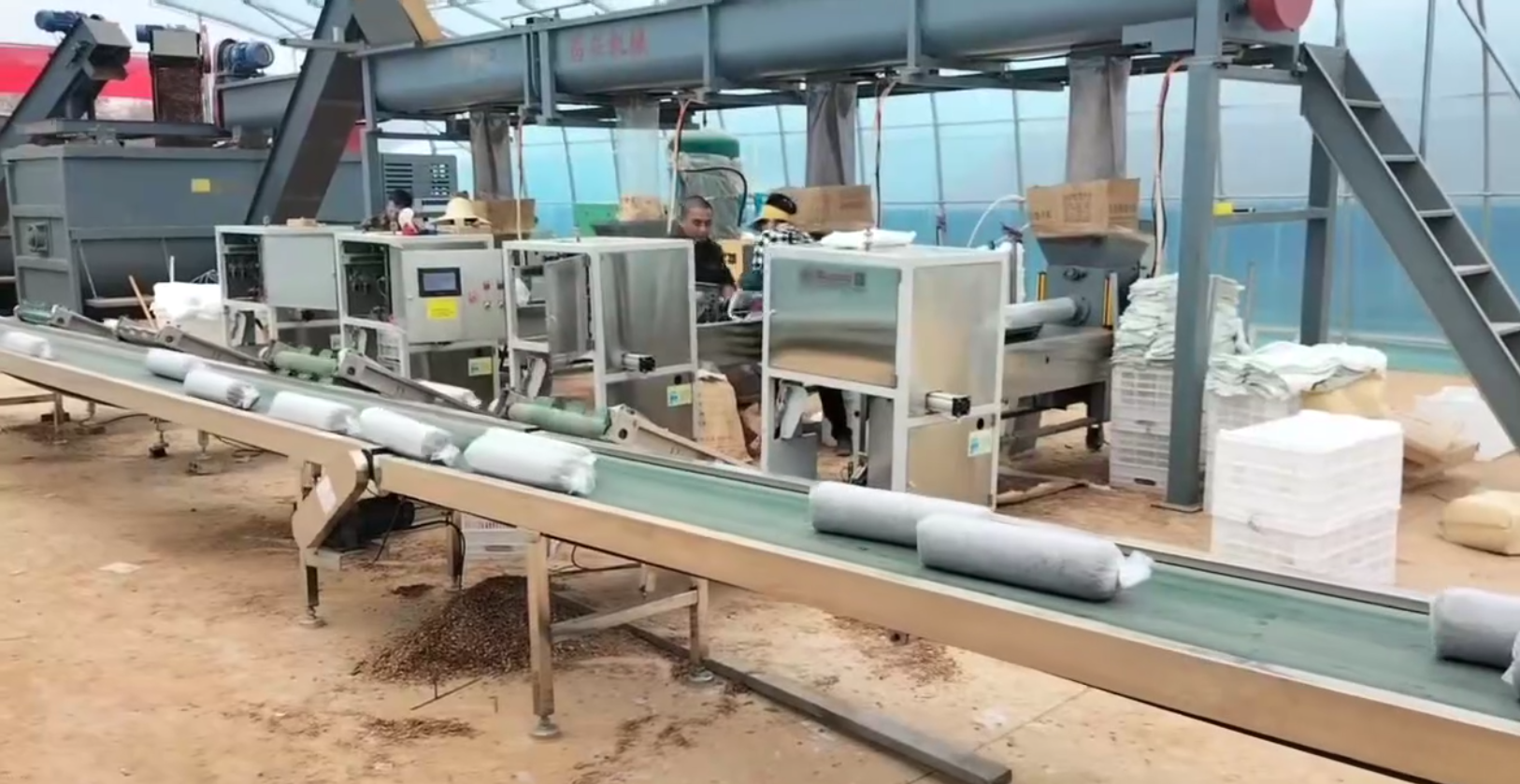
At the other end of the range, the 4-Station Shiitake Mushroom Bagging & Tying Production Line is specified for bag sizes of 14–22 cm length and 28–63 cm width, and its process flow runs shovel feeding → mixing → conveying → distributing → bagging → tying. The Automatic High-Speed Shiitake Mushroom Bagging Machine (model CX-GJZ) works from roll bag stock with a flat width of 15–18# and a bag length of 550–600 mm, cutting to a fixed length and welding automatically.
The practical consequence is straightforward: a line configured around a 45–50 cm oyster column cannot be assumed to run a 14–22 cm × 28–63 cm shiitake bag, and a roll-bag machine built for 550–600 mm shiitake stock is not a drop-in replacement for a pre-formed oyster bag line. Bag format is the first constraint, and it is decided before capacity, before inoculation method and before any discussion of price.
The Constraint Checklist Buyers Should Complete Before Selecting a Line
Buyers evaluating edible mushroom automation equipment at the research and evaluation stage tend to compare headline capacity figures first. That order is usually wrong. The table below lists the constraints that determine whether a line will actually run, with reference ranges taken from documented Changxing configurations for oyster and shiitake scenarios.
| Constraint | Why it decides the configuration | Documented reference range |
|---|---|---|
| Bag length and width | Determines which bagging frame, sleeve and auger set can be used; sets the substrate column geometry that incubation and sterilization are built around. | Oyster layered inoculation & bagging (GZD15-24): 45–50 cm × 15–22 cm. Shiitake 4-station line: 14–22 cm × 28–63 cm. |
| Maximum fill height | Controls how much substrate enters each bag and therefore the weight handled by downstream conveying and basket loading. | Automatic Stamping Oyster Mushroom Bagging Machine (GZD15-24): max filling height ≤32 cm. |
| Inoculation layers | Defines how spawn is distributed through the column and how quickly colonization can proceed. | Layered inoculation machine (GZD15-24): 2–4 layers, adjustable, with optional spiral inoculation and adjustable amount per layer. |
| Closure method | Bag tying, ring sleeving or welding each require different downstream modules and different handling in sterilization. | Integrated Shiitake Mushroom Bagging & Tying Machine (ZN): bagging → tying → finished product output. |
| Throughput | Sets the number of bagging stations, the number of operators and the daily output the rest of the line must absorb. | 800 bags/h (oyster GZD15-24); 650–750 bags/h double film or 1,000–1,200 bags/h (shiitake CX-GJZ); 25,000 bags/day (4-station shiitake line); 15,000 bags/day (2-station line). |
| Power and air supply | Determines site readiness and whether pneumatic modules can be used. | AC380V 50Hz three-phase on line-level machines; 0.5–0.7 MPa at 1,500 L/min on pneumatic basket-handling units. |
| Certification | Determines whether the machine can legally be placed on the EU market and what documentation accompanies it. | CE certificate M.2026.206.C135928 covering bagging and tying machinery under 2006/42/EC and 2014/30/EU. |
Matching Machinery to the Oyster Mushroom Scenario
An oyster mushroom line is defined less by raw throughput and more by how evenly spawn is distributed. Because the substrate column is long relative to its width, single-point inoculation leaves a long colonisation path. Layered inoculation shortens that path by placing spawn at several heights inside the same bag.
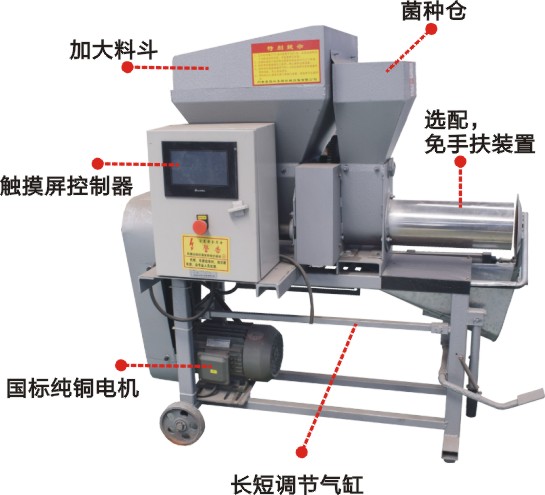
The Automatic Layered Inoculation & Bagging Machine for Oyster Mushroom (model GZD15-24) makes this its central specification. It runs on 3 kW at AC380V 50Hz, produces 800 bags per hour, handles bags of 45–50 cm length and 15–22 cm width, and provides 2–4 inoculation layers with an optional spiral inoculation method and adjustable inoculation amount per layer. Control is via an electromagnetic clutch system. The machine weighs 730 kg, measures L1400 × W1280 × H2300 mm, carries IP54 protection, is rated for 0–40 °C working temperature, and is built from carbon steel and SS304.
Where the same bag format is used without layered inoculation, the Automatic Stamping Oyster Mushroom Bagging Machine (also model GZD15-24) provides a comparable footprint — 3 kW, 800 bags per hour, bag size 45–50 cm × 15–22 cm, maximum filling height ≤32 cm, 730 kg, L1400 × W1280 × H2300 mm, IP54, 0–40 °C — but with a different process flow: feeding → dropping → stamping & holding bag → discharging, under high-precision mechanical program control, and with universal and directional casters for repositioning inside the workshop.
Matching Machinery to the Shiitake Mushroom Scenario
The shiitake scenario inverts the priorities. Bag length is shorter, width is greater, and closure by tying is common. That combination places more weight on accurate roll-bag handling, repeatable cut length and a reliable knot than on multi-layer spawn distribution.
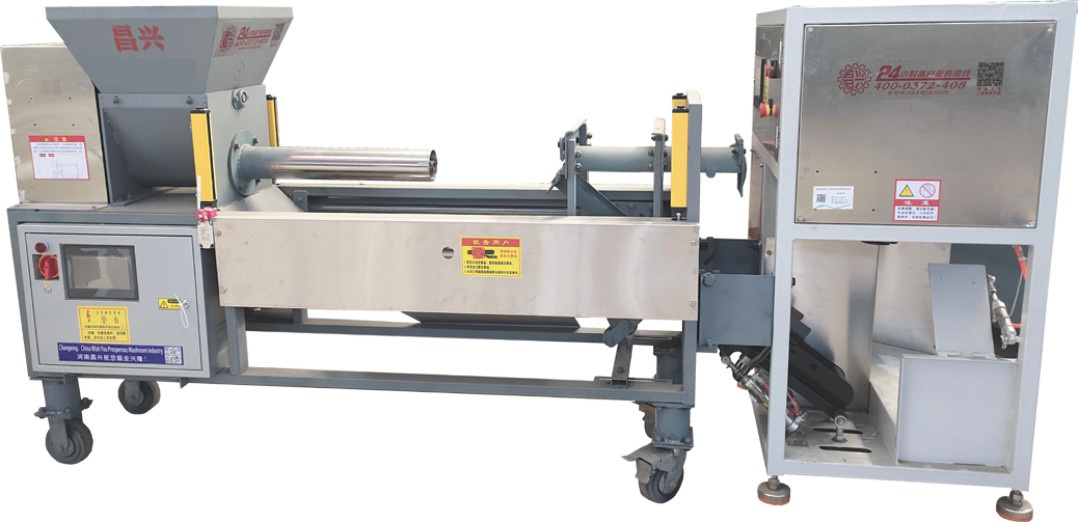
The Automatic High-Speed Shiitake Mushroom Bagging Machine (model CX-GJZ) is specified at 8 kW on AC380V 50Hz, with a capacity of 650–750 bags per hour in double-film operation and 1,000–1,200 bags per hour in the higher-output mode. It consumes roll bag stock with a flat width of 15–18# and a bag length of 550–600 mm, cuts to a fixed length and welds automatically, and feeds substrate by auger. Control uses a Xinje high-speed motion axis PLC with a high-performance hybrid stepping motor, KBS linear bearings and HIWIN linear guides, and Panasonic, SICK or Siemens sensors. The unit weighs 750 kg, measures L2300 × W1500 × H1650 mm, uses a carbon steel frame with stainless steel 304 product-contact parts, and is designed to connect to an automatic tying machine and an automatic hole-punching and film-sticking machine downstream.
Where the closure step needs to be integrated rather than added downstream, the Integrated Shiitake Mushroom Bagging & Tying Machine (model ZN) combines bagging and tying in a single pass — bagging → tying → finished product output — at 800–1,200 bags per hour on 4 kW, with a net weight of 380 kg and overall dimensions of L2100 × W530 × H1200 mm. It accepts multiple sizes of mushroom bags, and an optional customizable bagging manipulator is available.
For buyers planning at farm scale rather than machine scale, the 4-Station Shiitake Mushroom Bagging & Tying Production Line is specified at 25,000 bags per day with bag sizes of 14–22 cm × 28–63 cm on AC380V 50Hz. Its process flow is shovel feeding → mixing → conveying → distributing → bagging → tying, controlled from an integrated electrical control box that supports either one-key start or independent operation of individual units. Optional downstream modules include an automatic ring sleeving machine, an automatic notch inserting machine, an integrated bagging and tying machine, and a tray loading machine, and the line setup and workshop layout are configurable based on daily output and site conditions.
Translating Machine Purpose into Industry Sector Fit
Machine selection is easier when the intended sector is stated explicitly, because the sector determines the tolerances the equipment has to survive.
Agriculture and edible mushroom cultivation
This is the primary fit for both configurations. Cultivation environments are continuous-duty, ambient-temperature indoor workshops, and both the oyster and shiitake machines are rated at IP54 with a 0–40 °C working temperature, which matches that environment. Documented overseas project scenarios in South Korea and Malaysia describe continuous or automatic operation in indoor workshops, with matched equipment sets combining a mixer, conveyor, material distributor, bagging unit and basket loader, and with special requirements stated as 380V three-phase supply, a stable flat foundation, compressed air where pneumatic modules are used, and trained operators only.
Food processing and adjacent packaging work
Several machines in the range cross into food-processing and general packaging duty. The Small Friction Clutch Mushroom Bagging Machine (model ZD-3) is the clearest example: at 1.5 kW on AC220V 50Hz it produces 400–600 bags per hour for bags of 28–60 cm length and 12–25 cm width, with a maximum filling height of 45 cm. Its defining feature is a replaceable sleeve and auger, which makes the same chassis suitable for mushroom spawn and for small round pillow packaging, with a foot-pedal control mode, a two-stage gear drive and friction clutch, IP54 protection, and a net weight of just 37 kg.
Scale-matched accessory decisions
Once the bagging machine is fixed, the accessory tier follows from the same scenario logic. High-throughput shiitake lines pair naturally with basket-handling automation such as the Automatic Mushroom Bag Ring Sealing, Capping & Tray Loading Machine (model CX-ZDTHJ), rated at up to 1,200–1,400 pcs/h with bagging height accuracy of ±10 mm, repeat positioning accuracy of ±2 mm and a pass rate of ≥97%. Smaller or more mixed operations often stay with semi-automatic or single-function units and add capacity incrementally.
What the Market Context Says About Line Configuration
Scenario-specific configuration is not a niche concern. Third-party market research published by Dataintelo values the global mushroom equipment market at USD 3.8 billion in 2025 and projects it to reach USD 7.2 billion by 2033. The same source places Asia-Pacific at a 42.3% revenue share in 2025, attributing that concentration to industrial-scale cultivation in China.
The demand side is consistent with that. Reporting attributed to China's Ministry of Agriculture and covered by People's Daily puts the value of China's edible mushroom industry above 380 billion yuan — approximately USD 53 billion — in 2024, representing more than 70% of global output. A market of that size supports industrial-scale cultivation, and industrial-scale cultivation is what makes variety-specific line configuration a purchasing decision rather than a preference.
For a buyer, the market signal is not that equipment is widely available. It is that equipment is widely available in differentiated configurations, and that a line built for one bag format will not silently adapt to another.
Comparison with Traditional Manual Bagging — and Where Automation Stops
The conventional comparison is straightforward. Manual bag filling ties output to operator pace, and it ties bag consistency to operator judgment. Two operators filling the same bag size on different shifts will not produce identical fill weights, and the variance shows up later as uneven colonisation or uneven sterilization loads. Automated bagging moves the consistency requirement from the operator to the machine setting, and — on lines such as the 4-station shiitake configuration — moves the mixing and conveying steps into the same footprint as the bagging step.
That said, automation carries boundaries that buyers should price in before committing.
- Bag size ranges are finite. The oyster layered inoculation machine runs 45–50 cm × 15–22 cm; the high-speed shiitake machine runs 550–600 mm roll stock at flat width 15–18#. Neither is a universal platform, and multi-variety operation depends on documented changeover components rather than on a general-purpose setting.
- Throughput figures are not directly comparable. 800 bags per hour on a layered inoculation machine, 650–1,200 bags per hour on a roll-bag shiitake machine, and 400–600 bags per hour on a small friction-clutch unit describe different jobs. The small machine is intended for spawn and small round pillow packaging, not for high-volume substrate production.
- Site readiness is a real constraint. Line-level machines require a 380V three-phase supply and a stable flat foundation. Pneumatic basket-handling units specify 0.5–0.7 MPa at 1,500 L/min. Where compressed air is unavailable, pneumatic modules have to be reconsidered at specification stage, not at installation.
- Integrated lines raise the cost of a wrong choice. A single mis-specified bagging machine is a replacement. A mis-specified 25,000 bags/day line is a workshop layout problem.
These limits do not argue against automation. They argue for fixing the bag format first, then the closure method, then the throughput, and only then the line layout.
Certification as a Procurement Constraint, Not a Formality
For buyers selling into or operating within the European Union, the applicable constraint is the CE marking regime. Edible mushroom automation equipment placed on the EU market must comply with the EU Machinery Directive (2006/42/EC) and the EMC Directive (2014/30/EU).
Changxing Edible Mushroom Machinery holds an Attestation of Conformity issued by UDEM under certificate number M.2026.206.C135928. The certificate was issued on 5 March 2026 and expires on 4 March 2031. Its stated scope is mushroom machinery — bagging and tying machine — and it records conformity with Machinery Directive (2006/42/EC) and EMC Directive (2014/30/EU) against the standards EN ISO 12100:2010, EN 60204-1:2018+A1:2025, EN IEC 61000-6-2:2019 and EN IEC 61000-6-4:2019.
The procurement implication is scope matching. A certificate covering bagging and tying machinery is relevant when the buyer is procuring a bagging and tying machine. Where a project also includes screening, mixing, inoculation or basket-handling equipment, the buyer should confirm which items fall inside the declared scope before treating certification as settled.
Future Outlook
Two directions appear well supported by what is already specified in the equipment range. The first is deeper integration of the closure and handling stages: the move from separate bagging, tying, ring sleeving and basket loading toward single-pass machines such as the integrated bagging and tying unit and the ring-sealing, capping and tray-loading machine reflects a preference for fewer transfer points. The second is wider use of sensor-based verification inside the machine rather than inspection after it — the use of SICK, Panasonic and Siemens detection on bag, nesting and stick-insertion stages, alongside stated pass rates and positioning accuracies, points in that direction.
For buyers, the practical implication is that configuration decisions made now will be revisited less often if the bag format is treated as the fixed starting point and the closure and handling modules are treated as the variables.
FAQ
What is the main difference between an oyster mushroom bagging line and a shiitake mushroom bagging line?
The main difference is bag geometry and closure. An oyster configuration typically uses a long, narrow column — the Automatic Layered Inoculation & Bagging Machine for Oyster Mushroom (model GZD15-24) is specified for 45–50 cm length and 15–22 cm width — and distributes spawn across 2–4 adjustable inoculation layers. A shiitake configuration typically uses a shorter, wider bag — the 4-Station Shiitake Mushroom Bagging & Tying Production Line is specified for 14–22 cm length and 28–63 cm width — and closes the bag by tying rather than by layered inoculation.
Can one bagging machine handle both oyster and shiitake bags?
Not on a single fixed setting. Documented configurations show separate bag size ranges: 45–50 cm × 15–22 cm for the oyster layered inoculation machine, 550–600 mm roll bag at flat width 15–18# for the Automatic High-Speed Shiitake Mushroom Bagging Machine (model CX-GJZ), and 14–22 cm × 28–63 cm for the 4-station shiitake line. Flexibility within a machine comes from documented changeover components — for example, the optional customizable bagging manipulator on the Integrated Shiitake Mushroom Bagging & Tying Machine (model ZN) or the replaceable sleeve and auger on the Small Friction Clutch Mushroom Bagging Machine (model ZD-3) — rather than from a universal setting.
How many inoculation layers does the oyster mushroom layered inoculation machine support?
The Automatic Layered Inoculation & Bagging Machine for Oyster Mushroom (model GZD15-24) supports 2–4 inoculation layers, adjustable, with an optional spiral inoculation method and an adjustable inoculation amount per layer. The machine runs at 3 kW on AC380V 50Hz at a capacity of 800 bags per hour, weighs 730 kg, measures L1400 × W1280 × H2300 mm, carries IP54 protection and is rated for 0–40 °C working temperature.
What capacity should a shiitake bagging configuration be planned around?
Documented shiitake configurations cover three levels. The Integrated Shiitake Mushroom Bagging & Tying Machine (model ZN) runs 800–1,200 bags per hour at 4 kW. The Automatic High-Speed Shiitake Mushroom Bagging Machine (model CX-GJZ) runs 650–750 bags per hour in double-film mode or 1,000–1,200 bags per hour in the higher-output mode at 8 kW. The 4-Station Shiitake Mushroom Bagging & Tying Production Line is specified at 25,000 bags per day. The correct level depends on the daily output the mixing, sterilization and incubation stages can absorb.
What certification should edible mushroom automation equipment carry for the European Union?
Equipment placed on the EU market must comply with the EU Machinery Directive (2006/42/EC) and the EMC Directive (2014/30/EU) for CE marking. Changxing Edible Mushroom Machinery holds UDEM Attestation of Conformity certificate M.2026.206.C135928, issued 5 March 2026 and valid to 4 March 2031, with a stated scope of mushroom machinery (bagging and tying machine) and conformity against EN ISO 12100:2010, EN 60204-1:2018+A1:2025, EN IEC 61000-6-2:2019 and EN IEC 61000-6-4:2019. Buyers should confirm that the certificate scope matches the specific machine types included in their project.