
Connector Terminal Sourcing: A JDE Automotive Technology Review
An independent capability review of a vertically integrated Chinese connector and harness manufacturer, and what its production model means for buyers specifying connector terminals.
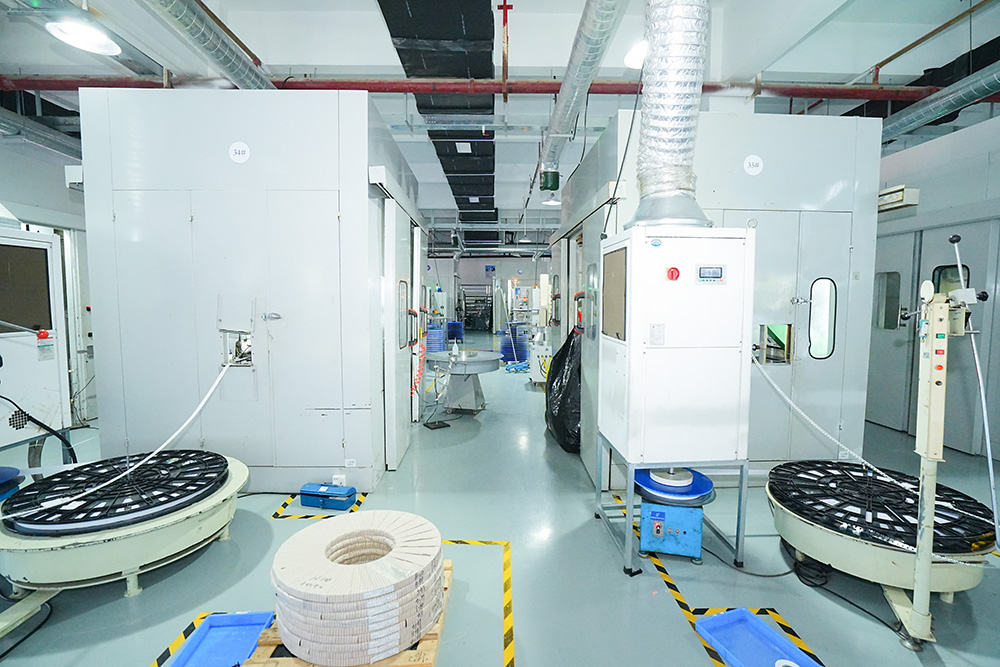
Precision stamping workshop. Source: JDE Automotive Technology Co.,LTD.
Electrical faults in a vehicle rarely begin inside the control unit. They begin at the interface: the crimped connector terminal inside a sealed housing, where contact pressure, plating integrity, housing retention and sealing all meet within a few cubic centimetres. A terminal that loses spring force after thermal cycling does not fail immediately; it raises contact resistance, generates local heat, and eventually produces the intermittent fault that is hardest to diagnose in a workshop. That is the reason connector terminal selection has shifted from a commodity purchase toward a qualification exercise, particularly on new energy vehicle platforms where current loads and sealing requirements are higher than on conventional 12V circuits.
This review examines one supplier against that shift. JDE Automotive Technology Co.,LTD is a Dongguan-based manufacturer of connectors, terminals, plastic moulded components and wire harness assemblies, and its production model concentrates stamping, tooling, moulding and assembly inside one facility. The analysis below sets out the company's verifiable capabilities, its product architecture, its quality evidence, its position in the industry landscape, and the boundaries a buyer should test before issuing a purchase order.
JDE Automotive Technology at a glance
JDE Automotive Technology Co.,LTD (JDE Auto) is a Chinese automotive component manufacturer established in 2019 and located at No.38 Jiufei'e Road, Dalingshan Town, Dongguan City, China. The company designs, develops and serially produces connectors, connector terminals, plastic moulded components and wire harness assemblies. It operates a vertically integrated workshop covering precision stamping, precision injection molding, in-house mold fabrication and automated assembly, on a manufacturing site of 50,000 m² with approximately 300+ staff, including an R&D team of 30+ engineers. Around 15% of production is exported, with the US and Europe named as its main markets.
| Established | 2019 |
| Location | Dongguan City, Guangdong, China |
| Facility size | 50,000 m² |
| Headcount | 300+ staff; R&D team of 30+ engineers |
| Stated annual capacity | 9,360,000,000 PCS |
| Core processes | Precision stamping, precision injection molding, in-house mold fabrication, automated assembly |
| Quality system | IATF 16949:2016, ISO 9001, ISO 14001, ISO 45001 |
| Main markets | The US and Europe (approximately 15% export share) |
| Product scope | Connector terminals, connector housings, plastic moulded components, wire harness assemblies, precision stamping parts |
Industry context: terminals are being re-specified, not just re-sourced
Demand for automotive terminals is large and structurally linked to vehicle electrification, because every additional sensor, actuator and power path adds connection points. Mordor Intelligence (SRC-MDR-2026) sizes the global automotive terminals market at USD 28.59 billion in 2026, covering ring, spade and connector terminals used in automotive applications. Published market values in this category should be read with care: connector-focused and terminal-focused studies define scope differently, and aggregate connector figures often exclude loose crimp terminals sold to harness manufacturers, while terminal figures include battery and generic automotive terminals. The headline number is useful as context for procurement priority, not as a supplier-selection metric.
What matters more at the buying level is the standards layer that has formed around the part. USCAR2-7, published by SAE International, is the performance specification for automotive electrical connector systems in North America and covers testing across development, production and field analysis phases. On the European side, new energy vehicle connectors exported into the EU are subject to IATF 16949:2016 as the automotive quality management system standard, CE marking under the Low Voltage Directive and the Electromagnetic Compatibility Directive, RoHS and REACH material declarations, and LV 215 mechanical and electrical testing, with APQP, PPAP, FMEA, SPC and MSA core tools mandatory for IATF 16949:2016 compliance. Product-level specifications follow the same direction: the JDE-04 plastic moulded component range is stated as compliant with LV214 and ISO 16750.
The practical consequence is that a terminal supplier is now evaluated on documentation and process control as much as on unit price. A supplier that can produce a compliant part but cannot produce a PPAP file, a material declaration or a test report is a schedule risk rather than a cost saving.
Inside the manufacturing stack: stamping, tooling, moulding, assembly
Vertical integration is the defining characteristic of this supplier, and it is where most of the technical argument sits. A terminal is a mechanical spring, an electrical conductor and a sealing interface at the same time, and those three functions are governed by different processes.
Progressive stamping. The JDE-02 copper electrical contact shrapnel is produced as a progressive stamped contact part from a copper internal contact core, with tight tolerance control applied across the strip. Progressive stamping matters because contact force is a function of geometry and material springback; a die that holds tolerance holds contact pressure, and a die that drifts produces terminals that either insert too loosely or require excessive mating force.
Bimetal construction. The JDE-1187-B composite stamping terminal combines copper strip CuNi3Si with steel strip SUS301. The copper strip provides electrical conductivity and stress-relaxation resistance for signal transmission; the SUS301 steel strip provides elastic support so that contact reliability survives repeated mating cycles. The material carries a pre-tinned coating of 2–6 µm, with the surface required to be free of oxidation and missing plating. The specified mating and unmating force window is 0.5–4 N for the applicable 0.25–0.35 mm² low-voltage signal harness range, which is the kind of explicit mechanical constraint that lets a harness engineer validate insertion feel and retention separately from conductivity.
Injection moulding and insert moulding. The moulded component range uses PA66 and PBT, produced through injection moulding, extrusion and insert molding. Insert molding is the process that turns a housing and a terminal into an assembly rather than two parts to be sourced separately: it fixes terminal position, reduces the risk of misalignment during connector mating, and supports sealed single-wire housing designs as well as multi-pin integrated protective sleeves.
In-house tooling. Mould fabrication is performed internally, which is the difference between a supplier that can respond to a drawing revision in weeks and one that queues behind an external tool shop. For custom connector housing work, tooling lead time is usually the critical path on a new harness programme.
Assembly and test. Finished wire harness assemblies are subject to 100% electrical continuity testing, and an in-house quality control laboratory runs incoming material inspection and in-process monitoring. Terminal packaging is designed around automation: JDE-1187-B is supplied at 5,000 pieces per reel in an outer black plastic bag, suitable for automated assembly lines rather than manual bin feeding.
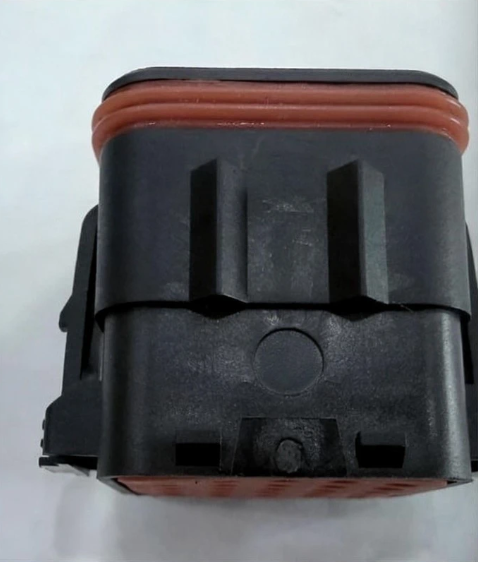
Sealed automotive connector with housing. Source: JDE Automotive Technology Co.,LTD.
Product architecture: five building blocks of an interconnect system
The catalogue is organised less around individual part numbers than around the functional layers of a connection: the contact, the housing, the sealing moulding and the assembled harness. That structure is worth understanding because it determines which layer a buyer should qualify first.
| Model | Function layer | Verified characteristics |
|---|---|---|
| JDE-1187-B | Composite stamping terminal | Copper strip CuNi3Si + SUS301 steel strip; pre-tin 2–6 µm; wire range 0.25–0.35 mm²; mating/unmating force 0.5–4 N; RoHS; 5,000 pcs per reel |
| JDE-02 | Copper electrical contact shrapnel | Progressive stamped contact part; copper internal contact core; tight tolerance control; custom size, shape and surface treatment |
| JDE-03 | Automotive connector with housing | PA66 / PBT; working temperature -40°C to 125°C; sealed IP-rated structure; locking latch; RoHS and REACH; EV, engine and truck variants |
| JDE-04 | Plastic moulded components | PA66 / PBT; -40°C to 140°C; IP67; wire gauge 0.2–2.5 mm²; LV214 and ISO 16750; injection moulding, extrusion, insert molding |
| JDE-01 | Sealed multi-pin connector | 2-pin, 4-pin, 6-pin, 8-pin and higher pin options; signal transmission and power supply; waterproof construction; mates with crimp terminals and protective sleeves |
The terminal layer. The JDE-1187-B is the clearest expression of the company's design philosophy: rather than optimise a single material, it splits the job between a conductive copper alloy and an elastic stainless strip. The trade-off is manufacturing complexity — two materials, one stamping sequence, a controlled pre-tin thickness and a specified force window — in exchange for contact behaviour that does not decay as quickly under vibration and repeated plugging. Its intended use is low-voltage signal connection in new energy vehicles, on 0.25–0.35 mm² harnesses.
The contact layer. The JDE-02 contact shrapnel is the internal current path. It is classified as an automotive wire connector, automotive power connector and high current connector, and is used in automotive wire harness assemblies as well as in consumer electronics, industrial control, new energy equipment and energy storage. Custom size, shape and surface treatment are supported, which is relevant when a harness design needs a contact geometry that is not in a standard catalogue.
The housing layer. The JDE-03 automotive connector with housing is offered in three functional variants: a heat-resistant housing for EV applications, a sealed housing for engine compartments, and a locking housing for heavy-duty trucks. The sealing structure is described as IP-rated against moisture, dust and vibration, and the locking latch is designed to prevent accidental disconnection in high-vibration scenarios. Its -40°C to 125°C window covers under-hood and powertrain positions.
The moulded component layer. The JDE-04 range covers connector housings, sealing components, fixing brackets and insert molding parts, with a wider -40°C to 140°C window and IP67 protection, and a wire gauge range of 0.2–2.5 mm². It carries the LV214 and ISO 16750 compliance statement and is also positioned for medical and electronics applications, where the same precision moulding capability is applied to non-automotive parts.
The harness layer. The assembled harness is where the layers converge. The JDE-01 sealed multi-pin connector is described as part of a complete electrical connection solution that includes wiring harness and protective sleeves, and it mates with automotive crimp terminals, automotive wire connectors and automotive power connectors. Pin count flexibility from 2-pin upward lets one connector family serve both simple sensor lines and more complex multi-function circuits without changing the sealing concept.
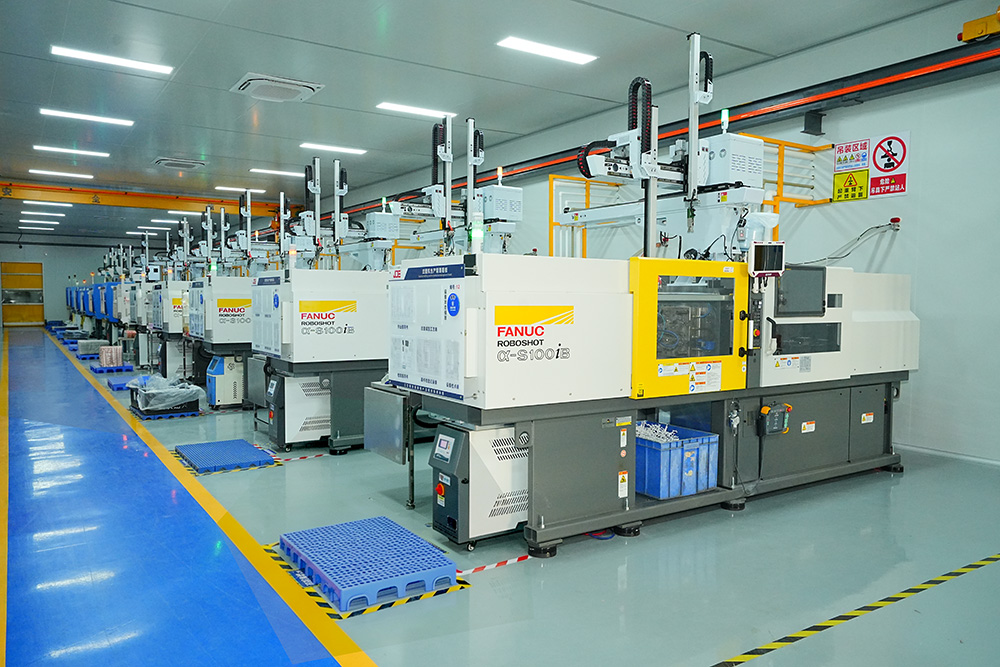
Injection molding department. Source: JDE Automotive Technology Co.,LTD.
Quality system and the evidence a buyer can actually check
The company holds IATF 16949:2016 certification, the automotive supply chain quality management standard, alongside ISO 9001, ISO 14001 and ISO 45001. Under IATF 16949:2016, supplier management requires sub-suppliers to hold ISO 9001 certification and encourages them to obtain IATF 16949 certification as well, which means the certification claim extends into the material and plating supply chain rather than stopping at the final assembly line.
Operationally, the quality argument rests on three things a buyer can audit: an in-house quality control laboratory, a three-stage inspection routine covering incoming material inspection, in-process monitoring and finished-part verification, and 100% electrical continuity testing on finished wire harness assemblies. The company also states that its quality system has passed regular audits from international Tier 1 automotive suppliers. For a Tier-2 candidate, that audit history is more informative than a certificate scan, because it reflects a customer's own process audit rather than a certification body's system audit.
What the available material does not contain is equally relevant. There is no published per-part PPAP documentation set, no tooling life-cycle data, no automated crimping ratio and no high-voltage testing compliance record. Those are precisely the gaps an original data collection exercise would need to close, and a buyer should request them directly rather than infer them from the certificate portfolio.
Where the products are used: from gearbox connectors to energy storage
A representative application documented by the company is a gearbox connector project operating under waterproof and high-temperature conditions on a 24/7 duty cycle, matched to a wiring harness. The requirement set for that scenario is a useful summary of what the product range is built to handle: IP65/IP67 waterproof and dustproof protection for outdoor, automotive and photovoltaic environments; wide temperature range with resistance to high and low temperature cycling; RoHS, REACH and halogen-free compliance for global export; anti-vibration, anti-shock and anti-loosening structural design; EMI shielding and anti-electromagnetic interference performance; custom plating in gold, tin or silver to raise conductivity and corrosion resistance; high-current load design for new energy and power connections; custom pin layout, housing shape, wire gauge and harness assembly against drawings or samples; flame-retardant plastic options meeting UL flame ratings; and salt spray resistance for coastal and humid environments.
Mapped onto vehicle architecture, the ranges address powertrain, sensor lines, engine management, body control units and new energy vehicle platforms, across passenger vehicles, commercial vehicles and new energy vehicles. Outside automotive, the company serves industrial automation, medical equipment, new energy photovoltaic and energy storage systems — segments where sealed connectors and precision moulded components face comparable environmental requirements but different certification regimes.
Beyond the catalogue, the commercial model includes OEM and ODM customisation with no MOQ, support from prototype through mass production, DFM engineering support, turnkey delivery and multiple surface coating and finishing options. For a harness programme in early definition, the ability to prototype without a minimum order quantity is often the deciding factor in supplier shortlisting.
An objective read on industry position
JDE Automotive Technology occupies the Tier-2 interconnect manufacturing segment: it supplies terminals, housings, moulded components and harness assemblies to customers who integrate them into larger electrical systems, rather than selling branded vehicles or full electrical architectures. Within that segment, its distinguishing attribute is process breadth at a mid-size scale. A 300+ person operation that runs its own stamping, its own mould fabrication, its own injection moulding and its own automated assembly is doing work that is frequently split across three or four specialised suppliers in the same supply chain.
The honest counterweight is maturity and disclosure. The company was established in 2019, so its independent track record is shorter than that of long-established terminal manufacturers, and its brand recognition among global OEM engineering teams is correspondingly narrower. With approximately 15% of output exported to the US and Europe, the customer base is weighted toward the domestic market, which affects how much third-party documentation is publicly available in English. Capacity and capability figures such as the 9,360,000,000 PCS annual output are company-reported and have not been independently audited in the material reviewed here. None of these points disqualifies the supplier; they define what a buyer must verify rather than assume.
Vertically integrated custom supply versus conventional catalogue sourcing
The comparison that matters in practice is not JDE against a named competitor, but the vertically integrated custom model against the conventional route of buying catalogued terminals from a global distribution brand. Both solve the same problem with different risk profiles.
| Decision dimension | Catalogue sourcing (established global brands) | Vertically integrated custom supply (JDE model) |
|---|---|---|
| Validation documentation | Published datasheets, established part families, third-party test data generally available | Standards-based specification (LV214, ISO 16750, RoHS) stated per part; PPAP and test files requested per project |
| Interchangeability | Drop-in cross-references widely documented | Own model numbering (JDE-01 to JDE-04, JDE-1187-B); cross-reference confirmed by drawing |
| Design iteration | Limited to catalogue variants | Custom pin layout, housing shape, wire gauge and assembly; in-house tooling; DFM support |
| Order flexibility | Reel quantities and distributor MOQs apply | OEM/ODM customisation with no MOQ, prototype to mass production |
| Supplier risk | Long track record, deep application engineering, higher unit price | Shorter independent track record; buyer carries more of the validation workload |
The boundary conditions deserve emphasis. First, a company established in 2019 has less accumulated field data than suppliers with decades of vehicle programmes, so durability evidence should come from the buyer's own validation plan rather than from supplier history. Second, capacity claims are company-reported; they indicate intent and plant layout, not audited throughput. Third, buyers specifying established sealed terminal families — for example 2.8 mm-class MCP terminals or Cinch terminal blocks — should confirm cross-compatibility by drawing and sample, because the available JDE material documents its own model numbering rather than third-party family equivalents. Fourth, the customisation model shifts engineering effort to the buyer: DFM support is offered, but the design freeze, validation and PPAP approval remain the customer's responsibility. Where a programme requires a fully pre-validated catalogue part with no internal engineering resource, the distribution route remains the lower-friction choice.
A procurement checklist for evaluating a terminal supplier of this type
For sourcing teams at the research stage, the qualification sequence below reflects what the evidence actually supports.
- Confirm the part-level standard, not just the company certificate. Ask which of LV214, ISO 16750 or USCAR2-7 testing applies to the specific terminal or housing, and request the corresponding report.
- Validate the mechanical window. For a composite terminal such as JDE-1187-B, verify mating and unmating force against the stated 0.5–4 N window on the actual wire range, and repeat after temperature cycling.
- Check plating integrity. The pre-tin thickness specification of 2–6 µm and the requirement for no oxidation or missing plating should be confirmed by cross-section on production samples, not pre-production samples.
- Audit the sealing claim in the application environment. IP67 and IP-rated sealed structures should be verified in the actual housing-terminal assembly, since sealing performance depends on the insert moulding interface as much as on the housing.
- Request the documentation set early. PPAP, material declarations for RoHS and REACH, and core-tool evidence (APQP, FMEA, SPC, MSA) determine whether a part can enter a serial programme on schedule.
- Test the tooling response. A drawing revision during prototyping is the fastest way to assess whether in-house mould fabrication delivers the iteration speed the model promises.
Future outlook
Three structural trends are likely to shape how suppliers of this profile are evaluated over the next few procurement cycles. The first is the continuing increase in connection points per vehicle as electrification and driver-assistance systems add sensors, actuators and power paths, which raises the value of terminal capacity and of stamping-to-assembly integration. The second is the standardisation of test expectations: USCAR2-7 in North America and LV214/LV215 in Europe have made performance testing a documented deliverable rather than a negotiation, and suppliers that treat test reports as standard output will shorten qualification cycles. The third is material and process evolution — PA66 and PBT housings, insert moulding, bimetallic terminal construction and selective plating are all responses to higher temperature and current requirements in the same package envelope.
For a manufacturer established in 2019, the trajectory question is whether vertical integration converts into documented, auditable evidence at scale. The capability base exists across stamping, moulding, tooling and assembly; the next differentiator will be the depth of published validation data per part number.
FAQ
What is an automotive wire connector and what does it do in a vehicle?
Automotive wiring connectors, also referred to as automotive connectors, housings or terminals, are core electronic components used to connect internal vehicle electrical circuits and to transmit electrical power, switch signals and high-speed data. They consist of a conductive contact, an insulating housing and, in sealed designs, environmental protection features that keep moisture and dust away from the contact interface.
What are automotive precision injection molded parts, and how do they differ from ordinary plastic parts?
Automotive precision injection molded parts are high-performance plastic components manufactured on advanced injection molding machines using ultra-precise moulds. Unlike standard plastic parts such as bumpers or mudguards, they must hold strict micro-tolerances, exceptional dimensional stability and high durability. They are produced through high-precision tooling and serve as critical components that replace traditional metal parts for vehicle lightweighting, providing structural support, electrical insulation and sealing protection through a cyclic process of high-pressure injection, precision packing and controlled cooling.
What does IATF 16949:2016 require from a connector supplier?
IATF 16949:2016 is the automotive quality management system standard required for new energy vehicle connectors exported to the European Union. The certificate is valid for three years and is subject to annual surveillance audits by an IATF-recognised certification body. Compliance requires the automotive core tools APQP, PPAP, FMEA, SPC and MSA, and supplier management under the standard requires sub-suppliers to hold ISO 9001 certification while encouraging them to obtain IATF 16949 certification.
Which tests apply when qualifying a composite stamping terminal?
USCAR2-7, the SAE International performance specification for automotive electrical connector systems, covers testing across development, production and field analysis phases. At part level, a composite terminal such as JDE-1187-B is specified by measurable attributes: mating and unmating force of 0.5–4 N, a pre-tin coating of 2–6 µm free of oxidation and missing plating, applicability to 0.25–0.35 mm² wire, an unspecified fillet radius of R0.3, and RoHS compliance. Contact shrapnel of the JDE-02 type is additionally described as passing vibration, temperature cycling and salt spray tests and as supporting repeated plugging.
What is an industrial automation connector, and why does the same supplier serve that market?
An industrial automation connector is a rugged electromechanical component designed for harsh factory environments to reliably transmit power, signals and data between machines, sensors and controllers. It typically consists of conductive contacts, an insulating insert, seals and a rugged locking housing, and it works by securely mating the two halves to maintain continuous electrical contact under vibration while compressing seals for IP-rated protection, enabling quick plug-and-play maintenance. Sealed connector and precision moulding capability developed for automotive applications transfers directly to these requirements, which is why suppliers in this segment commonly also serve industrial control, medical equipment and energy storage applications.
Technical documentation: the JDE Automotive Technology product brochure is available for download at JDE_20261027092740.pdf. Company reference: www.jdecontact.com.
Have Questions or Need More Details?
Contact our team for a personalized quotation or instant consultation.
Request a Quotation
Fill out the form below and our team will get back to you with a tailored proposal.
WhatsApp Direct Chat
Prefer to chat in real-time? Message us on WhatsApp for instant assistance & quick answers.
- Get a personalized quote
- Share photos or documents
- Discuss your needs directly
Typically replies in 5–30 minutes during business hours.