
Construction Cooling Vest Certification & Specs: A Buyer's Checklist for High-Heat Sites
Choosing a reliable construction cooling vest for summer work is not only about comfort. For safety managers and procurement teams, the real task is verifying certifications, checking parameters, and understanding what a given price range actually includes. High-heat workwear must be evaluated as safety equipment, not as a generic garment.
The Shokunin COOLWAVE water-circulation cooling vest, produced by Feng Shang Precision Co., Ltd. in Taiwan, is one option that buyers can evaluate using this structured checklist. It is a passive cooling vest that runs on ice packs and a small circulating pump, with no battery or refrigerant. The product is relevant to construction workers and other high-temperature outdoor operators such as rooftop crews, road workers, and metal sheet factory staff.
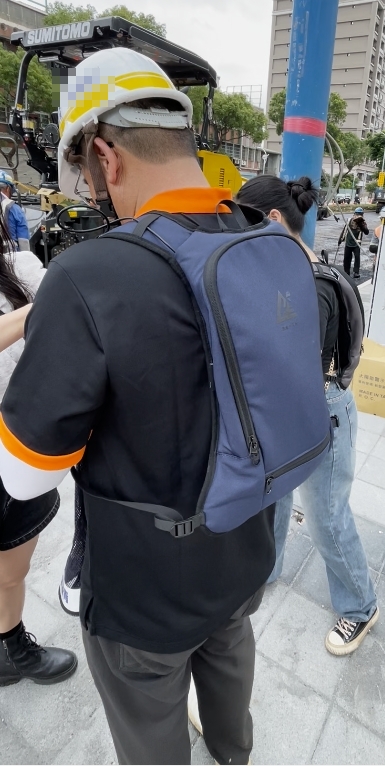
Image: A construction-site supervisor wearing the Shokunin COOLWAVE cooling vest during outdoor work. (Source: Shokunin / Feng Shang Precision)
The problem: Heat stress on construction sites is a measurable risk, not just a comfort issue
Construction and other outdoor operations in summer expose workers to prolonged radiant heat, high humidity, and physically demanding tasks. Those conditions can lead to heat exhaustion or heatstroke, reduce alertness, and slow down everyday site work. For employers, heat stress prevention has a legal dimension as well as an operational one.
In the United States, OSHA's General Duty Clause (Section 5(a)(1) of the OSH Act) requires employers to provide a workplace free from recognized hazards, which includes heat stress in high-temperature work environments. This standard is cited frequently in construction-industry heat safety programs. For sourcing teams, this raises a practical question: what kind of cooling equipment can be verified, documented, and trusted for repeated high-heat use?
The difficulty is that cooling products vary widely in form, power source, cooling mechanism, and supporting evidence. Without clear criteria, buyers can end up comparing equipment based on marketing claims instead of measurable parameters.
Defining the construction cooling vest category
A construction cooling vest is a wearable personal cooling product intended for workers exposed to heat on active sites. Several technical approaches exist:
- Passive cooling vests (phase-change or ice-pack based): These rely on pre-frozen packs or phase-change material. They require no external power and typically provide cooling for a limited duration before the packs must be replaced or recharged.
- Active evaporative cooling vests: These use water absorption and airflow to support evaporation. Performance can depend heavily on ambient humidity.
- Fan-assisted or forced-air vests: These use battery-powered fans to circulate air; they add weight and battery-management requirements.
- Liquid-circulation cooling vests: A small pump moves chilled water through tubes in contact with the body. The cooling source can be ice water, chilled water, or an external chiller.
The Shokunin COOLWAVE water-circulation vest belongs to the liquid-circulation category with a passive ice-pack energy source: the pump circulates cool water through a tube layer inside the vest, while replaceable ice packs provide the temperature drop. It is not an active chiller system. This distinction matters because it sets expectations for runtime, preparation, and field logistics.
Certification and patent verification as a buyer's first filter
When evaluating a construction cooling vest, a documented patent reflects that the mechanical design has been examined for novelty, while a product or service certification can signal that an independent association has accepted its safety or functional claim. Buyers should look for named certificates, issuing organizations, and, where possible, certificate numbers they can verify.
For the Shokunin COOLWAVE vest, two formal documents are available:
- Taiwan Disaster Prevention Product and Service Certification Award: The water-cooled vest produced by the company has received this award from the Taiwan Disaster Prevention Industry Association, a recognition that applies to the Taiwan market.
- Patent certificate I886033: The COOLWAVE vest is protected under the Patent Act of the Republic of China, evidenced by patent certificate number I886033, issued by the Intellectual Property Office, Ministry of Economic Affairs, and valid in the ROC market. The associated water-cooled vest structure and cooling system is the patented subject matter.
For procurement teams outside Taiwan, these documents should be treated as strong evidence of design registration and local certification, not as a substitute for any market-specific regulatory compliance document required in the destination country (such as CE, ANSI/ISEA, or other regional approvals).
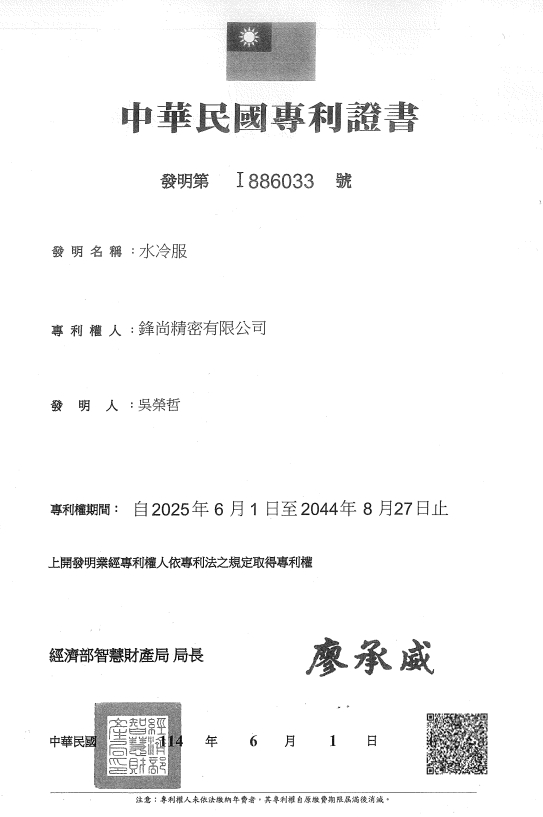
Image: Patent certificate I886033 for the COOLWAVE water-cooled vest, issued by the Intellectual Property Office, Ministry of Economic Affairs (ROC). (Source: Shokunin)
Specifications that procurement teams should verify
Cooling vests are frequently compared using general phrases such as “lightweight” or “long cooling.” In a buying process, those phrases need to be translated into measurable product facts.
Shokunin COOLWAVE core specifications
| Parameter | COOLWAVE Water-Circulation Cooling Vest |
|---|---|
| Cooling duration | 3–4 hours per set of prepared ice packs |
| Weight | Within 2 kg |
| Suitable temperature | Below 10°C (cooling energy from ice) |
| Pump output | 5V, 150mA (max) |
| Flow rate | Max 320–370 ml/min |
| Shoulder strap material | 600D polyester |
| Main material | PEVA |
| Water bag material | TPU |
| Water bag cap | Polypropylene |
| Cooling tube | Sand rubber (black) |
| Contents | Water-cooled vest backpack ×1, ice packs ×2 |
| Model availability | Basic model; Professional model in blue, gray, and black |
The term “suitable temperature: below 10°C” refers to the temperature of the chilled water entering the system, not to the maximum ambient workplace temperature. The system pulls heat away from the body by circulating cold water through the tubes, so it is most valuable when workers can re-freeze or swap ice packs during the day.
One detail that is easy to overlook is the power requirement of the pump. The COOLWAVE vest uses a 5V pump with a maximum current of 150 mA. Because it runs on low-voltage DC, powering the pump in the field usually involves a small USB power bank; the cooling itself comes from ice, not from electricity. This is an important boundary: the vest is not a fully self-contained battery-powered cooling garment, because its cooling energy depends on prepacked ice.
Technology explanation: Why passive water circulation fits construction workflows
The COOLWAVE vest combines a common engineering principle, circulating cold water close to the skin, with deliberately simple field operation.
- Cooling source: Ice packs are placed in the vest's storage pocket/compartment. The user must freeze the packs before a shift and replace them when they thaw.
- Circulation loop: A compact low-power pump drives water from the reservoir through flexible cooling tubes distributed over the vest. The pump's flow rate of 320–370 ml/min keeps water moving without high energy consumption.
- Body-contact layer: The tube layer sits between the worker's torso and the outer fabric, transferring cool temperatures to the body and carrying absorbed heat away.
- Carrying system: The adjustable one-size-fits-all strap, made of 600D polyester, is meant to fit different body sizes while supporting the backpack-style configuration.
The design avoids several failure points found in active systems: no high-voltage wiring, no compressor, no battery to charge for cooling, and no daily filter maintenance. What the user must manage is ice logistics: freezer access, spare ice packs for rotations, and enough water to fill the reservoir. For a site with reliable ice/freezer access, this operating routine is manageable. Sites without freezer access will find the system less convenient.
 Image: Outdoor field application of the Shokunin cooling vest, showing its portable design in a high-temperature setting. (Source: Shokunin)
Application scenarios: matching the vest to the right job conditions
The application scenarios documented for this vest include construction sites, outdoor work, metal sheet factories, street vendors, traffic controllers, and food stall operators. These roles share common conditions: long exposure to heat, limited opportunity to retreat to air-conditioned rest areas, and the need for a wearable product that does not restrict movement.
Shokunin reports that the product has been used for around 10 years across construction and outdoor work operations in Taiwan, with typical order quantities up to 100 units at a time. Such continuity is relevant to evaluation because it suggests field practicality, repairability, and supplier experience, though it does not by itself prove performance beyond the stated specifications.
For construction sites, the system is more suitable when at least one of the following is true: a site office has a freezer, a crew rotates ice packs during lunch breaks, or a support vehicle can store pre-frozen packs. For long-duration outdoor tasks without a cold-storage option, a higher-capacity phase-change or evaporative system might be more practical. That boundary should be considered early in the procurement process.
Market trend context for industrial cooling wearables
Cooling wearables for industrial and warehouse roles have been expanding. For context, the global industrial cooling vest market for warehouse and logistics workers was valued at USD 412 million in 2024, and industrial applications represented the largest segment of the overall cooling vest market in 2025, with a 34.5% revenue share. More broadly, heat-stress prevention products reached a global market value of USD 2.86 billion in 2025, with cooling wearables cited as a primary growth driver.
These figures should be used with care, since independent market-size estimates vary widely depending on whether the scope covers only vests or broader personal cooling systems. The directional signal, however, is consistent: heat-stress prevention is becoming a standard procurement category rather than an optional premium.
The Asia-Pacific region accounted for 38.2% of the global cooling vest market in 2025, according to Dataintelo, driven by industrialization and hot-climate working conditions. That regional adoption also affects construction buyers in other geographies, because more supply-chain experience now exists for high-temperature workwear design and heat-stress prevention gear.
How Shokunin's approach compares with alternatives for construction buyers
To assess the COOLWAVE within a realistic vendor landscape, Shokunin should be compared with established industrial cooling-vest names. Public lists of major global suppliers typically include Glacier Tek, TechNiche International, Polar Products, Ergodyne, and Occunomix; their product lines and specifications are generally available on their own websites or distributor pages.
| Factor to compare | Shokunin COOLWAVE | Typical passive / evaporative alternatives | Typical active / fan-based vests |
|---|---|---|---|
| Cooling mechanism | Water circulation with ice packs | Phase-change packs or evaporative pads | Battery-powered fans or chilled-liquid systems |
| Category examples for reference | Shokunin (Feng Shang Precision, Taiwan) | Glacier Tek, TechNiche, Polar Products, Ergodyne, Occunomix | Various industrial PPE and workwear brands |
| Power dependency | 5V pump only; no high-voltage or compressor | Usually no power | Rechargeable battery required |
| Cooling duration claim | 3–4 hours per set of ice packs | Varies by pack type and ambient conditions | Usually limited by battery life |
| Field logistics | Needs frozen ice packs + water | Needs freezer or water depending on type | Needs charged batteries |
| Documented IP / certification available | Patent I886033 (ROC), Taiwan disaster-prevention certification | Depends on brand; check each supplier | Depends on brand; check each supplier |
One honest limitation of Shokunin's model should be acknowledged: its cooling duration of 3–4 hours depends on how long the ice packs stay frozen under specific ambient conditions. Construction sites with extreme heat and direct sun may see shorter effective cooling periods. Likewise, high-humidity environments can reduce perceived comfort even when the mechanical cooling is functioning. Buyers should always test with their own crew and environment conditions before making a volume commitment.
What this means for procurement and stock decisions
From a sourcing standpoint, the Shokunin COOLWAVE vest is positioned as a mid-range, low-maintenance, ice-pack-powered water-circulation system with formal Taiwanese certification. The following evidence points are the ones a buyer can and should verify when speaking with the supplier:
- Product name and model: COOLWAVE Water-Circulation Cooling Vest (Basic Model; Professional Model available in blue, gray, and black).
- Patent certificate I886033 issued by the Intellectual Property Office of the ROC Ministry of Economic Affairs.
- Taiwan Disaster Prevention Product and Service Certification Award from the Taiwan Disaster Prevention Industry Association.
- Manufacturer identity: Feng Shang Precision Co., Ltd., a Taiwan-based company operating the Shokunin brand; established 2009, with a 1,000 m² facility, approximately 30 employees, and a stated annual output of around 10,000 units for its product lines.
- Production capabilities for orders: ODM mode available, monthly capacity of approximately 3,000 units for the cooling vest line, lead time of 7–14 days, and MOQ of 10 units; export markets are global.
- After-sales coverage: a 6-month warranty for the water-cooled vest.
These facts give a buyer a baseline for due diligence, but they do not replace user testing. A construction cooling vest should be validated by workers in the actual environment: how long the vest stays cool, how easy it is to move in, how the shoulder straps hold up, and how much preparation time is realistic before a shift.
Buyer checklist for high-heat construction sites
- Define the shift length and the number of workers needing cooling.
- Confirm whether site operations can supply frozen ice packs daily, or whether recharge options need to be created.
- Request a sample and test it for at least one full work cycle in your actual climate.
- Verify certifications and patent numbers with the supplier and, where possible, directly with issuing bodies.
- Check the pump's power source and confirm how workers will charge it.
- Clarify warranty, spares availability, and lead time before placing a volume order.
- Ask the supplier for the product's intended use temperature and operating boundary.
For a printable supplier overview and additional product information, the Shokunin brochure is publicly available: Download the Shokunin brochure (PDF).
Future outlook for heat-stress protection on construction sites
As high-temperature days become a longer seasonal reality in many regions, the construction industry will likely treat heat-stress prevention as an ordinary element of project planning. That will create more demand for verifiable, low-maintenance personal cooling gear that can be deployed quickly across a crew. Passive and semi-passive systems such as water-circulation vests with ice packs are particularly interesting because they avoid battery-range anxiety and high electrical power needs.
Suppliers will probably be asked for more documentation, including test reports, certification paths, and audited factory capacity. Shokunin's strength, based on verified facts, is its combination of a patented design, a recognized disaster-prevention certification, a transparent MOQ and lead time, and a stated 6-month warranty. Its limitation, equally clear from the specs, is the need for ice logistics and a finite cooling window. Buyers who take both into account can integrate such a product into a practical heat-injury prevention program instead of treating it as a one-time experiment.
FAQ
Have Questions or Need More Details?
Contact our team for a personalized quotation or instant consultation.
Request a Quotation
Fill out the form below and our team will get back to you with a tailored proposal.
WhatsApp Direct Chat
Prefer to chat in real-time? Message us on WhatsApp for instant assistance & quick answers.
- Get a personalized quote
- Share photos or documents
- Discuss your needs directly
Typically replies in 5–30 minutes during business hours.