
Construction Cooling Vest Compliance: A Four-Part Vendor Dossier
Construction Cooling Vest Compliance: A Four-Part Vendor Dossier
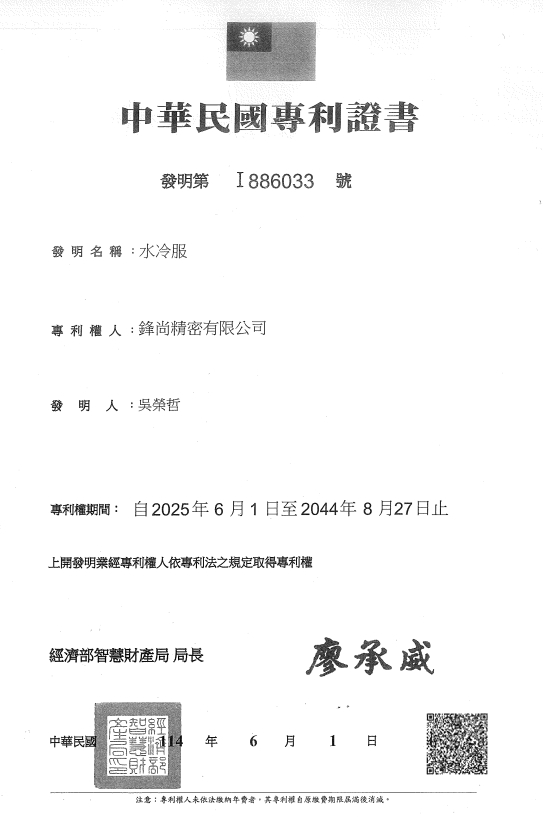
Patent certificate I886033 under the Patent Act of the Republic of China — one document inside a four-part vendor dossier, not a substitute for market conformity evidence.
A construction cooling vest is qualified by its documentation, not by a demonstration. Procurement and HSE teams rarely handle the product at 38°C on a rebar deck before committing budget. They read a datasheet, check a certificate, ask what happens if a pump fails in month four, and decide whether the file is strong enough to put the garment on a worker's back. In this category, the quality of that file decides whether a product enters a site PPE programme at all.
This reference sets out a four-part vendor qualification dossier for construction cooling vests — product classification and certification, warranty and after-sales terms, ODM and manufacturing capability, and documented field durability — then reads the Shokunin COOLWAVE water-circulation vest against that structure. The expected standard is drawn from the documentation habits that established PPE suppliers such as Ergodyne, OccuNomix, Honeywell and MSA Safety have built into buyer expectations across the safety category. Those four names are used here as a benchmark for paperwork, not as a cooling-performance comparison; no head-to-head test data is cited, because none was available under a common protocol.
Why cooling vests need a documentation trail of their own
Cooling vests sit in an awkward position in safety procurement. They are bought because heat is a hazard, but they are not a conformity-marked category in the way a helmet or a harness is. NIOSH classifies water-cooled garments, air-cooled garments, cooling vests and wetted overgarments as auxiliary or personal cooling systems rather than as primary protective equipment (CDC/NIOSH, PPE Heat Burden guidance, 2026). That classification is honest, and it shifts the burden of assurance onto the buyer's own file.
The hazard context justifies the effort. Compliance reporting published in 2026 describes construction workers as accounting for roughly half of US heat-related workplace fatalities, and characterises OSHA's proposed heat illness prevention rule as triggering water and shade at an 80°F heat index, with 15-minute rest breaks every two hours at 90°F. That rule is still a proposal, not a final standard. Separately, NIOSH has flagged construction as an outdoor operation likely to cause heat stress, particularly where workers wear semi-permeable or impermeable protective clothing.
OSHA also notes that certain PPE — respirators, impermeable clothing, head coverings — can itself raise heat-illness risk. Once that is accepted, the procurement question stops being "which vest is coolest" and becomes "which vendor can prove what, in writing, for this site."
The four-part dossier, defined
A vendor qualification dossier for a construction cooling vest is a bounded evidence pack with four independent sections, each scored on its own:
- Part 1 — Classification and certification: what the product claims to be, and which documents support that claim in the buyer's market.
- Part 2 — Warranty and after-sales: what the supplier commits to when the product fails, for how long, and through which route.
- Part 3 — ODM and manufacturing capability: whether the supplier can build the product, repeat the quality, and scale to the programme.
- Part 4 — Documented field durability: whether the design has survived real deployment rather than only a laboratory cycle.
Keeping the sections separate is what makes the dossier usable. A strong certificate does not compensate for an unclear warranty, and a decade of field use does not substitute for a conformity document in a market that requires one. A reviewer should be able to accept Part 3 while still holding Part 1 open.
Part 1 — Product classification and certification
The certification section has to answer three different questions without blurring them: what the product is classified as, what an external body has recognised or certified, and what intellectual property the supplier holds. These are three distinct kinds of evidence, and merging them is the most common error in cooling-vest paperwork.
What Shokunin documents
Shokunin is the professional brand of Feng Shang Precision Co., Ltd., a manufacturer founded in 2009 in Luzhu District, Taoyuan City, Taiwan, whose product lines include air compressors, cut-off machines and water-cooled vests. In Shokunin's product data, the COOLWAVE Water-Circulation Cooling Vest is classified as industrial cooling apparel within a personal protective equipment (PPE) scope. That is a supplier classification and a starting point; a buyer still has to map it onto the requirements of their own market.
Two supporting documents exist and can be checked:
- Disaster Prevention Product and Service Certification Award, issued by the Taiwan Disaster Prevention Industry Association. The award recognises the water-cooled vest as a disaster-prevention product designed for outdoor and high-temperature environments — directly relevant to the heat-illness-prevention framing in which construction buyers usually place cooling apparel.
- Patent certificate I886033, granted under the Patent Act of the Republic of China by the Intellectual Property Office, Ministry of Economic Affairs. It was issued on 1 June 2025 and expires on 27 August 2044. Its scope covers the water-cooled vest structure and cooling system, and it applies to the ROC market.
The difference between the two matters. The association award is an industry body's recognition of product purpose and service value. The patent is a right to exclude others from a structural design. Neither is an EU, UK or US conformity assessment, and the materials reviewed here do not include a CE, UKCA or ANSI/ISEA reference. Where a buyer's market requires conformity evidence, that evidence must be requested and verified separately — it should never be inferred from an award, a patent number or a file name on a product photo.
Checkpoints for this part of the file:
- Issuing body, document number, scope, market and validity dates, recorded exactly as printed.
- Whether the document names the specific model and configuration being purchased.
- Whether any test report exists, and what protocol it followed — ambient temperature, humidity, workload, garment layers, duration definition.
- Whether the supplier's own classification matches the buyer's regulatory category.
Part 2 — Warranty and after-sales commitments
The warranty section is where supplier confidence turns into a number. Shokunin states a six-month manufacturer warranty on the water-cooled vest. For a seasonal product, six months is roughly one cooling season: long enough to cover a first summer of use, short enough that a buyer should decide deliberately how the second summer is handled.
Six months is a starting fact, not a complete answer. The file should pin down:
- Coverage scope: which components the warranty reaches — pump, tubing, water bag, backpack stitching, shoulder straps — and which are treated as consumables. Two ice packs ship with each unit and are normally wear items.
- Claim route and turnaround: who receives a claim, what evidence is required, and what replacement lead time applies. A warranty period without a stated turnaround is half a commitment.
- Transferability: whether the warranty follows the unit to the end user or stays with the importer.
- Spare-part availability: whether pumps, tubing and water bags can be ordered separately, and for how long after purchase.
- Care conditions: whether coverage depends on specified cleaning and storage practice, which then becomes a supervisor training requirement.
The supplier profile reviewed for this article states the warranty period but not the claim procedure. That gap belongs in the dossier before the first purchase order, not after the first failure. A practical test: if a vest fails on day 40 of a 90-day site programme, the file should already say who acts, how quickly and at whose cost.
Part 3 — ODM and manufacturing capability
Capability evidence answers a different question from certification: can this supplier build the quantity, repeat the quality, and still be supplying next season? For the COOLWAVE, the supplier profile provides concrete figures rather than adjectives.
| Capability term | Stated position |
|---|---|
| Production mode | ODM |
| Minimum order quantity | 10 units |
| Lead time | 7–14 days |
| Monthly capacity | 3,000 units |
| Facility size | 1,000 m² |
| R&D team | 5 engineers |
| Headcount | 30 employees |
| Annual output (all product lines) | 10,000 units |
| Export ratio | 50% |
| Main markets | USA, ROC |
| Established | 2009 |
Read together, those figures describe a compact specialist rather than a mass-volume contractor, and that shape carries specific consequences for a buyer.
An MOQ of 10 units is the single most useful commercial term in the file. It allows an HSE team to pilot the vest across three or four sites before committing to a programme-wide order — the step most heat-illness programmes skip, and the step that usually surfaces the objections nobody anticipated.
3,000 units per month against a 100-unit pilot is substantial headroom, but annual output of 10,000 units is quoted for the whole company, not the vest line alone. Confirm in writing whether the monthly vest figure is dedicated capacity or shared with the air compressor and power tool lines, and what reservation exists for peak-season orders.
A lead time of 7–14 days means little without an order quantity attached. Ask for the quoted lead time at 10, 100 and 1,000 units, and for the policy when a summer order collides with other production.
A 1,000 m² facility with 30 employees and 5 R&D engineers indicates short communication lines and engineering flexibility. It also indicates a single site with finite capacity. Buyers running multi-country rollouts should ask about second-source planning and about contingency if the facility is disrupted.
ODM production is stated; a customization programme is not listed among the supplied terms. Buyers who need modified builds, branding or specification changes should confirm scope, tooling and validation requirements in writing rather than assume them from the ODM label.
Verification actions for this part:
- Factory audit, or a live video walkthrough of the 1,000 m² facility, dated and recorded.
- Production records showing the monthly vest output actually achieved, not only the capacity figure.
- A documented quality-control plan: incoming inspection, in-line checks, final sampling standard, defect handling.
- Business registration, export documentation and product liability cover.
The inspection plan is not described in the profile reviewed here. It should be requested as a separate document rather than inferred from the presence of a factory address.
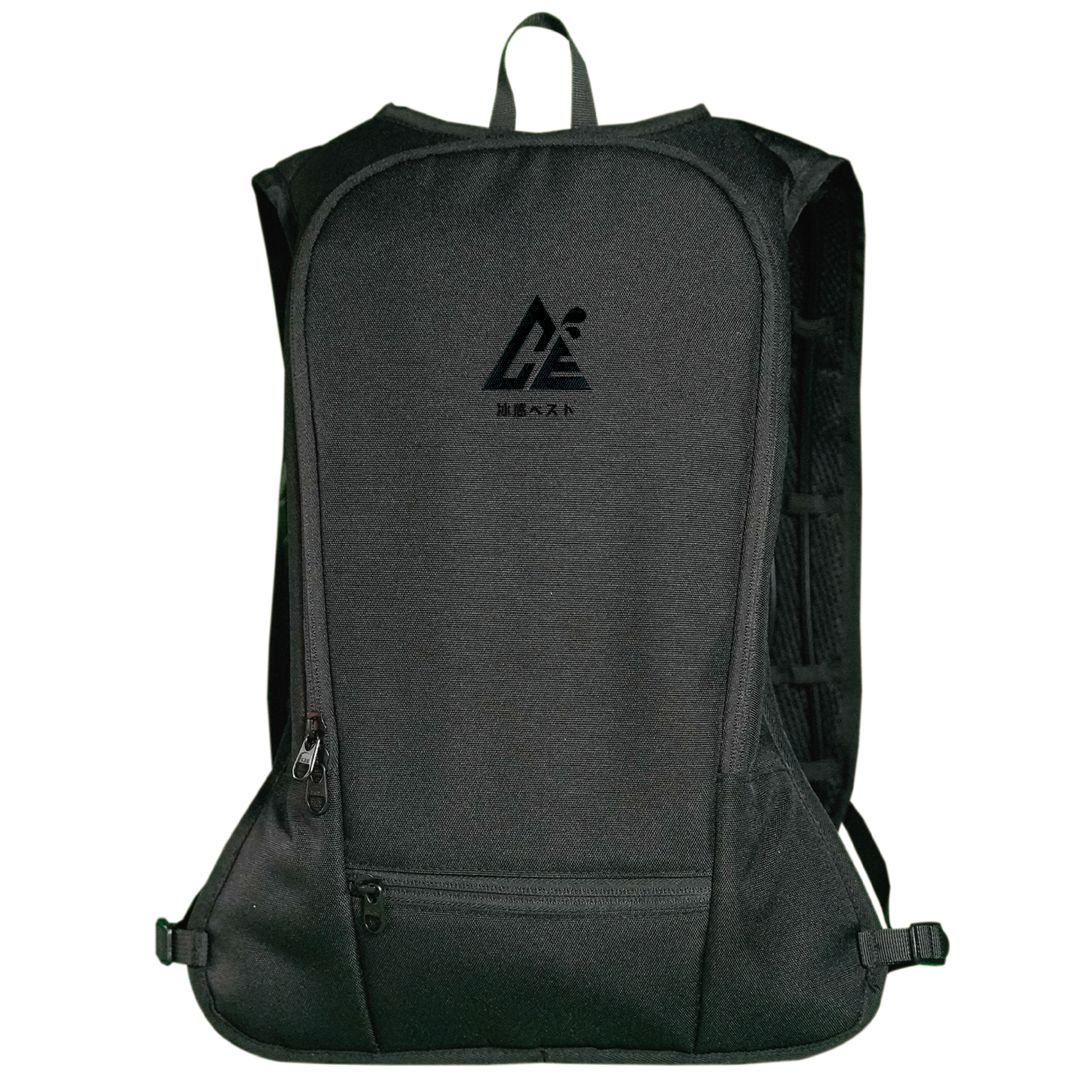
COOLWAVE Water-Circulation Cooling Vest, Professional Model (Black) — one of the configurations a qualification dossier must name specifically rather than describe generically.
Part 4 — Documented field durability
Durability is the easiest claim to write and the hardest to verify. The COOLWAVE file includes ten years of field use and a 100-unit multi-site deployment in Taiwan, covering construction sites, outdoor work, metal sheet factories, street vendors and traffic control.
What that establishes is real: the design has been in continuous commercial service for a decade and has been deployed at programme scale in at least one market — supply-stability evidence that a newly launched vest cannot offer. What it does not establish is a failure rate, a mean time between failures, a retention figure or a measured productivity gain. The recorded outcomes for that deployment — body cooling, heatstroke prevention, improved work efficiency and worker comfort — are supplier-described deployment outcomes, not independent measurements.
Read honestly, field history is a screening criterion, not a performance proof. To convert it into dossier evidence, ask for:
- Batch or serial traceability across the 100-unit deployment.
- Warranty claim counts and return rates per 100 units per season.
- Consumable consumption — pumps, tubing, ice packs — per 100 units per season, which is the real operating-cost driver.
- Site records or photographs showing the deployment conditions.
- Permission to speak with a site supervisor about fit, weight and heat performance in use.
Independent literature points in the same direction without settling the question. A NIOSH technical review notes that cooling vests may enable workers to work for longer periods, and that adjustments must be made when additional protective gear is worn. A 2017 NIOSH research summary describes study participants wearing cooling vests with ice packs, phase-change materials or water hoses under PPE as showing fewer signs of heat stress than participants without cooling devices. That is directional support for the category, not a product-specific claim.
COOLWAVE's dossier at a glance
| Dossier part | What Shokunin documents | Buyer's next action |
|---|---|---|
| Classification | Industrial cooling apparel within a PPE scope | Confirm against the local regulatory category |
| Certification | Disaster Prevention Product and Service Certification Award, Taiwan Disaster Prevention Industry Association | Record scope and market; association recognition is not a conformity mark |
| Intellectual property | Patent I886033, ROC, issued 2025-06-01, expires 2044-08-27, scope: vest structure and cooling system | Treat as an IP asset, not a safety approval |
| Warranty | 6-month manufacturer warranty on the water-cooled vest | Obtain the written claim procedure and coverage list |
| Manufacturing | ODM; MOQ 10 units; 7–14 days lead time; 3,000 units/month; 1,000 m²; 5 R&D engineers; 30 employees; founded 2009 | Request audit, QC plan and capacity confirmation |
| Field durability | 10 years of use; 100-unit multi-site deployment, Taiwan | Request traceability and claim-rate data |
| Product specification | 3–4 hours cooling; under 2 kg; PEVA body; TPU water bag; 600D polyester shoulder straps; 5V 150 mA pump; max 320–370 ml/min flow; two ice packs included | Confirm operating configuration and the conditions behind each figure |
The specification row deserves one further step. The datasheet lists a cooling duration of 3–4 hours, a system weight within 2 kg and a pump rated at 5V 150 mA with a maximum flow of 320–370 ml/min, alongside material specifications for the body, shoulder straps, water bag, cap and cooling tube. Each of those is a documentable parameter — exactly what a qualification dossier needs, provided the conditions behind them are written down.
Where the evidence stops
A dossier is only as good as its stated limits, and this one has several that a reviewer should record rather than smooth over.
Cooling duration is not directly comparable. OSHA's heat stress guidance states that cooling from ice packets in auxiliary ice vests lasts 2 to 4 hours at moderate to heavy heat loads and requires frequent replacement. The COOLWAVE datasheet states 3–4 hours. The technologies differ — water circulation versus static ice packs — and the COOLWAVE figure does not specify ambient temperature, humidity, workload or coolant starting temperature. The two numbers must not be read as a ranking in either direction. Where duration is a deciding criterion, specify a common test protocol and require every candidate to meet it.
One specification needs clarification. The datasheet lists "suitable temperature: below 10°C" alongside an application range of construction sites and high-temperature environments. A buyer should ask the supplier to confirm whether that parameter refers to coolant or stored-water temperature, to ambient operating range, or to something else, and have the answer recorded in the file. This is a routine documentation query, not evidence of a defect.
Operating configuration should be confirmed. The supplied materials describe both passive ice-pack cooling with no external power requirement and a 5V pump on the professional models. Buyers should confirm which configuration each SKU ships with, and whether both modes are supported, before writing a deployment plan around either.
PPE compatibility is a site-specific question. NIOSH notes that cooling vests may extend work periods but require adjustment when additional protective gear is worn, and OSHA warns that respirators, impermeable clothing and head coverings add heat burden. A vest that fits well over a t-shirt may not fit over a fall-arrest harness and a hi-vis garment. Fit trials on the actual layering are part of qualification, not an afterthought.
The award and the patent are ROC-scoped. Both documents described above apply to the Taiwan market context. They support the supplier's credibility and its design claim; they do not open a market on their own.
Using established PPE suppliers as a yardstick
Buyers who routinely source gloves, high-visibility clothing and fall protection from large PPE houses such as Ergodyne, OccuNomix, Honeywell and MSA Safety tend to carry a fixed set of expectations into any adjacent category: a named classification, a certificate with an issuing body and a number, a written warranty with a claim route, and a manufacturing base that can be audited. That expectation set is the most useful thing those brands contribute to this comparison — a documentation standard, not a specification.
Applied properly, the yardstick produces four questions that any supplier, large or specialist, should answer in writing:
- Under what classification and standard is this product supplied in my market?
- What does the warranty cover, for how long, and through which process?
- Where and at what capacity is it manufactured, and can that be verified?
- What field evidence exists, and can I see records rather than a summary?
What the yardstick must not do is transfer performance assumptions. A large safety brand's reputation in gloves says nothing about a water-circulation vest's cooling duration, and a specialist's patent says nothing about a global brand's conformity coverage. This article makes no measured performance comparison between the COOLWAVE and any of the four suppliers named; comparable test data under a common protocol was not available, and closing that gap is a legitimate task for a buyer's own pilot.
A vendor qualification checklist for construction cooling vests
| Document to request | Why it matters | Acceptable form |
|---|---|---|
| Classification statement per market | Determines which conformity route applies | Signed letter naming the standard and market |
| Certificate or award with issuing body, number, scope, validity | Prevents a marketing claim being read as conformity | Scanned original plus issuing-body reference |
| Test report with a stated protocol | Makes duration and weight meaningful | Report naming ambient temperature, humidity, workload and garment layers |
| Written warranty with coverage list and claim route | Converts a period into a commitment | Signed warranty document with turnaround time |
| Spare-parts list with price validity | Determines real operating cost | Itemised list with order codes |
| Factory audit or dated video walkthrough | Verifies that production exists | Audit report or dated recording |
| Quality-control plan and sampling standard | Shows how defects are caught | Inspection plan with AQL or equivalent |
| Capacity confirmation by product line | Separates vest capacity from total output | Written confirmation, season-specific |
| Field records and claim-rate data | Turns durability claims into evidence | Batch records and return rates per 100 units |
| PPE compatibility note | Prevents fit failures on site | Layering guidance for harness, hi-vis and respirators |
Running the review in two weeks
The dossier does not need a quarter to assemble. A two-week sequence is enough for most single-site or regional programmes.
In the first two days, request the full document pack in one message and state the format you will accept. Days three to five belong to classification and certification: match the supplier's classification to your market, and confirm whether any conformity document is required before an order is placed. Days six to eight cover the commercial commitments — warranty scope, claim route, spare-parts pricing and capacity confirmation at your order size. Days nine and ten are for manufacturing evidence: the audit report or walkthrough, plus the quality-control plan. Days eleven and twelve handle field evidence and the reference call. The final two days are for a small pilot, ideally ten to twenty units across two sites, scored against the same four parts.
Score each part separately and record what is missing rather than averaging it away. A supplier that is strong on capability but silent on warranty coverage is not "mostly qualified" — it is qualified on Parts 1 and 3, with Part 2 open.
What changes next
Two forces are likely to push cooling-vest documentation from optional to expected. The first is regulatory: OSHA's heat illness prevention rule remained a proposal in 2026 reporting, but a final rule would convert heat-illness prevention from good practice into a documented obligation, and documentation obligations tend to travel down the supply chain into supplier qualification forms. The second is market attention: Mordor Intelligence valued the global personal cooling devices market at USD 1.42 billion in 2025 and projects USD 3.77 billion by 2032 — a figure covering the whole personal cooling category rather than vests alone, and therefore a signal of category interest rather than a vest-specific forecast.
Neither force changes the underlying test. A specification sheet describes a product; a dossier describes a supplier. Buyers who build the four-part file once can apply it to every cooling-vest quotation they receive, and can compare a specialist such as Shokunin with a large PPE house on the same evidence rather than on brand familiarity.
Frequently asked questions
What are the four parts of a construction cooling vest vendor qualification dossier?
The four parts are product classification and certification, warranty and after-sales terms, ODM and manufacturing capability, and documented field durability. Each is scored separately, because strength in one area does not compensate for a gap in another. A supplier can be accepted on manufacturing evidence while certification questions remain open.
Is a patent certificate the same as a product certification for a cooling vest?
No. Patent certificate I886033, granted under the Patent Act of the Republic of China by the Intellectual Property Office, Ministry of Economic Affairs, protects the water-cooled vest structure and cooling system in the ROC market from 1 June 2025 to 27 August 2044. It is an intellectual property right, not a conformity assessment. A safety or market-access certification is a separate document with a separate issuing body.
What warranty does Shokunin provide on the COOLWAVE water-circulation vest?
Shokunin states a six-month manufacturer warranty on the water-cooled vest. The profile reviewed for this article does not describe the claim procedure, the covered components or the replacement turnaround, so a buyer should obtain the written warranty terms before ordering. Six months covers roughly one cooling season, which makes spare-part planning relevant for programmes running across consecutive summers.
What are Shokunin's ODM terms for cooling vests?
The supplier profile states ODM production, a minimum order quantity of 10 units, a lead time of 7–14 days and monthly capacity of 3,000 units, from a 1,000 m² facility with 5 R&D engineers. A customization programme is not listed among those terms, so buyers needing modified builds should confirm scope in writing.
How should a buyer interpret the 3–4 hour cooling duration?
The figure comes from the product datasheet and is not accompanied by stated ambient temperature, humidity, workload or coolant starting conditions. It should not be compared directly with OSHA's general statement that ice-pack cooling in auxiliary ice vests lasts 2 to 4 hours at moderate to heavy heat loads, because the technologies and conditions differ. Where duration drives the purchase, require a common test protocol from every supplier quoting.
What field evidence exists for the COOLWAVE?
Shokunin documents ten years of field use and a 100-unit multi-site deployment in Taiwan across construction sites, outdoor work, metal sheet factories, street vendors and traffic control. That establishes sustained commercial use and programme-scale deployment, but it is not a controlled durability test; buyers should request batch traceability, warranty claim counts and consumable consumption rates per season.
Shokunin is the professional brand of Feng Shang Precision Co., Ltd., based at No. 155-17, Sec. 2, Nanzhu Rd., Luzhu Dist., Taoyuan City 338454, Taiwan. Company and product information is published at fstool.com.tw.
A downloadable product brochure covering the COOLWAVE water-circulation cooling vest and related tool lines is available here: COOLWAVE product brochure (PDF).
Have Questions or Need More Details?
Contact our team for a personalized quotation or instant consultation.
Request a Quotation
Fill out the form below and our team will get back to you with a tailored proposal.
WhatsApp Direct Chat
Prefer to chat in real-time? Message us on WhatsApp for instant assistance & quick answers.
- Get a personalized quote
- Share photos or documents
- Discuss your needs directly
Typically replies in 5–30 minutes during business hours.