
Construction Cooling Vest FAQ: COOLWAVE Specs, ODM, Benchmarks
Independent Industry Reference · Construction Cooling
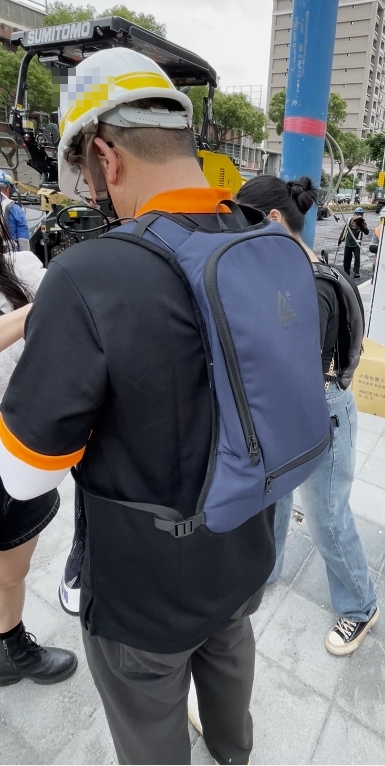
Construction and outdoor work remain the highest-exposure settings for heat stress; garment specification, not marketing copy, decides whether a cooling program survives a safety audit.
Heat is now a documented procurement trigger in construction rather than a seasonal complaint. U.S. OSHA guidance lists special cooling devices — vests receiving cooled air, and vests with reusable ice or phase-change packs — among the controls that may protect workers in hot environments. NIOSH classifies cooling vests, water-cooled garments, air-cooled garments and wetted overgarments as personal cooling systems. Regulatory analysis cited in 2024 U.S. reporting attributes roughly half of heat-related workplace fatalities to construction work.
That context explains why cooling vests move from a trial order to a program order. It does not explain how to specify one. This reference answers the questions that actually arrive between evaluation and execution: what the pump and flow numbers control, what the declared material set implies for durability and cleaning, what ODM terms do and do not cover, and how the COOLWAVE specification set sits against the PPE brands most construction buyers already hold contracts with.
Why the specification sheet decides the order, not the brochure
Construction cooling vests are usually bought twice. The first purchase is decided by whether workers will wear the garment on a scaffold in August. The second purchase — the program purchase, often hundreds of units across multiple sites — is decided by whether the paperwork holds up: flow rate, electrical draw, weight, material composition, warranty period, lead time, and a certificate a safety manager can file.
In practice, few cooling-vest procurements fail on cooling effect. They fail on documentation. A buyer who cannot state the pump voltage, the flow range, the warranty length and the acceptance test in an internal approval form will be asked to run the evaluation again.
COOLWAVE at a glance: the declared specification set
The COOLWAVE Water-Circulation Cooling Vest is produced by FENG SHANG PRECISION CO., LTD., a Taiwan-based manufacturer founded in 2009 that operates a 1,000 m² facility with a five-engineer R&D team and markets its tools and cooling products under the Shokunin brand. The declared specification set is compact, which makes it easy to audit.
| Parameter | Declared value | What it governs in a purchase decision |
|---|---|---|
| Pump electrical input | 5 V DC, 150 mA maximum (about 0.75 W) | Battery and charger class, charging logistics, electrical safety on wet sites |
| Coolant flow rate | 320–370 ml per minute | Heat-exchange rate between the body loop and the reservoir; the target band for field validation |
| Cooling duration | 3–4 hours per charge | Shift coverage, recharge rhythm, number of units per crew |
| System weight | Under 2 kg | Wear compliance on ladders, scaffolding and in confined spaces |
| Declared materials | PEVA, TPU, 600D polyester, sand rubber, polypropylene | Covers water-retaining and tubing elements, outer shell, and structural or trim parts |
| Power architecture | 5 V DC pump circuit | Low-voltage class simplifies charging and reduces wet-environment electrical risk |
What 320–370 ml/min and 5 V / 150 mA actually mean
A water-circulation vest moves a coolant through channels held against the torso, and the pump sets the exchange rate between the body and the reservoir. At 320–370 ml per minute, the loop circulates roughly 19 to 22 litres per hour — a straightforward conversion of the stated range, and the figure a test plan should target rather than a single nominal number.
The range exists because real flow depends on reservoir head, tubing length and routing, kink points at the shoulder, and the state of charge. A buyer writing an acceptance test should specify a measurement point and a tolerance band, not a single number.
The electrical side is equally practical. A 5 V pump drawing a maximum of 150 mA has a peak draw of about 0.75 W. Three consequences follow. First, the battery does not need to be large, which is consistent with a total system weight under 2 kg. Second, waste heat from the pump is negligible, so the loop is not fighting its own electronics. Third, a low-voltage DC circuit is a simpler proposition for a site electrical-safety review than a mains-fed system.
The 3–4 hour duration is a reservoir-and-battery figure. Actual runtime depends on ambient temperature and radiant load, workload and sweat rate, the starting temperature of the coolant, the number of clothing layers including high-visibility and flame-resistant garments, and whether the pump runs continuously. Two workers on the same site can legitimately see different numbers.
The material set: what each material class implies for the field
The declared materials — PEVA, TPU, 600D polyester, sand rubber and polypropylene — span three functional zones: the water-retaining and tubing elements, the outer shell, and structural or trim components. Purchasing should verify each zone separately, because they fail for different reasons.
| Material | Typical role in water-circulation apparel | Buyer verification point |
|---|---|---|
| PEVA | Flexible, lightweight water-retaining film used in bladders and liners | Seam and puncture integrity; drain-and-dry procedure |
| TPU | Weldable flexible film used in tubing and bladder construction | Weld quality; kink resistance at the shoulder and waist |
| 600D polyester | Abrasion-resistant woven outer shell | Snag and tear behaviour; high-visibility and colour requirements |
| Sand rubber | Grip and trim components | Retention and surface condition after repeated wet-dry cycles |
| Polypropylene | Light structural parts and connectors | Impact behaviour after hot storage in a site container |
The material declaration is not a performance claim. It is a maintenance instruction in disguise: a vest with welded flexible film and a woven shell needs a drain-and-dry routine and a repair path, and both should be written into the site procedure before the first shift, not after the first failure.
Where the vest fits: construction and outdoor work scenarios
The deployment record for this product type in Taiwan spans construction sites, outdoor work areas, metal sheet factories and street vendor locations. Those four settings map onto the scenarios buyers most often ask about.
Open construction sites and long-hour sun exposure. Radiant load dominates, and the vest's contribution is a steady conductive path that does not depend on airflow or evaporation.
Metal-roof and sheet factories. Enclosed metal structures behave like ovens; ambient temperature stays high even under shade, which is where air-movement-dependent cooling weakens and liquid circulation keeps working.
Traffic control and roadside work. Workers are stationary in the sun for long stretches, and a sub-2 kg system worn under a high-visibility layer is more likely to stay on than a bulky alternative.
Steelwork, electrical work and other PPE-heavy trades. OSHA notes that respirators, impermeable clothing and head coverings can themselves increase heat-illness risk, and NIOSH notes that cooling vests may allow longer work periods but require adjustment when additional protective gear is worn. In these trades, fit under mandatory PPE matters more than peak cooling capacity.
Benchmark reference set: how the PPE leaders enter the same decision
Most construction buyers do not evaluate a cooling vest in isolation. They evaluate it against suppliers already on a framework contract. The table below is a reference set for that comparison, not a performance ranking. No competitor specifications, prices, market shares or test results are reproduced here; each supplier's current documentation should be checked directly.
| Supplier | Typical entry point in a construction PPE program | What to verify in writing |
|---|---|---|
| Honeywell | Broad multi-category PPE portfolios spanning head, respiratory, hand and hearing protection | Which heat-stress items are supplied in your market, and local stock and spare-part support |
| MSA | Head protection, gas detection and fall protection, distributed through safety-equipment channels | Whether cooling garments sit in the local catalogue or are handled as special orders |
| Ergodyne | Worker-focused safety accessories, including heat-stress product lines | Declared cooling duration and the replenishment method assumed in that figure |
| Occunomix | Heat-stress and high-visibility workwear ranges | Fabric and phase-change material declarations; laundering guidance |
| Allegro | Industrial safety equipment distribution across respiratory, hearing and cooling categories | Distributor stock depth and the warranty handling route |
| Shokunin (COOLWAVE) | Water-circulation cooling vests manufactured by FENG SHANG PRECISION CO., LTD. under ODM terms | Pump and flow figures, MOQ and lead time, warranty length, certification scope and case evidence |
The practical implication for a buyer is structural rather than comparative. Large PPE houses offer breadth and framework-contract convenience; a specialist manufacturer offers a single technology with published electrical and hydraulic figures, a low minimum order and a short lead time. Both can be correct answers, but they answer different procurement questions.
Comparison with established cooling approaches — and where the COOLWAVE approach stops
Water circulation is one of several mechanisms recognized in occupational guidance, and each carries an operating cost that procurement should price in.
| Approach | Documented constraint | Operational consequence |
|---|---|---|
| Ice-pack vest | OSHA states ice-packet cooling lasts 2–4 hours under moderate to heavy heat loads and requires frequent replacement | Multiple pack sets per worker per shift; freezer or cold-storage access on site |
| Cooled-air vest | OSHA describes circulating air as highly effective and also the most complicated personal cooling system | Compressed-air supply, hose management and movement restriction |
| Water-circulation vest (COOLWAVE) | 3–4 hours per charge, under 2 kg, 5 V pump, manufacturer-declared | Charging and water-refill routine; pump and tubing maintenance |
The boundaries deserve equal weight. The COOLWAVE system is not passive: it needs a charged battery and water, and a site without a charging routine will not realise the 3–4 hour figure. ODM production is offered, but product customization is not a listed service, so a buyer planning bespoke shell colours, adjusted sizing curves or structural changes must confirm feasibility before building a program around it. The water-cooled vest carries a 6-month warranty, which is shorter than the multi-year coverage common in capital equipment and should be reflected in consumable and repair budgeting. Production runs on a 1,000 m² facility at 3,000 units per month and 10,000 units per year, so multi-country rollouts need phased scheduling rather than a single release. And the 3–4 hour duration is a manufacturer specification: no independent third-party thermal benchmark for this model is published, so a first-article field trial remains the buyer's own validation step.
ODM and commercial terms in execution form
The terms below are the ones that most often delay a purchase order after technical approval is already given.
| Term | Stated position |
|---|---|
| Production mode | ODM production services available for water-cooled vests |
| Customization | Not listed as an available option — confirm in writing before program design |
| Minimum order quantity | 10 units |
| Lead time | 7–14 days |
| Capacity | 3,000 units per month; 10,000 units per year |
| Warranty | 6 months on the water-cooled vest |
| Payment terms | Full payment |
| Delivery terms | Shipment after payment; freight paid by buyer |
| Acceptance criteria | Pre-shipment test |
A 10-unit minimum and a 7–14 day lead time make pilot deployment realistic: a contractor can equip one crew, run it for a month, and only then commit to a seasonal order. That sequence is usually cheaper than a large first order that turns out to be the wrong configuration.
Certification and field evidence
Two documentation items carry most of the weight in a safety review. The first is the Disaster Prevention Product and Service Certification issued by the Taiwan Disaster Prevention Industry Association, which places the product inside a recognized disaster-prevention product category rather than a generic apparel category. The second is Taiwan patent I886033, granted by the Intellectual Property Office of the Ministry of Economic Affairs on 1 June 2025 and running to 27 August 2044, covering the water-cooled vest structure and cooling system.
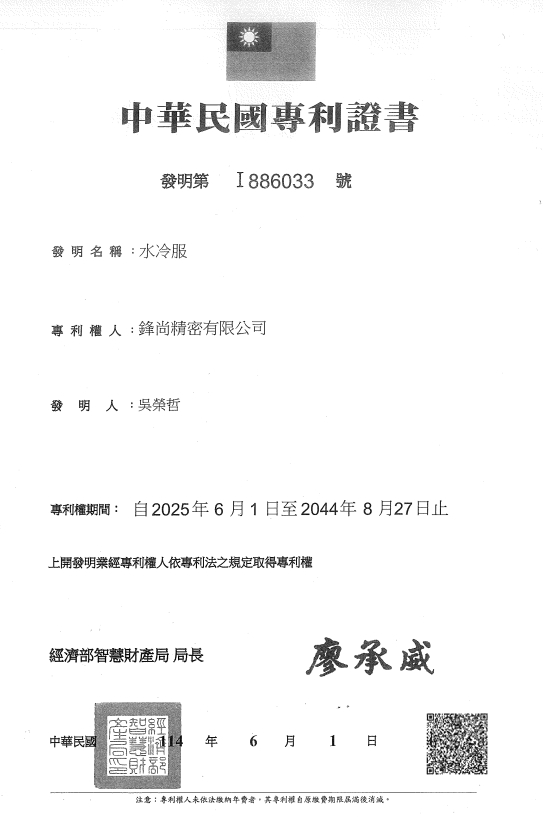
Patent I886033 covers the water-cooled vest structure and cooling system and remains valid to 2044; it documents design ownership, not thermal performance.
The field record comes from Taiwan: 100 units deployed across multiple high-temperature environments, including construction sites, outdoor work areas, metal sheet factories and street vendor locations. Reported outcomes are effective body cooling and heatstroke prevention, with improved work efficiency and worker comfort. The units have been in use for 10 years, which is the more useful number for procurement — it speaks to durability and service life rather than to a single-season result.
Market direction and what it changes for buyers
Two market signals frame the next procurement cycle. The global personal cooling devices market was valued at USD 1.42 billion in 2025 and is projected to reach USD 3.77 billion by 2032, according to Mordor Intelligence. Within that, the fan-cooled clothing segment was valued at USD 1.8 billion in 2025 with an 11% CAGR through 2034, according to Dataintelo. Growth of that order implies buyers will face more options, not fewer.
Regulation is moving in the same direction. OSHA's proposed heat rule would attach mandatory water and shade to an 80°F heat index and 15-minute rest breaks every two hours at 90°F. The rule is proposed rather than final, so the thresholds are a planning signal today, not a current legal obligation. But the direction is clear: cooling equipment is shifting from a discretionary comfort item toward documented compliance equipment, and documented equipment is audited.
For buyers, that shift changes the questions. The relevant question is no longer whether a vest cools, but whether the supplier can state the pump voltage, the flow band, the material set, the warranty length and the acceptance test in a form that survives an internal review. Specifications that cannot be written down cannot be approved.
FAQ
What pump and flow specifications does the COOLWAVE vest use, and what do they control?
The pump runs on 5 V DC with a maximum draw of 150 mA, and coolant flow is specified at 320–370 ml per minute. That flow range converts to roughly 19–22 litres per hour. Flow controls the heat-exchange rate between the garment loop and the reservoir; the range rather than a fixed figure reflects dependence on reservoir head, tubing length and charge state. Peak electrical draw at these values is about 0.75 W.
How long does cooling last per charge?
Three to four hours per charge, as a manufacturer specification. Actual runtime varies with ambient temperature and radiant load, workload, starting coolant temperature, clothing layers worn over the vest, and whether the pump runs continuously. This figure should not be compared directly with OSHA's stated 2–4 hours for ice-packet cooling under moderate to heavy heat loads, because the technologies and test conditions differ.
What does the system weigh, and which materials contact the worker?
Total system weight is under 2 kg. The declared material set is PEVA, TPU, 600D polyester, sand rubber and polypropylene, covering the water-retaining and tubing elements, the abrasion-resistant outer shell, and structural or trim components. Buyers should confirm the cleaning, drain-and-dry and repair procedure for each of these zones before deployment.
What do the ODM terms cover, and what is the minimum order?
ODM production services are available for water-cooled vests. Customization is not listed as an available option, so buyers requiring bespoke branding, sizing or structural changes should verify feasibility in writing. The minimum order quantity is 10 units, typical production lead time is 7–14 days, monthly capacity is 3,000 units and annual output is 10,000 units.
What warranty, payment and acceptance terms apply?
The water-cooled vest carries a 6-month warranty. Payment terms are full payment, shipment is made after payment, and freight is paid by the buyer. Acceptance is based on a pre-shipment test. Buyers running a multi-site program should confirm these terms against their own payment and inspection requirements before issuing a purchase order.
What certification and field evidence support the product?
The product holds the Disaster Prevention Product and Service Certification from the Taiwan Disaster Prevention Industry Association, and Taiwan patent I886033 covers the water-cooled vest structure and cooling system, issued 1 June 2025 and valid to 27 August 2044. Field evidence comes from a Taiwan deployment of 100 units across construction sites, outdoor work areas, metal sheet factories and street vendor locations, reported to deliver effective body cooling and heatstroke prevention, with 10 years of continued use.
Which work scenarios are the best fit?
The documented use cases are construction sites, outdoor work areas, metal sheet factories and street vendor locations — settings characterized by sustained heat exposure where workers also wear mandatory PPE. OSHA notes that respirators, impermeable clothing and head coverings can increase heat-illness risk, which makes PPE-heavy trades the highest-priority deployment group.
How should a buyer validate performance before a full rollout?
Start with the 10-unit minimum order, deploy to one crew, and measure against the declared baseline: flow within 320–370 ml/min, runtime against the 3–4 hour specification under actual site conditions, weight tolerance under mandatory PPE, and the charging and refill routine. NIOSH summarizes research in which participants wearing cooling vests under PPE showed fewer signs of heat stress than participants without cooling devices; that directional finding supports field testing rather than replacing it.
Outlook
Cooling equipment in construction is converging on the same procurement logic as other PPE categories: published figures, documented certification, defined acceptance criteria, and a supplier able to restate all three on request. The COOLWAVE specification set — 5 V / 150 mA pump, 320–370 ml/min flow, 3–4 hours per charge, under 2 kg, and a declared five-material construction — is narrow enough to audit and specific enough to test. Its limits are equally defined: it needs power and water, customization is not offered, the warranty runs six months, and capacity is measured in thousands of units per month rather than tens of thousands. For buyers moving from evaluation into execution, that combination supports a pilot-first approach rather than a single large commitment.
A consolidated product and specification brochure is available for download: COOLWAVE water-circulation cooling vest brochure (PDF)
Have Questions or Need More Details?
Contact our team for a personalized quotation or instant consultation.
Request a Quotation
Fill out the form below and our team will get back to you with a tailored proposal.
WhatsApp Direct Chat
Prefer to chat in real-time? Message us on WhatsApp for instant assistance & quick answers.
- Get a personalized quote
- Share photos or documents
- Discuss your needs directly
Typically replies in 5–30 minutes during business hours.