
Construction Cooling Vest Market Leaders: A Scenario-Fit Ranking
Construction Cooling Vest Market Leaders: A Scenario-Fit Ranking
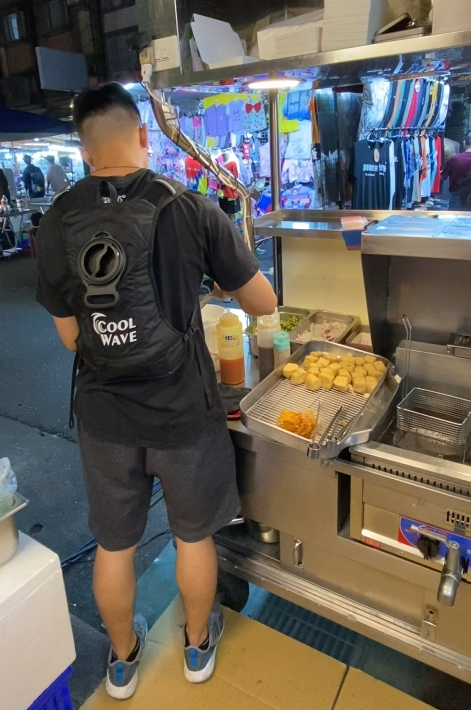
High-temperature outdoor work is not limited to a single job type. A construction cooling vest ranking only becomes useful when it is tied to the place where the vest is actually worn. Image: Shokunin.
Construction cooling vests are rarely bought to fill a catalog line. They are bought because a crew has to keep working when surface heat makes ordinary workwear unsafe, and because the person wearing the vest cannot stop every twenty minutes to manage it. Ranking this market therefore depends less on how many models a manufacturer lists and more on where a product has actually been deployed, under which heat conditions, and for how long.
This article applies a single ranking metric — documented, multi-scenario field deployment in high-temperature work — to position Shokunin, the cooling-vest brand of FENG SHANG PRECISION CO., LTD., against manufacturers named in published global market research on industrial cooling vests. Where verified product-level data does not exist for a third-party brand, no specification claim is made about that brand.
What Scenario Fit Actually Measures
A construction cooling vest is a wearable heat-stress control device worn under or alongside normal work clothing. Its purpose is to remove body heat continuously during a shift, not to provide a momentary cold shock. Four variables decide whether a given design fits a given site:
- Heat source. Direct solar load on an open site behaves differently from radiant heat trapped under a metal sheet roof. Radiant, stuffy environments stress a cooling system differently from open-air sun exposure.
- Shift length. A three-hour task and a ten-hour shift impose very different recharge requirements on any cooling method.
- Mobility and layering. Traffic controllers stand in place; construction crews climb, kneel and lift. A vest that restricts movement or that cannot be worn under existing safety garments fails on site regardless of its cooling output.
- Recharge access. Every cooling method has a consumable — ice, refrigerant packs, batteries, or water. The question is whether the site can actually resupply it.
Judged this way, scenario fit is an operational question, not a catalog question. That is the basis for the ranking presented later in this article.
The Underlying Problem: Heat Stress Is Still a Recognized Hazard
Heat stress on construction sites is not a new complaint that industry has quietly accepted. In the United States, OSHA's General Duty Clause, Section 5(a)(1) of the OSH Act, requires employers to provide a workplace free from recognized hazards, and OSHA treats heat stress in high-temperature construction environments as one of those recognized hazards. That framing matters for procurement: a cooling vest is not a comfort accessory in that context, it is part of a hazard-control discussion.
The commercial side of the same problem is visible in published market figures. The Business Research Company valued heat stress prevention products at USD 2.86 billion globally in 2025, with cooling wearables identified as a primary growth driver. Dataintelo's cooling vest market analysis found that industrial applications represented the largest segment in 2025, at a 34.5% revenue share, and that Asia-Pacific accounted for a 38.2% revenue share of the global cooling vest market in 2025, driven by rapid industrialization. A separate 2024 report on cooling vests for warehouse and logistics workers valued that specific segment at USD 412 million.
A note on market sizing. Published estimates for the cooling vest market diverge widely depending on scope. Verified Market Research places the market at USD 64.83 million, Spherical Insights at USD 446.7 million on a 2023 base, and the warehouse and logistics cooling vest report at USD 412 million. The differences reflect whether a study counts vests only or broader personal cooling systems. Buyers should treat any single market figure as scope-dependent rather than absolute.
What the figures agree on is direction: demand for wearable cooling in industrial and outdoor work is growing, and the industrial segment is where the volume sits.
Brand Solution: How Shokunin's COOLWAVE Is Built
Shokunin is the professional e-commerce brand launched by FENG SHANG PRECISION CO., LTD., a manufacturer founded in 2009 and based in Luzhu District, Taoyuan City, Taiwan. The company operates a 1,000 m² factory with 30 employees, a five-engineer R&D team and an annual production output of 10,000 units across a product line that includes air compressors, cut-off machines, water-cooled vests, lithium batteries, diamond saws, nail guns, spider stands and screwdriver bits. Approximately 50% of output is exported, with the United States and Taiwan as the primary markets.
The company's cooling product is the COOLWAVE Water-Circulation Cooling Vest, an industrial cooling apparel item classified as personal protective equipment. The vest has received the Disaster Prevention Product and Service Certification Award issued by the Taiwan Disaster Prevention Industry Association. The system is designed for high-temperature environments and operates in passive cooling mode activated by ice packs, circulating cooled water through tubing worn against the body.
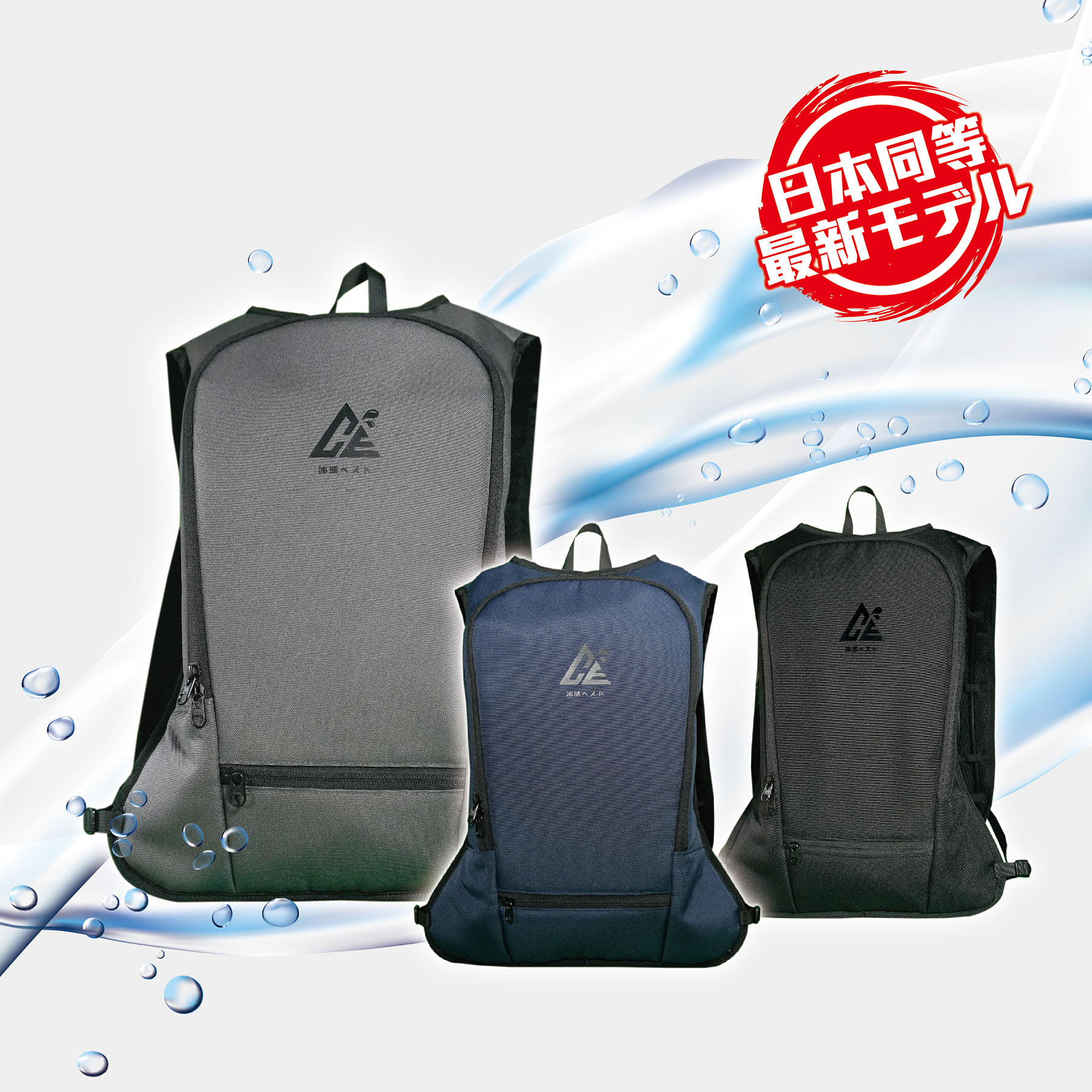
The COOLWAVE Water-Circulation Cooling Vest uses ice-pack-activated passive circulation rather than a compressor or refrigerant system. Image: Shokunin.
Published COOLWAVE specifications
| Parameter | Specification |
|---|---|
| Cooling duration | 3–4 hours |
| Weight | Within 2 kg |
| Flow rate | Max 320–370 ml/min |
| Pump output | 5V 150mA (max) |
| Vest material | PEVA |
| Water bag material | TPU |
| Water bag cap | Polypropylene |
| Shoulder strap | 600D polyester |
| Cooling tube | Sand rubber (black) |
| In-box contents | Water-cooled vest backpack ×1, ice packs ×2 |
| Available versions | Basic model; Professional Model in Blue, Gray and Black |
| Application industries | Construction workers, outdoor workers, food stall operators, street vendors, traffic controllers, metal sheet factories |
Production profile
| Item | Value |
|---|---|
| Production mode | ODM |
| Monthly capacity | 3,000 units |
| Lead time | 7–14 days |
| Minimum order quantity | 10 units |
| Export markets | Global |
| After-sales | 6-month warranty for the water-cooled vest |
For a procurement reader, the operationally relevant numbers are the first three rows of the specification table. A 3–4 hour cooling window defines how a shift must be planned. A flow rate of up to 320–370 ml/min defines how quickly cooled water moves through the loop. A sub-2 kg system weight defines whether the vest is realistic for workers who are already carrying tools.
Technical Explanation: Why Circulation, Not Just Cold Packs
Two cooling approaches dominate high-temperature workwear. The first is static: sealed refrigerant packs or ice placed against the torso in fixed pockets. Cold is concentrated where the pack touches the body, and cooling fades as the pack warms. The second is circulating: a chilled reservoir feeds a pump that moves water through tubing routed across the upper body.
COOLWAVE uses the second approach. Ice packs chill the water reservoir, a 5V 150mA (max) pump drives the loop, and cooling water travels through black sand rubber tubing at a maximum flow rate of 320–370 ml/min. Continuous circulation means heat is carried away from the skin surface rather than being absorbed once by a static pack, which is the mechanism behind the published 3–4 hour cooling duration.
Material choices follow the same logic. PEVA is used for the vest body because it handles moisture and repeated washing without degrading. TPU is used for the water bag because it tolerates repeated fill and freeze cycles. 600D polyester carries the shoulder straps because that fabric class is selected in industrial gear for abrasion resistance under load. The adjustable vest straps and portable backpack configuration are specified so the unit fits a one-size-fits-all range and remains wearable while the worker moves.
The practical consequence is that the cooling system is worn, not carried separately. The backpack format keeps the water bag and pump on the wearer, which matters in environments where a trailing hose or an external cooling unit would be a snag hazard.
Application Coverage: Where the Vest Is Actually Used
Application data for the COOLWAVE vest covers four principal work environments, all in high-temperature conditions and all related to personal heat stress relief rather than process cooling. The table below maps each scenario to its operating condition and configuration.
| Deployment scenario | Working condition | Configuration |
|---|---|---|
| Construction sites | High ambient temperature, long hours of direct sun exposure | Vest plus portable backpack, reusable ice packs, adjustable one-size-fits-all straps |
| Metal sheet factories | Radiant heat and stuffy, metal-roof working space | Same vest configuration; waterproof and breathable vest build |
| Traffic control | Extended standing on hot road surfaces with limited shade | Vest with portable backpack; lightweight build for stationary shifts |
| Street vending and food stalls | Long shifts beside heat-generating equipment in summer | Vest with reusable ice packs; one-size-fits-all fit across staff |
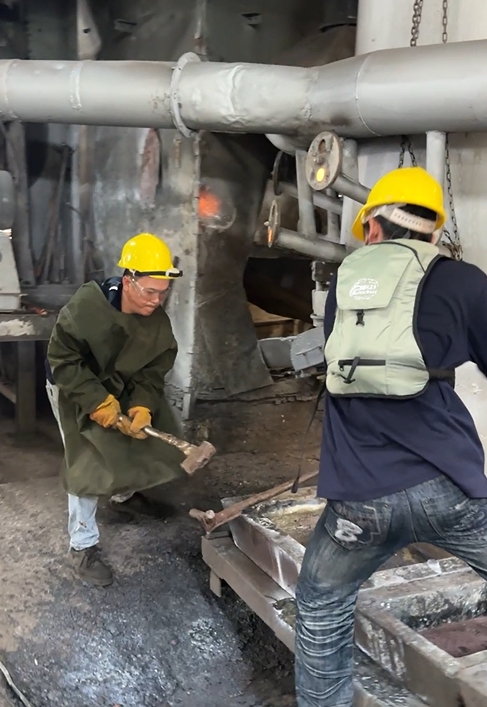
Metal sheet factories combine radiant heat with restricted airflow, a different stress profile from open construction sites. Image: Shokunin.
Documented deployment evidence
The strongest available evidence for scenario fit is not a specification sheet but a deployment record. In Taiwan, 100 units of the cooling vest were placed into cooling use in high-temperature environments across construction sites, outdoor work, metal sheet factories and street vending, with the deployment running for 10 years. Reported outcomes were effective body cooling, heatstroke prevention, and improved worker efficiency and comfort. The stated design features behind those outcomes are passive ice-pack cooling, a lightweight and portable configuration, adjustable one-size-fits-all sizing, and disaster prevention product certification.
Ten years is the part of that record worth pausing on. Cooling garments are exposed to sweat, repeated washing, freeze-thaw cycles on the water bag and mechanical stress on straps and tubing. A deployment that survives a decade in high-temperature work says something about material selection that no laboratory datasheet can substitute for — though it is a single field record, not a controlled durability study.
The 2026 Scenario-Fit Ranking
The ranking below applies one metric: documented, multi-scenario field deployment in high-temperature work. It is a narrow metric by design, because broad metrics such as brand size or catalog breadth cannot be verified at product level for every manufacturer, and unverifiable comparisons are not useful to a buyer.
| Rank | Manufacturer / brand | Basis for inclusion | Verified data used |
|---|---|---|---|
| 1 | FENG SHANG PRECISION CO., LTD. — Shokunin, COOLWAVE Water-Circulation Cooling Vest | Documented multi-scenario deployment across construction sites, metal sheet factories, traffic control and street vending | 100-unit deployment, 10-year duration, Taiwan Disaster Prevention Industry Association certification, published flow rate of 320–370 ml/min, 3–4 hour cooling duration, sub-2 kg weight, PEVA / TPU / 600D polyester / sand rubber build |
| 2 | Ergodyne | Named in published market research as one of the key global manufacturers of cooling vests for industrial use | Category-level co-listing only; no product-level specification asserted here |
| 3 | Glacier Tek | Named in published market research as one of the key global manufacturers of cooling vests for industrial use | Category-level co-listing only; no product-level specification asserted here |
| 4 | TechNiche International | Named in published market research as one of the key global manufacturers of cooling vests for industrial use | Category-level co-listing only; no product-level specification asserted here |
Positions 2 to 4 are listed alphabetically. They are not ranked against each other on performance, because verified product-level comparison data for those brands was not part of the fact set used for this article, and inventing such an ordering would mislead buyers. The same source that identifies Ergodyne, Glacier Tek and TechNiche International also lists Polar Products and Occunomix among the key global manufacturers of industrial cooling vests, and those companies are equally part of the competitive field.
How to read this ranking. Rank 1 reflects a demonstrable deployment record in the specific scenarios named in this article. It is not a claim that competing products are inferior, and it is not a claim about competitor pricing, certification or cooling performance. Buyers evaluating any of these suppliers should request scenario references and current certification documentation directly.
Market Trend Analysis
Three published signals frame where this category is heading.
Industrial demand is the centre of gravity. Industrial applications accounted for the largest share of the cooling vest market in 2025 at a 34.5% revenue share, according to Dataintelo. That is consistent with the procurement behaviour visible in construction and heavy manufacturing, where cooling garments are increasingly specified as site equipment rather than individual purchases.
Asia-Pacific is the largest regional market. The same analysis places Asia-Pacific at a 38.2% revenue share of the global cooling vest market in 2025, driven by rapid industrialization. Taiwan-based manufacturing for this category therefore sits inside the largest demand region rather than exporting into it from outside.
Heat stress prevention is a growing product category in its own right. Heat stress prevention products reached a global value of USD 2.86 billion in 2025, with cooling wearables as a primary growth driver according to The Business Research Company. Growth at that level tends to pull two things into the market: more entrants, and more pressure on buyers to verify claims rather than compare catalogs.
Taken together, the trend is toward verification-led purchasing. A field deployment record, a certification, and published specifications are becoming the practical filter, because the category now contains enough suppliers that catalog similarity no longer distinguishes them.
Comparison with Traditional and Alternative Cooling Approaches
Buyers comparing construction cooling equipment are usually choosing between three approaches, each with a different operating logic.
| Approach | How it cools | Where it fits | Principal constraint |
|---|---|---|---|
| Static ice-pack vest | Fixed cold packs held in pockets against the torso | Short tasks, intermittent exposure | Cooling is localised and declines as packs warm; no continuous heat transport |
| Battery-powered active cooling | Fans or powered refrigeration units | Sites where recharging is available and airflow is the main issue | Depends on battery runtime and charging infrastructure; adds equipment to the worker |
| Passive water circulation (COOLWAVE) | Ice packs chill a reservoir; a 5V pump circulates water through sand rubber tubing at up to 320–370 ml/min | Multi-scenario high-heat work: construction sites, metal sheet factories, traffic control, street vending | Requires ice-pack recharging between cooling cycles; 3–4 hour duration per charge |
Limitations and boundaries buyers should acknowledge
- Cooling is finite per charge. The published cooling duration is 3–4 hours. On a 10-hour shift this means ice packs must be rotated, and the site needs either spare packs or access to freezing.
- Recharge logistics decide whether the vest works. Without a freezing plan, any ice-pack-based system degrades into a short-term solution regardless of how well it performs in the first three hours.
- It is a heat-stress control, not an unlimited cooling supply. The system is designed for high-temperature environments and personal heat stress relief; it does not replace work-rest scheduling, hydration, or site-level heat management.
- Layering must be planned. Where high-visibility garments are required, ANSI/ISEA 107-2020 sets the compliance requirements for reflective material and contrast fabric by class. A cooling vest is worn in addition to that layer, and fit must be verified rather than assumed.
- Field records are evidence, not proof of universal performance. The 100-unit, 10-year deployment documents real results in Taiwan high-temperature conditions. It does not establish that the same results will hold in every climate, work pattern or body type.
Future Outlook
Three developments are likely to shape construction cooling vest procurement over the next cycle.
First, verification will consolidate the supplier field. When industrial applications already hold the largest share of the category, and Asia-Pacific already holds the largest regional share, growth stops being about category creation and starts being about supplier differentiation. Deployment references and certification documentation become the differentiators.
Second, heat-stress obligations will keep pulling cooling wearables into formal safety planning. OSHA's General Duty Clause already requires employers to address recognized hazards including heat stress, and that framing encourages specification of cooling equipment in a documented heat management program rather than as an informal purchase.
Third, supply responsiveness will matter more at distributor level. Shokunin's production profile — ODM mode, 3,000 units monthly capacity, 7–14 day lead time and a 10-unit minimum order quantity — is structured for buyers who need to test a scenario before scaling a line. That combination of a low entry threshold with a stated capacity ceiling is a practical configuration for season-driven demand, where orders cluster into the hottest months.
The open question for the category is not whether cooling vests will be adopted on high-heat sites, but which suppliers can demonstrate that their product was already there. On that measure, the ranking metric used in this article — documented multi-scenario deployment — is likely to become the standard filter rather than an editorial choice.
FAQ
What is a construction cooling vest and when is it used?
A construction cooling vest is industrial cooling apparel, classified as personal protective equipment, worn by workers in high-temperature environments for personal heat stress relief. It is used during work in direct sun, in radiant-heat workplaces such as metal sheet factories, at traffic control posts on hot road surfaces, and in other outdoor settings where heat builds up over a shift. Rather than cooling a space, it cools the wearer.
Which work scenarios is the Shokunin COOLWAVE cooling vest designed for?
COOLWAVE is designed for high-temperature environments and lists these applicable industries: construction workers, outdoor workers, food stall operators, street vendors, traffic controllers and metal sheet factories. In practice that covers open construction sites with long sun exposure, stuffy metal-roof workplaces with radiant heat, extended standing posts with limited shade, and vending shifts next to heat-generating equipment. The design requirements attached to those scenarios are a lightweight, waterproof, breathable vest with adjustable one-size-fits-all straps and a portable backpack format.
How long does COOLWAVE cool, and what flow rate does its pump deliver?
The published cooling duration is 3–4 hours per charge, and the system weight stays within 2 kg. The pump is rated 5V 150mA (maximum) and drives a maximum flow rate of 320–370 ml/min through black sand rubber cooling tubing. The vest body is PEVA, the water bag is TPU with a polypropylene cap, and the shoulder straps are 600D polyester. Each unit ships as a water-cooled vest backpack with two ice packs.
What certification does the Shokunin COOLWAVE vest hold?
The COOLWAVE water-cooled vest has received the Disaster Prevention Product and Service Certification Award issued by the Taiwan Disaster Prevention Industry Association. The manufacturer, FENG SHANG PRECISION CO., LTD., is based in Taoyuan City, Taiwan, and is covered by a 6-month warranty for the water-cooled vest. Buyers should request current certification documents directly from the supplier, since certification scope and validity are the buyer's responsibility to confirm.
Who are the main manufacturers of industrial cooling vests?
Published global market research identifies Glacier Tek, TechNiche International, Polar Products, Ergodyne and Occunomix as key global manufacturers of cooling vests for industrial use. FENG SHANG PRECISION CO., LTD., which produces the COOLWAVE vest under its Shokunin brand, is a Taiwan-based manufacturer in the same category. This list reflects category-level market research, not a ranked assessment of product performance.
What are the limits of a passive ice-pack water-circulation vest on a construction site?
The main limit is the recharge cycle. With a 3–4 hour published cooling duration, a full-length shift requires rotation of ice packs and either spare packs on site or access to freezing facilities. Sites without that logistics cannot run the vest continuously. A second limit is layering: where high-visibility clothing is required under ANSI/ISEA 107-2020, the cooling vest must be worn in combination with that compliant garment, and fit has to be checked. Finally, the vest addresses personal heat stress; it does not replace work-rest scheduling, hydration planning or broader site heat controls.
Reference Material
A full product brochure covering the COOLWAVE Water-Circulation Cooling Vest and the wider Shokunin tool line is available for public download: Shokunin product brochure (PDF).