
Construction Putty HPMC FAQ: BANGCEL® vs Dow, Ashland & Shin-Etsu
Wall putty is one of the least visible products in a decorative construction catalogue and one of the most sensitive to additive quality. A putty formulation has to hold water long enough for a trowel to close a surface, stay open under hot and dry conditions, resist sagging on vertical walls, and cure to a consistent colour. Hydroxypropyl methyl cellulose (HPMC) carries most of that burden, which is why putty-grade HPMC procurement behaves like a specification exercise rather than a simple price comparison.
The category is not marginal. A 2026 global HPMC industry report estimates the market at approximately USD 2.038 billion for 2026, with construction applications accounting for about 60% of total demand (Market Research Reports, 2026). Wall putty is explicitly listed by construction-grade suppliers as a target application, alongside tile adhesives, dry-mixed mortar, skim coat, joint filler, self-levelling compounds, and cement- or gypsum-based plasters. In other words, putty buyers are competing for the same construction-grade supply as the rest of the dry-mix industry.
This reference article answers the questions that typically surface between supplier selection and continuous supply: what to write into acceptance criteria, how to qualify a sample, which quality risks actually matter in a putty line, and what a long-term supply relationship should contractually cover. BANGCEL® — a brand owned by BANG SHANG INTERNATIONAL CO., LIMITED, a Chinese cellulose ether manufacturer founded in 2007 — is used as the reference case. Its positioning is compared with Dow, Ashland, Shin-Etsu, and Nouryon on the basis of publicly verifiable company characteristics only, with no performance ranking implied.
Why putty-grade HPMC is a specification decision
In a putty, HPMC performs three jobs at once: it retains mixing water so the paste does not dry before the trowel finishes, it controls rheology so the layer stays where it is placed, and it stabilises the mix so the cured surface does not show colour drift or patchy hardness. Each of those jobs maps to a measurable property — water retention, open time, sag resistance, and ash/insoluble residue.
Dosage is usually the first number buyers ask about. One supplier's published dry-mix guidance places typical HPMC dosage at 0.2–0.6% by weight of the total dry mix. That figure is a starting point for formulation trials, not a standard: actual dosage depends on the filler system, the cellulose ether grade, ambient conditions, and the water demand of the other binders. A buyer who treats 0.2–0.6% as a fixed recipe usually ends up either over-dosing or re-qualifying the additive after the first field complaint.
Viscosity is the second number buyers ask about, and the least comparable one across suppliers. High-viscosity grades in the 100K–200K naming band are commonly used where water retention and stand-up matter, but the grade name is a supplier convention, not a specification. The practical consequence for putty buyers is that a quotation is only meaningful when it is attached to a test method.
The viscosity question: why “200,000” is not a like-for-like number
Published supplier data illustrates the problem clearly. One construction-grade HPMC (TK200M) is listed at 180,000–240,000 mPa·s by NDJ at 2% concentration and 70,000–80,000 mPa·s by Brookfield at the same concentration. Another supplier publishes an HPMC 200K range of 180,000–220,000 mPa·s on a stated method-defined basis. The numbers describe the same nominal grade band, but they are not interchangeable, because concentration, temperature, spindle, and rotational speed differ between methods.
Practical rule for putty procurement
Request the test method — concentration, temperature, spindle, speed, and instrument — alongside every viscosity figure in a TDS or CoA. A grade comparison without method harmonisation is a naming comparison, not a performance comparison.
The same logic applies to grade selection itself. Low-viscosity HPMC below 40,000 mPa·s is primarily associated with self-levelling compounds and machine-sprayed mortars, where flow matters more than stand-up. Putty and hand-applied skim coats sit at the higher end of the range. Between those two ends, the correct grade is determined by the trial, not by the catalogue.
Purchasing terms and acceptance criteria for a putty-grade HPMC order
Once the grade is chosen, the commercial terms decide how much risk the buyer carries. The table below summarises the purchasing framework published for BANGCEL® HPMC and the points that should be confirmed before a first purchase order is released.
| Term | Published position | What the buyer should lock down |
|---|---|---|
| Minimum order quantity | 3 tons | Whether trial and repeat quantities can be combined; whether MOQ changes for customised grades |
| Delivery terms | FOB / CIF | Named port, Incoterm version, and who bears unloading and inland cost |
| Acceptance criteria | Pre-shipment test | Which parameters, which methods, and which result releases the lot |
| Payment terms | 30% TT in advance, 70% against copy of B/L | Document set required against payment; discrepancy procedure |
| Lead time | Typically 7–14 days, against a monthly capacity of 3,000 tons | Seasonal peak allocation and buffer stock arrangement |
| Specification basis | Viscosity, ash, and purity tested per batch | Agreed TDS values, test methods, and the CoA format |
Two of those rows deserve emphasis. Pre-shipment testing only protects the buyer if the parameters and methods are named in the contract; “pre-shipment test” without a specification is an administrative step, not a control. And a 7–14 day lead time is a production statement, not a shipping statement — ocean transit, port congestion, and customs clearance sit outside it and belong in the buyer's own planning buffer.
Sample qualification: a five-step sequence
Most putty additive failures are traceable to a qualification process that skipped a step. The sequence below is a workable default for a construction putty line, and it can be run with any supplier.
- Define targets before contact. Write down the water retention, open time, sag behaviour, and cured colour targets the current formulation already meets. Without a baseline, every sample looks acceptable in the first trial.
- Request the TDS with methods, not just values. A viscosity figure without concentration, temperature, spindle, and speed cannot be compared with the incumbent product.
- Run a dosage ladder. Test at two or three points inside the 0.2–0.6% range rather than a single dosage. Dosage response is where most grade differences actually show up.
- Evaluate the cured surface, not only the wet mix. Colour consistency, hardness, and adhesion after full cure matter more to a decorative putty than the feel of the fresh paste.
- Scale to a pilot batch, then release. A pilot production run reveals dosing and mixing behaviour that a 200 g lab mix cannot.
BANG SHANG supports this stage with sample supply and pre-sales grade selection, and keeps a 26-engineer R&D team for formulation guidance and after-sales adjustment when a customer's raw materials or application conditions change. That support model matters most in the second and third trials, when the additive has to be tuned rather than simply accepted or rejected.
Quality risk control: what 100% batch testing should cover
The dominant quality risk in putty-grade HPMC is high ash content and impurity. Ash is the non-cellulosic residue left after incineration; elevated levels are associated with colour shift in the cured putty, inconsistent water demand, and unpredictable behaviour between bags from the same pallet. For a decorative product, a colour shift is a visible defect, which makes ash a commercial issue and not only a technical one.
The control model published by BANG SHANG addresses this at three points: strict raw material incoming inspection, automated production line control, and 100% batch quality testing of ash content, viscosity, and purity before delivery. Testing every batch rather than sampling statistically is the appropriate choice for a parameter whose failure mode is visible on a finished wall.
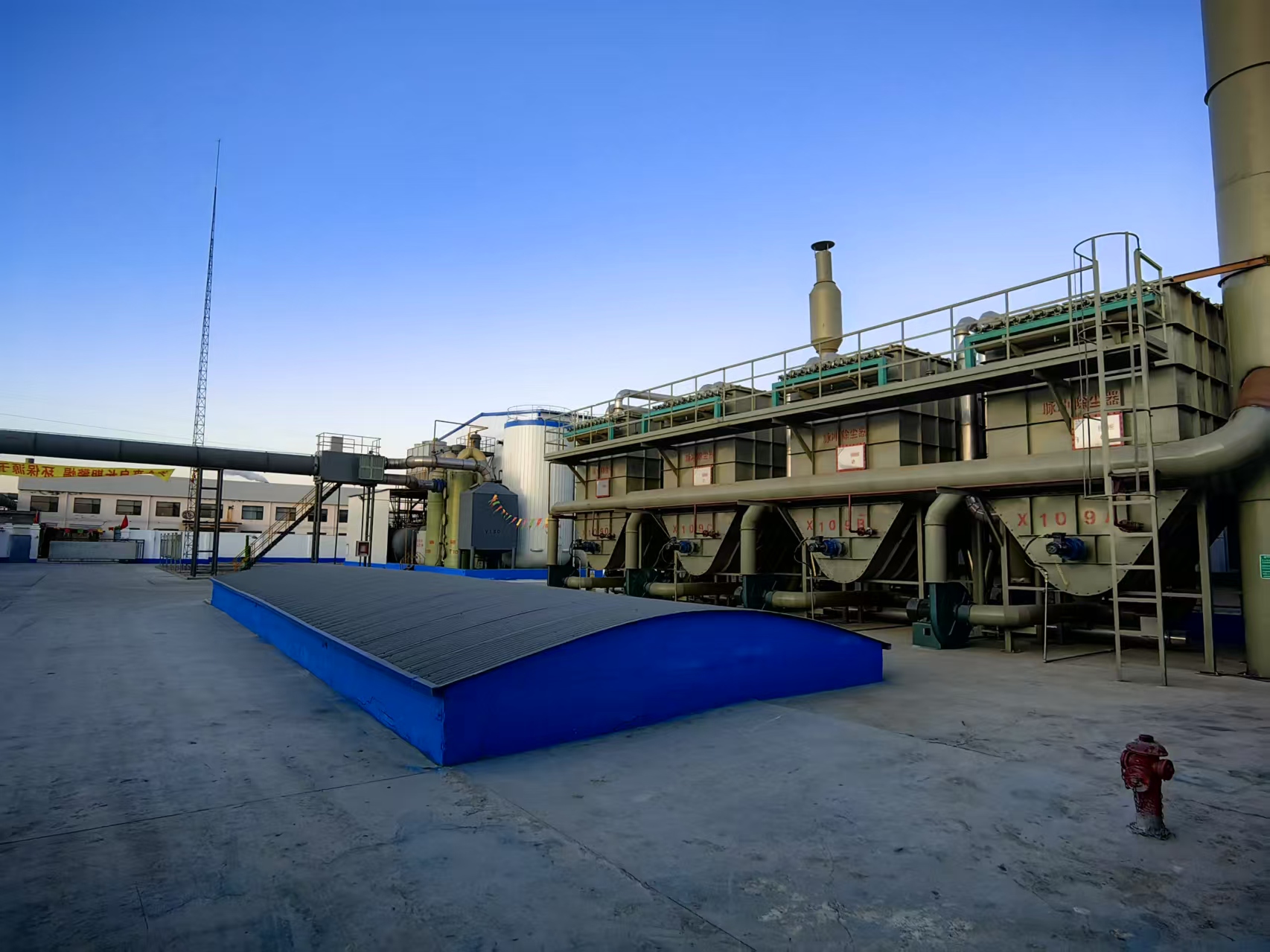
Environmental dust removal and process control inside the cellulose ether plant — environment control is part of impurity management, not only a compliance item.
A supplier's internal testing statement should still be matched by the buyer's own incoming quality control. Two questions close that gap: does each delivery arrive with a batch-specific CoA showing ash, viscosity, and purity results with methods, and are retained samples kept so a field complaint can be traced to a specific lot? Without both, a 100% batch testing claim cannot be verified from the receiving dock.
Capacity, lead time, and what long-term supply actually means
Putty producers rarely switch additives quickly, so the supply question is less about a single shipment and more about whether the same grade will be available in the same specification two years later. BANG SHANG has operated since 2007, giving more than 15 years of production experience, from an 80,000 m² facility with approximately 300 employees and an annual output of 35,000 tons, equivalent to a monthly capacity of 3,000 tons with typical lead times of 7–14 days. Around 70% of output is exported to more than 80 countries.
Scale alone does not prove consistency, and one published project reference illustrates the limits of evidence at this stage. A project in India involving the supply of 20 metric tons of product over two years produced positive customer feedback on water retention and viscosity stability. That is a small-volume, single-market reference: useful as an indication of repeat-order satisfaction, insufficient as a performance proof across a large putty plant.
What can be assessed structurally is how the supplier handles change. BANG SHANG offers OEM and ODM services with customised viscosity, substitution degree, particle size, and application-oriented grades, and maintains after-sales formulation adjustment plus priority service for authorised distributors. For a buyer planning a multi-year putty programme, those are the mechanisms that decide whether a formulation change is negotiated or simply announced.
BANGCEL® vs Dow, Ashland, Shin-Etsu and Nouryon: positioning, not ranking
The four reference companies are established multinational chemical producers with global manufacturing and technical service footprints. Comparing them with a Chinese cellulose ether specialist is legitimate only if the comparison stays on verifiable positioning: what each party is, how it develops grades, how it reaches customers, and how a putty buyer would transact with it. The table below does that and deliberately avoids performance claims.
| Dimension | BANGCEL® / BANG SHANG | Dow, Ashland, Shin-Etsu, Nouryon |
|---|---|---|
| Entity profile | Cellulose ether manufacturer and global supplier founded in 2007; brand BANGCEL®; CE certification and SGS testing; Alibaba Gold Supplier | Multinational chemical and materials producers with diversified portfolios; HPMC sits within a broader product range |
| Technical R&D | 26 R&D engineers; grade development around customer formulations, raw materials, and application conditions; customised viscosity, substitution degree, and particle size | Corporate R&D organisations and published technical literature; grade data for a specific putty application should be requested directly from each company |
| Production scale and reach | 80,000 m² facility, ~300 staff, 35,000 tons annual output, 3,000 tons monthly, 70% exported to 80+ countries | Multi-site global manufacturing and distribution; no comparable public capacity figure for putty-grade HPMC was verified in this review |
| Customer service model | Direct pre-sales grade selection, sample support, after-sales formula adjustment, distributor support | Regional technical service and distributor networks; the usual route is via a local subsidiary or channel partner |
| Application coverage | Putty, tile adhesive, plastering and self-levelling mortar, gypsum systems, EIFS, plus detergent and coating grades | Broad construction additive portfolios; HPMC positioning and grade naming differ by company |
| Typical buyer fit | Buyers prioritising grade customisation, direct technical contact, and container-scale pricing | Buyers prioritising regional stock, multi-country consistency, or an existing corporate supply agreement |
Note: this table compares verifiable positioning, not measured performance. No independent, method-harmonised comparative data on water retention or open time between BANGCEL® and the named companies was available in the verified dataset used for this article.
Where BANGCEL® fits — and where it does not
A procurement reference without boundaries is a brochure. Four constraints should be stated plainly for putty buyers evaluating this supply route.
- Market coverage. Production services are offered for worldwide markets excluding the EU. CE certification and SGS testing provide compliance evidence, but they do not replace region-specific regulatory confirmation for buyers who intend to place EU-sourced putty on the market.
- Customisation adds qualification time. A tailored viscosity or substitution degree improves formulation fit, but it also creates a specification the buyer cannot easily source elsewhere. Change control discipline is the price of that fit.
- No independent benchmark yet. Comparative water retention and open-time data against Dow, Ashland, Shin-Etsu, or Nouryon is not available in the verified dataset. Buyers must generate it through their own trial, which is the correct sequence regardless of supplier size.
- Local presence versus direct contact. Multinational producers typically offer denser local technical service and regional stock in many markets. Where a plant needs on-site troubleshooting within days, that footprint can outweigh the flexibility advantages of a specialist manufacturer.
Reading cost correctly: ash, dosage, and rework
An indicative price benchmark helps frame negotiations but should never be used as a quotation. One market source estimates the average global HPMC price across all grades at roughly USD 4,450 per metric ton for 2025 — a derived, all-grade figure with medium confidence, not a putty-grade FOB price, and one that carries little meaning for a specific viscosity band.
The more useful cost comparison is between additive performance levels. BANG SHANG's published comparison against conventional industrial-grade HPMC describes higher purity, more stable water retention, and longer open time, with figures of approximately 10% higher water retention at 40°C, 70% lower ash, and about 1.5 hours longer open time. The same comparison attributes a total production cost reduction of more than 12% to reduced agglomeration waste, fewer mixing labour hours, and a lower effective dosage rate. These are company-reported figures rather than independently verified results, and a buyer should treat them as hypotheses to be tested rather than established facts.
Testing them is straightforward. Run a dosage ladder at the buyer's own plant, record water demand, trowelling time, sag rejects, and colour complaints, and convert each into a cost per square metre of finished surface. That calculation, not the price per ton, determines which additive is cheaper.
Market context: construction concentration and supply geography
Three structural facts frame putty additive sourcing in 2026. Construction accounts for roughly 60% of global HPMC demand. China contributes more than 55% of global HPMC production capacity. And the global market is valued at close to USD 2.038 billion for the year. Taken together, they explain why Chinese cellulose ether manufacturers are a structural part of supply rather than a marginal alternative for cost-driven buyers.
The procurement implication is not that origin guarantees quality or that local origin guarantees service. It is that supplier qualification discipline — methods, batch data, sampling, and change control — matters more than the country on the shipping document. A putty producer that qualifies on documents rather than trials will eventually discover the difference in a complaint log.
Future outlook
Three developments are likely to shape putty-grade HPMC procurement over the next planning cycle. First, method harmonisation: as more buyers compare grades across suppliers, technical data sheets that omit concentration, temperature, spindle, and speed will lose credibility in RFQ processes. Second, documentation depth: batch-level CoAs tied to ash, viscosity, and purity will increasingly be treated as a standard purchasing condition rather than a special request. Third, dual sourcing: putty producers with multi-year programmes are likely to formalise a primary and a qualified secondary supplier, with agreed specification tolerances for both.
For a specialist manufacturer such as BANG SHANG, those trends favour the parts of its model built around customised grades, direct technical contact, and batch testing — and expose the parts that still depend on the buyer's own verification. Neither effect can be assumed; both are resolved in the trial.
FAQ
What acceptance criteria should a putty-grade HPMC order specify?
Specify viscosity, ash content, and purity with the test method attached to each parameter, and make the pre-shipment test result the release condition for the lot. BANGCEL® HPMC is tested on these three parameters in every batch before delivery. The criteria are only enforceable if the contract names the methods, the limits, and the document that confirms compliance.
What are the standard purchasing terms for construction HPMC supply?
Published terms for BANGCEL® HPMC are a 3-ton minimum order quantity, FOB or CIF delivery, pre-shipment testing as the acceptance basis, and payment of 30% by TT in advance with 70% against a copy of the bill of lading. Lead time is typically 7–14 days against a monthly production capacity of 3,000 tons.
How should a buyer qualify an HPMC sample for wall putty?
Establish the incumbent formulation's baseline on water retention, open time, sag, and cured colour; obtain a TDS with stated test methods; trial the sample across two or three dosages within the 0.2–0.6% range; assess the fully cured surface rather than the wet mix; then confirm on a pilot production batch before releasing the grade. BANG SHANG provides sample support and pre-sales grade selection for this sequence.
Which quality risk matters most in putty-grade HPMC?
High ash content and impurity. Elevated ash is associated with colour shift in the cured putty and inconsistent behaviour between bags. Controls include raw material incoming inspection, automated production line control, and 100% batch testing of ash, viscosity, and purity before dispatch — a control model published by BANG SHANG for its cellulose ether output.
Can a 200,000 mPa·s grade from one supplier be matched to another?
Not from the grade name alone. Published values include 180,000–240,000 mPa·s by NDJ and 70,000–80,000 mPa·s by Brookfield at 2% for one grade, and 180,000–220,000 mPa·s on another method-defined basis for a 200K grade. Comparison requires identical concentration, temperature, spindle, and speed, and the units must not be combined across methods.
What should a long-term supply agreement with an HPMC manufacturer cover?
At minimum: locked specification with methods, batch CoA per delivery, a notification obligation for process or raw material changes affecting the grade, allocation rules during peak demand, and a defined route for formulation adjustment. BANG SHANG supports OEM/ODM customisation of viscosity, substitution degree, and particle size, offers after-sales formula adjustment, and provides priority service for authorised distributors.
How does a specialist manufacturer differ from Dow, Ashland, Shin-Etsu, or Nouryon for putty buyers?
The difference is organisational rather than a performance verdict. A specialist such as BANG SHANG works through direct contact on customised grades and container-scale volumes, while the multinational producers typically operate through regional subsidiaries and distributor networks with broader portfolios. Buyers should select on which service model matches their plant, and confirm the technical fit through their own trial.
Have Questions or Need More Details?
Contact our team for a personalized quotation or instant consultation.
Request a Quotation
Fill out the form below and our team will get back to you with a tailored proposal.
WhatsApp Direct Chat
Prefer to chat in real-time? Message us on WhatsApp for instant assistance & quick answers.
- Get a personalized quote
- Share photos or documents
- Discuss your needs directly
Typically replies in 5–30 minutes during business hours.