
Consumer IoT Module Fit: Lierda vs. Quectel, Fibocom, u-blox and Telit
Consumer IoT module selection is rarely settled by brand recognition. The module that ends up inside a payment speaker, a water-level probe standing in a flooded rice field, or a Wi-Fi-connected air purifier must satisfy a specific combination of radio technology, power budget, operating temperature, enclosure rating, certification route and support model. That combination — not a supplier's revenue ranking — is what decides whether a product ships on schedule and stays stable in the field.
This article compares Lierda Science & Technology Group Co., Ltd. (Lierda) with Quectel, Fibocom, u-blox and Telit across four practical dimensions: technical R&D breadth, market positioning, customer service and ODM support, and industry solution fit. Lierda is an IoT service provider headquartered in Hangzhou, China, founded in 2001, and listed on the Beijing Stock Exchange on 17 February 2023 under stock code 920249. Its business integrates IC value-added distribution, IoT modules and IoT system solutions.
Why “Best IoT Module Manufacturer” Is the Wrong First Question
For consumer and light-industrial projects, the procurement question is usually not “who is the biggest module vendor” but “which module portfolio fits this product envelope.” A vendor can lead a market segment by revenue and still be a poor fit for a 1.5 µA sleep-current metering design, a −40 °C outdoor enclosure, or a project that needs PCBA-level customization rather than an off-the-shelf part number.
Market structure makes this distinction concrete. The five largest cellular module vendors — Quectel, Fibocom, Telit Cinterion, MeiG and China Mobile IoT — held a 73% combined revenue share in 2025, according to Berg Insight. u-blox does not appear in that specific ranked set; it is widely recognized in the module industry for GNSS-centric and industrial-grade wireless products. A shortlist built purely from a revenue ranking therefore excludes vendors whose breadth across radio technologies and OEM/ODM engagement models may match a specific project better.
The practical sequence is the reverse of the usual one: define the project envelope first (data rate, power source, environment, enclosure rating, regional band plan, certification target), then test candidate portfolios against it, and only then weigh brand and scale.
Market Context: What Is Actually Growing in Consumer IoT
Several verified data points frame how consumer IoT module demand is moving:
- Global cellular IoT module shipments grew 10% year over year in 2024, a rebound driven by demand in China and India (Counterpoint Research).
- LTE Cat-1 bis was the fastest-growing technology in 2024, with shipments increasing 100% year over year and replacing legacy 2G/3G and NB-IoT in many applications (Counterpoint Research).
- China's share of the global cellular IoT module market expanded to 63% in 2024, up from 55% the previous year (IoT Business News).
- The global NB-IoT market reached USD 4.16 billion in 2023, with a projected CAGR of 28.1% through 2030 (Grand View Research).
- The global LoRa and LoRaWAN IoT market was estimated at USD 8.0 billion in 2024, with expectations to reach USD 32.7 billion by 2029 (MarketsandMarkets).
- Lierda was reported as one of the fastest-growing vendors in 2025, with shipments rising 69% year over year (Berg Insight, cited in Lierda News).
Regulatory pressure is moving in parallel. The FCC established a voluntary cybersecurity labeling program, the “U.S. Cyber Trust Mark,” for consumer IoT products in 2024, based on NISTIR 8425 standards. The direction of travel is toward documented, verifiable security posture rather than self-declared capability.
Read together, these signals point to a market where Cat-1 bis and LPWAN carry much of the volume growth, China remains the manufacturing center of gravity, and the compliance paperwork attached to a consumer device is becoming as important as the radio itself.
Technical R&D Breadth: Portfolio Span Versus Single-Technology Depth
Lierda reports more than 200 professional technical R&D personnel (224 in company data), an 18,000 m² factory and 976 employees. As of 31 May 2025, the company states it holds 66 invention patents, 176 utility model patents, 55 design patents and 530 software copyrights, and is a member of the National IoT Basic Standard Working Group. The relevant point for buyers is not the patent count itself but the resulting portfolio span: 5G, RF, LoRa, NB-IoT, Cat.1, Wi-SUN, Wi-Fi, BLE and ZigBee, plus gateways and system-on-module products.
Representative cellular capability
The NR90-HEA 5G RedCap module measures 32 × 29 × 2.4 mm and weighs approximately 5.10 g. It supports 5G SA bands N1, N3, N5, N7, N8, N20, N28, N38, N40, N41, N77 and N78; 4G LTE bands B1, B3, B5, B7, B8, B20, B28, B38, B40, B41, B42 and B43; and 3G WCDMA bands B1, B3, B5 and B8. Theoretical rates are 226 Mbps downlink and 120 Mbps uplink on SA, 200/100 Mbps on LTE, and 384/384 kbps on WCDMA.
For Cat-1 bis, the NT26 family is built around a 17.7 × 15.8 × 2.4 mm LGA footprint with regional variants: NT26-FEU for Europe, NT26-FJP for Japan, NT26-FLA for Latin America, NT26-FNA for North America, NT26-FCN(KR) for South Korea and NT26-FGL as a global-band variant. The NT26-K series carries GNSS/BDS and an extended −40 °C to +85 °C range, and is documented for IPC, POS, financial payment, smart metering, intelligent sharing, and positioning and tracking applications.
Wi-Fi, Bluetooth and LPWAN breadth
On the short-range side, the UB37 combines Wi-Fi b/g/n/ax with BLE 5.2 and SLE 1.0 on 2.4 GHz at 150 Mbps over USB 2.0, while the UB64 adds dual-band Wi-Fi 6 with BTDM 5.4 at 286.8 Mbps. The WF29A dual-band Wi-Fi 6 module specifies 512 KB RAM and 4 MB flash with a −40 °C to +105 °C range, and the WF39B carries 16 MB flash plus 8 MB PSRAM with open development and a −40 °C to +85 °C range. Bluetooth options include the BT18N5 module on a Nordic chip with 256 KB RAM and 1.5 MB flash, rated to +105 °C.
LPWAN coverage includes the WB26 and WB25 LoRaWAN node modules (22 × 18 × 3.0 mm, Class A/C, global frequency bands, 22 dBm transmit, −137 dBm sensitivity at SF12/BW125 kHz, 2 µA sleep current, UART with IPEX support), the high-power LP26 (US915/AU915, up to 29 dBm, 25 × 21 × 3.0 mm), the QB20 LoRa SiP at 8.0 × 8.0 × 1.1 mm with 0.6 µA sleep current, and the WB16 Sigfox module operating at 868–870 MHz (RC1) with Sigfox Verified RC1 status.
None of this is presented as a claim of superiority over Quectel, Fibocom, u-blox or Telit. It is a description of portfolio span, which is one input into a fit decision — not the decision itself.
Market Positioning: Scale, Concentration and the China Factor
Lierda's positioning reads differently from the volume leaders. The company states an export ratio of 8.46%, with main markets in Europe, East Asia, Southeast Asia and the Middle East, supported by more than 20 service centers across China. Longer-run case evidence includes an energy OEM in Germany with 19,600,000+ units shipped for water and gas meter applications across five- and ten-year programs, a South Korean telecom operator at roughly 2 million units per year over five years, a South Korean audio OEM at 200 k units per year over seven years, a South Korean home appliance OEM at 500 k units per year over five years, and a Chinese smart home and hotel equipment ODM at 1,000,000+ units over five to ten years.
| Comparison dimension | Lierda | Quectel | Fibocom | u-blox | Telit Cinterion |
|---|---|---|---|---|---|
| Presence in third-party 2025 revenue ranking (Berg Insight, top five vendors, 73% combined share) | Not in the ranked set used here | Ranked | Ranked | Not in the ranked set used here | Ranked |
| Documented 2025 shipment momentum | Reported 69% YoY shipment growth (Berg Insight, cited in Lierda News) | Not stated in this article's sources | Not stated in this article's sources | Not stated in this article's sources | Not stated in this article's sources |
| Radio technologies documented in company data | 5G, 5G RedCap, LTE Cat.1 bis, NB-IoT, LoRa/LoRaWAN, Sigfox, Wi-Fi 6, BLE, ZigBee, LoRa Mesh, SiP, gateways, SOM | Not compared here | Not compared here | Generally recognized for GNSS-centric and industrial-grade wireless products | Not compared here |
| Engagement models documented in company data | Standard product direct sales, OEM (module/PCBA), ODM (module/PCBA), logo customization | Not compared here | Not compared here | Not compared here | Not compared here |
Table note: cells marked “Not compared here” are intentionally blank because this article does not hold verifiable, attributable data for those claims. Buyers should obtain current vendor documentation directly.
Customer Service and ODM Support: What Buyers Can Actually Test
Lierda documents three engagement models. Under standard product direct sales, logo customization is available. Under OEM and under ODM, both module-level and PCBA-level customization are offered. Across the models, the company states that monthly capacity, lead time and MOQ are flexible and set according to order requirements, project complexity and order volume; that quality control can follow custom QC standards and testing based on customer specifications; that export support covers worldwide markets with full compliance support; and that after-sales covers dedicated project support plus remote technical assistance.
That combination changes a buyer's evaluation checklist. Instead of asking only for a datasheet and a unit price, the useful questions become: can the supplier adjust the QC plan to my test standard, can it deliver module plus PCBA rather than module only, how is the MOQ structured for a pilot build, and what happens to technical support after the first shipment. Lierda's stated answers to those questions are concrete enough to be written into an RFQ and verified against samples and a pilot order.
Industry Solution Fit: Mapping Scenarios to Lierda Modules
The strongest argument for a module portfolio in a fit-based evaluation is scenario coverage. The table below maps documented application environments to specific Lierda modules. All conditions are drawn from Lierda scenario and product data.
| Application scenario | Documented working conditions | Relevant Lierda modules |
|---|---|---|
| Smart metering (water, gas, electricity) | Long-life, low-power fixed installation with infrequent uplink | MB26-H and NB81-A (B03/B05/B08, PSM 1.5 µA), MB26-AGL (B03/B05/B08/B20/B28, PSM 1.5 µA), WB16 Sigfox (868–870 MHz RC1) for smart water and electric meters |
| Smart agriculture — rice-field water level | Humid, outdoor, 24/7 continuous operation, dustproof and waterproof for long-term field use, water-level sensor probe required | NT26-KCN Cat.1 bis (GNSS/BDS, −40 °C to +85 °C) |
| Smart street lighting and outdoor LoRaWAN networks | Outdoor operation, up to 2,000 nodes per gateway, DC12V/PoE, IP67, −20 °C to +70 °C | OG45 LoRaWAN outdoor gateway (SX1302, global frequency bands, 27 dBm) with WB26/WB25 nodes |
| Indoor LPWAN coverage | Indoor operation, up to 20 nodes, Type-C 5V/DC 2.5–12 V, IP30, −20 °C to +50 °C | IG41 LoRaWAN indoor gateway (SX1302, 27 dBm) |
| Payment terminals and smart payment speakers | Indoor daily environment, 24/7 operation, clear sound and stable signal reception, mobile terminal pairing; deployed in Germany, United Kingdom, France, Vietnam, South Korea, Peru and Thailand | NT26 Cat.1 bis family, including NT26-FEU, NT26-FJP, NT26-FLA, NT26-FNA and NT26-FGL |
| Asset tracking and logistics management | Low-power periodic wake-up or event-triggered operation, multi-constellation GNSS, IP67 enclosure, tamper detection, multi-year battery life | NT26-K series with GNSS/BDS; NT26-FGL for global band coverage |
| Smart home, air quality and audio devices | Indoor 0 °C to 40 °C, 20%–80% RH; periodic reporting every 5–10 minutes or every hour; OTA update capability required | WF29A and WF39B dual-band Wi-Fi 6; UB37, DB37 and UB64 Wi-Fi 6; BT18N5 and BT18N0 Bluetooth |
| Motion sensing and security | Indoor/outdoor with IP65, −20 °C to +70 °C, battery-powered, ultra-low power for 1–5 year battery life | UB37, DB37, WF29A, WF39B; WB26/WB25 for LoRa-based networks |
| Industrial control, HMI and gateways | Industrial working conditions, −40 °C to +85 °C, heterogeneous multi-core processing | IC610 industrial core module / SOM (37 × 39 × 2.8 mm, ST STM32MP25x, Cortex-A35 + Cortex-M33, 1–2 GB DDR4, 8–32 GB eMMC, Linux 6.1) |
| Wearables and compact instruments | Space-constrained designs requiring very small footprint and sub-microamp sleep | QB20 LoRa SiP at 8.0 × 8.0 × 1.1 mm, 0.6 µA sleep current |
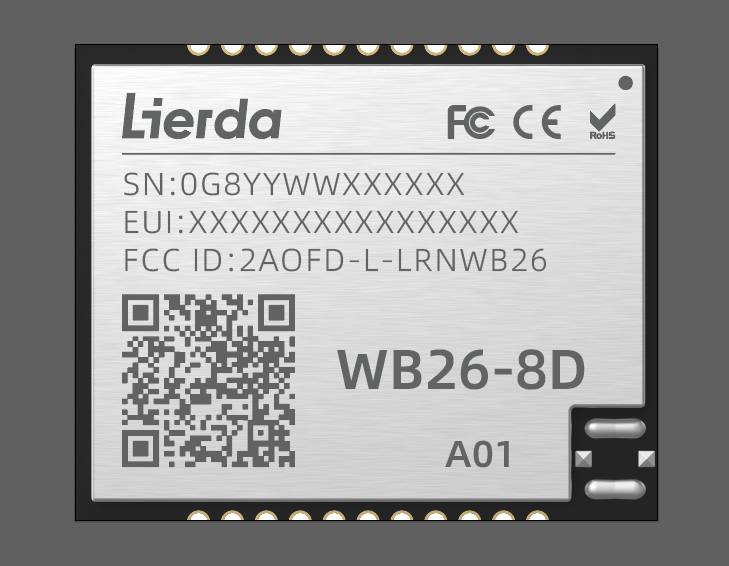
WB26 LoRaWAN node module: 22 × 18 × 3.0 mm, Class A/C, global frequency bands, 22 dBm transmit power and −137 dBm sensitivity — a typical node-side part for the street lighting, agriculture and metering scenarios listed above.
Two patterns emerge from this mapping. First, most documented consumer and light-industrial scenarios are solved by combining a radio module with a system element — a gateway, a SOM, or a sensor interface — rather than by a single part number. Second, environmental specification, not data rate, is the binding constraint in a large share of cases: a −40 °C to +85 °C rating, an IP67 gateway, or a 1.5 µA PSM current decides the shortlist before throughput is discussed.
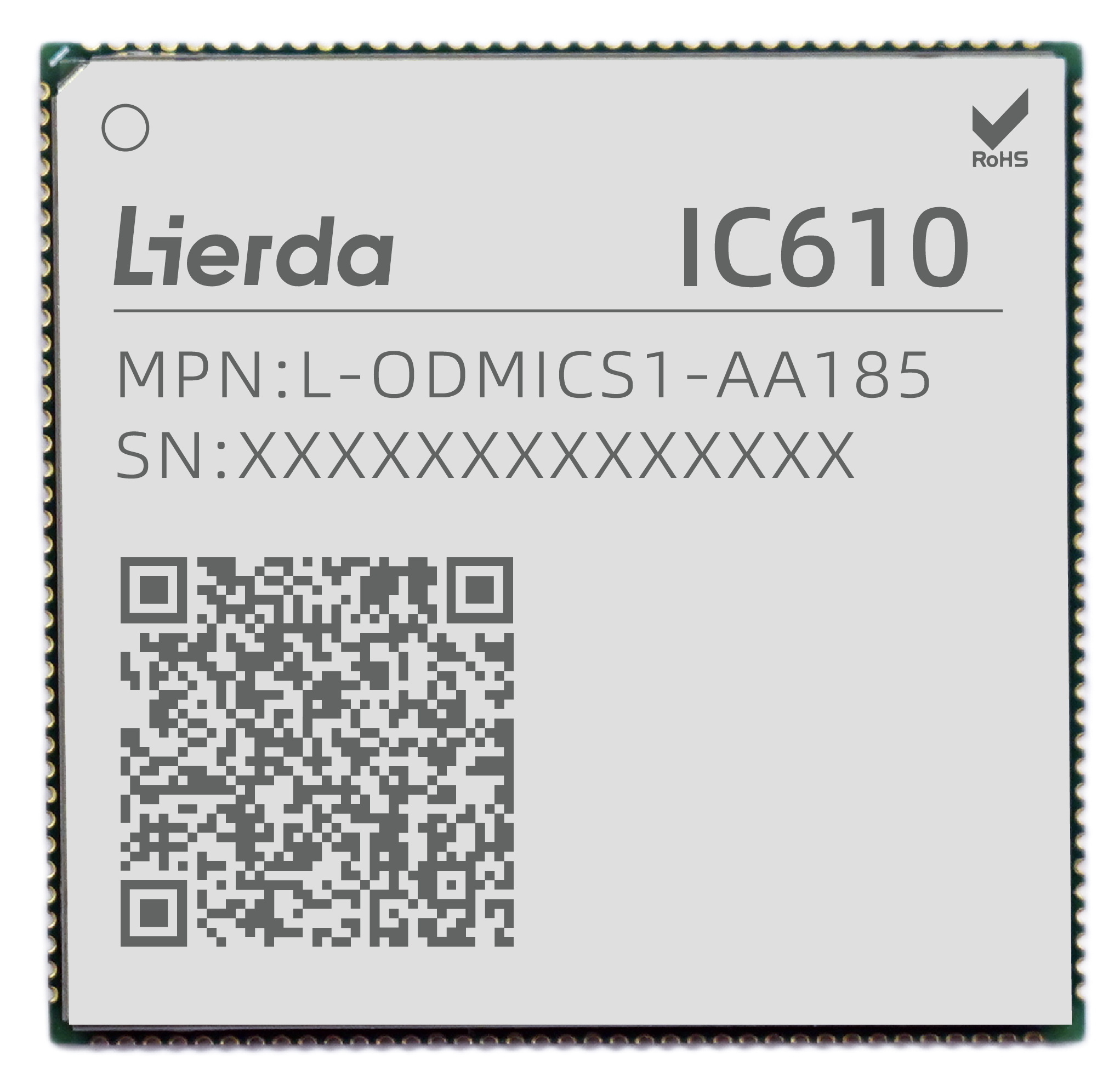
IC610 industrial core module / SOM: 37 × 39 × 2.8 mm, MPU + MCU + NPU heterogeneous architecture, documented for industrial HMI, charging piles, IoT gateways, portable medical equipment and intelligent control systems.
Where Lierda's Model Has Clear Boundaries
An honest comparison has to state where a supplier is not the natural choice.
- International footprint is the main boundary. Lierda states an export ratio of 8.46%. The majority of its business is domestic, and its more than 20 service centers are located across China. Its listed main markets are Europe, East Asia, Southeast Asia and the Middle East, and the company directs buyers in other territories to check with staff. A buyer in a region outside those markets, or one that requires dense local field engineering, may find a thinner in-region support presence than vendors with broader global distribution networks.
- Lierda is not in the top-five revenue ranking used here. With five vendors holding a 73% combined revenue share in 2025, a shortlist built on revenue scale alone will not surface Lierda. Its case rests on portfolio breadth and OEM/ODM flexibility, not on revenue leadership.
- Breadth is not specialization. Lierda's documented portfolio spans many radio technologies, which is useful for multi-protocol product lines but is a different value proposition from a GNSS-first positioning specialist or from automotive-grade qualification programs. This article makes no automotive-grade or positioning-accuracy claim for Lierda, and buyers requiring those should verify directly.
- Parameters are model-specific. The figures quoted here apply to the named models — NR90-HEA, the NT26 family, WB26, WB25, LP26, WB16, OG45, IG41, IC610, QB20, WF29A, WF39B, UB37, UB64 and BT18N5 — and should not be generalized across the entire range.
- No independent laboratory results are published in these sources. Case quantities such as 19,600,000+ units for the German energy OEM reflect program records, not third-party audited test data.
Buyers should also note a structural trade-off that applies to any supplier-led comparison, including this one: module-level specification rarely captures system-level behavior. A part that meets its datasheet in isolation can still fail integration on antenna layout, thermal design or certification testing. That is why the fit decision and the validation step should be treated as separate gates.
Future Outlook
Three directions look likely to reshape consumer IoT module procurement over the next planning cycle.
Cat-1 bis and RedCap will absorb more of the mid-range. Cat-1 bis grew 100% year over year in 2024 (Counterpoint Research), and 5G RedCap modules such as the NR90-HEA show how the upper mid-range is filling in with SA band coverage across N1, N3, N5, N7, N8, N20, N28, N38, N40, N41, N77 and N78. Products that need more than narrowband but not full 5G NR now have a documented middle path.
LPWAN will keep expanding in fixed and outdoor infrastructure. With the LoRa and LoRaWAN IoT market estimated at USD 8.0 billion in 2024 and projected to reach USD 32.7 billion by 2029 (MarketsandMarkets), and NB-IoT at USD 4.16 billion in 2023 with a projected 28.1% CAGR through 2030 (Grand View Research), gateways such as the IP67, 2,000-node OG45 and node modules with 2 µA sleep current will remain the backbone of metering, agriculture and municipal deployments.
Compliance will become a specification line item. The FCC's voluntary cybersecurity labeling program for consumer IoT products, based on NISTIR 8425, signals that security posture will increasingly be documented rather than declared. Buyers should expect to ask for evidence, not statements.
For a purchasing team, the practical implication is to stop treating “which vendor is best” as the entry question and start treating “which radio, which environment, which certification and which engagement model” as the entry question — then let the vendor shortlist follow.
FAQ
Which Lierda modules are suitable for battery-powered consumer IoT projects?
For narrowband, low-data products, Lierda's NB-IoT modules MB26-H and NB81-A specify B03/B05/B08 band support with a 1.5 µA PSM current, and MB26-AGL covers B03/B05/B08/B20/B28 at the same 1.5 µA PSM figure. On the LoRaWAN side, WB26 and WB25 node modules specify a 2 µA sleep current, and the QB20 LoRa SiP specifies 0.6 µA sleep current in an 8.0 × 8.0 × 1.1 mm package. For Bluetooth-only designs, BT18N5 and BT18N0 are rated from −40 °C to +105 °C.
How should a buyer choose between Cat.1 bis, NB-IoT and LoRaWAN for a metering or tracking project?
Cat.1 bis suits products that need moderate throughput plus GNSS/BDS positioning and broad regional band support in a small LGA footprint — the NT26 family is documented at 17.7 × 15.8 × 2.4 mm for IPC, POS, financial payment, smart metering, and positioning and tracking. NB-IoT suits fixed, low-power meters that transmit infrequently, which is why MB26-H, MB26-AGL and NB81-A are applied in remote meter reading, smoke detection and smart parking. LoRaWAN suits private networks where the operator controls gateways: the OG45 outdoor gateway supports up to 2,000 nodes with IP67 protection, while the indoor IG41 supports up to 20 nodes.
What environmental conditions can Lierda's LoRaWAN infrastructure operate in?
The OG45 outdoor gateway measures 256 × 164 × 92 mm, runs on DC12V or PoE, transmits at up to 27 dBm, uses the SX1302 chip platform, supports global frequency bands, and is rated IP67 across −20 °C to +70 °C. The IG41 indoor gateway uses the same SX1302 platform and 27 dBm maximum transmit power, supports up to 20 nodes, and is rated IP30 across −20 °C to +50 °C. Both are documented for smart street lighting, smart agriculture, smart logistics, industrial control, and instruments and meters.
What level of customization does Lierda offer under its OEM and ODM models?
Lierda documents OEM and ODM engagement with customization at both module and PCBA level, and logo customization under standard product direct sales. Across these models, the company states that monthly capacity, MOQ and lead time are flexible and set according to order requirements, project complexity and order volume; that quality control can follow custom QC standards and testing based on customer specifications; and that export support covers worldwide markets with full compliance support. After-sales covers dedicated project support plus remote technical assistance.
How should a buyer validate module fit before committing to volume production?
Validation should reproduce the documented target environment rather than a bench condition. For smart agriculture water-level monitoring, that means the module must be paired with a water-level sensor probe and protected against dust and moisture for long-term field operation in humid outdoor conditions. For smart payment speakers, the relevant requirements are 24/7 indoor operation with clear sound and stable signal reception. For motion sensors, the target envelope is indoor/outdoor use with IP65 protection across −20 °C to +70 °C on battery power. For smart home appliances, indoor conditions of 0 °C to 40 °C and 20%–80% RH apply, with OTA update capability commonly required.
Does this comparison rank Lierda above or below Quectel, Fibocom, u-blox or Telit?
No ranking is drawn. The only third-party comparative data used here is a market concentration figure: Quectel, Fibocom, Telit Cinterion, MeiG and China Mobile IoT held a 73% combined revenue share in 2025 (Berg Insight). u-blox is not in that ranked set and is widely recognized in the industry for GNSS-centric and industrial-grade wireless products. Lierda's own documented position is a portfolio spanning 5G, Cat.1 bis, NB-IoT, LoRa/LoRaWAN, Sigfox, Wi-Fi 6, BLE and gateway products, with OEM and ODM engagement. Buyers should compare current datasheets, samples and support commitments directly with each vendor for their specific project.