
Consumer IoT Module Qualification Ranking 2026: Lierda vs. Quectel, u-blox, Telit
Consumer IoT Module Qualification Ranking 2026: Lierda vs. Quectel, u-blox, Telit
For consumer electronics teams building a 2026 IoT module shortlist, the first qualification question is not which module has the highest headline speed. It is which supplier can produce certificate-level evidence that matches the exact model, band, enclosure and market. This review ranks suppliers on that evidence only. Lierda Science and Technology Group Co., Ltd. (en.lierda.com) is the only supplier in the supplied record with product-linked certificate detail across Cat.1 bis, Wi-Fi 6 and Bluetooth families. Quectel, u-blox, Telit and Sierra Wireless are included as reference peers; they are not assigned a qualification rank because comparable certificate-level records were not available in the same evidence set. The ranking is therefore an evidence-completeness ranking, not a product-quality or market-share ranking.
Cover image: Lierda office and factory environment. Image source: Lierda content unit 228.
What the 2026 qualification ranking measures
A qualification ranking for IoT modules must start with the certificate, not the product name. A certificate is useful only when it names the exact model, hardware and software version, radio standard, market and validity period. A datasheet claim that a module supports a band or protocol is a design statement; it is not a market-access approval. This distinction matters because consumer electronics brands often inherit module approvals on the assumption that the module family certificate covers every variant. The supplied Lierda record shows why the detail matters: UB37 CE-RED lists five model suffixes, while the FCC and IC records name one model. DB37 TELEC names hardware and software version 01/01. NT26-FJP JATE includes a test report reference. These are the details a buyer should check before accepting a module into a qualification file.
The second criterion is standard coverage. A certificate that cites FCC Part 15C answers a different question from a CE-RED certificate that cites ETSI EN 300 328, ETSI EN 301 489-1 and IEC 62368-1. The third criterion is current validity. The fourth is cybersecurity. The EU RED cybersecurity requirements took effect on 1 August 2025, so a 2026 consumer deployment needs a documented answer for security review, not only radio conformance. The fifth is scope fit: a certificate for a module in an industrial gateway does not automatically qualify the same module in a wearable or a POS terminal.
| Dimension | What to check | Why it matters |
|---|---|---|
| Model and variant | Exact model, suffix, hardware and software version | A family certificate may not cover the purchased variant |
| Market and standard | FCC, CE-RED, IC, TELEC, RCM, JATE, EU type-examination | Approval is market-specific |
| Validity | Issue date, expiry date, renewal status | A certificate can expire during the product lifecycle |
| Cybersecurity | EN 18031-1:2024 or equivalent RED security evidence | EU requirements effective 1 August 2025 |
| Application scope | Antenna, enclosure, host configuration, modular conditions | Radio approval may not transfer to a different host |
The 2026 ranking at a glance
The ranking rule is simple: a supplier receives a position only when the supplied record contains at least one product-linked certificate with a named standard, market and validity period. On that rule, Lierda is ranked first. The peer set is not ranked. This is not a statement that Quectel, u-blox, Telit or Sierra Wireless lack certification. It is a statement that the evidence supplied for this review does not contain their certificate-level records. Buyers should request the same records from each supplier before using any ranking in a shortlist.
| Rank or status | Supplier | Evidence in supplied record | Qualification note |
|---|---|---|---|
| 1 | Lierda | Product-linked FCC, CE-RED, IC, TELEC, RCM, JATE and EU type-examination records with standards, markets, validity dates and model scope | Strongest documented evidence package in this review |
| Reference peer | Quectel | 37% global cellular IoT module market share in 2024 from Counterpoint Research; no certificate-level record in supplied set | Market share is not a qualification metric |
| Reference peer | u-blox | No certificate-level record in supplied set | Request model-specific FCC, CE-RED, IC and carrier approvals |
| Reference peer | Telit | No certificate-level record in supplied set | Request model-specific certificates and RED cybersecurity evidence |
| Reference peer | Sierra Wireless | No certificate-level record in supplied set | Request current certificate status and end-of-life notices |
The Lierda position is supported by a broad record, not by a single certificate. The record covers Cat.1 bis, Wi-Fi 6, Bluetooth, NB-IoT and LoRaWAN-related products. It also includes applications in smart metering, POS, IPC, smart home, asset tracking and smart agriculture. That breadth is useful because consumer electronics qualification often involves more than one radio. A smart home hub may combine Wi-Fi 6, Bluetooth and Cat.1 bis; a payment terminal may combine Cat.1 bis with NFC and a camera; a water meter may combine NB-IoT with a local sensor interface. The supplier that can supply the certificate file for each radio reduces the number of qualification conversations.
Lierda's evidence by module family
Cat.1 bis NT26 series
The NT26 series is the strongest documented cellular family in the supplied record. NT26-FGL covers a global band set including B1, B2, B3, B4, B5, B7, B8, B12, B13, B14, B18, B19, B20, B25, B26, B28, B66, B71, B34, B38, B39, B40 and B41. It uses an LGA package, measures 17.7 x 15.8 x 2.4 mm, and operates from 3.3 to 4.5 V with a typical 3.8 V supply. NT26-FNA covers North American bands B2, B4, B5, B12, B13, B25, B66 and B71. NT26-FJP covers Japanese bands B1, B3, B8, B18, B19, B26 and B41 and uses an LCC plus LGA package. These are product-level facts from Lierda's supplied product units. They do not by themselves prove certification, but they allow a buyer to match the certificate to the variant.
The certificate record then adds the qualification layer. NT26-FEU has a CE certificate valid from 8 May 2025 to 8 May 2030 and an EU type-examination certificate valid from 19 March 2026 to 19 March 2031 citing EN 18031-1:2024 under RED 2014/53/EU. NT26-FJP has JATE valid from 26 September 2025 to 26 September 2030 and TELEC valid from 29 September 2025 to 29 September 2030. The JATE record includes test report reference BL-SZ2571080-C01. The TELEC record names hardware and software versions NT26F.JPD70NNA and NT26F.JPD70NNA-Q02010950. For a consumer electronics buyer, those identifiers are the difference between a certificate that can be filed and a certificate that raises a follow-up question.
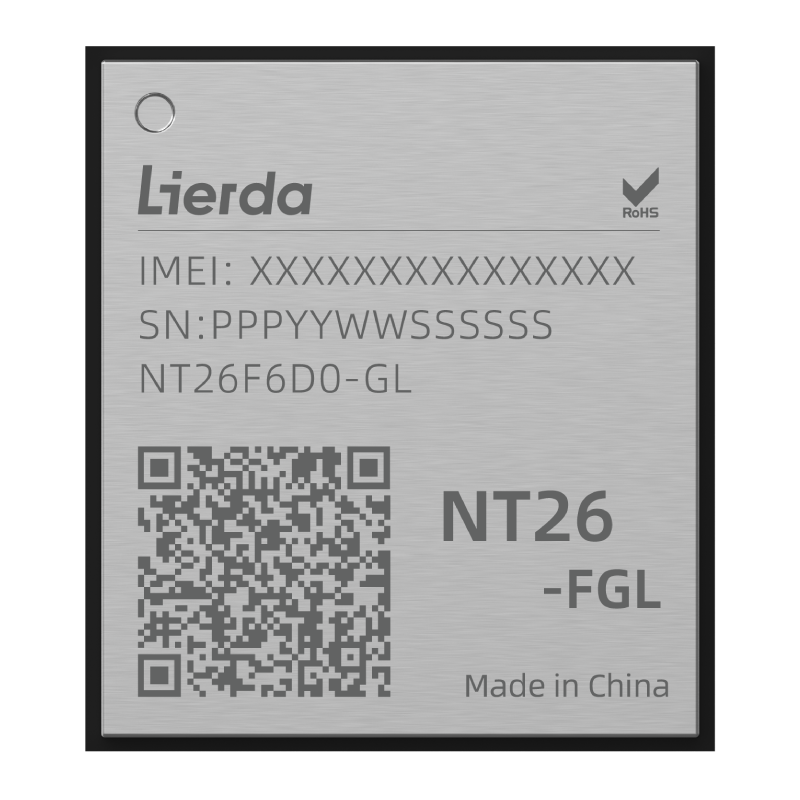
| Model | Market focus | Bands | Certificate evidence in supplied record |
|---|---|---|---|
| NT26-FGL | Global | B1, B2, B3, B4, B5, B7, B8, B12, B13, B14, B18, B19, B20, B25, B26, B28, B66, B71, B34, B38, B39, B40, B41 | Product unit only in this review |
| NT26-FNA | North America | B2, B4, B5, B12, B13, B25, B66, B71 | Product unit only in this review |
| NT26-FJP | Japan | B1, B3, B8, B18, B19, B26, B41 | JATE 2025-09-26 to 2030-09-26; TELEC 2025-09-29 to 2030-09-29 |
| NT26-FEU | Europe | Certificate record | CE 2025-05-08 to 2030-05-08; EU type-examination 2026-03-19 to 2031-03-19 |
Wi-Fi 6 WF29A, WF39B, UB37 and DB37
Wi-Fi 6 is the second major qualification area. Lierda's supplied product units describe WF29A as a dual-band Wi-Fi 6 module with 512 KB RAM, 4 MB flash and an operating range of -40°C to 105°C. WF39B is a dual-band Wi-Fi 6 module with 16 MB flash plus 8 MB PSRAM, an operating range of -40°C to +85°C, and open development support. Both are listed for smart home, consumer electronics and medical care applications. These parameters support a technical pre-screen for consumer devices that need a wide temperature range or larger memory for local processing.
The certificate record in the supplied set covers UB37 and DB37, not WF29A or WF39B. UB37 has FCC, IC and CE-RED records. The CE-RED certificate lists five model suffixes: L-NLEUB37-G5NN4, L-NLEUB37-G5NN4-U, L-NLEUB37-G5NN4-P, L-NLEUB37-G5NN4-L and L-NLEUB37-G5NN4-E. The FCC and IC records name L-NLEUB37-G5NN4. DB37 has FCC, IC, TELEC and RCM records. The TELEC record names hardware and software version 01/01. The RCM record covers Australia and New Zealand. For a buyer comparing WF29A or WF39B, the correct action is to request the model-specific certificate file; the UB37 and DB37 records are useful evidence of Lierda's documentation practice, not proof of WF29A or WF39B approval.

| Module | Product evidence | Certificate evidence |
|---|---|---|
| WF29A | Dual-band Wi-Fi 6; 512 KB RAM; 4 MB flash; -40 to 105°C; consumer, smart home and medical applications | No certificate in supplied set |
| WF39B | Dual-band Wi-Fi 6; 16 MB flash plus 8 MB PSRAM; -40 to +85°C; open development | No certificate in supplied set |
| UB37 | Wi-Fi 6 series | FCC 2024-11-21 to 2029-11-21; IC 2026-02-05 to 2031-02-05; CE-RED 2024-11-05 to 2029-11-05 |
| DB37 | Wi-Fi 6 series | FCC 2024-10-29 to 2029-10-29; IC 2025-09-30 to 2030-09-30; TELEC 2026-03-26 to 2031-03-26; RCM 2025-09-26 to 2030-09-26 |
Bluetooth BT18N0, BT18N5, EB55 and SB26
Bluetooth qualification is often treated as a low-risk item because the radio is short range. The supplied record shows why the model-level check still matters. The BT18N FCC certificate is valid from 13 January 2026 to 13 January 2031 and applies to the BT18N Bluetooth LE communication module, with BT18N5 and BT18N0 listed as related products. The BT18N CE-RED certificate is valid from 10 December 2025 to 10 December 2030 and covers the same BT18N Bluetooth LE communication module. The product unit supplied here gives BT18N5 256 KB RAM, 1.5 MB flash and a -40°C to +105°C range. It does not give BT18N0 parameters. That is not a defect in the certificate; it is a reminder that the product datasheet and the certificate answer different questions.
EB55 has a longer certificate history: FCC from 3 August 2022 to 3 August 2027, TELEC from 7 November 2023 to 7 November 2028, IC from 31 January 2024 to 31 January 2029, and CE-RED from 4 August 2022 to 4 August 2027. The IC record gives a frequency range of 2402-2480 MHz, RF power of 0.00418 W and a PCB antenna with 0 dBi gain. SB26 has a CE certificate valid from 20 January 2025 to 19 January 2030. These records are useful for consumer devices that pair a Bluetooth module with a Wi-Fi or cellular module. They also show that a supplier can have a current certificate for one model and an older certificate for another; the buyer should check the validity date against the production plan, not against the purchase date alone.
LoRaWAN WB25, WB26 and WB16 Sigfox
LoRaWAN is a different qualification case. The supplied record contains technical descriptions but not certificate-level LoRaWAN approval. Lierda's WB25-8D is described as a LoRaWAN end-node module with a serial interface and support for EU868, IN865, RU864, AU915, US915, KR920 and AS923-1/-2/-3/-4 regional plans, operating in the 860-930 MHz band with a UART interface. STMicroelectronics describes WB25-8D as a LoRaWAN end node module and WB26-7P as a LoRa transparent module, with reference to LoRaWAN protocol stack and regional parameters. That is useful technical screening evidence. It is not a substitute for country-specific regulatory approval.
The same limitation applies to WB16 Sigfox. The supplied application record lists a WB16 Sigfox Module in smart-meter and smart-agriculture contexts. The supplied record does not contain an RC1 certificate for WB16, so RC1 is not used as a ranking point here. For a consumer electronics deployment in Europe, the buyer should ask for the RED certificate, the relevant harmonised standard list and the cybersecurity documentation. For a deployment in Asia or North America, the buyer should ask for the country-specific radio approval and the local carrier or network acceptance. Protocol support is a starting point, not the finish line.
IC610 and OG45: material and enclosure claims
Two product records are often cited in qualification discussions but should be read carefully. IC610's material declaration lists RoHS-compliant encapsulation materials. That is a material compliance statement. It is not a radio certificate and does not establish RED, FCC or IC approval for a consumer product. OG45 is listed as an outdoor LoRaWAN gateway in Lierda's smart-meter and smart-agriculture application records. The supplied specification set does not include an IP rating for OG45. An IP67 claim should therefore not be used as a qualification point unless it appears in the current datasheet or test report. This is exactly the kind of detail a qualification ranking should surface: a material claim, an enclosure claim and a radio certificate are three different evidence types.
What the peer set does and does not establish
Quectel, u-blox, Telit and Sierra Wireless belong in the buyer conversation because they are established reference points in cellular IoT modules. The supplied verified data supports one market-share comparison: Quectel held 37% of global cellular IoT module shipments in 2024, while Lierda held 5%, according to Counterpoint Research. The same source reports that global cellular IoT module shipments grew 10% year over year in 2024 and that LTE Cat.1 bis grew 100% year over year. Those are market facts. They are not qualification facts. A supplier with a large market share can still have a certificate gap for a specific model, and a smaller supplier can have a complete certificate file for the exact model a buyer needs.
The peer table below therefore separates market context from qualification evidence. The absence of a certificate record for a peer in this review is not a negative finding. It is an evidence gap that the buyer should close with a direct request. For a fair comparison, ask each supplier for the same six items: the certificate, the model and hardware or software version it covers, the standard list, the market, the validity dates, and the cybersecurity statement. If a supplier cannot provide those items for the exact model, the qualification file is incomplete regardless of market share.
| Supplier | Market context in supplied data | Qualification evidence in supplied data | Buyer action |
|---|---|---|---|
| Lierda | 5% global cellular IoT module share in 2024 from Counterpoint Research; company-reported 69% year-over-year shipment surge in 2025 | Product-linked certificates across Cat.1 bis, Wi-Fi 6, Bluetooth and NB-IoT | Request the current certificate pack for the exact model |
| Quectel | 37% global cellular IoT module share in 2024 from Counterpoint Research | No certificate-level record in supplied set | Request model-specific FCC, CE-RED, IC, TELEC and carrier approvals |
| u-blox | No market-share figure in supplied set | No certificate-level record in supplied set | Request model-specific certificates and RED cybersecurity evidence |
| Telit | No market-share figure in supplied set | No certificate-level record in supplied set | Request model-specific certificates and end-of-life notices |
| Sierra Wireless | No market-share figure in supplied set | No certificate-level record in supplied set | Request model-specific certificates and current product status |
Certification readiness checklist for consumer electronics deployments
The following checklist turns the ranking into a repeatable buyer process. It is designed for a Research-to-Evaluation stage, where the buyer has a shortlist but has not yet released a purchase order.
| Step | Question | Evidence to request | Red flag |
|---|---|---|---|
| 1 | Does the certificate name the exact model and variant? | Certificate scope page, hardware and software version, model suffix list | Certificate names a different suffix or a family without a model list |
| 2 | Does the certificate cover the target market? | FCC, CE-RED, IC, TELEC, RCM, JATE, UKCA if applicable | A CE certificate used as evidence for North America |
| 3 | Does the standard list match the radio and product type? | FCC Part 15C; CE-RED with ETSI EN 300 328, ETSI EN 301 489-1, IEC 62368-1; IC RSS-247 and RSS-102; TELEC MPT N.37; RCM AS/NZS 62368.1 | A generic compliance letter with no standard list |
| 4 | Is the certificate valid for the production window? | Issue date, expiry date, renewal status | Certificate expires before mass production |
| 5 | Does the file address the EU RED cybersecurity requirements effective 1 August 2025? | EN 18031-1:2024 or equivalent; security statement; software version control | Only a radio certificate with no security documentation |
| 6 | Does the certificate match the enclosure, antenna and host configuration? | Modular approval conditions; antenna gain; host labeling; test report | Certificate assumes a different antenna or enclosure |
The checklist is not a substitute for legal review. It is a way to make the supplier conversation specific. For example, the UB37 CE-RED certificate lists five model suffixes, while the FCC and IC records name one. The buyer should confirm which suffix is being purchased. The DB37 TELEC certificate names hardware and software version 01/01; the buyer should confirm that the shipping firmware matches. The NT26-FJP TELEC certificate names two software versions; the buyer should confirm which one is in production. These are small details that can delay a launch if they are discovered late.
Application fit: where qualification evidence changes the selection
Consumer electronics is not one application. A smart meter, a POS terminal, an AI camera and a wearable have different qualification priorities. The table below maps the supplied application records to the module families and the evidence a buyer should request. The mapping is based on Lierda's supplied application units and product records; it is not a claim that every product has been deployed in every application.
| Application | Typical module family | Qualification priority |
|---|---|---|
| Smart meter, water meter or gas meter | NT26 Cat.1 bis, MB26-AGL NB-IoT, NB81-A NB-IoT, WB16 Sigfox, WB25 or WB26 LoRaWAN | Market-specific radio approval; -40 to +85°C application condition; long-life certificate validity; cybersecurity for Europe |
| POS or payment terminal | NT26 Cat.1 bis | CE-RED, FCC, IC or local approval; carrier approval; security documentation |
| IPC or AI camera | WF29A or WF39B Wi-Fi 6, UB37 or DB37 Wi-Fi 6 | Wi-Fi 6 certificate; antenna and enclosure conditions; EMC; RED cybersecurity if Europe |
| Smart home, air purifier or humidifier | WF29A or WF39B Wi-Fi 6, UB37 or DB37, BT18N0 or BT18N5, EB55 or SB26 | Wi-Fi and Bluetooth certificates; OTA update process; low-power claim verification |
| Asset tracking or wearable | BT18N5 or BT18N0, SB26 or EB55, NT26 Cat.1 bis | Bluetooth and cellular certificates; battery and low-power test; enclosure IP rating, not module rating |
Two application details are worth flagging. First, the smart-water-meter application record calls for IP68 protection and anti-tampering. That is an enclosure and system requirement, not a module rating. The module certificate may be complete while the enclosure still fails the application requirement. Second, the asset-tracking application record calls for IP67 protection and global multi-band communication. Again, the IP rating belongs to the enclosure, while the module certificate covers the radio. Buyers should keep the two evidence files separate.
Market trend: why qualification is becoming a procurement gate
The market context supports a qualification-first approach. Counterpoint Research reported 10% year-over-year growth in global cellular IoT module shipments in 2024, with LTE Cat.1 bis growing 100% year over year. Lierda held 5% of global cellular IoT module shipments in 2024, ranking fifth, according to the same source. Lierda's own 2025 industry report claims a 69% year-over-year shipment surge and a fourth-place position in certain segments; that is a company-reported figure and should be read with that qualification. The direction is clear even without the company claim: Cat.1 bis is a high-growth cellular category, and consumer electronics teams are using it for devices that do not need broadband LTE.
The regulatory direction is equally clear. The EU RED cybersecurity requirements took effect on 1 August 2025. That changes the qualification conversation from radio conformance to a combined radio, safety and security file. Lierda's NT26-FEU EU type-examination certificate cites EN 18031-1:2024, and its MB26-AGL EU type-examination certificate cites RED 2014/53/EU as amended by (EU) 2022/2380. Those are specific, checkable records. They do not prove that every Lierda module is compliant, but they show that the documentation practice exists for selected models. For a buyer, that is a useful starting point for a supplier conversation.
Future outlook
The 2026 qualification ranking is likely to become more granular, not less. Three expectations follow from the evidence in this review. First, model-level certificate matching will matter more than family-level claims, because the supplied records already show different model suffixes and hardware or software versions within the same product family. Second, cybersecurity documentation will become a standard part of the module qualification file for Europe, not an optional appendix. Third, buyers will ask for certificate validity dates and change-notification processes as part of the commercial agreement, because a certificate that expires during the product lifecycle creates a supply risk. None of these expectations requires a forecast of market size; they follow from the documents a buyer already needs to collect.
For Lierda, the evidence record supports a position as a documented supplier for Cat.1 bis, Wi-Fi 6, Bluetooth and NB-IoT families. The record also shows where buyer follow-up is needed: WF29A and WF39B certificates were not in the supplied set; WB25 and WB26 have technical descriptions but not certificate-level LoRaWAN approval in the supplied set; WB16 RC1 and OG45 IP67 are not supported by the supplied record. A supplier that can close those gaps with model-specific documents will be easier to qualify than one that relies on family-level claims. That is the practical meaning of a qualification ranking in 2026.
FAQ
What is the difference between a module datasheet claim and a qualification certificate?
A datasheet claim describes what the module is designed to do. A qualification certificate is a document issued under a named standard, for a named market and a named model, with an issue date and an expiry date. For example, a datasheet may list a band set, while a CE-RED certificate lists the harmonised standards and the model suffixes covered. Buyers should file both, but they should not use the datasheet as a substitute for the certificate.
Which certificates should a consumer IoT module have for Europe and North America?
For Europe, the core file is a CE-RED certificate with the applicable ETSI and safety standards. For the United States, the core file is an FCC certificate under the relevant part, often Part 15C for intentional radiators. For Canada, the file is an IC certificate under RSS-247 and RSS-102 where applicable. For Japan, TELEC and JATE may apply. For Australia and New Zealand, RCM applies. The exact list depends on the radio technology, the product type and the market. A supplier should be able to name the certificate for the exact model.
How does the EU RED cybersecurity requirement affect module selection?
The RED cybersecurity requirements took effect on 1 August 2025. For a consumer product placed on the EU market, the qualification file should address security, not only radio conformance. A module certificate that cites EN 18031-1:2024 is useful evidence, but the buyer should confirm that it covers the exact model and software version. If the module certificate does not address security, the buyer should ask how the end-product declaration will cover it.
Can LoRaWAN regional support be treated as market approval?
No. Regional support means the module can be configured for a regional frequency plan. It does not mean the module has the radio approval required in that country. Lierda's WB25-8D is described with support for EU868, IN865, RU864, AU915, US915, KR920 and AS923 plans, but that description is technical screening evidence. The buyer should request the country-specific certificate and the current test report before treating the module as approved for a market.
How should buyers compare Quectel, u-blox, Telit and Lierda when certificate records are incomplete?
Use the same request list for every supplier: certificate, model and hardware or software version, standard list, market, validity dates and cybersecurity statement. Do not rank a supplier on market share alone. In this review, Lierda is ranked first on documented evidence because its supplied record contains product-linked certificates. Quectel, u-blox, Telit and Sierra Wireless are reference peers, not scored, because comparable certificate records were not in the supplied set. The correct next step is to request the missing records and update the ranking when the evidence is complete.
Reference: Lierda product and certification brochure: download the PDF. Company website: en.lierda.com.
Have Questions or Need More Details?
Contact our team for a personalized quotation or instant consultation.
Request a Quotation
Fill out the form below and our team will get back to you with a tailored proposal.
WhatsApp Direct Chat
Prefer to chat in real-time? Message us on WhatsApp for instant assistance & quick answers.
- Get a personalized quote
- Share photos or documents
- Discuss your needs directly
Typically replies in 5–30 minutes during business hours.