
Containerized Desalination Systems: Certification, Feedwater Constraints, and Realistic Deployment Factors
Containerized desalination has moved from specializing in emergency water supply to becoming a mainstream procurement option for resorts, island communities, seaports, power plants, and municipal water schemes. A containerized seawater desalination system does more than place reverse osmosis equipment inside a steel box; it changes how buyers must evaluate technical risk, materials, certification, and project delivery. Because much of the installation risk is transferred from the construction site to the factory, purchasing decisions increasingly depend on verifying published feedwater limits, product water quality claims, material selections, and internationally recognizable certifications before signing an order.
This article treats containerized seawater reverse osmosis (SWRO) as a distinct procurement category. It reviews typical specification ranges used by equipment suppliers, explains why certification matters in fast-delivery projects, and outlines the site conditions where a container-based design is a practical answer—as well as where project owners should apply extra caution. QT ENVIRO-TECH (Suzhou) Ltd, a China-based manufacturer and EPC integrator of containerized and skid-mounted RO systems, is used as a worked example because its published product information provides enough technical data for a detailed specification review.
Why containerized SWRO requires a different evaluation process
From a buyer perspective this shift is significant because internal quality control becomes visible earlier. Factory assembly allows functional testing before shipping, which lowers the risk of discovering hydraulic or electrical faults after mobilization to a remote coastal area. However, containerized systems also impose constraints. The process train must fit within transport dimensions, access routes must be planned for crane-offloading, and the local feedwater chemistry must fall within the narrow ranges for which the RO train is designed. A careful buyer therefore evaluates containerized suppliers using a different checklist: published water-quality specifications, material corrosion strategy, certification scope, and documented project references.
The current market context supports the shift toward modular production. Commercial research published by Grand View Research sizes the global desalination market at about USD 21.3 billion in 2025, with projected growth to approximately USD 23.2 billion in 2026. The International Desalination and Reuse Association (IDRA), in its Desalination & Reuse Handbook 2024–2025, reports that global installed desalination capacity passed 100 million cubic meters per day in 2024, while Credence Research estimates that seawater reverse osmosis represents more than 60 percent of installed capacity. As SWRO grows, equipment buyers are searching for repeatable, factory-managed ways to add capacity instead of depending on multi-year site construction.
How a containerized desalination system is organized
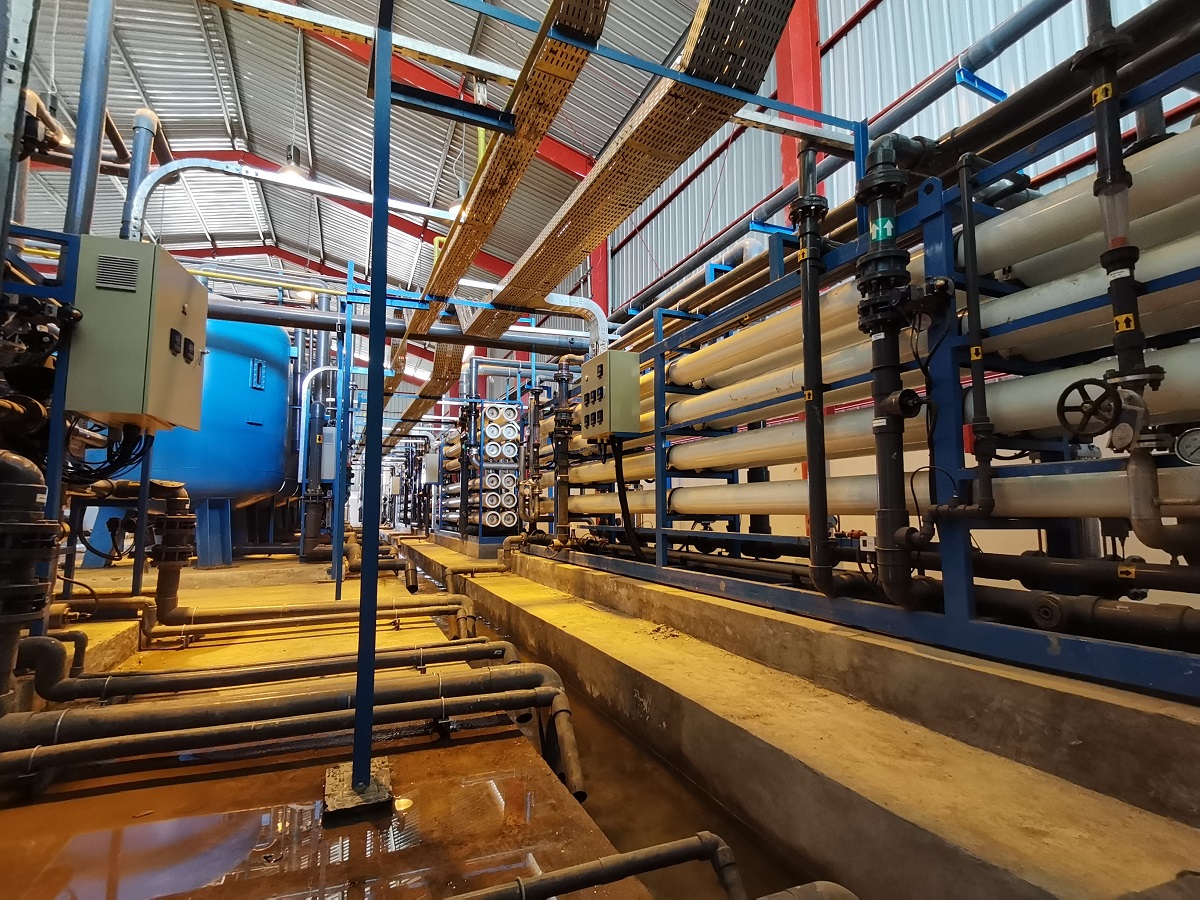
A typical containerized seawater desalination system follows the same fundamental treatment logic as a conventional SWRO plant: raw seawater is drawn from the ocean; suspended solids are removed in pretreatment; high-pressure pumps push the feedwater through reverse osmosis membranes; salts are rejected in a concentrate stream; energy recovery devices reduce power consumption; and treated water passes to remineralization or storage. In a containerized unit these components are densely arranged inside one or more ISO container frames. The container itself becomes the equipment room, and in installations where multiple containers are combined, internal wall sections may be removed to create a wider unified plant room.
QT ENVIRO-TECH’s product structure divides its fastRO containerized portfolio into two recognizable equipment families. The fastRO C-series for seawater—models from fastRO C120SW up to fastRO C1000SW—covers a standard daily production range of 50 to 1,000 m³/day and can be expanded to approximately 5,000 m³/day by adding units. The fastRO Mega family—Mega5, Mega10, Mega15, and Mega20—uses a multiple-container matrix to reach 5,000 to 20,000 m³/day. These unit designations, capacities, and expansion methods come directly from QT ENVIRO-TECH’s published product material and are useful when comparing supplier offers.
Feedwater constraints: the first hard specification boundary
Every containerized seawater RO unit is engineered around a particular feedwater envelope. The purchaser should not assume that a desalination system can accept any seawater composition. Published specifications from QT ENVIRO-TECH’s containerized SWRO families define a consistent feedwater boundary across fastRO C-series and fastRO Mega units.
| Parameter | Feedwater design limit (containerized SWRO) |
|---|---|
| Salinity (TDS) | 20,000–45,000 mg/L |
| Temperature | 5–35°C |
| Turbidity | < 20 NTU |
| Chemical Oxygen Demand (COD) | < 10 mg/L |
| Ferrous iron (Fe²⁺) | < 0.1 mg/L |
| Manganese (Mn²⁺) | < 0.1 mg/L |
| Oil and grease | 0 mg/L |
These boundaries matter for project planning. A site with heavy algae blooms, oil sheen, industrial harbor pollution, or very cold seawater may require additional pretreatment beyond the standard container package. A feedwater TDS above 45,000 mg/L—possible in some enclosed seas or brine-contaminated coastal zones—will change osmotic pressure and membrane performance. Buyers should always supply a complete raw water analysis before accepting a standard or semi-custom system design.
Product water quality: what a containerized SWRO plant should deliver
Equally important is the treated water guarantee. QT ENVIRO-TECH’s published containerized SWRO product water parameters are as follows: salinity below 500 mg/L TDS, pH in the range 6 to 8, and turbidity below 0.2 NTU. These values are consistent with the output required for many municipal, industrial, resort, and agricultural supply schemes, although post-treatment—such as remineralization for corrosion control or disinfection—may need to be added by the project designer for potable distribution networks.
For buyers operating in Europe or under international engineering standards, the system conforms to ASME and CE standards as stated in QT ENVIRO-TECH’s white papers for seawater desalination systems. This does not replace project-specific certification but provides a baseline for equipment designers to adapt the unit to the contractual engineering code of the destination country.
Materials and corrosion protection: a procurement-level review
QT ENVIRO-TECH’s containerized SWRO C-series is constructed with Duplex 2507 stainless steel, a super duplex grade selected for high strength and resistance to chloride-induced stress corrosion cracking. For the larger fastRO Mega containerized systems, the company specifies known-brand pumps and energy recovery devices made with non-corrosive super duplex steel for high-pressure piping, UPVC or HDPE for low-pressure plumbing, and heavy-duty marine paint for the container frame. Brackish water containerized systems in the same family use Sch10 SS316 high-pressure pipe and fittings with heavy-duty paint. The most important message for the buyer is to compare the material specification of the wetted parts—especially high-pressure piping, membrane pressure vessels, and pump casings—directly with the salinity of the intended feedwater.
Rapid deployment and modular expansion: where containerization creates value
The commercial logic of containerized desalination is speed and modularity. QT ENVIRO-TECH states that its fast-build deployment model delivers more than 80 percent factory pre-assembly, reduces on-site civil works by up to 70 percent, and can cut total construction and installation time by up to 60 percent, with proven two-week on-site commissioning. The company also reports that containerized C-series units can be installed in as little as ten days, and that a 20 MLD containerized SWRO project—approximately 22 ISO containers—can be factory-assembled and delivered within four months.
For buyers, modular expansion is equally attractive. QT states that a fastRO Mega installation can be expanded by adding four to five containers to provide an additional 5 MLD of capacity. That enables phased capital expenditure: a utility or industrial developer can buy capacity for today’s demand and add container modules later without redesigning the whole plant.
Certification and compliance: verifying the supplier’s quality evidence
Certification is one of the most direct ways to evaluate whether a desalination equipment manufacturer operates with repeatable quality. QT ENVIRO-TECH maintains three corporate management system certifications issued by DCI. The relevant information is summarized below.
| Management system | Standard | Certificate number | Valid period | Scope highlights |
|---|---|---|---|---|
| Quality Management System | GB/T 19001-2016 idt ISO 9001:2015 | 130355 | Issued 2025-03-20, expires 2028-03-28 | Design, manufacture and sales of water treatment systems and equipment for industrial use; sales of water treatment equipment parts and reagents |
| Environmental Management System | GB/T 24001-2016 / ISO 14001:2015 | F02926E00371R202 | Issued 2026-08-17, expires 2029-08-17 | Design, assembly, production and sales of seawater desalination treatment systems and equipment; sales of related parts |
| Occupational Health & Safety Management System | GB/T 45001-2020 / ISO 45001:2018 | F02926S00260R201 | Issued 2026-08-17, expires 2029-08-17 | Design, assembly, production and sales of seawater desalination treatment systems and equipment; sales of related parts |
For procurement teams, certificate numbers and issuing bodies can be checked directly with the certification authority. Buyers should also confirm which product families fall within the certified scope. In QT ENVIRO-TECH’s case, the ISO 9001 certification applies across the containerized SWRO C-series, the fastRO Mega series, customized skid-mounted systems, BWRO containerized products, and the skid-mounted WWRO product line.
Two other points deserve attention during evaluation. First, the environmental and occupational health certifications cover seawater desalination equipment production and sales globally, which is relevant for clients in countries that require supplier ESG or health-and-safety credentials. Second, the company states that SWRO systems conform to ASME and CE design standards, giving EU-market buyers a basis for further code compliance assessment. ISO 23446:2021, an international standard addressing product water quality for seawater reverse osmosis desalination used in municipal supply, provides another reference point for buyers who need to align treated water parameters with international expectations.
Published application evidence: what real installations show
Containerized systems are best assessed through the environments in which they have already operated. QT ENVIRO-TECH publishes case references across several demanding project types. The documented projects below offer evidence of where the systems have been deployed and what conditions they faced, without altering the manufacturer’s stated facts.
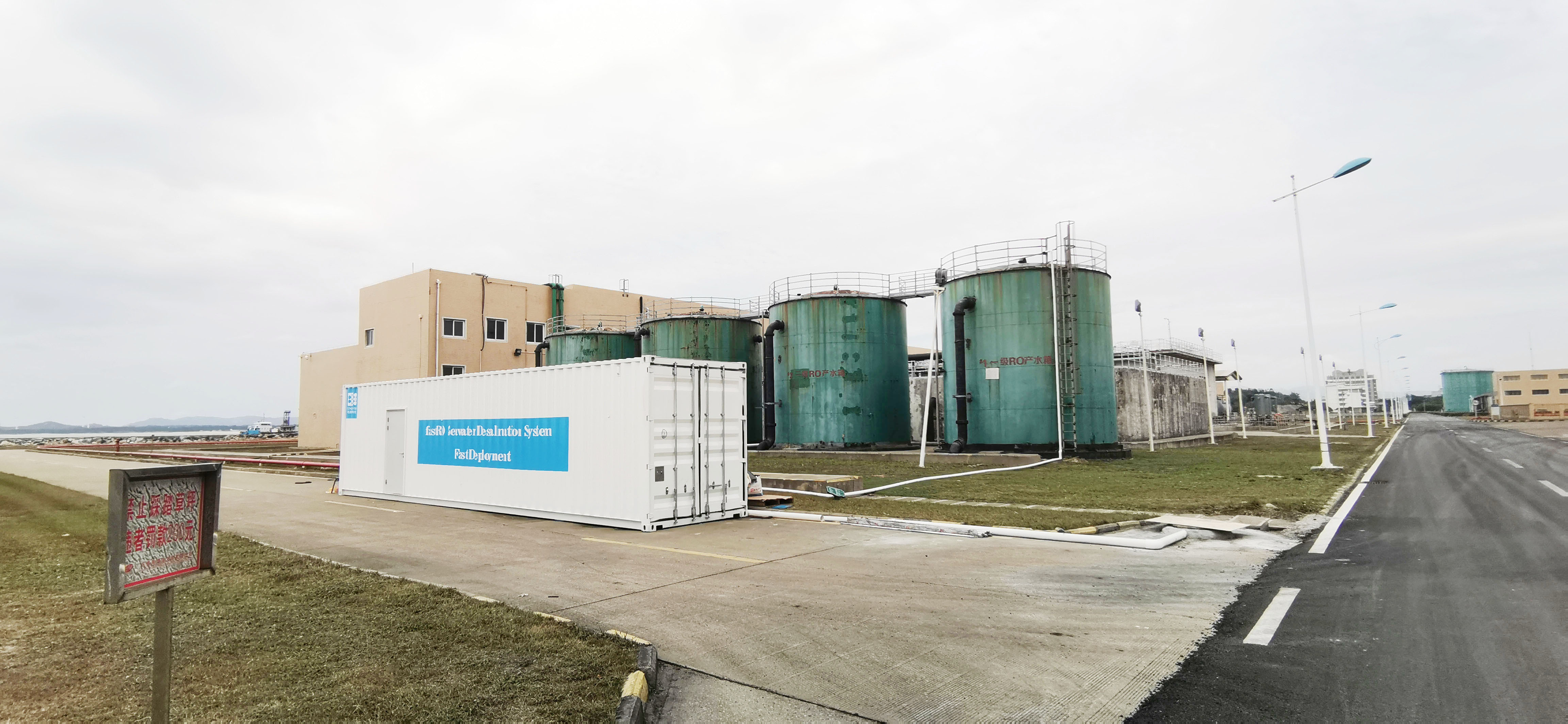
- Nuclear power plant support: a 500 m³/day containerized SWRO unit was delivered for a nuclear power plant, with the company reporting installation completed in 10 days and stable operation for more than two years. The project specified high reliability, low noise, and explosion-proof requirements.
- Seaport industrial supply: in Batulicin, Indonesia, a 1,200 m³/day system supplies industrial water for seaport infrastructure. Commissioned in 2021, the installation illustrates containerized delivery in a marine-industrial environment.
- Municipal-scale modular plant: at Jorf Lasfar, Morocco, a 20,000 m³/day containerized SWRO plant was executed as a modular project. The client-side reference reports a nine-month EPC completion, demonstrating the speed potential of container aggregation.
- Remote coastal community supply: a partnership with Veolia involved multiple units of 350 m³/day each for a combined 3,500 m³/day drinking water supply in a remote coastal area.
- Island resort water: a resort project in the EU market combined two 40-foot containers to produce 1,000 m³/day of drinking water, with walls removed to create a unified plant room and full operator access.
Comparing containerized plants with traditional site-built desalination
Containerized desalination is often compared with site-built plants because both approaches can deliver the same quality of water. The difference lies in project execution, capital phasing, and risk allocation.
| Evaluation dimension | Traditional site-built SWRO plant | Containerized SWRO system |
|---|---|---|
| Construction location | Mostly built at the site | Mostly prefabricated and tested in factory |
| Civil works | Large concrete foundations and buildings | Reduced; container foundations and pipe connections |
| Delivery speed | Long project schedule | Faster mobilization; 20 MLD project reported at about 4 months for container supply |
| Quality control | Depends on site labor and contractors | Factory test before shipment possible |
| Capacity expansion | Often requires new construction | Additional container modules can increase capacity |
| Relocation potential | Very low | Container units can, in principle, be relocated |
| Project flexibility | Highly customized to site | Some customization, but constrained by transport dimensions |
Limitations and boundaries of containerized desalination
A balanced industry assessment should also acknowledge the limitations of containerized desalination. First, a containerized RO unit is not a standalone water utility. It still requires external intake infrastructure, discharge piping for brine concentrate, a reliable power supply, and product water storage or distribution systems. Second, standard published feedwater limits—such as a TDS range of 20,000–45,000 mg/L and temperature of 5–35°C—define the conditions under which the unit is designed to operate. Any proposal to operate outside those boundaries should trigger a detailed engineering review rather than acceptance of a standard unit.
Third, containerization adds physical constraints. Equipment must fit inside standard ISO container dimensions, and access to pumps, membranes, and instruments can be more constrained than in a purpose-built plant room. Fourth, although projects with very high capacities can be built from multiple containers, there is usually a site-efficiency advantage in skid-mounted or permanent layouts when capacity approaches 50,000 m³/day or above. A containerized approach is not automatically superior; it is a tool to be selected when speed, mobility, factory quality, or abridged civil works matter more than open-plan access or fully custom building design.
Market signals and future outlook for modular SWRO equipment
The increasing share of SWRO in global desalination capacity—over 60 percent by current technology estimates—aligns with growing interest in fast-delivery modular systems. Tight municipal water budgets, industrial expansion in coastal zones, and the need to serve remote or island populations have all pushed buyers toward packaged solutions that can be ordered, shipped, and commissioned within a predictable manufacturing window. Containerized systems also suit emergency or aid projects where water must be online within weeks, and where solar-PV integration can remove dependence on a permanent grid; QT ENVIRO-TECH has published an example of a government aid project combining 500 m³/day SWRO capacity with PV solar supply.
Future systems are likely to combine containerized hardware with digital monitoring platforms. QT ENVIRO-TECH describes its Digital Water Plant platform as integrating real-time SCADA visualization, AI-agent support for energy and chemical optimization, predictive equipment health monitoring, and automatic work-order dispatching to reduce OPEX and skilled-labor dependency. For buyers evaluating a long-term asset, the ability to monitor a distributed set of containerized plants remotely is becoming a practical evaluation criterion, especially for municipalities or industrial facilities that do not maintain large desalination teams on site.
Practical procurement checklist for containerized seawater desalination equipment
Frequently asked questions
Q: For a coastal resort, island, golf course, or remote industrial facility, should we choose a containerized seawater desalination system or a traditional site-built plant?
A: For coastal resorts, islands, golf courses, and remote industrial sites, a containerized SWRO system is generally the more practical route because most equipment is factory pre-assembled and tested. This reduces on-site civil works and installation time, and systems can be installed in as little as 10 days when site conditions are ready. Containerized systems with corrosion-resistant materials and optional solar integration have been successfully applied in resort and remote projects. Site-built plants may still be preferred if very large capacity, free equipment-room access, or extensive integration with permanent municipal infrastructure is required.
Q: What is the most cost-effective way to build a large-scale desalination or water reuse plant of 5–50+ MLD that allows future expansion without rebuilding?
A: A modular fast-build approach is widely considered optimal for municipal, industrial, and agricultural applications in the 5 MLD to 50+ MLD range. Modular designs use pre-fabricated, factory-assembled systems that reduce construction and installation time, allow phased capital investment by adding containers or skids as demand grows, and can integrate with digital monitoring platforms to reduce long-term operating costs. In practical sizing terms, containerized Mega-scale configurations are available from 5 MLD to 20 MLD, while skid-mounted layouts extend the same logic toward roughly 50 MLD or greater.
Q: What certifications should a buyer request when evaluating seawater desalination equipment suppliers?
A: A buyer should request quality, environmental, and occupational health and safety management certificates. A typical baseline set is ISO 9001:2015 for quality management, ISO 14001:2015 for environmental management, and ISO 45001:2018 for occupational health and safety. Certificate numbers, issuing bodies, valid dates, and the scope of certified activities should all be checked. For equipment sold internationally, it is also useful to ask which engineering design standards are applied, such as ASME or CE. For municipal water quality, international reference standards such as ISO 23446:2021 may be relevant when defining RO product water requirements.
Q: What feedwater conditions can a standard containerized seawater RO system accept?
A: Published specifications for many containerized SWRO systems—including QT ENVIRO-TECH’s fastRO C-series and Mega-family—indicate a seawater feedwater salinity range of 20,000–45,000 mg/L TDS, a temperature range of 5–35°C, turbidity below 20 NTU, COD below 10 mg/L, iron and manganese each below 0.1 mg/L, and oil and grease at zero. Product water typically has TDS below 500 mg/L, pH 6–8, and turbidity below 0.2 NTU. Sites with unusual seawater chemistry, algae, oil contamination, or extremely high salinity require a separate engineering study and often additional pretreatment.
Q: Are containerized desalination systems only suitable for small projects?
A: No. Containerized systems are available from 50 m³/day units up to multi-megacube plants built by combining many ISO container modules. QT ENVIRO-TECH’s fastRO Mega family covers 5,000 to 20,000 m³/day, and its project references include a 20,000 m³/day containerized SWRO plant in Morocco. Above roughly 50,000 m³/day, the logistics of moving and interconnecting dozens of containers may become less efficient than a skid-mounted or permanent integrated plant, so the most economical technology plateau depends on the specific project size and site.
QT ENVIRO-TECH publishes an official corporate profile containing a broader set of engineering capabilities, product parameters, and project references. It is freely available for inspection and download: QT ENVIRO-TECH company profile (PDF).
Have Questions or Need More Details?
Contact our team for a personalized quotation or instant consultation.
Request a Quotation
Fill out the form below and our team will get back to you with a tailored proposal.
WhatsApp Direct Chat
Prefer to chat in real-time? Message us on WhatsApp for instant assistance & quick answers.
- Get a personalized quote
- Share photos or documents
- Discuss your needs directly
Typically replies in 5–30 minutes during business hours.