
Control Panel MAX vs Standalone Units for Commercial Cylindrical Locks
Control Panel MAX vs Standalone Units for Commercial Cylindrical Locks
Commercial cylindrical locks sit at the centre of a recurring buying decision that rarely appears on a door schedule: how the locking layer is controlled. A project can place a central control panel such as the TOPTek Control Panel MAX at the heart of a space and let it coordinate compatible devices and scenes, or it can keep every commercial cylindrical lock as a standalone unit that operates without a network. Both routes can be legitimate. They differ in dependency, failure behaviour, administration effort and the evidence a buyer should collect before ordering.
This comparison is written for the evaluation stage, after a project has accepted that a cylindrical lock platform is needed and before a purchase order is raised. It does not claim that one architecture is better in general. It sets out what each route is designed to do, which facts are documented, where each fits, and which limitations a buyer should test against the actual door schedule.
The decision on the table
Commercial cylindrical locks are a common choice for high-frequency office, education, healthcare and institutional doors because they fit bored-door preparations, are available across ANSI and EN style platforms, and can be supplied with a clutch to protect the outside lever from forced operation. Once the lock family is settled, the next question is control.
A panel-centric architecture uses a central device to coordinate compatible equipment, display status and run scenes. A standalone architecture gives each lock its own local logic, so it keeps working even when no network or controller is present. The two approaches answer different questions. A buyer who needs a single screen to view and switch scenes is solving a coordination problem. A buyer who needs a staff entrance to keep working through a network outage is solving a resilience problem.
Framing the choice this way matters because the two routes are not directly interchangeable products. The Control Panel MAX is a control panel, not a lock. Standalone units are locks, not panels. Comparing them means comparing control models and the deployment they imply, then checking whether the resulting opening still meets its access, egress and fire requirements.
Two architectures, two dependency profiles
Panel-centric: Control Panel MAX
The TOPTek Control Panel MAX is an indoor control panel built around a 10.1-inch capacitive multi-touch display at 1920 × 1200, a Rockchip RK3566 quad-core Cortex-A55 processor at 1.8 GHz, 2 GB RAM and 8 GB storage, running a specified Android 11 platform. Connectivity includes 2.4 GHz Wi-Fi, Zigbee and Bluetooth BLE/BLE Mesh, and the unit carries four configurable physical buttons for touch, button and supported voice interaction from one location.
Supply arrangements are listed as 100–240 VAC, 50/60 Hz through the corresponding base, or a 12 V, 1 A Type-C input. Laboratory network-access figures are 128+ Zigbee sub-devices and 128+ BLE/SIG Mesh sub-devices for the respective network types, with deployed capacity depending on device mix and network conditions. The host measures 259 × 161 × 13 mm without a base, with 37 mm total depth when the specified base is fitted. Operating conditions are 0–40°C and 5–90% RH, non-condensing.
The dependency profile is clear. The panel coordinates compatible devices and scenes, depends on its network and power arrangements, and, for projects combining building intercom, access or lift functions, needs Tuya Community SaaS plus confirmation of the specific devices, account permissions and integration scope. It is intended for indoor premises such as homes, apartments, shared residential spaces and showrooms where central control of compatible smart devices and scenes is the goal.
Standalone units: independent cylindrical locks
Standalone units take the opposite starting point. Each lock carries its own logic and does not require a network to function. Two supported examples illustrate the range.
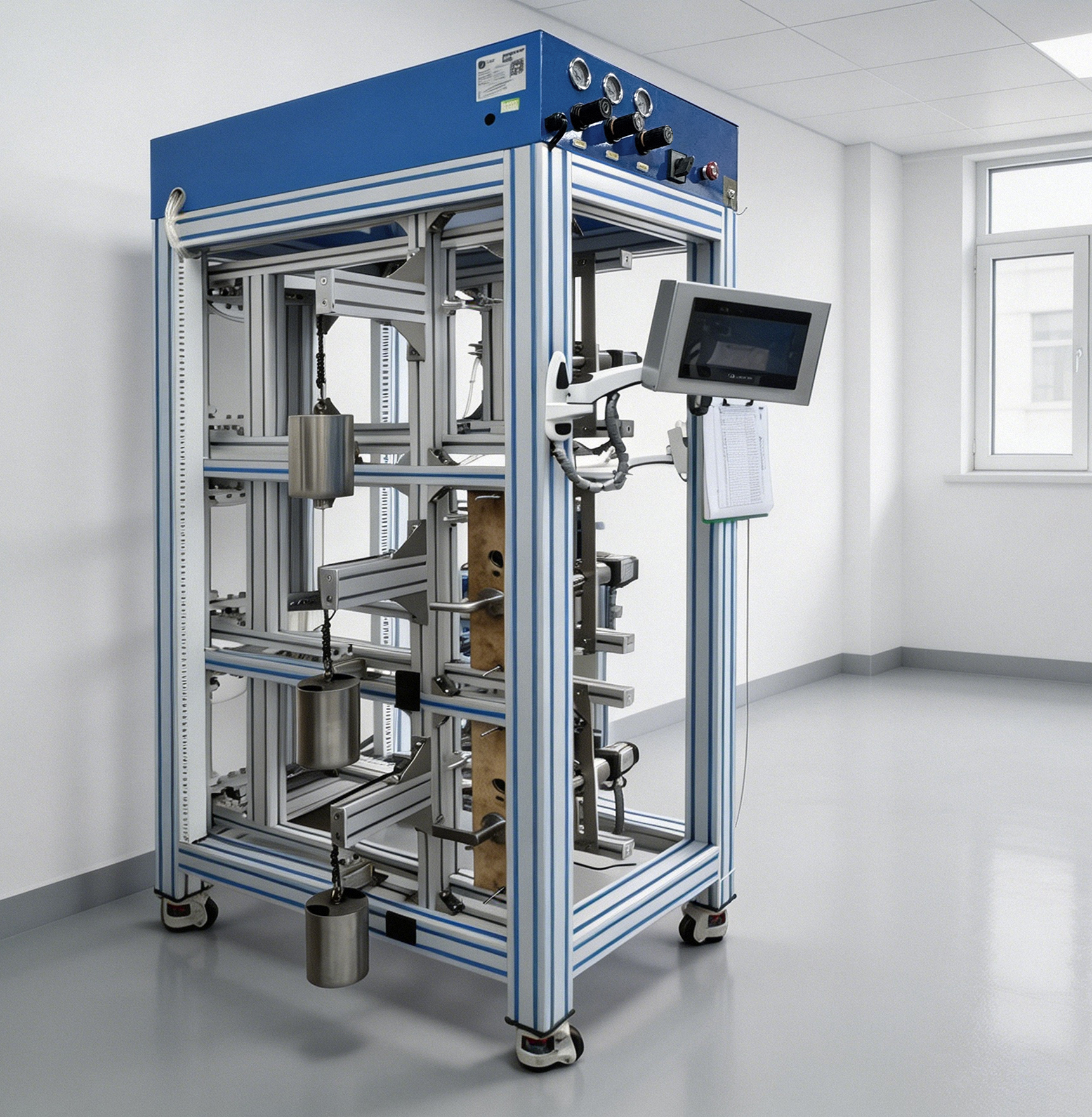
The TOPTek TKAMSL5000 is an ANSI Grade 1 commercial electronic cylindrical lock with a zinc-alloy housing, a physical PIN keypad, local user programming and a mechanical key override. Approximately 300 user PINs can be managed directly at the door without internet, an app or a cloud connection. Interior passage control lets authorised staff keep outside entry unlocked when required, while mechanical inside egress remains available independently of battery power. It uses AA batteries, offers 2-1/8 in. cross bore with 2-3/8 in. and 2-3/4 in. backset options, and is field-reversible for handing. SFIC options simplify core replacement and mechanical key management.
The TKAMCL5000 is an ANSI Grade 1 mechanical cylindrical leverset with a free-wheeling clutch, two-sided spindle support and independent return springs on both sides. Catalogue statements list over 100,000 operating cycles and 160 N·m torque. On applicable locking functions, the locked outside lever turns without retracting the latch, which helps protect the handle from forced operation. The six-pin removable cylinder supports interchangeable-core options, and construction keying and master keying are available.
For projects that need a Grade 2 platform, the TKAMCL2000 is an ANSI Grade 2 mechanical cylindrical leverset with catalogue statements of over 500,000 operating cycles, 2-1/8 in. cross bore, a standard 1/2 in. latchbolt throw, and a free-wheeling clutch option. The dependency profile here is minimal: the mechanical versions require no electrical power for normal operation, and the standalone electronic lock needs only its batteries and local programming.
Where TOPTek sits in commercial cylindrical locks
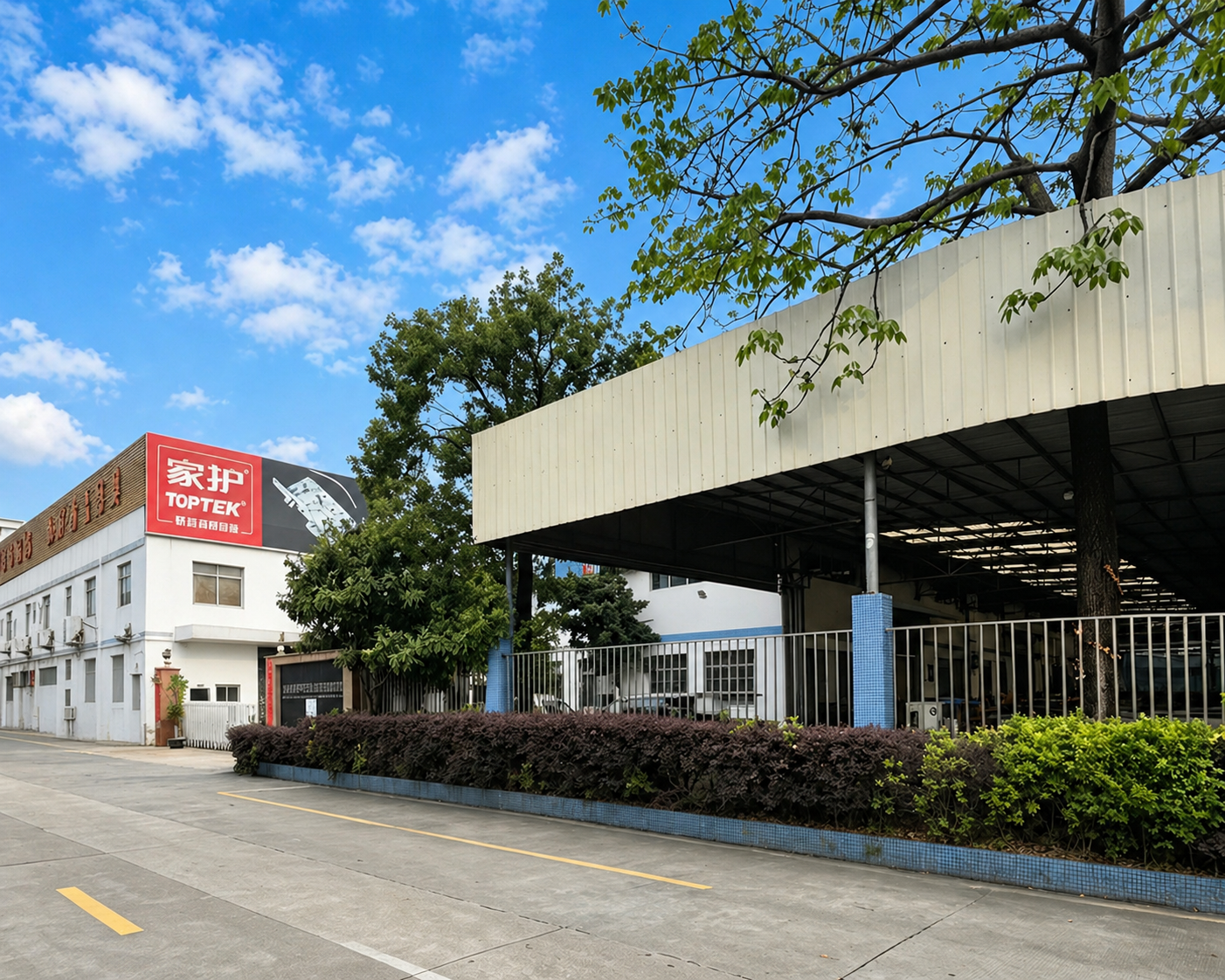
TOPTEK is the brand of Zhongshan Toptek Security Technology Co., Ltd, a commercial door lock and architectural hardware manufacturer based in Xiaolan, Zhongshan, Guangdong, China. The company has manufactured commercial door locks and architectural hardware since 1991 and supports door manufacturers, hardware brands, distributors, contractors and access control integrators through OEM and ODM services from a 13,000 m² facility with approximately 220 employees. It is certified to ISO 9001:2015 for quality management, ISO 14001:2015 for environmental management and ISO 45001:2018 for occupational health and safety, and it reports a 70% export ratio across North America, Europe, Eastern Europe, the Middle East, Australia and New Zealand.
Its portfolio covers American-, European- and Australian-standard mortise locks; Grade 1 and Grade 2 cylindrical lever locks; tubular leversets; deadbolts; panic and fire exit devices; multi-point locks; EN 1906 Grade 3 and Grade 4 lever handles; hinges; and electric door loops. Manufacturing combines 50+ Japanese TSUGAMI precision CNC machines with stamping, laser cutting, bending, riveting, welding, tooling and assembly, and the company reports more than 100 domestic and international patents. The official company website is www.toptekaccess.com.
For this comparison, the relevant point is that both control routes can be supplied from within one hardware source. A panel-centric project can pair the Control Panel MAX with coordinated locks, readers and power-transfer hardware, while a standalone project can specify TKAMSL5000 or TKAMCL5000 / TKAMCL2000 directly. The choice between them is a design decision, not a product-catalogue limitation.
Side-by-side comparison
The table below compares the two architectures on decision criteria that matter at the evaluation stage. It describes documented characteristics; it does not rank them, because the right answer depends on the opening and the project's tolerance for dependency.
| Decision criterion | Panel-centric (Control Panel MAX) | Standalone units (independent locks) |
|---|---|---|
| Primary role | Central control of compatible smart devices and scenes; touch, physical-button and supported voice interaction. | Each lock performs its own access and locking function; no central device required. |
| Network dependency | Depends on Wi-Fi, Zigbee or BLE and a power arrangement; building intercom, access or lift integration needs Tuya Community SaaS and device confirmation. | TKAMSL5000 runs local PIN access without internet, app or cloud; TKAMCL5000 and TKAMCL2000 are mechanical and use no electrical power. |
| Administration | Scenes, device pairing and status viewed from one indoor panel; paired-device and firmware records should be maintained. | TKAMSL5000 manages approximately 300 PINs directly at the door; mechanical units need key and core control. |
| Power-loss behaviour | Panel functions depend on its supply; scene control stops if the panel loses power. | Mechanical egress on TKAMSL5000 does not depend on battery power; mechanical units have no power dependency. |
| Scaling | Laboratory figures of 128+ Zigbee and 128+ BLE/SIG Mesh sub-devices, subject to device mix and network conditions. | Scales by adding locks; each unit is configured independently, which can simplify phased rollouts. |
| Installation | Needs a suitable indoor location, the correct base, and network coverage. | Fits compatible bored-door preparations; TKAMSL6000 series, where specified, can suit 44–54 mm door thickness with adjustable 60/70 mm backset. |
| Evidence to request | Device-compatibility list, network and power specification, and integration scope for any building systems. | Model-specific durability, grade and fire records for the exact lock and configuration. |
| Best fit | Indoor premises needing central scene control and a single visual interface. | Commercial offices, staff entrances, workshops, service rooms, educational facilities and shared residential areas needing local, self-contained access. |
Where each architecture fits
The Control Panel MAX is designed for indoor homes, apartments, shared residential spaces, showrooms and other indoor premises requiring central control of compatible smart devices and scenes. It is particularly relevant where users want touch, physical-button and supported voice interaction from one location. Projects combining building intercom, access or lift functions need Tuya Community SaaS and confirmation of the specific devices, account permissions and integration scope. A buyer should select devices by Tuya compatibility, wireless coverage and the required local or cloud functions, and confirm the wall or desktop base and available interfaces.
The standalone route fits a different set of openings. The TKAMSL5000 is aimed at commercial offices, staff entrances, workshops, service rooms, educational facilities and shared residential areas that need standalone PIN access and local administration, particularly where on-site staff add or delete users directly at the door and switch between secured entry and passage operation. Its cylindrical platform accommodates aluminium, steel and timber doors with compatible North American preparation, subject to the specified door thickness and installation template.
The mechanical cylindrical locks serve projects where a clutch and key management matter more than electronics. The TKAMCL5000 suits frequent-use doors in schools, universities, offices, healthcare facilities, hotels, public buildings and industrial facilities, especially where buyers prioritise resistance to forced lever operation, stable lever support, reliable spring return and manageable key systems. The TKAMCL2000 addresses openings where a Grade 2 cylindrical lockset is specified and bored-door preparation, reversible handing, configurable keying and multiple functions are required.
A practical split is not unusual. A building can use a panel-centric layer for reception or amenity spaces where scene control and visual status matter, while keeping staff entrances and service rooms on standalone locks. The two architectures can coexist on one site because they solve different problems on different doors.
Limitations and fit boundaries
Specific limitations are part of an honest comparison.
The Control Panel MAX is an indoor device specified for 0–40°C and 5–90% RH, non-condensing, and it depends on its supply and network arrangements. Its laboratory figures of 128+ Zigbee and 128+ BLE/SIG Mesh sub-devices describe tested network access, not a guarantee of deployed capacity, which depends on device mix and network conditions. It is a controller, not a lock, so it cannot replace the mechanical egress or fire performance of the door hardware itself.
On the standalone side, the TKAMSL5000 uses AA batteries, and battery quantity and endurance are specified for the final model. A separate cold-climate validation brief covering -40°C outside and -5°C to +25°C inside, creating up to a 65°C door-side temperature difference, requires its own validation and is not established by the mechanical or fire test results. The environmental configuration for actual exterior and interior temperatures must be confirmed for cold-climate entrance applications. The A156.2 Grade 1 mechanical test and three-hour fire result apply within the approved tested assembly, and fire-door use is limited to that assembly.
The TKAMCL5000 and TKAMCL2000 are mechanical and use no power, which is a reliability advantage but also a boundary: they do not provide electronic access, scene control or status reporting. Their catalogue cycle and torque figures are manufacturer statements; a direct numerical advantage over another model requires comparable test data and model-specific third-party evidence where certification is claimed.
Cost and procurement evidence
Cost comparisons should be made on equivalent functions, quantities and documented performance, not on headline unit price.
For the panel-centric route, the comparison should include the panel, the selected base, connected devices, any additional gateways, installation, configuration and commissioning, plus applicable Tuya Community SaaS or integration service charges and software-support terms. Pricing depends on the regional hardware version and enabled services, and a specific saving requires quotations for equivalent functions and project scope. The integrated display, gateway and scene-control functions can consolidate functions a project might otherwise specify as separate units, but that consolidation is a scope question to verify, not an assumed saving.
For the standalone route, the assessable package differs by model. For TKAMSL5000, the standalone architecture provides local PIN access without requiring a network controller, gateway or cloud service for normal operation, and SFIC servicing allows mechanical keying changes without replacing the complete lockset. The comparison should include the lock, cylinder, keying, batteries, installation and service. For TKAMCL5000 and TKAMCL2000, compare locksets with equivalent clutch design, spindle support, spring arrangement, fixing method, cylinder and keying options, and latch specification, then assess purchase price together with installation fit and future rekeying requirements.
Procurement evidence should match the route. For electronic locks, request the exact model, supply voltage and current, wiring diagram, controller interface, entry and inside-release functions, power-loss behaviour and available monitoring signals, then test the complete agreed configuration. For mechanical locks, request the model-specific technical drawing, function description, materials and finish, installation instructions and relevant numbered certificates or test reports, and check the document issuer, standard edition, product and model scope against the ordered configuration.
Deployment context
Whether a project centralises or decentralises control depends on how the space is used and who administers it. A site with a reception point, shared amenity spaces and staff who benefit from scene control has a natural place for a panel. A site with many independent tenancies, remote service doors or a phased handover may prefer standalone locks that can be commissioned door by door without a network dependency.
The decision should also account for maintenance. A panel-centric deployment needs records of paired devices, firmware versions, button assignments, scenes and account permissions, plus checks of touch and button operation, gateway connections and local scene execution after changes. A standalone deployment needs records of PINs, keys, cores and batteries, plus checks of fixing tightness, lever return, latch and deadbolt travel and strike alignment.
These are conditional considerations, not a prediction of which architecture a market will choose. The evidence available supports describing how each route behaves; it does not support a claim about which route is growing or which will dominate a region.
Frequently asked questions
- What is the difference between fail-safe and fail-secure locking?
- Fail-safe commonly releases the electrically controlled access side when power is lost; fail-secure commonly keeps it secured. These terms describe power-loss behaviour, not automatically the inside exit function or the fire suitability of a door. Review the access side and the exit side separately, because a fail-secure design can still offer free mechanical exit from inside depending on its construction and function. Confirm the exact order configuration, wiring, mechanical override and project fire or alarm sequence rather than choosing a power-loss mode from the terminology alone.
- What must be confirmed before integrating a TOPTek electronic lock with a controller or panel?
- Confirm the exact lock model, supply voltage and current, wiring diagram, controller interface, entry and inside-release functions, power-loss behaviour and available monitoring signals. Check door preparation and protected cable transfer, then test the complete agreed configuration before release. TOPTek electronic locks do not all share one wiring diagram, and not all status signals are always included; confirm the ordered door, latch, deadbolt, handle or request-to-exit monitoring options and signal types, and validate compatibility with a connected sample.
- Can a TOPTek lock be used on a fire-rated or emergency-exit door?
- Only where the selected model and complete door and hardware configuration are covered by the required evidence and project approval. Check the numbered certificate or test report, model schedule, door construction, installation conditions and intended function. A generic product description does not establish a fire or escape-door approval, and an ANSI Grade 1 mechanical rating alone does not establish a fire rating. Confirm that the tested door construction, dimensions, lock, trim, strike, hinges and installation conditions match the proposed opening.
- What evidence should I request for a TOPTek commercial lock?
- Request the model-specific technical drawing, function description, materials and finish, installation instructions and relevant numbered certificates or test reports. Check the document issuer, standard edition, product and model scope, and limitations against the actual ordered configuration. Depending on the product, relevant standards may include ANSI/BHMA for the specified US hardware type, EN 12209 for mechanical locks, EN 14846 for electromechanical locks, EN 1906 for handles, EN 1303 for cylinders or AS 4145 for the specified Australian lock. A test report is not the same as every certification claim; confirm whether the project needs a report, a certificate or a verifiable certification listing and whether the proposed variant is covered.
- How should I choose a TOPTek commercial lock for a commercial building?
- Start with the project country and specified standard, then confirm door material, thickness, preparation, handing, usage frequency and lock function. Match the appropriate ANSI, EN or AS platform, cylinder, trim and strike, and review any fire, escape or electrical requirements before ordering. Send the door schedule, target market, door construction and thickness, function, handing, quantities and required evidence. No single model suits every door: office, classroom, storeroom, apartment and exit doors may require different functions and hardware sets.
Conclusion
The choice between a panel-centric deployment and standalone units for commercial cylindrical locks is a choice between coordination and self-containment. The Control Panel MAX is designed to bring compatible devices and scenes under one indoor interface, with documented network, power and integration characteristics. The standalone locks, including the TKAMSL5000 electronic cylindrical lock and the TKAMCL5000 and TKAMCL2000 mechanical cylindrical leversets, are designed to work independently, with their own access logic, key or PIN management and documented durability and grade statements.
Buyers at the evaluation stage should match the architecture to the opening, the administrator and the failure behaviour they can tolerate, then request model-specific evidence for the exact configuration. A sensible next step is to prepare the door schedule and identify, door by door, which openings need central scene control and which need local autonomy. That mapping is more useful than a single verdict, because most buildings will need both.
A downloadable overview of the manufacturer's capabilities and product families is available in the TOPTEK Company Profile (EN).
Have Questions or Need More Details?
Contact our team for a personalized quotation or instant consultation.
Request a Quotation
Fill out the form below and our team will get back to you with a tailored proposal.
WhatsApp Direct Chat
Prefer to chat in real-time? Message us on WhatsApp for instant assistance & quick answers.
- Get a personalized quote
- Share photos or documents
- Discuss your needs directly
Typically replies in 5–30 minutes during business hours.