
Convex Mirror Scenario Fit: Mnsd YD-OC Series vs. Fred Silver, K-10, Bell, CIPA
Convex Mirror Scenario Fit: Mnsd YD-OC Series vs. Fred Silver, K-10, Bell, CIPA
Blind spots are a site-design problem before they become an accident record. At a T-junction, an underground garage corner, a warehouse cross-aisle or a loading dock, the person who cannot see is rarely the person who chose how the site was built. A fixed convex mirror is one of the few safety measures that changes sight lines without power, sensors or software, which is why the category keeps expanding across road, facility and industrial environments.
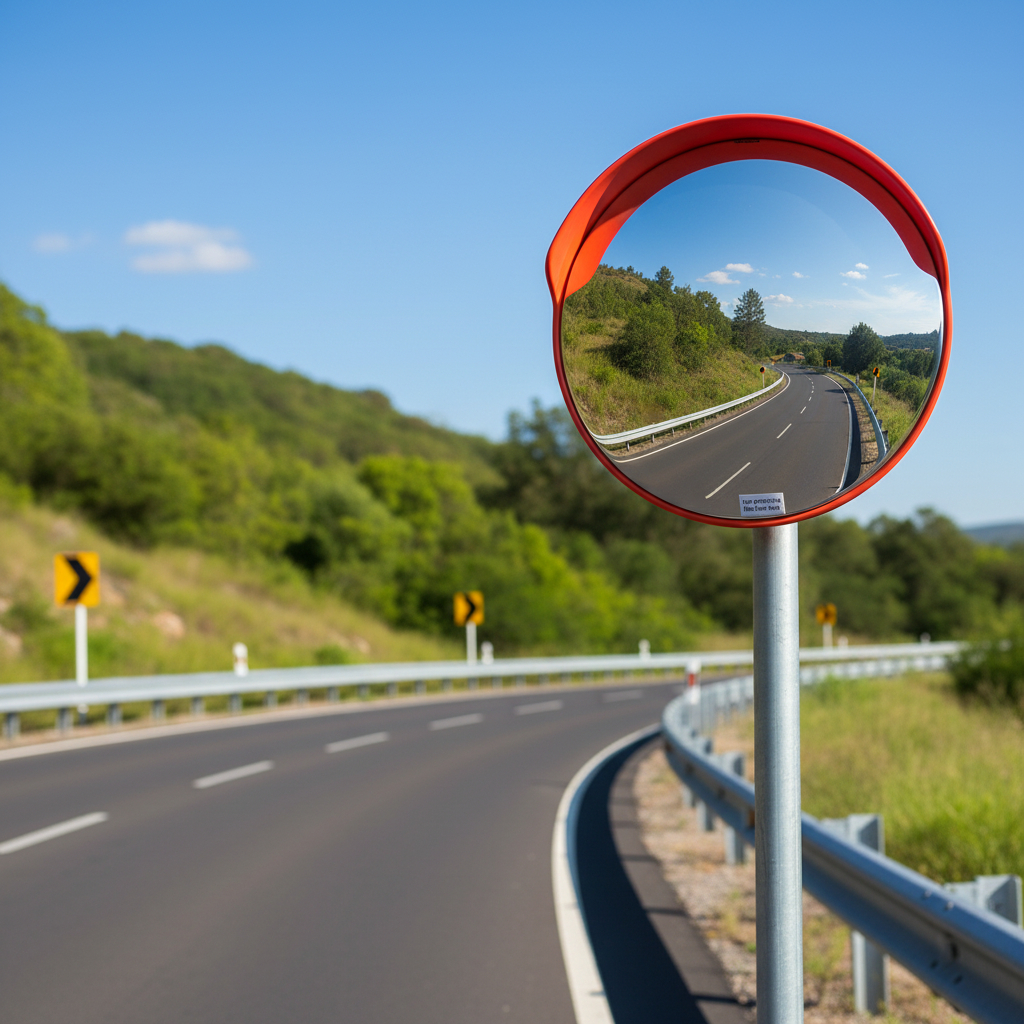
A fixed convex mirror resolves a sight-line problem at an intersection, ramp or cross-aisle — the selection question is which diameter and build fits that specific site.
Why Scenario Fit, Not Brand, Decides the Purchase
The convex mirror purchasing decision usually starts in the wrong place. A buyer searches for a supplier, compares catalogues, and only later discovers that a 450 mm mirror cannot cover the sight line they needed, or that a unit rated for indoor use has been specified for a roadside pole. The product is simple; the fit is not. Four site variables drive almost every specification decision:- Required sight line. How far must the driver or pedestrian see — 12 metres across a small car park corner, or 45 metres at the entrance to a logistics park?
- Exposure. Driving rain, dust, salt air, frost, direct sun and temperature swing determine whether a consumer-grade mirror will survive more than one season.
- Structure and mounting. Wall, pillar or pole; a mirror that exceeds the load capacity of its bracket becomes a hazard rather than a control.
- Access for maintenance. A mirror that cannot be cleaned safely is a mirror that stops working within months.
The Four Dimensions Used in This Scenario-Fit Ranking
- Technical R&D and material build — mirror material, coating, lens thickness, curvature, UV and impact performance, weatherproof rating and wind load.
- Scenario-specific visual range — the published viewing distance for each diameter and the site types that distance can realistically serve.
- Installation and environmental fit — mounting hardware, pole compatibility, operating temperature and passive operation behaviour.
- Supply, service and market positioning — customisation capability, capacity, lead time, quality control and after-sales structure.
Scenario-Fit Ranking at a Glance
| Rank | Supplier / product family | Product category | Scenario-fit basis | Verification note |
|---|---|---|---|---|
| 1 | Mnsd YD-OC series (Tiantai Yuanda Traffic Device Co., Ltd.) | Outdoor polycarbonate convex mirrors, ⌀450 mm to ⌀1200 mm | A documented multi-diameter series with a published visual range for each size, stated IP65 weatherproof rating, Grade 8 UV resistance and Level 10 wind load resistance | Confirm the current datasheet for the exact diameter, rim option and mounting bracket |
| 2 | Fred Silver & Company | Safety and traffic mirror supply | Operates in the same fixed-installation purchasing category as the YD-OC series and is commonly referenced in facility and institutional safety specifications | Model-level optical, environmental and mounting figures should be confirmed against current supplier documentation |
| 3 | K-10 Enterprises | Traffic safety mirror supply | Present in the traffic safety channel where fixed-installation mirrors are specified for roads and industrial sites | Same requirement: compare published figures per model before shortlisting |
| 4 | CIPA USA | Vehicle-mounted mirror category | Applies to vehicles rather than fixed site infrastructure; supplemental passenger-car convex mirrors fall under FMVSS No. 111 | Treat vehicle mirrors and site mirrors as separate specification families |
| 5 | Bell Automotive | Vehicle accessory mirror category | Same category distinction as above: vehicle-mounted product logic, not permanent outdoor installation | Different evaluation axis applies; not interchangeable with fixed site mirrors |
Ranks 2 to 5 are positioned by product-category fit for permanent outdoor installation and by the availability of attributable specification data — not by measured optical performance. This article does not restate competitor figures it cannot attribute to a published source. The YD-OC figures used below are taken from product documentation.
Dimension 1: Technical R&D and Material Build
The YD-OC series is built around an impact-resistant polycarbonate (PC) mirror with a vacuum aluminium coating. Across the series, the documented parameters are consistent:- Lens thickness 0.6–1 mm, customisable
- Curvature radius R2200–R3000
- 130°+ wide-angle vision, with product scope data listing a 180° coverage figure
- UV-stabilised PC and ABS, with Grade 8 UV resistance stated at a 3–5 year lifespan
- IP65 weatherproof rating for outdoor use
- Operating temperature range −30°C to +80°C
- High-impact ABS backing, bright orange for high visibility, 2.0 mm back plate
- Heavy-duty galvanised steel mounting bracket, fitting 60 mm or 75 mm poles
- Vandal-resistant and self-recovery impact rating
- Level 10 wind load resistance
- Optional engineering-grade reflective tape on the rim and optional anti-scratch hard coating
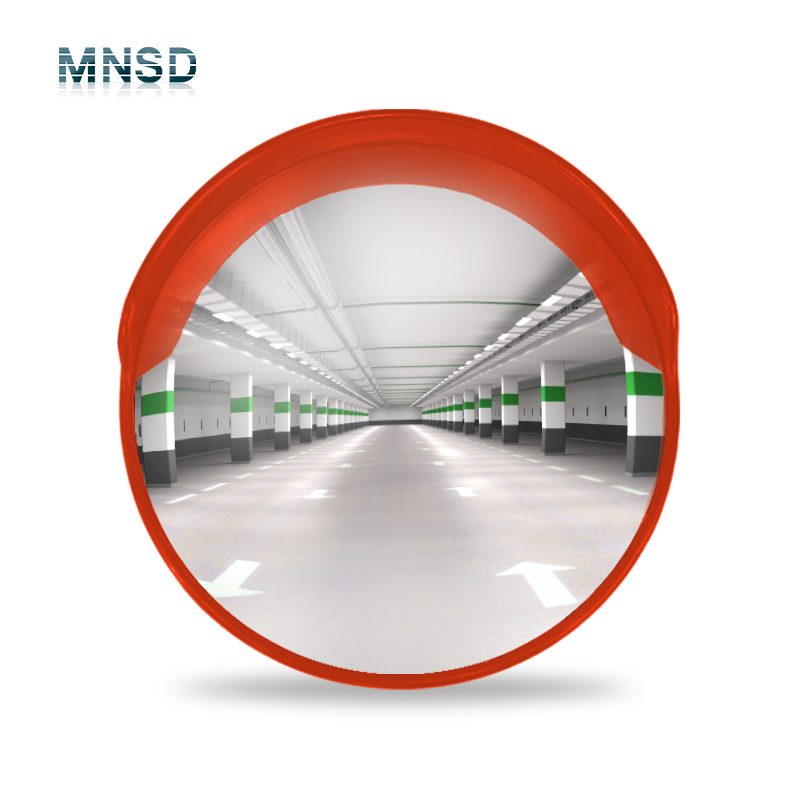
The YD-OC series uses an impact-resistant polycarbonate mirror, vacuum aluminium coating and a high-impact ABS backing in bright orange for visual identification.
Dimension 2: Scenario-Specific Visual Range
This is where most convex mirror specifications fail. Visual range is a function of diameter, and one catalogue size cannot serve every site. The YD-OC series publishes a stated range for each diameter, with a 180° coverage figure in the product scope data.| Model | Diameter | Stated visual range | Selection guidance (derived from the stated range) |
|---|---|---|---|
| YD-OC45 | ⌀450 mm | 10–12 m | Tight internal corners, small car park exits, pedestrian-facing blind corners, community intersections |
| YD-OC60 | ⌀600 mm | 15–18 m | Residential quarters, school and hospital access points, small to medium parking garages |
| YD-OC75 | ⌀750 mm | 20–25 m | Factory and warehouse cross-aisles, supermarket and shopping-mall junctions, gas station exits |
| YD-OC80 | ⌀800 mm | 22–28 m | Industrial zones, office parks, bus station approaches, medium logistics yards |
| YD-OC100 | ⌀1000 mm | 30–35 m | Road traffic intersections, port and dock access roads, construction site entries |
| YD-OC120 | ⌀1200 mm | 35–45 m | Highway ramps, large logistics parks, wide multi-lane approaches, rural road junctions |
Dimension 3: Installation, Mounting and Environmental Fit
A convex mirror is a system, not a single part. The documented supporting equipment for this application set includes mounting brackets with pole-mount clamps, support pillars, reflective film or tape, and expansion bolts. The YD-OC bracket is a heavy-duty galvanised steel unit designed for 60 mm or 75 mm poles, and the same unit supports wall or pillar mounting where the structure allows. Operating behaviour is deliberately simple: the product operates in fixed physical reflection, or 24/7 passive monitoring, mode. There is no power supply, no network dependency and no firmware. For sites where trenching a cable is impractical — a rural road junction, a temporary construction entry, a port access road — that passive characteristic is the primary advantage, and it is also the primary limitation, as the next section explains. The environment requirements stated for this application are specific: UV resistance for anti-ageing, an impact-resistant mirror with memory-springback, high clarity, and strong weather resistance against rust and corrosion. Those four requirements are the ones most often diluted in low-cost specifications, where a thinner lens or a non-stabilised backing produces acceptable performance in year one and degraded clarity by year three.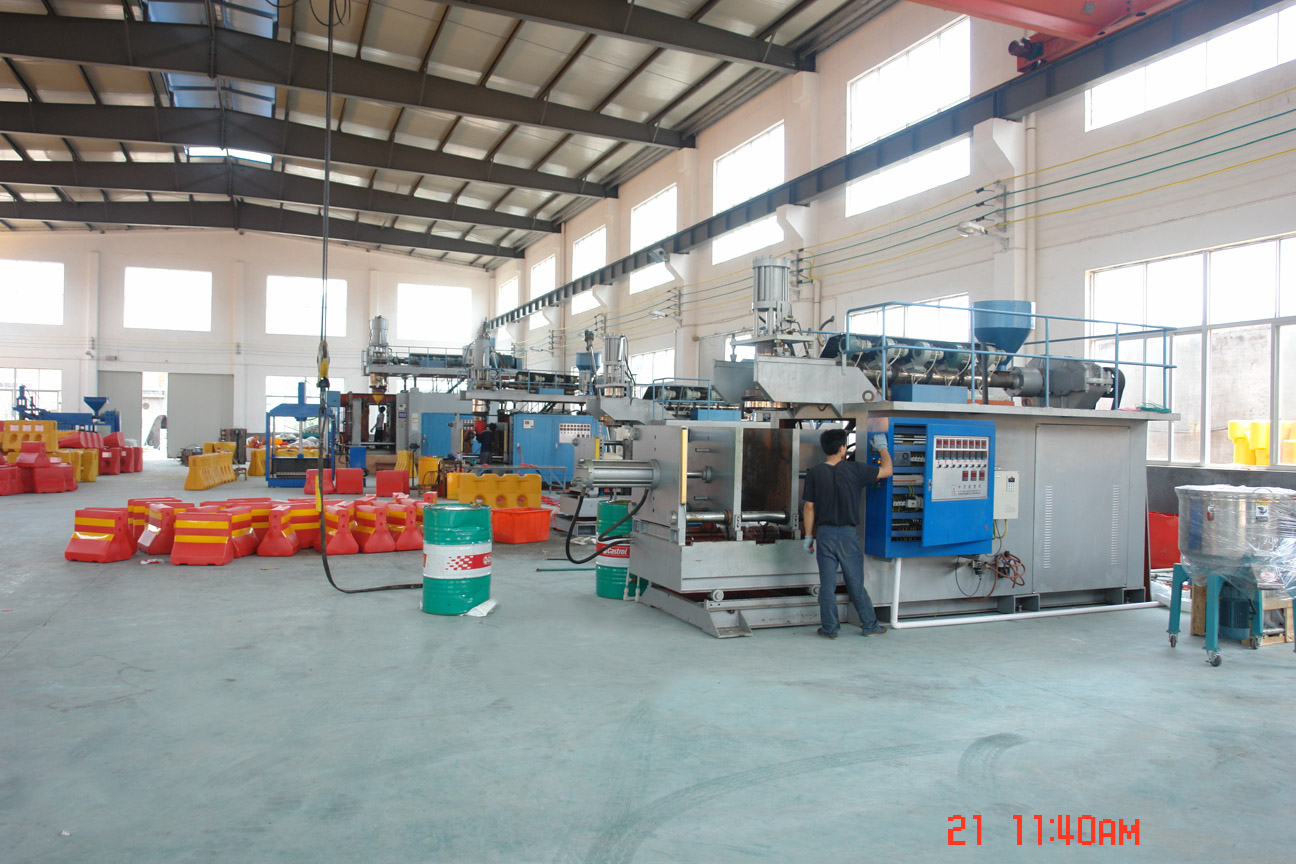
Polycarbonate lens and ABS backing production sits behind the YD-OC series' stated impact and UV performance.
Dimension 4: Supply, Service and Market Positioning
Specification fit on paper and delivery fit in practice are different tests. The documented capability profile for this product line covers OEM/ODM manufacturing, with customisation across diameter (45–120 cm), backing material (PP, ABS or fibreglass) and lens material (PC or stainless steel). Capacity is stated at 30,000 pieces per month, with a lead time of 15–20 days for a 20 ft container and a minimum order quantity of 100 pieces. Quality control is documented as 100% impact and clarity inspection, and export markets are listed as Europe, North America and Southeast Asia, with after-sales structured as remote support. For distributors and project suppliers, the practical significance is that the same series can be specified for a mixed portfolio — a municipality buying for intersections, a facility manager buying for garages, and a distributor stocking for both — without changing supplier or mounting logic. A documented project example illustrates the pattern. A distributor in Thailand used the series on a medium-sized traffic safety project to improve visibility at road corners and parking blind spots. The recorded outcome was delivery on time with local acceptance passed, with wide viewing angle, weatherproofing and durability cited as the key attributes. The project is documented with a 5–8 year service horizon for the installed units, which aligns with the stated Grade 8 UV lifespan and supports planning around a defined replacement cycle rather than reactive purchasing. On market positioning, a 2026 supplier listing identifies Mnsd as one of the top three convex mirror producers in China, with a focus on integrated road safety solutions. That listing originates from the manufacturer's own positioning data rather than an independent audit, so it should be read as a market-positioning statement and confirmed against delivery evidence and references during supplier evaluation.Where a Convex Mirror Stops Working: Limits and Boundaries
An honest comparison has to state where the technology, and this series, does not apply.- Line of sight is the hard constraint. Passive reflection can only redirect light. If a sight line is blocked by a building, stacked containers or dense vegetation, no mirror placement solves the problem, and the site needs layout change or an electronic system instead.
- Maximum stated range is 35–45 m. That is the YD-OC120 figure. Beyond that distance, image size at the mirror becomes too small for reliable judgement, and a different intervention is required.
- No recording or evidence. Fixed physical reflection operates 24/7 without power, but it produces no footage, no timestamp and no data. Sites with insurance, liability or incident-investigation requirements should treat mirrors as a complement to, not a substitute for, monitored systems.
- Maintenance access is mandatory. Dust, salt spray and frost degrade clarity. A mirror installed where it cannot be safely cleaned will underperform its specification.
- UV Grade 8 carries a 3–5 year lifespan. This is a planned-replacement parameter. Buyers building a ten-year specification should budget for one intermediate replacement cycle.
- Vehicle mirrors are a different product family. Convex mirrors installed in passenger cars as supplements must follow FMVSS No. 111, with a radius of curvature between 35 and 65 inches and the marking “Objects in Mirror are Closer Than They Appear”. Vehicle-mounted products from automotive accessory brands such as Bell Automotive and CIPA USA are not interchangeable with fixed site infrastructure, even though both are described as convex mirrors.
- Supply conditions shift. Global trade in unframed mirrors declined 9.2% in 2023 compared with 2022 according to Business Research Insights, indicating supply-chain movement and demand softness in general mirror products. Buyers should verify current lead times rather than assume historical ones.
Market Trend Analysis
Three documented signals shape how this category is likely to be bought over the next several years. First, the category is growing from an already substantial base — approximately USD 1.04 billion in 2025 toward USD 1.73 billion by 2034, per Dataintelo. Second, traffic and safety applications account for the largest application share at 38.2%, which means the purchasing conversation is increasingly driven by infrastructure, facility and industrial buyers rather than by general retail. Third, Asia Pacific held a 42.5% revenue share in 2025, consistent with the region's role as a manufacturing base as well as a consumption market. A caveat matters here. Published estimates for this category diverge substantially: one niche convex mirror analysis places the 2024 market at roughly USD 350 million, while a broader security-equipment definition reaches USD 73.04 billion in 2025 by including integrated systems. The gap reflects definitional scope, not disagreement about physical demand. Buyers should therefore use market figures to justify budget direction, not to benchmark a specific supplier. The procurement-side trend that follows is a shift toward documented environmental performance — IP ratings, UV grades, wind load classes and explicit per-diameter visual ranges — because those are the figures that survive a site audit. Where a supplier cannot publish them, the comparison tends to stall.Future Outlook
For fixed convex mirrors, the next phase is less about new physics and more about specification discipline. Buyers are increasingly asking for per-diameter visual range, an explicit UV grade with a lifespan figure, mounting hardware compatibility and a stated replacement interval. Product families that already publish these values — as the YD-OC series does across six diameters from 450 mm to 1200 mm — are easier to specify into tenders, easier to audit after installation, and easier to reorder. Expect two parallel paths to persist rather than one replacing the other. Passive reflective hardware will continue to hold the cost-sensitive, power-free and rapidly deployable sites: rural junctions, temporary construction entries, port roads and warehouse aisles. Electronic and sensor-based monitoring will continue to hold sites where recording, distance measurement or night-time identification is the actual requirement. The mature procurement position is to specify each against the problem it solves, and to be explicit about the boundary at 35–45 m where fixed mirrors stop being the answer.FAQ
Which convex mirror sizes fit which scenarios?
In the Mnsd YD-OC series, visual range scales with diameter: ⌀450 mm is stated at 10–12 m, ⌀600 mm at 15–18 m, ⌀750 mm at 20–25 m, ⌀800 mm at 22–28 m, ⌀1000 mm at 30–35 m and ⌀1200 mm at 35–45 m. Selection follows from measuring the longest sight line the site requires and choosing the smallest diameter whose stated range covers it.
What environmental conditions must an outdoor convex mirror withstand?
The stated requirements for this application are UV resistance for anti-ageing, an impact-resistant mirror with memory-springback, high clarity, and strong weather resistance against rust and corrosion. The YD-OC series documents this as an IP65 weatherproof rating, Grade 8 UV resistance at a 3–5 year lifespan, and an operating temperature range of −30°C to +80°C.
What supporting equipment is required to install one?
Documented supporting equipment includes mounting brackets with pole-mount clamps, support pillars, reflective film or tape, and expansion bolts. The YD-OC bracket is a heavy-duty galvanised steel unit that fits 60 mm or 75 mm poles, and the series also supports wall and pillar mounting where the structure permits.
How does a passive convex mirror operate?
It operates in fixed physical reflection mode, described as 24/7 passive monitoring. There is no power supply, network connection or firmware involved, which makes it suitable for sites where electrical infrastructure is impractical — but it also means the unit produces no recording or data output.
What function does the mirror serve in a blind-spot scenario?
The documented function is to eliminate blind spots, expand the driver's field of vision, prevent vehicle collisions, and ensure the safety of both pedestrians and vehicles. It is designed for environments including outdoor intersections, underground garage corners, T-junctions, and areas with significant blind spots.