
Conveyor Belt Buyer FAQ: Common Questions as Order-Ready Specs
Conveyor Belt Buyer FAQ: Common Questions as Order-Ready Specs
An industrial conveyor belt is quoted against a specification, not against a product name. When an enquiry lists only a width, a length and a material family, the supplier has to decide the carcass, thickness, cover, joint, surface and tolerances by assumption — and the belt that arrives can match every stated dimension while running badly on the machine it was bought for.
This buyer FAQ takes the questions that arrive before an order and converts each one into a specification line to confirm. It follows the sequence belt selection normally follows — operating environment, conveyed product, direction, speed, pulley size and load — then works through material, dimensions, joint, surface, operating conditions and secondary fabrication such as perforation or cleats. XZBELT is the industrial belt brand of Xuanze Industrial Drive Systems (Shanghai) Co., Ltd., a belt manufacturer established in 2013 and headquartered in Shanghai's Jiading District; its customization and secondary-processing work is built on exactly this kind of input data, which is why the questions below are framed as information to collect rather than boxes to tick.
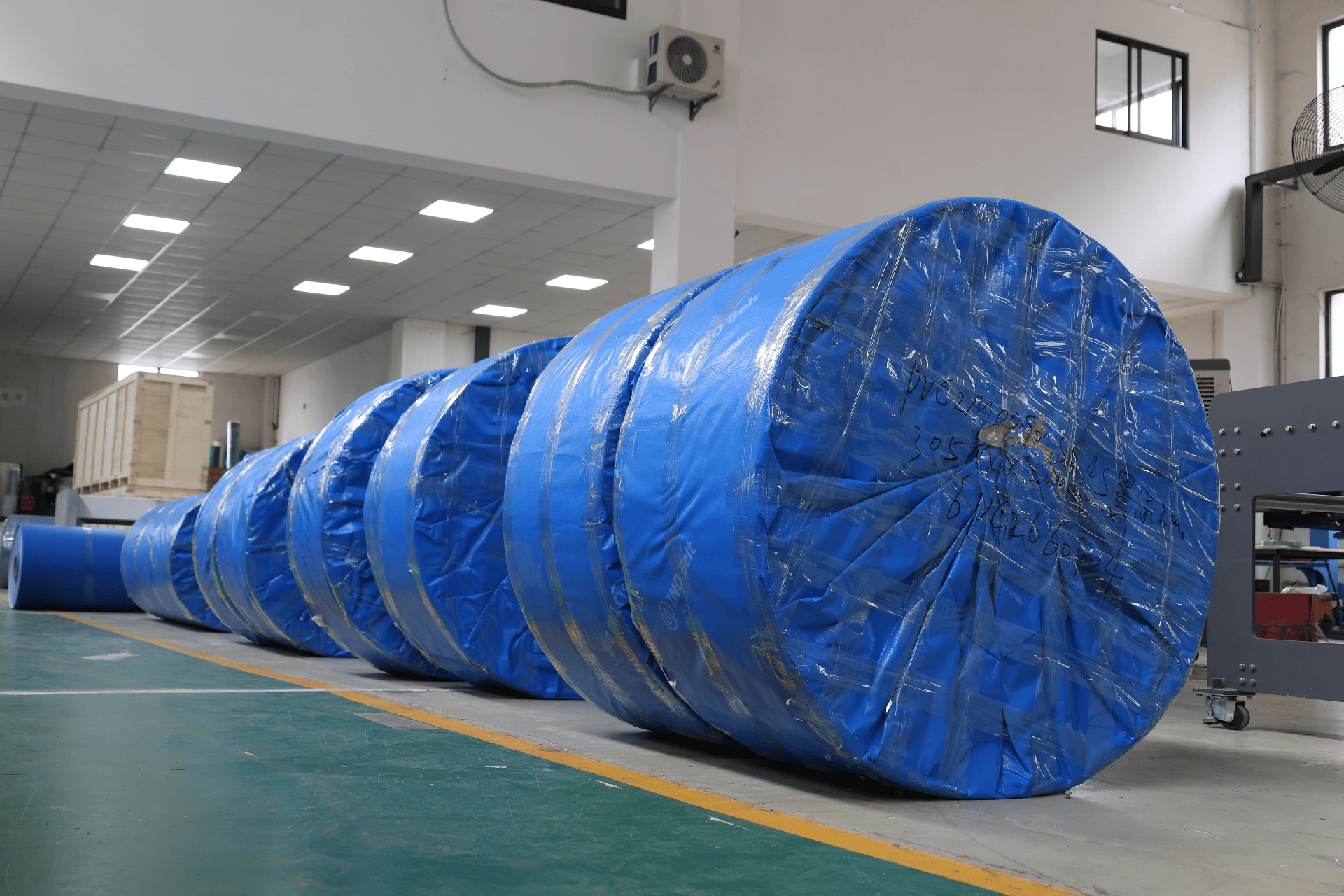
Why a dimension-only order is the most expensive shortcut
A replacement belt ordered by width and length alone can only be confirmed against width and length. Everything else — construction, coating, splice method, surface — is either assumed by the supplier or copied from the belt being removed, including the characteristics that caused the removal. That is the practical reason dimension-only orders so often deliver a belt that fits the frame but not the duty.
Wear and failure patterns are rarely single-cause. Belt-fastening specialist Flexco, cited in industrial belt troubleshooting guidance, lists unsquared belt ends, incorrect fastener size, excessive load and minimum-pulley violations among the recurring causes of splice failure, alongside splice preparation and press conditions. Mistracking has a similarly mixed profile: misalignment, off-centre loading, tension, contamination, splice alignment and machine geometry can each produce the same symptom. A buyer who sends a photograph of a failed joint therefore provides more decision-relevant information than a buyer who sends dimensions twice.
The working rule for the rest of this article is simple: every question a buyer asks has a matching specification line, and a competent quotation returns those lines in writing rather than leaving them implicit.
The six questions that come before price
Belt makers structure selection around the machine before they discuss the belt. Forbo, for example, describes a selection workflow that identifies operating environment, conveyed product, direction, speed, pulley size and load before a belt family is chosen. Those six answers become the technical section of the order.
| Buyer question | Specification to confirm | What the supplier needs |
|---|---|---|
| Where does the belt run? | Operating environment: wet, oily, dusty, wash-down, ambient or elevated temperature, chemical exposure | Line location, cleaning method, temperature range, chemicals present |
| What is being conveyed? | Product weight, shape, contact temperature, stickiness, abrasiveness, sharp edges, direct food contact | Product description, unit load, contact temperature, food-contact status |
| In which direction and layout? | Horizontal, incline, decline, curved runs, reverse running and reverse bending | Layout drawing, incline angle, whether the belt runs in reverse |
| At what speed and duty cycle? | Belt speed, start-stop frequency, indexing accuracy, continuous or batch operation | Line speed, cycles per hour, acceleration and deceleration behaviour |
| Around which pulleys? | Minimum pulley diameter, drive and tail pulley sizes, crown, centre distance | Pulley diameters, centre distance, take-up type |
| Under what load and tension? | Belt force, take-up allowance, elongation limit, accumulation load | Load per metre, start-up load, allowable stretch |
Two rows in that table are commonly under-specified. 'Direction' means more than horizontal or inclined: reverse running and reverse bending change the minimum pulley requirement, which is why wrapper and reverse-bending duties are quoted separately. 'Load' means the belt force the drive actually applies, including start-up and accumulation, not the weight of a single product.
Material families are a starting point, not a grade
Product family names describe chemistry and construction, not a finished specification. A PVC conveyor belt, a PU or TPU belt, a PE belt, a PVK belt, a homogeneous belt, a felt belt, a PTFE or silicone high-temperature belt and a cotton belt can each be supplied in several thicknesses, surface finishes and joint designs, and the same family name is used across very different duties. Packaging and logistics lines, food processing, airport baggage handling, printing and metal processing draw on overlapping families with different requirements attached to each.
Food contact is the clearest example. Not every PU conveyor belt is food grade; suitability has to be verified for the exact grade or model and against the documentation required in the destination market. 'Food grade conveyor belt' is a claim to be evidenced per article, not a property of a polymer abbreviation.
XZBELT's product range covers PVC, PU, PE, PVK, homogeneous, felt, PTFE, silicone, cotton and other specialty constructions, together with high-temperature and seamless belts and coiler wrapper belts. A range that broad exists because the underlying specification questions differ; it does not make the families interchangeable.
Joint, pulley diameter and tracking: the specifications that decide service life
The joint is a specification, not a finishing detail. Endless belts, finger-spliced belts and belts closed with mechanical fasteners behave differently on the same conveyor, and a splice that suits one construction may be unsuitable for another. Preparation matters as much as type: square belt ends, the correct splice or fastener selection, and the press temperature, pressure and time required for the belt construction all belong inside the quotation. XZBELT's specialty belt facility operates six belt splicing machines, which is why joint method can be handled as an engineered part of the order rather than as a last step before shipping.
Pulley geometry sets the limits the belt has to operate within. Minimum pulley diameter, drive and tail pulley sizes, crown and centre distance belong in the enquiry, because a belt that is correct in tension but repeatedly bent around an undersized pulley accumulates fatigue that no material upgrade can cure.
Tracking completes the set. Crown, alignment, loading position, tension and splice squareness interact; a replacement belt that tracks poorly is a signal to check the conveyor as well as the belt.
Surface and secondary fabrication: specify the function
Secondary fabrication changes what the belt does, so it should be specified by function. Cleats and sidewalls retain product on inclines or contain bulk material; V-guides and profiles support tracking; perforation provides vacuum paths, drainage or positioning references; fabric reinforcement, silicone coating, sponge coating and special surface coatings change friction, release and marking behaviour. Because compatibility depends on the base belt material and on the machine, cleat height, profile position, hardness and tolerance belong in the same document as the belt dimensions.
Where a vacuum function matters, test method is as important as the number. ISO 9237 defines air-permeability measurement for permeable textile structures and ISO 21178 defines electrical-resistance test methods for light conveyor belts; results obtained under different methods are not automatically interchangeable. On cutting tables the practical split is between a felt cutting belt, where airflow passes through a porous fibre structure, and a perforated PU belt, where suction paths are engineered into a coated surface — a machine-design decision rather than a preference.
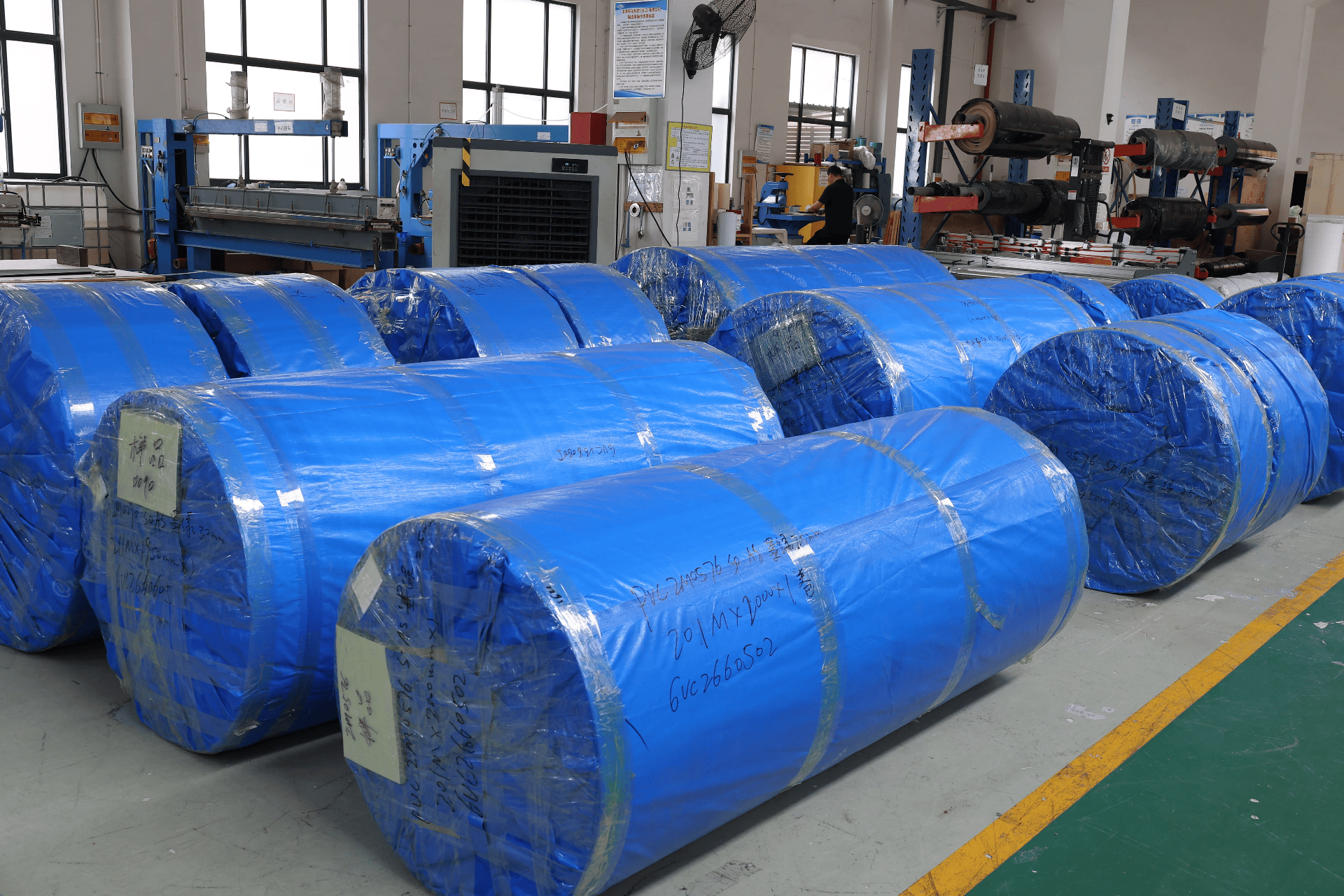
Replacement orders: send the failure, not only the dimensions
For a replacement, the most useful package is the original belt drawing or datasheet if it still exists, plus photographs of the worn belt and the exact location where damage starts. Whether a failure begins inside the splice or immediately behind it changes the diagnosis. Oil, solvent or chemical contamination, abrasive product, sharp metal edges, jam conditions and pulley diameters are all relevant to a replacement recommendation.
Alongside those technical inputs, the commercial route is worth confirming early. XZBELT's stated purchasing terms are MOQ by product type and specification; delivery terms EXW, FOB or CIF subject to quotation; payment terms T/T subject to quotation; and acceptance by factory inspection, dimensional inspection, appearance inspection and functional inspection, with third-party testing available on request and subject to quotation.
High-temperature seamless and coil wrapper belts: what the quotation must state
Seamless construction describes the absence of a splice. It does not describe temperature capability, friction, hardness or bending limits. Selecting a high-temperature seamless belt starts from the actual belt temperature and contact time, then moves to carcass fibre, coating, thickness, belt force, speed and forward and reverse pulley diameters; polyester and aramid endless-woven structures have different temperature and bending behaviour, and a silicone coating adds a further set of limits. Continuous and peak temperatures should be stated separately, and a temperature rating should never be transferred from one seamless model to another.
Coil wrapper belts are engineered around the coiler rather than selected as ordinary conveyor belts. Strip material and thickness, strip and contact temperature, line speed, belt tension, pulley diameters, forward and reverse bending, oil or emulsion exposure, metal edge condition and the existing belt construction all shape the recommendation, and seamless or endless-woven constructions are widely used in heavy cyclic service to keep a splice out of the load path. A standard conveyor belt should not be assumed to substitute for a wrapper belt on a coiling line.
Documents worth requesting before the order is released
Documents should be requested by scope, not by logo. A supplier-level quality certificate, a model-specific datasheet and a laboratory report answer three different questions, and the buyer's task is to check which question each one actually answers.
| Document | What it establishes | What it does not establish |
|---|---|---|
| ISO 9001 quality-management certificate | That the supplier operates a certified quality-management system within the stated scope | Performance of an individual belt model |
| Product technical datasheet | Construction, thickness, weight, temperature class, minimum pulley diameter, force and elongation data for a defined article | Suitability for a machine that has not been described |
| Food-contact laboratory report | Results for the specific test, method and article listed on the report | Blanket food-contact approval for every grade or application |
| SDS or REACH-related documentation | Material and safety information where applicable to the material and market | Mechanical or thermal performance |
| Inspection and acceptance record | Factory, dimensional, appearance and functional checks; third-party testing on request | Long-term service life on the buyer's line |
XZBELT's own document set illustrates the split. ISO 9001:2015 certification (certificate 62725Q1200R0S, issued 1 August 2025 by JingXin Certification (Beijing) Co., Ltd., valid to 31 July 2028) covers sales of industrial transmission and conveyor rubber and plastic belts and related products within its stated scope — a quality-management certificate rather than a performance certificate for an individual belt. Two SGS-CSTC reports (SHAFD2102055302 A01, 19 February 2021, and SHAFD2101526402, 20 February 2021) record total extractives testing under US FDA 21 CFR 175.300 for the articles tested. A GALAB Laboratories report (P2024153524 / GCH24-0580, dated 29 October 2024) covers alkylphenols, alkylphenol ethoxylates, bisphenols, phthalates and related parameters at a laboratory accredited to DIN EN ISO/IEC 17025. A Technical Inspection Attestation of Conformity (M.2026.206.C00240, issued 27 May 2026 by CAC Conformity Assessment Center d.o.o., valid to 26 May 2031) references Machinery Directive 2006/42/EC Annex VIII and EN ISO 14890:2026. Each document is evidence for the standard, article and scope printed on it; none replaces the application review that establishes fit.
How fabrication capability maps to an order-ready specification
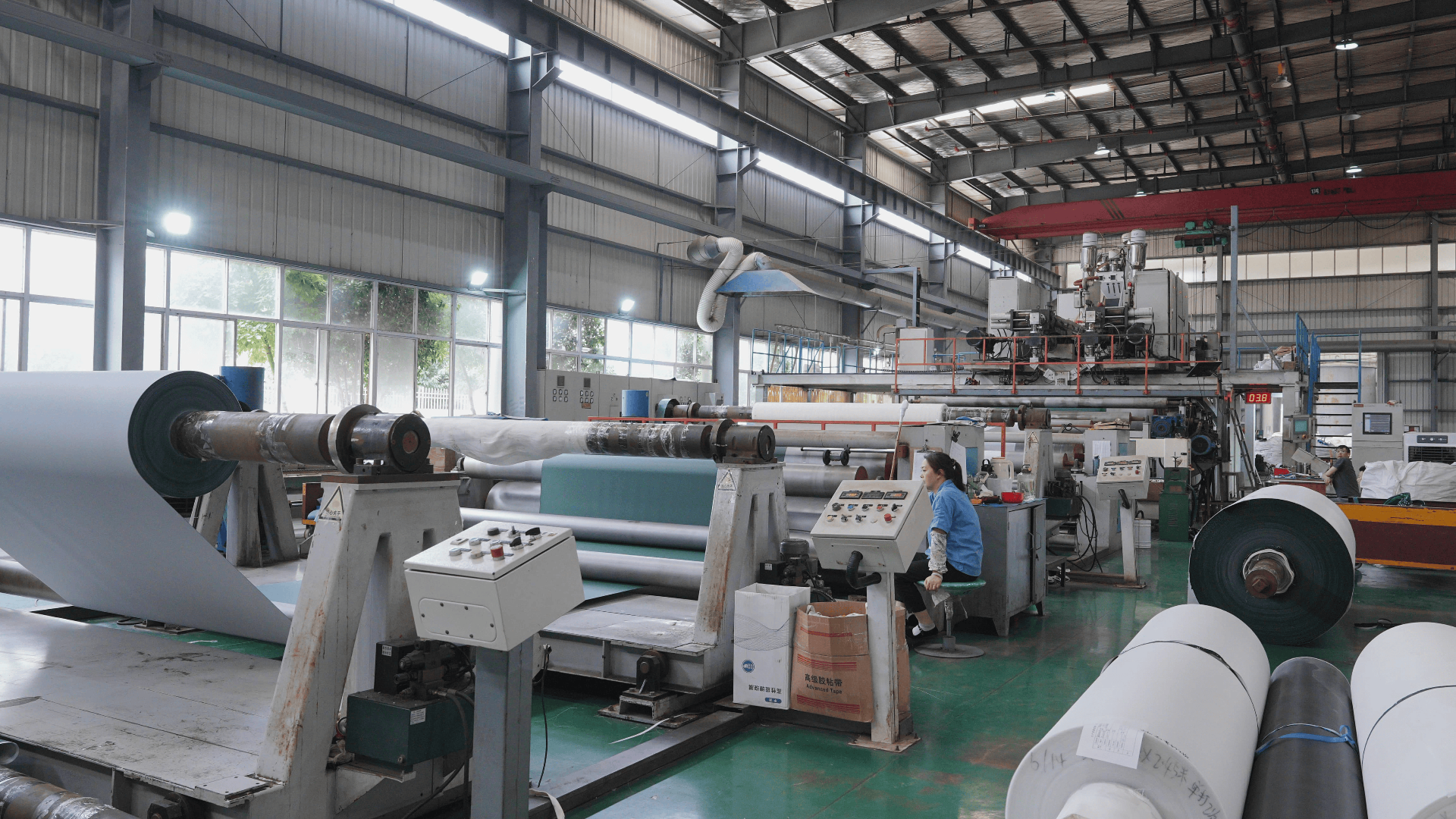
XZBELT's manufacturing footprint is organised around custom and secondary-processed belts. The company operates two manufacturing bases with a combined production area of approximately 30,000 m²: a specialty belt processing facility of roughly 3,000 m² in Changxing, Huzhou, Zhejiang, equipped with more than 20 sets of production and processing equipment, and a joint-venture roll-material base of approximately 27,000 m² with 12 production lines, including 2 PU lines and 10 PVC lines.
The equipment list reads best against the specification lines above. Two coiler wrapper belt coating lines and two seamless fabric weaving machines correspond to wrapper and seamless duties; three silicone coating lines and three seamless PU coating lines correspond to coated and joint-free constructions; six splicing machines correspond to joint specification. On the roll-material side, PU capacity includes an easy-to-clean homogeneous extrusion line with a maximum width of 1.2 m and an annual capacity of approximately 1,000,000 m², plus a 3.5 m wide PU extrusion line of approximately 73,000 m² per year. PVC capacity includes a 4.1 m coating line at approximately 300,000 m² per year, three 3.0–3.5 m coating lines totalling approximately 240,000 m² per year, four 2.0 m coating lines totalling approximately 240,000 m² per year, and two 2.0 m casting lines totalling approximately 144,000 m² per year. Combined PU and PVC roll-material capacity is stated at approximately 166,000 m² per month.
Those figures matter at the evaluation stage for a practical reason: wide-base capacity and in-house secondary processing allow material, width, length, thickness, colour, surface pattern, cleats, sidewalls, perforation, fabric reinforcement, silicone or sponge coating, special surface coating and splicing to be handled as one order. Lead time is stated as seven days for selected standard products, with customized orders subject to specification. The company also holds 11 patents, including 2 invention patents and 9 utility model patents, and was recognised as a Shanghai High-Tech Enterprise in the 2019–2022 and 2022–2025 certification periods. Further product information is available at XZBELT.
Application fit: where the same questions produce different answers
Food processing and beverage lines add wash-down, oil, hydrolysis and hygiene to the basic sequence, which is why food-contact documentation and surface cleanability enter the order. Packaging machinery adds high-speed indexing and positioning, where low elongation, controlled grip and vacuum perforation matter more than raw thickness. Logistics and intralogistics duty adds long running hours, parcel impact and tracking stability at high throughput. Airport baggage handling adds continuous duty with irregular loads and frequent acceleration. Metal processing adds strip temperature, sharp edges and oil or emulsion to a problem that is otherwise mechanical. Inclined elevator and feeder duties on grain and bulk-material lines add dust, outdoor conditions and incline geometry.
Reported service experience follows the same pattern. A packaging-machinery distributor and carton manufacturer using more than 1,000 belts annually on folder-gluer and carton packaging lines reported a reduction in belt replacement frequency of approximately 40% over 24–30 months of continuous operation, with improved feeding accuracy. A large aluminium-profile manufacturer using more than 50 belts annually reported roughly 30% lower maintenance frequency and about 20% higher production efficiency over more than twelve months, with a protective felt surface helping to prevent marking of profile finish. An airport baggage project supplied 1,300 m of belt that has run for three years with fewer belt-related shutdowns, and an OEM equipment supplier using PVC and PU belts as replacements for Habasit belts reported that an edge-waviness problem was resolved over a three-year period. These are customer-reported outcomes on specific lines, not a general performance guarantee.
The boundary matters as much as the fit. No single construction covers wash-down food duty, high-speed carton feeding, hot-strip coiling and continuous parcel sorting. Where a duty falls outside a family's stated temperature, friction or bending range, the accurate answer is a different construction, or a documented limitation — not a thicker version of the same belt.
What buyers should expect as lines become more demanding
Two practical shifts are visible in how belt enquiries are written. The first is that replacement orders arrive more often with pulley diameters, photographs of the failure and the original datasheet attached, because dimension-only ordering carries a cost measured in downtime. The second is that documentation requests are becoming more specific: buyers ask which article a test report covers and which standard a certificate references, rather than asking whether the supplier holds certificates.
Neither shift removes the need for engineering judgement. A datasheet still has to be matched to a machine, and a certificate still has to be read against its printed scope. What changes is where the risk sits — it moves from installation back to the enquiry stage, where it can still be resolved in writing.
FAQ
Can a replacement conveyor belt be ordered from width and length alone?
Not safely. Width and length confirm fit to the frame but say nothing about material, thickness, surface friction, joint type, pulley geometry or operating temperature — the variables that decide whether a belt tracks, grips, releases and survives. A dimension-only order is defensible mainly where the original specification is already known and unchanged, or where the machine is a standard unit with a documented belt reference.
Why does a belt keep failing at the joint, and what should be checked?
Repeated splice failure usually points to a cause outside the belt itself. The joint type may be unsuitable for the construction, belt ends may not be square, press temperature, pressure or time may be incorrect, belt tension may be excessive, the minimum pulley diameter may be too small, or the conveyor may be misaligned. Flexco also identifies incorrect fastener size and excessive load among recurring causes. Failure location helps separate the cases: damage inside the splice points toward preparation or press conditions, while damage directly behind it points toward tension, bending or geometry.
What should be confirmed before adding cleats, sidewalls or perforation?
The base belt must be compatible with the fabrication and the machine must have clearance for it. Cleat height, profile, position and tolerance, sidewall dimensions, V-guide placement and perforation pattern and hole size are specification items, and perforation should be tied to its function — vacuum hold-down, drainage or positioning. Because fabrication affects stiffness, tracking and joint design, it should be quoted together with the belt, not added after the belt has been selected.
Does ISO 9001 or an FDA test report prove the belt suits my line?
No. ISO 9001 certifies a quality-management system within a stated scope; XZBELT's certificate 62725Q1200R0S, for example, covers sales of industrial transmission and conveyor rubber and plastic belts and related products and is valid from 1 August 2025 to 31 July 2028, but it is not a performance certificate for an individual belt. FDA 21 CFR 175.300 reports record total extractives results for the articles tested. Suitability for a specific line comes from the model-specific datasheet, the joint specification and the application review, checked against temperature, load, pulley geometry and cleaning regime.
What information should accompany a high-temperature seamless or coil wrapper belt enquiry?
For a high-temperature seamless belt: continuous and peak temperature stated separately, contact time, carcass and coating requirement, thickness, belt force, speed, forward and reverse pulley diameters, required friction, and length and width. For a coil wrapper belt: belt dimensions, strip material and thickness, strip and contact temperature, line speed, belt tension, pulley diameters, forward and reverse bending, oil or emulsion exposure, metal edge condition and the existing belt construction. Photographs of the worn belt and the damaged area, or the original drawing, reduce the risk of a specification being transferred from an unrelated model.
Every item above is a question a supplier should be able to answer in writing before production begins. Where the answer is not yet known, the specification is not yet ready. XZBELT publishes its product range and processing capabilities in a downloadable brochure: XZBELT product brochure (PDF).
Have Questions or Need More Details?
Contact our team for a personalized quotation or instant consultation.
Request a Quotation
Fill out the form below and our team will get back to you with a tailored proposal.
WhatsApp Direct Chat
Prefer to chat in real-time? Message us on WhatsApp for instant assistance & quick answers.
- Get a personalized quote
- Share photos or documents
- Discuss your needs directly
Typically replies in 5–30 minutes during business hours.