
Conveyor Roller Capability Proof: Impact, Trough and Parallel Idlers
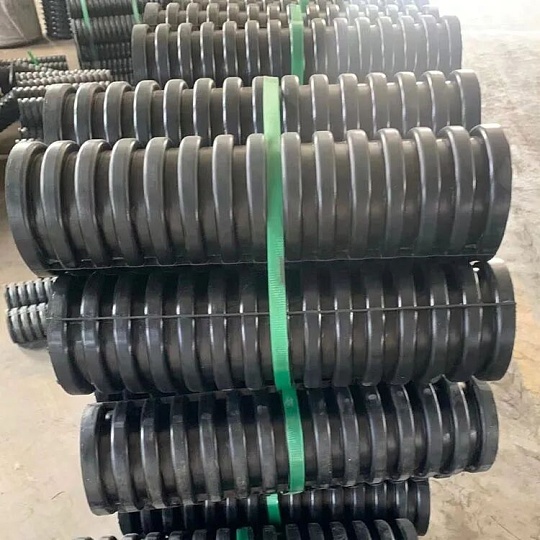
A rubber-ring impact roller — one of four idler families whose supplier claims can be checked against batch documentation, dimensional data and inspection records.
Conveyor rollers and idlers are the highest-count wear components on most bulk material conveyors, and they are also among the least rigorously evaluated at the purchasing stage. Most roller sourcing decisions are made on a catalogue page, a unit price and a delivery promise. The gap between that and a defensible purchase is the subject of this article: what a conveyor roller supplier should be able to prove, type by type, before an order is placed.
The commercial context makes this gap expensive. The rollers and idlers segment was valued at USD 4.14 billion in 2025 and is projected to reach USD 7.05 billion by 2034, according to Straits Research. Mining and quarrying accounted for 36% of total rollers-and-idlers revenue in 2024, and steel remained the dominant roller material with 64% of global market share in the same year. In a market that size, with that concentration of demand in heavy-duty applications, capability evidence is not a formality — it is the mechanism that separates a supplier who can repeat a good batch from one who happened to ship a good batch once.
This article works through the evidence file for four roller families — impact rollers, trough idlers, parallel idler rollers and aligning idlers — using documented product facts from Shanghai Eastrise Trading Co., Ltd. as the worked example. Shanghai Eastrise Trading Co., Ltd. is a foreign-trade enterprise headquartered in Shanghai, China, whose core business is the supply of mining accessories, including conveyor idler rollers, to global buyers. Its documented data is used here as a concrete reference set, not as a ranking claim.
Why “Capability” Needs a Definition Before It Needs a Price
A conveyor roller is a simple assembly: a tube, a shaft, bearings, a seal, and for some families a rubber ring or a pivoting frame. Complexity is not the problem. The problem is that every one of those elements has a manufacturing tolerance attached to it, and those tolerances only become visible through inspection — not through a specification sheet.
For a buyer at the Research and Evaluation stage, capability therefore resolves into four checkable questions:
- Dimensional evidence — can the supplier hold tube diameter, shaft diameter and roller length to the drawing, batch after batch?
- Kinematic evidence — is radial run-out and rotational resistance measured and recorded, or merely assumed?
- Documentary evidence — does each batch travel with a material and inspection record, and against which standard is it written?
- Configuration evidence — can the supplier respond to a non-standard belt width, a heavy-dust environment or an OEM nameplate requirement without redesigning the product from zero?
Rollers support the belt through bearing rotation and convert rotational motion into the linear travel of the belt, which is the basic mechanism of belt conveying. Because the bearing is the interface where that conversion happens, most field failures originate in sealing, contamination and run-out rather than in the tube itself. That is why the evidence a supplier provides should concentrate on bearings, seals, run-out and dimensional control — not on cosmetic claims.
The Evidence Baseline: Standards, Batch Reports and Quality Systems
Three documentation layers normally sit behind a credible roller supply.
1. A quality management system certificate
Shanghai Eastrise Trading Co., Ltd. holds ISO 9001 certification issued by China Quality Center. The applicable standard is ISO 9001:2015, and the declared scope covers design, procurement, production and quality management. The certification is stated as applicable to the global market, and the certification number is listed as TBC — a point addressed later under evidence limits.
2. A batch-level Material and Inspection Report
Conveyor rollers in this product line are supplied with a Material and Inspection Report. It is a batch quality document whose number is generated by batch, issued by internal QC or by a third party depending on the order. Its declared coverage is material, dimensions, radial runout, rotational resistance and appearance, and it applies to the global market. The standards referenced are DIN 22112, CEMA or GB/T 10595, subject to project requirements.
3. Reference to recognised idler standards
The standards named in the documentation correspond to real, citable rule sets. ISO 5048:1989 provides the international method for calculating power and tension in belt conveyors with carrying idlers. CEMA Standard No. 502-2022 establishes dimensional standards and load ratings for bulk material belt conveyor troughing and return idlers in North America and by global reference. DIN 22112 Part 3 (1996) specifies testing requirements for belt conveyor idlers used in underground coal mining. A supplier naming these three frameworks is signalling which design logic its rollers are dimensioned against.
Impact Roller Proof Points at Loading Points and Crusher Discharge
Impact rollers are the family most exposed to abuse. They sit directly under the material stream at transfer points, where lump size and drop height determine the shock load.
The documented impact roller is a rubber-ring type built from carbon steel and wear-resistant rubber. Its stated role is to absorb heavy material impact at loading points and protect the belt from tearing damage. Suggested parameters are a tube diameter of Ø108 mm and a shaft diameter of Ø25 mm, with a suggested length range of 315–1,150 mm; the rubber ring specification is listed as TBC, and load capacity is described as designed for operating conditions rather than fixed.
The verifiable proof points attached to this product are specific:
- Compliance with DIN 22112, CEMA and GB/T 10595 standards is stated for the impact roller.
- Batch material and inspection reports are available.
- OEM and ODM services are supported.
- Tube diameter, shaft diameter and roller length are customizable.
- Factory inspections cover radial run-out and rotational resistance.
- An optional optimized sealing structure is available for heavy-dust environments, aimed at preventing bearing seizure.
- The roller is designed for 24/7 continuous heavy-load operation in mining and high-impact transfer points.
For an evaluation-stage buyer, the two items that carry the most weight are the batch inspection reports and the sealing option. Impact rollers fail predictably in dusty conditions: abrasive fines enter the bearing cavity, rotational resistance rises, the roller stops turning and the belt wears through on a stationary tube. A documented radial run-out and rotational resistance check, combined with a sealing structure specified for heavy dust, addresses that failure path directly.
Trough Idler Proof Points: Batch Dimension and First-Article Control
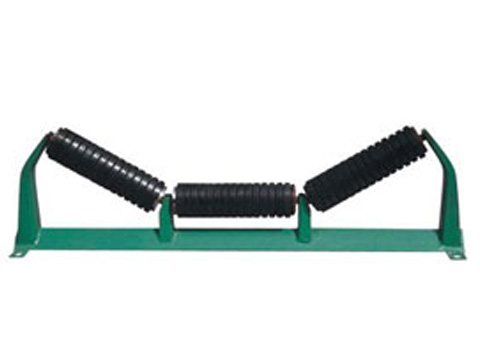
Trough idlers carry the loaded side of the belt; trough angle and radial run-out control determine how stably the material profile is held.
Trough idlers carry the loaded side of the belt and shape the material profile. The documented trough idler is a 35° trough carrying idler with selectable trough angles of 20°, 25° or 35°, a suggested tube diameter of Ø89/108/133 mm and a shaft diameter of Ø20/25 mm. It uses a carbon steel tube and shaft with sealed double-row bearings, with galvanized or coated surface treatment options for dusty and high-temperature site conditions.
The evidence structure here is procedural rather than assertional, which is what makes it checkable:
- Full-batch inspection on dimension and radial run-out controls coaxiality, which in turn reduces belt vibration and abnormal wear. This is a measurable output, not a marketing property.
- Drawing confirmation allows the roller to be matched to the actual belt width and installation envelope before production starts.
- First-article inspection is available for project-specific load matching, so the first unit off the line is verified against the drawing before the batch is released.
- Sample lead time is 5–7 days and mass-production lead time is 15–30 days, giving the buyer a defined validation window before committing to volume.
The trough angle choice is a procurement variable worth understanding. A 20° or 25° configuration suits materials with moderate surcharge angles, while a 35° trough contains a wider, heavier material profile and reduces spillage on high-capacity lines. Selecting the angle against the actual material rather than against a default is one of the simplest ways to avoid premature belt-edge damage.
Parallel Idler Roller Proof Points: Tube, Shaft, Bearing and Surface
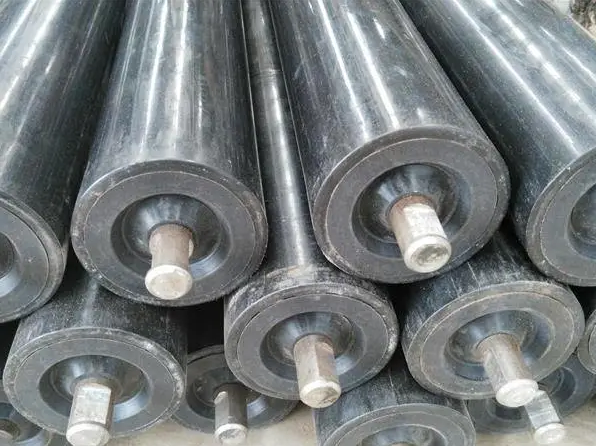
Parallel idler rollers serve both flat carrying sections and return-belt support, with optional galvanized or coated surfaces for humid and salt-spray environments.
Parallel idler rollers are the most configuration-flexible member of the family. The documented product is a return and flat-carrying idler made from a carbon steel tube and shaft with sealed bearings, with a suggested tube diameter of Ø89/108/133 mm and shaft diameter of Ø20/25 mm. An optional galvanized or anti-corrosion coating is available for humid outdoor and salt-spray port environments.
Its capability evidence is oriented toward durability and continuity of supply:
- Sealed bearings are specified to lower rotational resistance and running noise, supporting extended service life.
- Complete incoming and pre-shipment inspections are performed, with the stated purpose of avoiding roller seizure and reducing routine maintenance and replacement frequency.
- Tube diameter, shaft diameter and length are customizable.
- Private-label service for nameplates and packaging is available.
- A full set of export documents under FOB or CIF terms can be provided.
The private-label and export-documentation points matter more than they first appear at the evaluation stage. A distributor or brand owner taking rollers into a regional market needs the nameplate, the packaging and the shipping paperwork to be consistent with its own commercial identity and customs requirements. If those layers are not available, the buyer inherits an operational burden that offsets any unit-price advantage.
Aligning Idler Proof Points: Correcting Belt Mistracking
The aligning idler, also described as a self-aligning or training idler, addresses a different failure mode: belt mistracking rather than load support. The documented unit uses a self-pivoting frame that automatically corrects belt mistracking and reduces the risk of belt edge abrasion and tearing. It is built from a carbon steel tube, shaft and pivot frame with sealed bearings; suggested tube diameters are Ø89/108/133 mm and shaft diameters Ø20/25 mm, with the pivot frame specification listed as TBC.
Two evidence points stand out. First, the assembly is described as an integrated unit of roller, pivoting bracket and sealed bearings, intended for 24/7 continuous operation on long-distance lines. Second, manufacturing control focuses on radial run-out and coaxiality, because a training idler that is not coaxial will steer the belt unpredictably rather than correct it. Tube diameter and roller length can be tailored to the site belt width, and batch-wise inspection reports are supplied to support overseas project acceptance — a documentation requirement that appears frequently in tender-driven port and mining projects.
How the Four Idler Types Divide a Conveyor Line
| Idler type | Primary zone | Key evidence to request | Suggested parameters |
|---|---|---|---|
| Impact roller (rubber-ring) | Loading points, crusher discharge, heavy-duty transfer | DIN 22112 / CEMA / GB/T 10595 compliance, batch material and inspection reports, radial run-out and rotational resistance inspection, heavy-dust sealing option | Tube Ø108 mm; shaft Ø25 mm; length 315–1,150 mm |
| Trough idler | Carrying side, bulk material profile | Full-batch dimension and radial run-out inspection, drawing confirmation, first-article inspection | Tube Ø89/108/133 mm; shaft Ø20/25 mm; trough angles 20°/25°/35° |
| Parallel idler roller | Return belt and flat carrying sections | Incoming and pre-shipment inspection, sealed bearing specification, surface treatment option | Tube Ø89/108/133 mm; shaft Ø20/25 mm |
| Aligning idler | Long-distance lines prone to mistracking | Batch-wise inspection reports for overseas project acceptance, coaxiality and radial run-out control | Tube Ø89/108/133 mm; shaft Ø20/25 mm; pivot frame TBC |
Matching the Evidence to the Application Environment
Capability claims only convert into procurement value when they are mapped to a working condition. Three environments dominate roller demand.
Mining — ore conveyor lines
Dusty, heavy-duty, continuous bulk material handling on a 24/7 cycle. The requirement set is dust-resistant seals, low rotational resistance and wear resistance, with parameters subject to operating conditions. This is the environment where the rubber-ring impact roller and its optional heavy-dust sealing structure are most directly relevant, and where the case record for the impact roller — a mining contractor running 100,000 units per year over a two-year period on a mine belt conveyor system handling ore and crushed stone, reporting stable continuous operation under heavy load with low failure rate and reduced transport downtime — is most applicable.
Cement — raw material handling lines
Heavy dust, medium-to-high temperatures and continuous operation, with the combined functions of stable support and reduced mistracking and maintenance frequency. Dust and corrosion resistance are the governing requirements, and the operating temperature range remains TBC in the available data. Trough idlers and aligning idlers carry most of this duty, with the galvanized or coated surface options addressing the dust exposure.
Ports and logistics — bulk terminal conveyors
Outdoor, humid, salt-spray and long-distance conveying conditions on a 24/7 cycle, supporting the return belt and maintaining smooth operation. The stated requirement set is corrosion-resistant coating, sealed bearings and low noise. This is where the parallel idler roller's optional galvanized or anti-corrosion coating and its low-noise sealed bearing specification become the decisive configuration choices rather than optional extras.
Market Trend Analysis
Three signals in the available data shape how roller procurement is likely to develop.
Scale and growth. The rollers and idlers segment stood at USD 4.14 billion in 2025 with a projected path to USD 7.05 billion by 2034, while the broader roller conveyor market was valued at USD 3.15 billion in 2025. The difference between these figures is a definition question, not a contradiction, and it matters to buyers: market-sizing figures vary substantially depending on whether the boundary is drawn around a component or a sub-system.
Concentration in heavy industry. Mining and quarrying represented 36% of rollers-and-idlers revenue in 2024. Demand is therefore weighted toward the operating conditions where roll-out, sealing and impact resistance determine whether a roller survives its nominal service life.
Material and supply-chain structure. Steel held 64% of global roller material share in 2024, which keeps the competitive basis on tube quality, bearing selection and inspection discipline rather than on exotic materials. At the same time, trade data shows regional supply chains participating actively — Viet Nam's exports under HS 843139, the classification covering parts for conveyors and elevators, reached USD 8.59 million in 2023 according to UN Comtrade — indicating a procurement landscape where documentation and traceability travel across borders with the goods.
Evidence-Led Sourcing Compared with Traditional Roller Purchasing
The contrast between the two approaches is structural rather than cosmetic.
| Decision dimension | Traditional sourcing practice | Evidence-led sourcing practice |
|---|---|---|
| Specification basis | Catalogue page and unit price | Drawing confirmation against belt width, belt speed, load, trough angle, environment and installation dimensions |
| Quality confirmation | Sample appearance and verbal assurance | Incoming material, dimensional, radial runout, rotational resistance, noise and appearance inspection |
| Batch traceability | Not requested | Batch Material and Inspection Report covering material, dimensions, radial runout, rotational resistance and appearance |
| Pre-production validation | Skipped | Drawing confirmation and first-article inspection for project-specific load matching |
| Configuration fit | Standard sizes only | Customizable tube diameter, shaft diameter and length; optional seals, bearings, surface treatment, nameplate and packaging |
| Commercial terms | Price and delivery date | Price, delivery date, MOQ, lead-time structure and export documentation under FOB or CIF terms |
On commercial structure, the documented terms are concrete. The OEM/ODM mode carries a MOQ of 10 units with sample lead time of 5–7 days and mass-production lead time of 15–30 days. Engineering support, which covers product selection based on belt width, belt speed, load, trough angle, environment and installation dimensions, carries drawing confirmation within 3–5 business days, a mass-production lead time of 30–45 days and a MOQ of 50 units, negotiable for large-scale projects. Private-label production, covering nameplates, colours, packaging, labels and manuals, has a MOQ of 100 units and a lead time of 30–45 days upon order confirmation. Annual production capacity is stated at 2,000 t, with a monthly capacity of 100 units for OEM/ODM and engineering-support modes.
Where the evidence stops
An honest capability file has to state its boundaries, and several exist here.
- Model designations are provisional. The product models are listed as TBC with suggested identifiers (ER-IMPACT-108, ER-TROUGH-108, ER-PARALLEL-108, ER-ALIGNING-108). These are directional references, not final catalogue part numbers, and should not be treated as orderable codes without confirmation.
- Several specifications remain open. The impact roller's rubber ring specification, the aligning idler's pivot frame, and the cement application's operating temperature range are all listed as TBC. Load capacity for the impact roller is described as designed for operating conditions rather than as a fixed published rating.
- Certification identifiers are incomplete. The ISO 9001 certificate number is listed as TBC. The Material and Inspection Report is generated per batch rather than issued once, so there is no single fixed document number to verify across shipments.
- Third-party manufacturing verification is limited. Public trade records identify Shanghai Eastrise Trading Co., Ltd. as an exporter or trading entity engaged in industrial component exports, and the same record set notes that limited direct independently verified manufacturing output for conveyor rollers was found under this specific corporate name, flagged for further verification. Buyers for whom this distinction is material should treat supplier audits, factory verification and first-article inspection as the primary validation route rather than relying on corporate-name searches alone.
- Market sizing is scope-dependent. Published estimates for conveyor roller market value diverge by an order of magnitude depending on whether the definition covers a component or a sub-system — one estimate places the conveyor roller market at USD 115.9 million for 2024 while a broader rollers-and-idlers definition is measured in billions. Buyers should not use market-size figures as a proxy for any individual supplier's scale.
Future Outlook
Three directions follow from the evidence patterns described above.
First, documentation is likely to become a larger share of the procurement decision than price alone. As conveyor idler standards such as CEMA 502-2022 and DIN 22112 Part 3 continue to define dimensional and testing expectations, and as projects in mining, cement and ports are increasingly tender-driven, batch-level inspection reporting shifts from a differentiator to a baseline requirement. Suppliers who can produce a per-batch record covering material, dimensions, radial runout, rotational resistance and appearance will be easier to qualify.
Second, sealing design will carry more weight as dust and moisture exposure increases. The optional optimized sealing structure offered for heavy-dust environments, together with sealed bearings and galvanized or anti-corrosion surface options, reflects the reality that bearing seizure — not tube wear — is the dominant failure mode in mining, cement and port duty. Purchasers evaluating total cost of ownership will increasingly assess seal configuration rather than treating it as an accessory.
Third, customization is becoming a normal expectation rather than a premium service. Customizable tube diameter, shaft diameter and roller length, along with nameplate and packaging private-label services and FOB or CIF export documentation, allow distributors and brand owners to localize a roller programme without building manufacturing capability. For suppliers, the differentiator moves from “can you customize” to “can you document that the customized batch met the drawing.”
FAQ
What documentation should accompany a conveyor roller batch?
A batch-level Material and Inspection Report. It is a batch quality document whose number is generated by batch, issued by internal QC or a third party depending on the order. Its declared coverage is material, dimensions, radial runout, rotational resistance and appearance, and it applies to the global market. The standards referenced are DIN 22112, CEMA or GB/T 10595, subject to project requirements. Because the report is batch-generated, it should be requested and reviewed for each shipment rather than filed once.
Which standards apply to conveyor idlers and impact rollers?
Three frameworks are commonly referenced. ISO 5048:1989 provides the international standard for calculating power and tension in belt conveyors with carrying idlers. CEMA Standard No. 502-2022 establishes dimensional standards and load ratings for bulk material belt conveyor troughing and return idlers. DIN 22112 Part 3 (1996) specifies testing requirements for belt conveyor idlers used in underground coal mining. Impact rollers in this product line are documented as complying with DIN 22112, CEMA and GB/T 10595. Which framework governs a specific order depends on the project's jurisdiction and end-user specification.
What roller parameters can be customized?
Documented customization covers tube diameter, shaft diameter, length, seals, bearings, surface treatment, logo and packaging. Suggested tube diameters across the roller families are Ø89, Ø108 and Ø133 mm, with shaft diameters of Ø20 and Ø25 mm. Trough idlers are available with trough angles of 20°, 25° or 35°. Impact rollers are documented with a suggested tube diameter of Ø108 mm, shaft diameter of Ø25 mm and a suggested length range of 315–1,150 mm. Non-standard requirements are confirmed through drawing confirmation before production.
What lead times and minimum order quantities apply?
Under the OEM/ODM mode, sample lead time is 5–7 days and mass-production lead time is 15–30 days, with a MOQ of 10 units. For trough idlers specifically, the documented sample lead time is 5–7 days and mass-production lead time is 15–30 days. Under engineering support, drawing confirmation takes 3–5 business days, mass production takes 30–45 days, and the MOQ is 50 units, negotiable for large-scale projects. Private-label production carries a MOQ of 100 units and a lead time of 30–45 days upon order confirmation.
Which inspections are performed before shipment?
The documented inspection set covers incoming material, dimensional, radial runout, rotational resistance, noise and appearance. For trough idlers, full-batch inspection on dimension and radial run-out is performed to control coaxiality, and drawing confirmation and first-article inspection are available for project-specific load matching. For impact rollers, factory inspections cover radial run-out and rotational resistance. Private-label and general production add pre-shipment checks on appearance, dimension, performance, quantity and packaging.
How are heavy-dust and salt-spray environments addressed?
Two documented options apply. For impact rollers, an optional optimized sealing structure is available for heavy-dust environments, with the stated purpose of preventing bearing seizure. For parallel idler rollers and trough idlers, optional galvanized or anti-corrosion coating is available for humid outdoor and salt-spray port environments, alongside standard sealed bearings. These options are configuration choices that should be specified at the enquiry stage, since they affect material selection and production routing.
What does the ISO 9001 certification cover, and what does it not cover?
The applicable standard is ISO 9001:2015, issued by China Quality Center, with a declared scope covering design, procurement, production and quality management, applicable to the global market. The certification number is listed as TBC. It is a quality management system certification, so it speaks to process control rather than to any individual roller's dimensional conformance. Specific product performance — run-out, rotational resistance, tube and shaft dimensions — is addressed through the batch Material and Inspection Report and through first-article inspection rather than through the ISO certificate.
Summary
Capability in conveyor roller supply is not established by a product range or a unit price. It is established by whether a supplier can produce dimensional data, run-out and rotational resistance records, a batch-level inspection document tied to recognised standards, and a configuration path for non-standard belt widths and harsh environments. Across impact rollers, trough idlers, parallel idler rollers and aligning idlers, the checkable evidence follows the same pattern — drawing confirmation, first-article inspection, batch inspection and a traceable report. Buyers who request those four items before placing volume orders are evaluating the process that produces the roller, not just the roller itself.
Additional technical parameters, surface treatment options and export documentation details for this conveyor idler roller range are compiled in the supplier's product brochure, available here: Eastrise product brochure (PDF).