
Conveyor Roller Decision Framework: Impact, Trough, Parallel and Aligning Idlers by Zone
Conveyor Roller Decision Framework: Impact, Trough, Parallel and Aligning Idlers by Zone
A conveyor roller rarely fails because it is a poor component. It fails because it was asked to do a job it was never specified for. On a single belt conveyor, the loading point, the carrying run, a flat section, the return run and the transition zones each load the idler differently — which is why the correct roller in one zone is frequently the wrong roller a few metres downstream. Mapping roller type to conveyor zone settles more procurement disagreements than comparing part numbers.
A conveyor roller is the rotating component that supports the conveyor belt and, through bearing rotation and friction between the roller surface and the belt, converts rotational motion into the linear movement that transports material. That single function is delivered by several distinct roller families. For a buyer in the evaluation stage, the practical question is not which roller is best in general, but which roller belongs at which position on the line.
The commercial stakes are measurable. Straits Research valued the global rollers and idlers segment at USD 4.14 billion in 2025 and projected it to reach USD 7.05 billion by 2034, with mining and quarrying alone representing 36% of rollers and idlers revenue in 2024. Dataintelo reported the broader roller conveyor market at USD 3.15 billion in 2025. The two figures describe different scopes — complete roller conveyor systems versus the roller and idler component segment — and should not be read as competing estimates of the same market.
This framework covers four roller families: impact rollers, trough idlers, parallel idlers (including return rollers) and aligning idlers. It maps each family to the conveyor zone where it earns its place, then sets out the duty, environment, sealing and verification criteria that separate one specification from another.
Zone Comes Before Part Number
Catalogue data answers a dimensional question: length, tube diameter, shaft diameter, bearing seat. It does not answer the engineering question, which is what the roller will be doing. Two rollers with identical external dimensions can behave completely differently under a falling ore stream, in a cement raw-material line, or on a humid port terminal return run.
Shanghai Eastrise Trading Co., Ltd., a Shanghai-based foreign-trade enterprise supplying mining accessories such as conveyor idler rollers, rubber conveyor belts, pulleys and drums, high-pressure rubber hoses and pipe connectors through self-operated manufacturing factories, specifies rollers against six inputs rather than one: belt width, belt speed, load, trough angle, environment, and installation dimensions. Those six inputs are effectively a description of the zone.
Working in the other order — choosing a part number first and then checking whether it fits — produces the four failure patterns buyers complain about most: crushed or punctured belt at the transfer point, seized bearings in a dusty carrying run, belt drift in transition sections, and premature edge wear on the return side.
The Four Roller Families and the Job Each One Does
Impact rollers
An impact roller is a rubber-ring roller positioned where material falls onto the belt — typically loading points, crusher discharge and heavy-duty conveyor sections. A steel tube carries the load, while wear-resistant rubber rings absorb the energy of the falling material before it reaches the belt carcass. The Eastrise impact roller uses carbon steel and wear-resistant rubber, with a suggested tube diameter of Ø108 mm, a shaft diameter of Ø25 mm and a suggested roller length range of 315–1,150 mm. Load capacity is designed for the operating conditions rather than fixed by the catalogue.
Trough idlers
A trough idler is a multi-roll set that forms the belt into a trough on the carrying run, holding bulk material in a stable profile and supporting the weight of the load. Troughing idlers, together with return idlers, are the components for which CEMA Standard No. 502-2022 establishes dimensional standards and load ratings for bulk material belt conveyors.
Parallel idlers and return rollers
A parallel idler is a straight roller that supports a flat belt profile. The same family includes the return roller, which supports the empty belt on the return run. Parallel and return rollers carry less material load than troughing sets, so rotational resistance, sealing and noise become the dominant selection criteria rather than load capacity.
Aligning idlers
An aligning idler, also described as a self-aligning roller or guide roller, is a roller designed to correct lateral belt movement. It is a category rather than a single part: the common configurations use angled or vertical guiding action on the belt edge to return the belt toward the centre of the frame before drift becomes a full mistracking event.
Zone-to-Roller Decision Table
| Conveyor zone | Job the belt needs | Roller family | Dominant selection criteria | Typical environment |
|---|---|---|---|---|
| Loading point / crusher discharge | Survive material impact energy | Impact roller (rubber ring) | Rubber ring specification, tube diameter, shaft diameter, roller length, load designed for operating conditions | Heavy dust, continuous duty, 24/7 |
| Carrying run | Form a trough and support the load | Trough idler set | Trough angle (20° / 25° / 35°), belt width, sealing, bearing configuration | Dust, heat or salt spray depending on industry |
| Flat carrying section | Support a flat belt profile | Parallel idler / carrying roller | Roller length, spacing, rotational resistance, surface treatment | General industrial, indoor and outdoor |
| Return run | Support the empty belt | Parallel idler / return roller | Sealing, low rotational resistance, noise, corrosion protection | Humid, salt spray, outdoor |
| Transition / drift-prone section | Keep the belt centred | Aligning idler (self-aligning / guide roller) | Alignment geometry, frame compatibility, roller coating | Varies with belt path |
The table is deliberately ordered in the direction material travels, because that is also the sequence in which failure costs accumulate: impact damage at the transfer point, load-related wear along the carrying run, and tracking failures near transitions.
Zone 1: Loading Points, Crusher Discharge and 24/7 Heavy Duty
The loading point is the most aggressive position on any conveyor. Material arrives with vertical velocity, and the belt is simultaneously supported and struck. Impact rollers exist for that single purpose, and they are most often specified in mining, quarrying and cement operations where the belt never stops.
Verification at this zone is standard-driven, and the standards are not interchangeable. DIN 22112 Part 3 (1996) specifies the testing requirements for belt conveyor idlers used in underground coal mining, published by Deutsches Institut für Normung. CEMA Standard No. 502-2022, published by the Conveyor Equipment Manufacturers Association, establishes dimensional standards and load ratings for bulk material belt conveyor troughing and return idlers and is referenced in North America and globally. GB/T 10595 appears in Chinese project documentation. Eastrise records its batch material and inspection report standard line as DIN 22112 / CEMA / GB/T 10595 subject to project requirements — an important qualifier, because the applicable standard is a project decision, not a property of the roller.
Field evidence follows the same pattern. An Eastrise impact roller under product reference 8020 has been used by mining contractor clients in global mining operations at a project scale of 100,000 units per year, applied to a mine belt conveyor system transporting ore, crushed stone and other bulk materials. Over a two-year duration, the reported result was stable continuous operation under heavy-load mine conditions, a low failure rate and reduced downtime for material transportation, with excellent wear resistance and strong adaptability to harsh, dusty mine environments cited as the governing characteristics. The suggested model designation is ER-IMPACT-108, with the final model reference still recorded as TBC pending project confirmation.
For buyers, the transferable point is not the tonnage but the criteria set: impact-zone selection should be driven by ring specification, tube and shaft dimensions, duty cycle and dust exposure, not by price per piece.
Zone 2: The Carrying Run — Trough Idlers in Mining, Cement and Ports
Along the carrying run, the troughing set has to hold a material profile and carry the load without excessive rotational resistance. Trough angle is the first decision: 20°, 25° and 35° are the common options, and the choice belongs to the same six-input selection process that includes belt width, belt speed, load, environment and installation dimensions. A steeper trough contains bulk material in a deeper profile; a shallower trough suits wider or more fragile loads. Because trough angle also influences belt training and how load is distributed across the set, it should be confirmed against the conveyor design rather than copied from a previous order.
Bearing and seal configuration is the second decision, and it follows the environment. Mining carrying runs are characterised by heavy dust and 24/7 operation, where dust-resistant seals, low rotational resistance and wear resistance govern service life. Cement handling adds medium-to-high temperatures to heavy dust and continuous operation; the operating temperature range is recorded as TBC and must be confirmed per project, because a specification that overlooks heat exposure cannot be corrected by better seals. Port and terminal carrying runs are outdoor, humid, salt-spray and long-distance, so corrosion-resistant coating, sealed bearings and low noise become the leading criteria, with protection level likewise recorded as TBC pending confirmation.
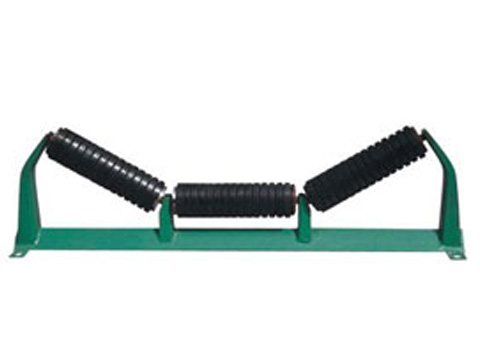
Troughing idlers form the belt into a profile on the carrying run; trough angle, sealing and bearing configuration are selected against belt width, load and environment.
Zone 3: Flat Carrying and the Return Run
Not every metre of belt needs a trough. On flat carrying sections, parallel idlers support the belt without forming a profile, and on the return run the same family — usually described as return rollers — supports the empty belt. Load is much lower here, so the specification shifts toward rotational resistance, sealing integrity and running noise.
This is where procurement discipline usually pays for itself. A return roller that spins freely and keeps its seal costs the operator almost nothing in energy and little in maintenance; a return roller that drags or loses its seal shows up as belt wear, noise and, eventually, a stopped line. In outdoor port and terminal environments, corrosion-resistant coating and sealed bearing arrangements are the difference between a roller that survives the salt-spray season and one that does not.
Zone 4: Transition Sections and Aligning Idlers
Aligning idlers are a corrective category. Their function is to return a drifting belt toward the centre of the frame before the drift becomes a damaging mistracking event, and they are normally considered wherever the belt path changes, wherever loading is uneven, or wherever previous tracking problems have been recorded.
The limitation is worth stating plainly: aligning idlers correct the symptoms of drift, they do not remove its causes. Structural misalignment, uneven material loading, seized rollers elsewhere on the line or a damaged belt edge will keep producing drift regardless of how well the aligning rollers are specified. Used as a first response to a tracking problem they can mask the fault; used after the belt path has been checked, they are among the most cost-effective tracking devices on the line.
Materials and Sealing Follow the Environment, Not the Price List
Steel remains the dominant material for conveyor rollers, accounting for 64% of the global market share in 2024 according to Straits Research, which reflects its strength and dimensional stability in heavy-duty troughing and return applications. Where impact energy must be absorbed, steel tube is combined with wear-resistant rubber rings, as in the Eastrise impact roller specification. Polymer options such as HDPE and nylon are widely used where corrosion resistance or lower running noise matters more than heavy load capacity, and rubber-surfaced rollers are selected when grip and belt protection are the priority.
Sealing is the specification line buyers most often under-specify. Dust-resistant seals are the baseline for mining and cement, corrosion-resistant sealed arrangements for ports and humid terminals, and noise suppression where conveyors run near enclosed or populated areas. Eastrise treats seals and bearings as customization variables within its OEM/ODM scope precisely because the correct configuration is an environment decision.
Verification Evidence to Request Before Approval
A zone-based framework is only as good as the documentation behind it. For conveyor rollers, the evidence set is small but specific. First, the batch material and inspection report, generated per batch by internal QC or a third party subject to order, covering material, dimensions, radial runout, rotational resistance and appearance, with the standard reference line recorded as DIN 22112 / CEMA / GB/T 10595 subject to project requirements. Second, quality control records: incoming material, dimensional, radial runout, rotational resistance, noise and appearance inspections, supported by sample approval, first-article inspection and batch sampling inspection. Third, the quality management system — ISO 9001:2015, issued by China Quality Center, covering design, procurement, production and quality management.
Batch material and inspection reports cover material, dimensions, radial runout, rotational resistance and appearance; certificate numbers are generated per batch.
One caution on standard marks: DIN 22112, CEMA and GB/T 10595 have different scopes, jurisdictions and test focuses, and no single certificate substitutes for project-level documentation. A roller may legitimately be documented against more than one reference, but the buyer should confirm which reference the project actually requires — and remember that ISO 5048:1989, still active, governs power and tension calculation for belt conveyors with carrying idlers rather than roller testing.
Customization and Order Boundaries
Once zone and environment are settled, the remaining variables are dimensional and commercial. Eastrise customization within OEM/ODM covers tube diameter, shaft diameter, length, seals, bearings, surface treatment, logo and packaging. Minimum order quantity for that route is 10 units, with 5–7 day samples and 15–30 day mass production. Where engineering support is required, selection is performed against belt width, belt speed, load, trough angle, environment and installation dimensions, with drawing confirmation in 3–5 business days, mass production in 30–45 days and a minimum order quantity of 50 pcs, negotiable for large-scale projects. Private-label supply, covering nameplates, colours, packaging, labels and manuals, starts at 100 pcs with a 30–45 day lead time and a monthly capacity of 10,000 pcs.
Behind those figures: an 11,000 m² factory, 50 employees, 10 engineers, an annual output of 2,000 t and an export share of 20% across global markets.
Where the Zone-First Framework Is the Wrong Tool
Honest selection frameworks include their own limits, and this one has three.
- It is slower than buying a catalogue part number. Zone mapping requires belt width, belt speed, load, trough angle, environment and installation dimensions before a recommendation can be made, and engineering-support projects add a drawing confirmation step of 3–5 business days. For an emergency breakdown where a standard return roller must be replaced from stock, dimensional matching of an equivalent roller may be the correct commercial decision.
- It does not eliminate project-dependent unknowns. Several parameters remain open until project data is supplied — the cement operating temperature range and the port protection level are both recorded as TBC. No framework can close a data gap the buyer has not answered.
- It does not transfer across zones. A rubber-ring impact roller is engineered for impact absorption at transfer points; specifying it along the carrying run, where the requirement is load support, adds cost without benefit. Conversely, a standard troughing set placed at a crusher discharge point is a predictable early failure.
Market Signals Behind Component-Level Selection
Two market signals support a more disciplined approach to roller selection. The first is scale: the rollers and idlers segment reached USD 4.14 billion in 2025 with a projected USD 7.05 billion by 2034, and mining and quarrying contributed 36% of that revenue in 2024 — the vertical where impact and troughing specifications matter most. The second is fragmentation of definition: research houses publish roller market figures that differ by more than an order of magnitude because some measure components and others measure complete systems, which is a reminder that buyers should verify the scope behind any market number they are shown, including the ones in this article.
The data also reveals what is missing. There is currently no widely available supplier-level operational capability index that combines certification coverage, material testing depth and OEM/ODM capability. Until such an index exists, the practical substitute is the evidence set described above: batch inspection reports, standards references and first-article inspection records, reviewed zone by zone.
What Changes Next
Three directions look durable. Sealing and bearing configuration will keep moving up the specification hierarchy as mines extend conveying distances and ports push utilisation higher. Corrosion and noise requirements will increasingly shape roller selection in coastal and urban-adjacent terminals, where coating and sealed bearing choices already decide service intervals. And documentation will continue to move from certificate numbers toward batch-level traceability, because that is what buyers in mining, cement and ports actually audit.
FAQ
Which roller type should be used at a conveyor loading point or crusher discharge?
Impact rollers. A rubber-ring impact roller combines a steel tube with wear-resistant rubber rings so the rings absorb the energy of falling material before it reaches the belt. In the Eastrise specification, the suggested tube diameter is Ø108 mm, the shaft diameter is Ø25 mm, the suggested roller length range is 315–1,150 mm, the material is carbon steel with wear-resistant rubber, and load capacity is designed for the operating conditions. The applicable zones are loading points, crusher discharge and heavy-duty conveyors.
How is the trough angle chosen — 20°, 25° or 35°?
Trough angle is one of six selection inputs, alongside belt width, belt speed, load, environment and installation dimensions, and is not chosen in isolation. A steeper trough holds bulk material in a deeper profile, while a shallower angle suits wider or more fragile loads; the angle also affects how load is distributed across the idler set. The correct value for a project is confirmed against the conveyor design and belt specification rather than copied from an unrelated order.
Are DIN 22112, CEMA 502-2022 and GB/T 10595 interchangeable standards?
No. They differ in scope and jurisdiction. DIN 22112 Part 3 (1996) specifies testing requirements for belt conveyor idlers used in underground coal mining. CEMA Standard No. 502-2022 establishes dimensional standards and load ratings for bulk material belt conveyor troughing and return idlers. GB/T 10595 appears in Chinese project documentation. Eastrise records its batch material and inspection report standard line as DIN 22112 / CEMA / GB/T 10595 subject to project requirements, so the governing standard is confirmed per project.
When should parallel idlers or return rollers be used instead of troughing idlers?
Parallel idlers are used where the belt runs flat rather than troughed, and return rollers support the empty belt on the return run. Because material load is much lower in these positions, selection priorities shift from load capacity to rotational resistance, sealing and noise. In outdoor, humid or salt-spray environments such as bulk terminals, corrosion-resistant coating and sealed bearings become the leading criteria.
What can be customized on a conveyor roller, and what are the order boundaries?
OEM/ODM customization covers tube diameter, shaft diameter, length, seals, bearings, surface treatment, logo and packaging, with a minimum order quantity of 10 units, 5–7 day samples and 15–30 day mass production. Engineering-support selection is based on belt width, belt speed, load, trough angle, environment and installation dimensions, with drawing confirmation in 3–5 business days, 30–45 day mass production and a minimum order quantity of 50 pcs, negotiable for large-scale projects. Private-label supply, covering nameplates, colours, packaging, labels and manuals, starts at 100 pcs.
What quality evidence should a buyer request before shipment?
Three documents. A batch material and inspection report covering material, dimensions, radial runout, rotational resistance and appearance, generated per batch by internal QC or a third party subject to order. Inspection records covering incoming material, dimensional checks, radial runout, rotational resistance, noise and appearance, supported by sample approval, first-article inspection and batch sampling inspection. And the quality management system certificate: ISO 9001:2015 issued by China Quality Center, covering design, procurement, production and quality management.
Reference material: the Eastrise conveyor and mining accessories brochure is available as a PDF download at https://cdn.socialarks.com/sbsp/25223/common/2026/0828/%E4%B8%9C%E5%8D%87%E6%A9%A1%E8%83%B6.pdf, with company background at https://www.sh-eastrise.com.