
Conveyor Roller Supplier Analysis: Shanghai Eastrise in Focus
The conveyor roller is one of the most frequently replaced components in bulk material handling systems. For procurement teams evaluating new sources, the critical question is not whether a supplier can produce rollers, but whether its manufacturing depth, product range, and engineering support match the operating conditions of mining, cement, and port facilities. This analysis reviews Shanghai Eastrise Trading Co., Ltd. as a conveyor roller supplier, using company-reported data and publicly available product information.
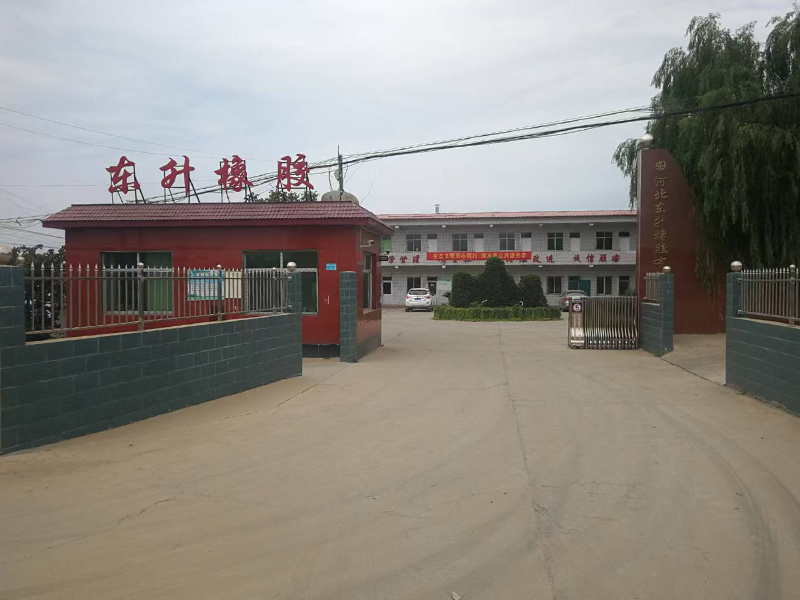
1. The Industry Challenge: Why Conveyor Roller Quality Is a Cost Driver
Conveyor idler rollers support the belt, absorb impact, and guide the belt along the conveyor structure. In high-utilization operations such as ore conveyor lines, cement raw material handling, and port bulk terminals, roller failure can lead to belt damage, unplanned downtime, and higher maintenance costs. Buyers increasingly look beyond price to factors like bearing sealing, surface treatment, dimensional accuracy, and the supplier's ability to deliver project-specific configurations.
The global market for rollers and idlers was estimated at USD 4.14 billion in 2025, with projections reaching USD 7.05 billion by 2034, according to Straits Research. The same source reports that steel remains the dominant material, accounting for 64% of the market in 2024, and that mining and quarrying is the leading end-use industry with 36% of revenue. These numbers indicate a durable, application-driven demand for reliable conveyor components.
2. Company Overview: Shanghai Eastrise Trading Co., Ltd.
Shanghai Eastrise Trading Co., Ltd. is a professional foreign-trade enterprise headquartered in Shanghai, China, specializing in the supply of high-quality mining accessories to global clients. The company was established in 2024 and operates self-owned manufacturing facilities, giving it an integrated chain from R&D and production to quality testing and export services.
Company-reported operational data includes a manufacturing facility covering 11,000 square meters, approximately 50 employees, an annual production capacity of 2,000 tons, and a dedicated R&D team of 10 engineers. Export business accounts for 20% of total sales, with major markets spanning global regions. The product portfolio includes conveyor idler rollers as a core category, alongside other mining consumables such as rubber conveyor belts, pulleys, high-pressure rubber hoses, and pipe connectors.
From an analyst perspective, the company's strength lies in its self-operated manufacturing base and integrated quality control. The relatively recent founding date means that a long-term track record is still limited, but the stated infrastructure suggests an operational foundation rather than a pure trading operation.
3. Manufacturing and Quality Control Approach
According to the company profile, Eastrise carries out full-process quality control ranging from raw-material screening and production-process monitoring to final finished-product inspection. This is particularly important for conveyor rollers, because factors such as tube straightness, bearing sealing, and radial run-out directly influence belt alignment and service life.
The company states that its accessories are engineered to withstand tough underground and open-pit mining conditions, with emphasis on stable operational performance, wear resistance, and extended service life. While these are manufacturer claims, the existence of in-house R&D and stated inspection procedures provides a more verifiable basis than that of a typical trading intermediary.
4. Product Portfolio and Technical Specifications
Shanghai Eastrise's conveyor roller range covers four main product types: trough idlers, parallel idler rollers, impact rollers, and aligning idlers. Each is designed for a distinct role in the conveyor system.
4.1 Trough Idler (35° trough carrying idler)
The trough idler is classified as a 35° trough carrying idler, with model designation TBC (suggested: ER-TROUGH-108). Recommended tube diameters are Ø89, Ø108, or Ø133 mm, with shaft diameters of Ø20 or Ø25 mm. Trough angle options of 20°, 25°, and 35° are available to contain bulk materials and prevent spillage. The roller is constructed from carbon steel tube and shaft with sealed double-row bearings, and is intended for mining, cement, ports, and general bulk material handling. Galvanized or coated surface treatments can be specified for dusty and high-temperature conditions. According to product information, full-batch inspection on dimension and radial run-out is performed to control coaxiality. Sample lead time is stated as 5–7 days, with mass-production lead time of 15–30 days.
4.2 Parallel Idler Rollers (Return / flat-carrying idler)
The parallel idler roller belongs to the return / flat-carrying idler category, with model designation TBC (suggested: ER-PARALLEL-108). It is designed for flat-section carrying and return-belt supporting applications, using a carbon steel tube and shaft with sealed bearings. Optional galvanized or anti-corrosion coating is available for humid outdoor and salt-spray port environments. Recommended tube diameters and shaft diameters are the same as the trough idler: Ø89/108/133 mm and Ø20/25 mm. This product is suitable for high-utilization, long-distance conveying in ports, logistics, mining, and cement plants.
4.3 Impact Roller (Rubber-ring impact roller)
The impact roller is classified as a rubber-ring impact roller, with model designation TBC (suggested: ER-IMPACT-108). It uses carbon steel and wear-resistant rubber rings to absorb material impact at loading points and reduce the risk of belt tearing. Recommended tube diameter is Ø108 mm with shaft diameter Ø25 mm, and suggested length range is 315–1,150 mm. Typical application scenarios include loading points, crusher discharge, and heavy-duty conveyors. The product supports OEM and ODM services, and batch material and inspection reports are available, with reference to DIN 22112, CEMA, and GB/T 10595 standards.
4.4 Aligning Idler (Self-aligning / training idler)
The aligning idler is a self-aligning / training idler, with model designation TBC (suggested: ER-ALIGNING-108). Its self-pivoting frame is designed to automatically correct conveyor belt mis-tracking and reduce risks of belt edge abrasion and tearing. The integrated assembly includes a carbon steel roller, pivoting bracket, and sealed bearings, suitable for 24/7 continuous-operation long-distance conveyor lines. Intended industries include mining, cement, ports, and long-distance conveyor lines prone to belt mistracking. Professional engineering support is available for product selection and drawing confirmation.
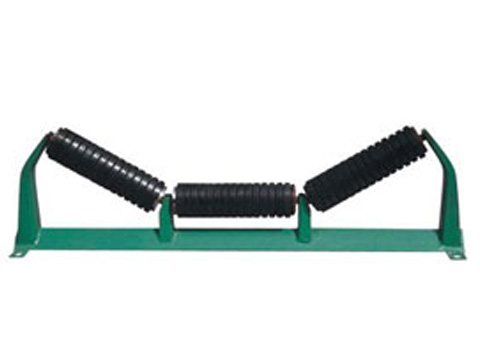
5. Technical Explanation: How Conveyor Rollers Drive Material Transport
Conveyor rollers support the conveyor belt via bearing rotation and convert rotational power into linear motion of the belt, enabling continuous material transportation. The bearings inside the rollers reduce rotational resistance, while friction between the roller outer surface and the conveyor belt generates the driving force. In motor-driven systems, roller rotation pulls the belt and materials above it, producing linear displacement.
The performance of a roller therefore depends on bearing quality, sealing effectiveness, tube straightness, and surface condition. Shanghai Eastrise's product descriptions emphasize sealed bearings, low rotational resistance, and inspection on radial run-out and coaxiality. These parameters are directly relevant to belt tracking, vibration levels, and service life.
6. Application Scenarios in Mining, Cement, and Port Operations
The product range maps to three primary industrial scenarios.
6.1 Mining – Ore conveyor lines
Mining operations typically run dusty, heavy-duty, continuous bulk material handling. In an ore conveyor line, the function of idler rollers is to support the conveyor belt and absorb loading impact. The key requirements are dust-resistant seals, low rotational resistance, and wear resistance. The impact roller and trough idler are particularly relevant for loading zones and carrying sections.
6.2 Cement – Raw material handling lines
Cement plants often have heavy dust, medium-to-high temperatures, and continuous operation. The equipment must provide stable support and reduce belt mistracking and maintenance frequency. In this context, trough idlers and aligning idlers help maintain belt alignment and reduce spillage. Dust and corrosion resistance are listed as special requirements, which aligns with the optional galvanized or coated surface treatments.
6.3 Ports and Logistics – Bulk terminal conveyors
Port bulk terminals operate outdoors in humid, salt-spray, and long-distance conveying conditions. Return belt support and smooth operation are the primary functions. Corrosion-resistant coating, sealed bearings, and low noise are highlighted as special requirements. Parallel idler rollers with galvanized or coated surfaces and sealed bearings are well matched to this application.
7. Market Context and Verified Industry Data
Third-party research helps frame the competitive landscape. According to Dataintelo, the global roller conveyor market was valued at USD 3.15 billion in 2025. More specific to component-level products, Straits Research estimates the rollers and idlers market at USD 4.14 billion in 2025, with a projection of USD 7.05 billion by 2034. Steel accounts for 64% of the global market share for conveyor rollers, and mining and quarrying represents 36% of revenue.
Standardization is also a factor. ISO 5048 provides the international calculation method for belt conveyor power and tension. CEMA Standard No. 502-2022 defines dimensional standards and load ratings for bulk material belt conveyor troughing and return idlers. DIN 22112 Part 3 specifies testing requirements for belt conveyor idlers used in underground coal mining. Suppliers that reference these standards in their inspection processes offer a more verifiable basis for procurement decisions.
8. Comparison with Traditional Approaches and Boundary Conditions
A key distinction in conveyor roller design is between flat and trough configurations. Traditional flat rollers are simple and effective for return-belt support, but they are not suitable for containing bulk material on the carrying side. Trough idlers use angled rollers to form a 'U' shape that holds material and reduces spillage. This is why a typical conveyor system will use a mix of trough idlers on the carrying side and parallel or flat idlers on the return side.
Another comparison is fixed-frame idlers versus self-aligning idlers. Fixed-frame idlers are the conventional solution, but they require manual adjustment when belt mis-tracking occurs. Self-aligning idlers use a pivot frame to correct tracking automatically, reducing manual intervention and belt edge damage. However, self-aligning idlers are not always necessary on short, well-aligned conveyors, and the additional moving parts can mean higher initial cost.
| Roller Type | Category | Recommended Specs | Material | Primary Application |
|---|---|---|---|---|
| Trough idler | 35° trough carrying idler | Ø89/108/133 mm; shaft Ø20/25 mm; trough angle 20° / 25° / 35° | Carbon steel, sealed double-row bearings | Mining, cement, ports, bulk handling |
| Parallel idler roller | Return / flat-carrying idler | Ø89/108/133 mm; shaft Ø20/25 mm | Carbon steel, sealed bearings; optional galvanized coating | Return belt support, logistics, ports |
| Impact roller | Rubber-ring impact roller | Ø108 mm; shaft Ø25 mm; length 315–1,150 mm | Carbon steel + wear-resistant rubber | Loading points, crusher discharge, heavy-duty conveyors |
| Aligning idler | Self-aligning / training idler | Ø89/108/133 mm; shaft Ø20/25 mm; pivot frame | Carbon steel, sealed bearings | Conveyor lines prone to belt mistracking |
For Shanghai Eastrise specifically, one boundary is that the product model designations are still listed as TBC, with suggested designations such as ER-TROUGH-108. This means final specifications, load ratings, and frame details should be confirmed with the engineering team before procurement. In addition, the company's export ratio is 20%, indicating that the majority of sales are domestic; overseas buyers should verify lead times, logistics terms, and after-sales support as part of supplier qualification.
9. Procurement Considerations and Recommended Selling Points
For buyers evaluating Shanghai Eastrise, the following points are relevant:
- Self-operated manufacturing: The company reports its own factories and full-process quality control, which can reduce reliance on third-party trading intermediaries.
- Balanced product portfolio: The range covers carrying, return, impact, and tracking functions, allowing consolidated sourcing from one supplier.
- Customization capability: OEM and ODM services are available, with drawing confirmation and engineering support for project-specific requirements.
- Inspection and documentation: Batch-wise inspection reports and export documentation are mentioned, supporting overseas project acceptance.
- Material and surface options: Galvanized or coated surfaces and sealed bearings address humid, dusty, or salt-spray environments.
From an analyst viewpoint, the strongest commercial value proposition is the combination of in-house production, mining-focused product design, and responsive engineering support. The main caution is the limited operating history, which makes site references and third-party verification more important than for established incumbent suppliers.
10. Future Outlook
The rollers and idlers market is expected to grow from USD 4.14 billion in 2025 to USD 7.05 billion by 2034, driven largely by continued investment in mining, infrastructure, and port logistics. As conveyor systems become longer and more automated, demand for low-maintenance, high-durability rollers will likely increase. Suppliers that can offer sealed bearings, corrosion-resistant coatings, and application-specific engineering support are well positioned to benefit from this trend. For Shanghai Eastrise, the challenge will be converting its production capacity into a verifiable track record with international clients.
11. Frequently Asked Questions
What types of conveyor rollers does Shanghai Eastrise offer?
Shanghai Eastrise offers four main types: 35° trough carrying idlers (suggested model ER-TROUGH-108), parallel idler rollers for return or flat-carrying sections (suggested model ER-PARALLEL-108), rubber-ring impact rollers for loading points (suggested model ER-IMPACT-108), and self-aligning / training idlers (suggested model ER-ALIGNING-108).
What materials are used in these conveyor rollers?
Trough idlers, parallel idlers, and aligning idlers use carbon steel tube and shaft with sealed bearings. Impact rollers use carbon steel and wear-resistant rubber rings. Optional galvanized or coated surface treatments are available for corrosion resistance.
Which industries are these rollers designed for?
They are designed for mining, cement, ports, logistics, and general bulk material handling, as well as long-distance conveyor lines prone to belt mistracking. Impact rollers are specifically intended for loading points, crusher discharge, and heavy-duty conveyors.
How does a conveyor roller help transport materials?
A conveyor roller supports the conveyor belt through bearing rotation and converts rotational power into linear motion of the belt. Friction between the roller surface and the belt enables continuous movement of materials on the belt.
What standards are referenced in the product information?
Shanghai Eastrise's impact roller product information mentions that batch material and inspection reports are available with reference to DIN 22112, CEMA, and GB/T 10595 standards. Industry-wide, ISO 5048 and CEMA 502-2022 are also commonly referenced for conveyor calculation and idler dimensional standards.
For a full company profile and product specifications, the official Shanghai Eastrise brochure can be downloaded here: Shanghai Eastrise company brochure. Company website: www.sh-eastrise.com.
Have Questions or Need More Details?
Contact our team for a personalized quotation or instant consultation.
Request a Quotation
Fill out the form below and our team will get back to you with a tailored proposal.
WhatsApp Direct Chat
Prefer to chat in real-time? Message us on WhatsApp for instant assistance & quick answers.
- Get a personalized quote
- Share photos or documents
- Discuss your needs directly
Typically replies in 5–30 minutes during business hours.