
Cookie Jar Procurement: Glass Specs, Compliance and MOQ
A cookie jar is often bought as a decorative object, but in packaging terms it is a food-contact glass container with a closure, a sealing requirement, a decoration route and an order model. For buyers in the research and evaluation stage, the useful question is not which jar looks best on a shelf. It is which glass jar specification can be documented, sealed, decorated and supplied at a workable minimum order quantity.
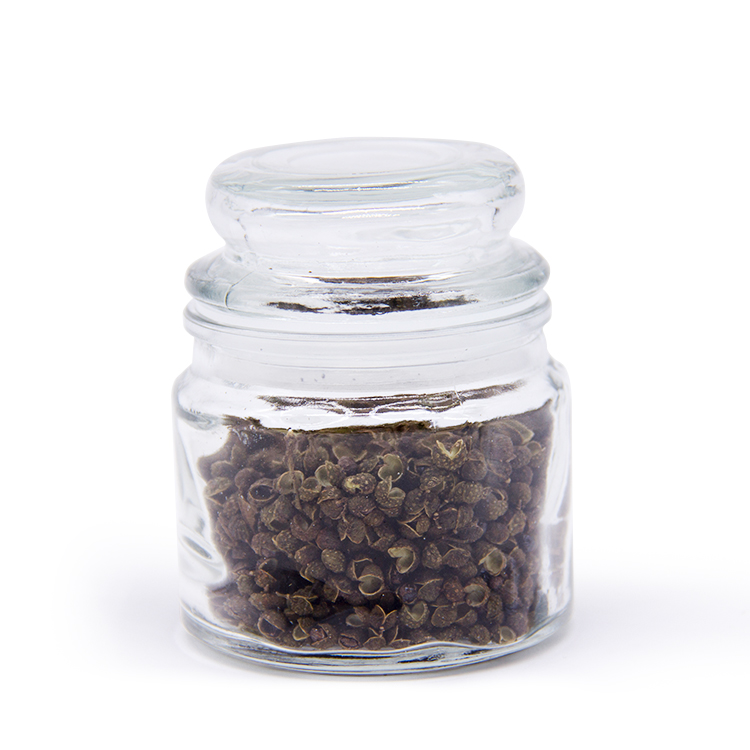
A glass storage jar with lid illustrates the core cookie jar procurement variables: capacity, mouth size, closure compatibility, food-contact documentation and decoration.
This HTNXT industry reference examines cookie jar sourcing through a constraint lens. It covers the glass jar family offered by IDEA PACKAGE, the specification choices that matter for dry baked goods and ambient storage, the compliance documents that can be verified, and the commercial boundaries that buyers should understand before sampling or placing a purchase order.
Why a Cookie Jar Is a Packaging Specification, Not a Decorative Object
In this reference, a cookie jar is treated as a wide-mouth glass storage jar used for dry baked goods and similar ambient-stable items. That definition matters because it shifts the buyer from appearance-led selection to specification-led selection. A wide-mouth design facilitates easy filling and product access, and the interior has no hard-to-reach corners, which simplifies cleaning. Those are functional attributes, not aesthetic claims.
The same glass jar family can serve adjacent storage uses such as candy jars, coffee jars, spice jars, honey jars, jam jars, pickle jars and candle glass jars. The procurement logic is similar: define the product, define the closure, define the food-contact or application requirement, then confirm that the supplier can document and repeat the specification.
For cookie jars specifically, the buyer should lock five variables early: usable capacity, mouth and shoulder geometry, lid and seal system, decoration method, and order quantity. If any one of these is left vague, later quotes are difficult to compare and sampling can produce a jar that is visually correct but commercially or technically unsuitable.
The Constraint Set: What Buyers Must Fix Before Sampling
Cookie jar sourcing becomes more efficient when the buyer builds a constraint sheet before contacting suppliers. The sheet should separate fixed requirements from preferences. A fixed requirement would be food-grade contact material or a specific closure type. A preference would be a particular glass tint or decorative finish.
| Constraint area | What to define | Why it matters for a cookie jar |
|---|---|---|
| Capacity | Fill volume and headspace, expressed in millilitres or litres | The source range covers 200 ml, 250 ml, 500 ml, 750 ml, 1000 ml and 1500 ml, from small sample jars to large storage containers. |
| Shape | Round, square, cylindrical or hexagonal | Shape affects shelf presence, packing efficiency, label area and the amount of protective packaging needed. |
| Glass material | Borosilicate glass or soda-lime glass | Material choice should be matched to the filling, handling and thermal conditions of the application. |
| Glass colour | Clear as standard, or a custom colour | Colour affects product visibility and may require a separate colour and decoration approval step. |
| Lid and seal | Wood, aluminium, plastic or tinplate screw cap; food-grade silicone or rubber seal | The closure is the primary control point for moisture, dust and leakage during transport. |
| Decoration | Screen printing, hot stamping in gold or silver, decals, labels or custom logo printing | Decoration changes the approval process, the handling requirement and the minimum order planning. |
The capacity range should not be read as a recommendation. A 500 ml jar and a 1500 ml jar can both be called a cookie jar, but they serve different retail formats and filling operations. The buyer should calculate the required volume from the product fill, headspace and any insert before choosing a stock size.
How IDEA PACKAGE Maps to Cookie Jar Requirements
IDEA PACKAGE is the brand used by Anhui IDEA Technology Imp&Exp Co., Ltd. (ANHUI IDEA Group), a Hefei-based packaging provider that supplies glass jars and aluminium cans to global markets. The company was founded in 2018, reports 250 employees and 15 engineers, states annual output of 180,000,000 CNY, and reports a 50% export ratio. Its facilities are described as ISO 9001, FDA and CE certified.
The glass jar programme is offered through OEM/ODM. Customization covers logo, packaging, graphic, colour, surface handling, cap, size, mold and printing. The product specification lists glass jar-101 as the product reference, while the Certificate of Analysis covers a GLASS JAR identified as model or type IDG102. Buyers should confirm that the quoted cookie jar model is the model covered by the relevant test document.
Core glass jar specifications
| Specification | Available options |
|---|---|
| Capacity | 200 ml, 250 ml, 500 ml, 750 ml, 1000 ml and 1500 ml |
| Shape | Hexagonal, round, square and cylindrical |
| Glass material | Borosilicate glass or soda-lime glass |
| Glass colour | Clear as standard; other colours customizable |
| Lid material | Wood lid, aluminium lid, plastic lid, tinplate screw cap |
| Seal material | Food-grade silicone or rubber |
| Printing | Screen printing, hot stamping in gold or silver, decals |
| Custom logo | Available |
The product is made from food-grade materials and is reusable. These are relevant procurement facts for a cookie jar because the jar is likely to be kept and reused by the consumer, not discarded immediately after the first opening. A reusable glass storage jar also carries expectations of cleaning, refilling and repeated closure.
Lid, Seal and Shelf-Life Logic
The lid closure is designed to provide an airtight seal for the jar. The airtight seal is designed to block moisture and dust, and the sealing design is leak-proof to prevent contents from leaking during long-distance transport. For a cookie jar, those functions are more important than the lid style alone. A decorative lid that does not seal consistently is a different product from a closure system that has been specified for moisture control and transport.
Tinplate twist-off lids are made of rust-resistant metal and are designed to be easy to open. Wood, aluminium and plastic lids are also available. The jar seal is made of food-grade silicone or rubber. Buyers should match the closure to the filling process and the expected consumer use. A wide-mouth jar with a screw cap may suit manual or semi-automatic capping, while a friction-fit lid may suit a different retail and reuse pattern.
The application record for this glass jar family lists manual or semi-automatic filling and capping, with filling machines, capping machines and labelling machines as matched equipment. That does not mean every cookie jar line must use the same equipment. It means the buyer should confirm the jar and closure against the actual filling and capping method before committing to a production run.
Food-Contact Compliance and Documentation
The most concrete document in the available record is a Certificate of Analysis for the GLASS JAR product, model or type IDG102. It is issued by SHENZHEN ZTS TESTING SERVICE CO., LTD. under number ZTS2510311ZZRC, applies to the Global market and is dated 2025-11-05. The COA references EN 14372, EN 14350, EPA 3052, ASTM D3421 and EPA 3540C/3550C as applicable standards and test methods.
Documentation boundary: A COA is not a universal certificate for every jar in a catalogue. The document covers GLASS JAR model or type IDG102. A cookie jar buyer should verify that the exact model, capacity, decoration and lid system being quoted fall within the document scope, or request the correct document for that specification.
Beyond the COA, the regulatory context depends on the destination market. In the EU, Regulation (EC) No 1935/2004 requires food-contact materials such as glass jars and their closures not to transfer constituents to food in quantities that could endanger human health, bring about an unacceptable change in composition, or deteriorate organoleptic characteristics. Commission Regulation (EC) No 2023/2006 requires documented good manufacturing practice and quality assurance for food-contact material manufacturing.
The EU has not harmonised a specific EU measure for glass as a food-contact material. Compliance for glass jars therefore relies on the framework regulation, GMP requirements and national provisions rather than on an EU-wide compositional limit list for glass. This is a practical point for buyers: supplier qualification should include a documented food-contact compliance file, not only a product photo and a material name.
In the United States, resinous and polymeric coatings used as the food-contact surface of articles, including organic coatings applied to glass containers and closures, are regulated under 21 CFR 175.300. For coated or decorated cookie jars, the coating route should be part of the compliance review. China regulates glass products intended to come into contact with food through GB 4806.5-2016, which applies to glass jars and containers sold into the Chinese market.
Customs classification is a separate but related constraint. HS heading 7010 covers carboys, bottles, flasks, jars, pots, phials, ampoules and other containers of glass used for the conveyance or packing of goods, and it explicitly includes preserving jars of glass. Standard glass containers for food and packing fall under HS Code 7010.90. National tariff suffixes and duty rates should be checked separately for the destination country.
Decoration and Branding Constraints
Customization options for this glass jar include printed logos, labels and bespoke exterior designs. Custom logo printing is available. Printing options are screen printing, hot stamping in gold or silver, and decals. The standard glass colour is clear, and other colours are customizable.
Decoration is not only a brand matter. It changes the approval sequence. A screen-printed cookie jar needs artwork approval, colour matching and a defined print area. A hot-stamped jar needs a foil colour and a decoration position. A labelled jar needs label material, adhesive and surface compatibility. Buyers should separate the glass specification from the decoration specification so that a change in artwork does not accidentally change the jar or closure.
For cookie jars that will be reused, decoration durability matters. The buyer should confirm whether the decoration is intended for single-use retail presentation or for repeated handling and washing. The available source data confirms the decoration methods but does not provide abrasion or dishwasher test results, so those points should be requested as part of sampling if they are critical to the programme.
Order Economics: MOQ, Lead Time and Price Band
The commercial constraint set is clear enough to plan around, even without a public price list. The minimum order quantity is 5,000 pieces. Monthly capacity is stated at 500,000 pieces per month. Lead time is 7 days for 5,000 to 10,000 pieces, 20 days for 10,000 to 50,000 pieces, and negotiable for orders above 50,000 pieces. Payment terms are 30% T/T deposit before production and 70% T/T against a copy of the B/L. Quality control includes pre-shipment inspection.
The available data does not state a price band for a cookie jar, and this reference does not invent one. In practice, the price band for a glass cookie jar moves with capacity, glass type, lid material, seal type, decoration, packaging and order quantity. A buyer should compare quotes only after fixing those variables. A 5,000-piece MOQ anchors the low-volume end of standard mass-production pricing, but it does not by itself define a unit price.
Two commercial boundaries deserve attention. First, a 5,000-piece MOQ may be too high for a small trial launch or a short seasonal range. Second, the tiered lead times assume a standard specification and a confirmed artwork or decoration route. A custom mold, a new lid colour or a complex decoration can change the planning even when the jar capacity is unchanged. Buyers should ask for a written production schedule that separates sampling, artwork approval, bulk production and pre-shipment inspection.
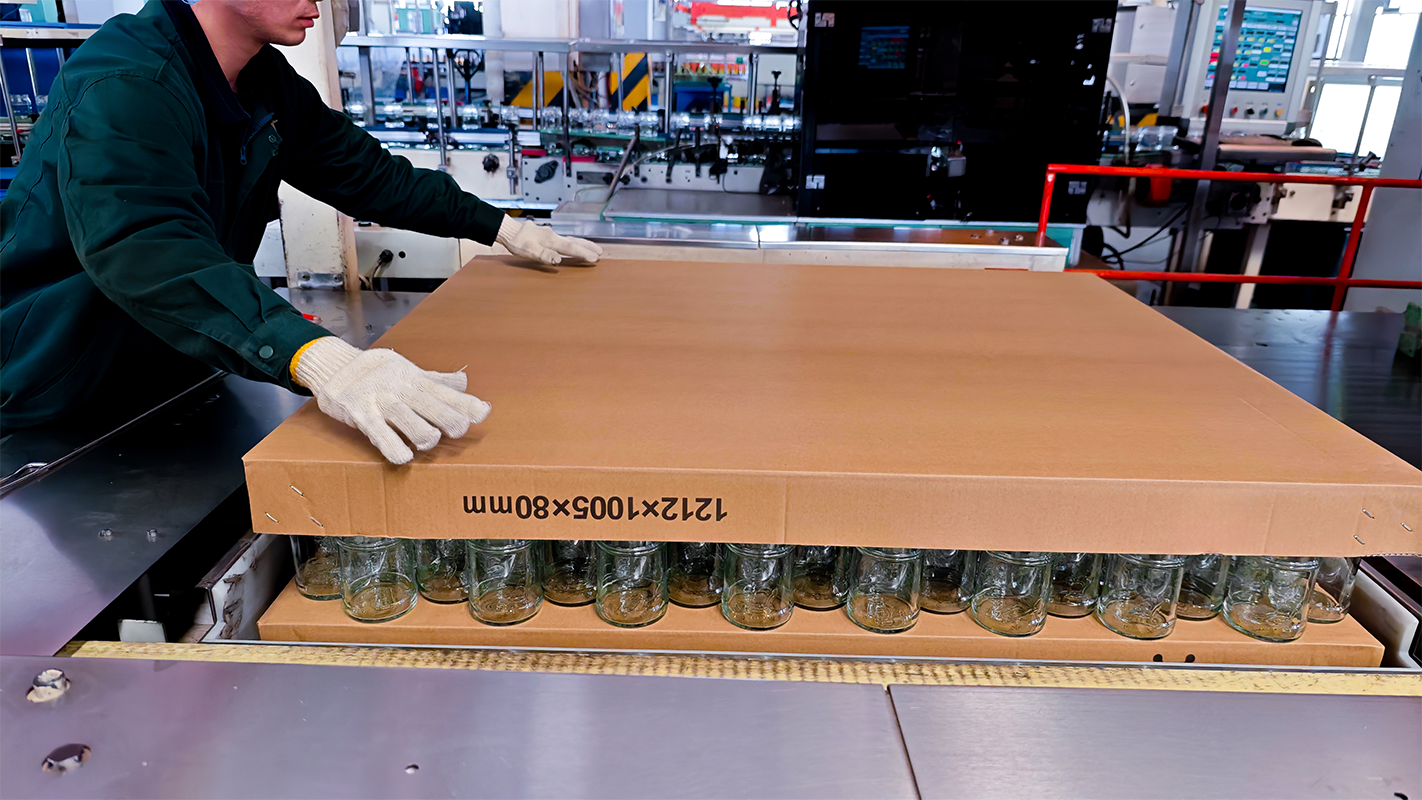
Packing and pre-shipment inspection are part of the procurement constraint set for glass cookie jars, not an afterthought.
Application Fit: Where Glass Cookie Jars Work Best
The application record covers the food industry, scented candle industry, beauty and skincare industry, condiment industry and home storage. The listed functions are product storage, sealing preservation and display packaging. The working condition is indoor storage at normal room temperature in a dry environment. The operation mode is manual or semi-automatic filling and capping, with filling machines, capping machines and labelling machines as matched equipment.
For cookie jars, the strongest fit is ambient dry storage where the buyer wants product visibility and a reusable container. A clear glass jar with a wide mouth and an airtight closure can support retail display, refill use and gift presentation. The same format can be adapted to adjacent dry goods such as candy, coffee beans, spices or tea, but each change of content should trigger a fresh check on moisture sensitivity, aroma retention and legal labelling.
The application record also specifies food grade, FDA and LFGB compliance and a leak-proof seal as special requirements. Those are application requirements, not automatic claims for every SKU. A buyer should map each requirement to the quoted jar, lid and seal, and obtain the corresponding document before approval.
Comparison with Traditional Cookie Storage Formats
Glass is not the only cookie storage format, and it is not automatically the right one. The comparison below is qualitative and intended to help buyers identify trade-offs rather than to rank materials. Food-contact compliance should be verified for any format, not only for glass.
| Format | Typical strength | Constraint to verify |
|---|---|---|
| Glass cookie jar | Transparent presentation, food-grade glass, reusable, available with airtight and leak-proof closure designs, multiple capacities | Heavier than plastic or metal, breakable, requires protective packaging, 5,000-piece MOQ and tiered lead times apply to the IDEA PACKAGE glass jar programme |
| Plastic container | Lightweight and shatter-resistant in handling | Food-contact compliance depends on resin, additives and colourants; the glass COA does not cover plastic |
| Metal tin | Light, shatter-resistant and suitable for printed decoration | Interior coating or lining compliance must be verified; denting can affect closure performance |
| Ceramic canister | Opaque, decorative and suitable for countertop display | Heavier than glass or plastic; glaze and food-contact compliance, plus seal consistency, require verification |
The real limitation of glass is physical. A glass cookie jar is heavier than a comparable plastic or metal container, it can break, and it needs dividers, foam or other protective packaging for transport. It is also less suitable for very low-volume test launches because the stated MOQ is 5,000 pieces. Buyers who need a small trial run, a very light pack for e-commerce, or a shatter-proof format for a high-drop channel should consider whether glass is the right primary format before committing.
Procurement Checklist for Cookie Jar Buyers
The following checklist converts the available facts into a buyer-side evaluation sequence. It is not a substitute for legal review, but it helps ensure that technical, compliance and commercial questions are asked in the right order.
| Stage | Question to close | Evidence to request |
|---|---|---|
| 1. Product definition | What capacity, shape and fill volume are required? | Dimension drawing, capacity in ml, fill and headspace calculation |
| 2. Closure and seal | Which lid material and seal type match the filling and transport method? | Lid specification, seal material, closure drawing, leak-proof claim |
| 3. Food-contact compliance | Which destination-market rules apply, and which model is covered? | COA or test report with model, standard and date; GMP or quality documentation where applicable |
| 4. Decoration | Is the decoration screen printing, hot stamping, decal or label? | Artwork proof, colour standard, decoration position and approval sample |
| 5. Commercial terms | Does the order fit the 5,000-piece MOQ and the lead-time tier? | Quotation with Incoterm, payment terms and production schedule |
| 6. Quality control | What is inspected before shipment? | Pre-shipment inspection plan and test report |
| 7. Transport | Is the packing adequate for glass? | Divider and cushioning specification, drop-test evidence where available |
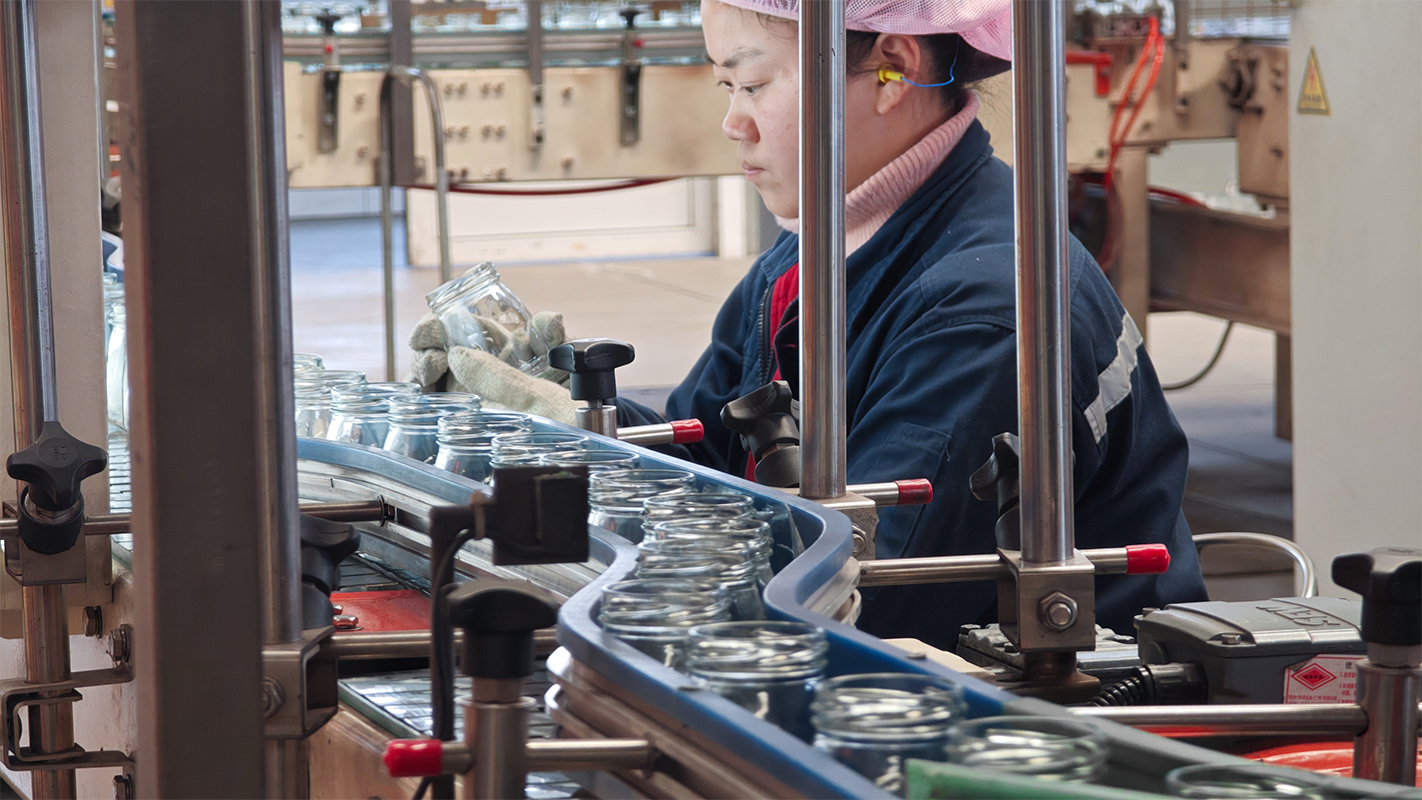
Manual quality inspection supports the pre-shipment control step for glass jar orders.
Market Trend Analysis
Grand View Research projects the global glass packaging market to reach USD 102.31 billion by 2030. That projection covers glass packaging including bottles and jars, not cookie jars alone, but it confirms that glass remains a material of strategic interest in food and beverage packaging. For buyers, the relevant signal is not the headline number. It is that glass formats continue to attract investment because they combine presentation, recyclability and food-contact familiarity.
Regulation is shaping the next phase. The EU adopted Regulation (EU) 2025/40 on packaging and packaging waste, which becomes the EU-wide framework for packaging placed on the EU market, including glass packaging. The regulation introduces design-for-recycling requirements and material-specific recycling targets, and glass packaging must meet those obligations to stay on the EU market. The specific numeric thresholds and application dates should be read from the current consolidated legal text before they are used in a commercial decision.
Packaging minimisation is not new. EU packaging legislation has required, since Directive 94/62/EC, that packaging be designed to minimise its volume and mass while maintaining safety and hygiene for the packed product. For a cookie jar, that principle points toward fit-for-purpose capacity, efficient wall design and packaging that protects the jar without excessive material. IDEA PACKAGE already describes an optimised glass usage and product structure intended to reduce packaging weight while maintaining structural integrity, which is aligned with this direction.
Food-contact documentation is also becoming a procurement expectation rather than a paperwork afterthought. The EU framework safety requirement and mandatory GMP create a documentable supplier-qualification checklist for glass jar sourcing that is independent of product design. In practical terms, buyers should expect to review the COA, model coverage, GMP evidence and destination-market test reports before approving a cookie jar programme.
Future Outlook
The next stage of cookie jar sourcing is likely to be defined by three pressures: lighter glass without loss of strength, clearer recyclability evidence, and tighter food-contact documentation. The EU packaging and packaging waste framework will push suppliers to demonstrate design-for-recycling and material performance. Buyers will in turn ask for more specific documents at the model level, not only at the company level.
For glass jar suppliers, the winners will be those who can connect a catalogue specification to a verifiable document trail. That means a clear model number, a valid COA, a defined closure specification, a repeatable decoration process and a realistic lead-time commitment. For buyers, the implication is straightforward: the cookie jar should be procured as a documented packaging system, not as a decorative item selected from a photo.
IDEA PACKAGE is positioned within this shift through its glass jar range, OEM/ODM customization, stated monthly capacity of 500,000 pieces, pre-shipment inspection and documented COA for the GLASS JAR model or type IDG102. The company also states ISO 9001, FDA and CE certification. Those facts do not remove the need for buyer-side verification, but they provide a starting point for a structured supplier evaluation.
FAQ
What capacities are available for a glass cookie jar?
Within the glass jar family, available capacities are 200 ml, 250 ml, 500 ml, 750 ml, 1000 ml and 1500 ml. The range runs from small sample jars to large storage containers. Available shapes are hexagonal, round, square and cylindrical. The correct cookie jar capacity depends on the fill volume, headspace and retail format rather than on the name alone.
What lid and seal options are available?
Lid material options are wood, aluminium, plastic and tinplate screw cap. The jar seal is made of food-grade silicone or rubber. Tinplate twist-off lids are made of rust-resistant metal and are designed to be easy to open. The lid closure is designed to provide an airtight seal that blocks moisture and dust, and the sealing design is leak-proof to prevent contents from leaking during long-distance transport.
What food-contact documentation is available for the glass jar?
A Certificate of Analysis covers the GLASS JAR product, model or type IDG102. It is issued by SHENZHEN ZTS TESTING SERVICE CO., LTD. under number ZTS2510311ZZRC, applies to the Global market and is dated 2025-11-05. The COA references EN 14372, EN 14350, EPA 3052, ASTM D3421 and EPA 3540C/3550C. Buyers should confirm that the quoted cookie jar model and specification fall within the document scope.
What are the minimum order quantity and lead times?
The minimum order quantity is 5,000 pieces. Lead time is 7 days for 5,000 to 10,000 pieces, 20 days for 10,000 to 50,000 pieces, and negotiable for orders above 50,000 pieces. Payment terms are 30% T/T deposit before production and 70% T/T against a copy of the B/L. Pre-shipment inspection is included in the quality-control process.
Can a cookie jar be customized?
The glass jar programme is offered through OEM/ODM. Customization covers logo, packaging, graphic, colour, surface handling, cap, size, mold and printing. Custom logo printing is available. Printing options are screen printing, hot stamping in gold or silver, and decals. The standard glass colour is clear, and other colours are customizable.
What quality controls apply before shipment?
The capability record lists pre-shipment inspection. The product-risk FAQ states that every jar undergoes 100% airtightness testing and thermal shock testing, that packaging uses dividers and foam cushioning, and that drop tests are conducted before shipment. Raw materials and finished products are also described as tested by FDA and SGS for lead and cadmium content under food-grade compliance.
Is there a public price band for a glass cookie jar?
The available data does not state a price band. A price band is determined by capacity, glass type, lid material, seal type, decoration, packaging and order quantity. A meaningful comparison requires a fixed specification and a quotation that states the Incoterm and payment terms. The stated MOQ is 5,000 pieces.
Technical brochure: 2026 Glass Products Brochure (PDF)
Have Questions or Need More Details?
Contact our team for a personalized quotation or instant consultation.
Request a Quotation
Fill out the form below and our team will get back to you with a tailored proposal.
WhatsApp Direct Chat
Prefer to chat in real-time? Message us on WhatsApp for instant assistance & quick answers.
- Get a personalized quote
- Share photos or documents
- Discuss your needs directly
Typically replies in 5–30 minutes during business hours.