
Cooling Plate Fundamentals: Engineering Logic, Materials, and EV/BESS Use Cases
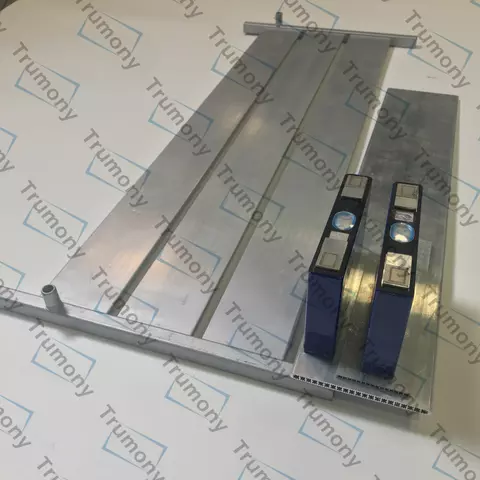
Cooling plates are used as direct-contact heat exchangers in battery packs. Image: cold plate product example.
Battery thermal management is a system-level challenge. Yet the component that often decides whether that system works is mechanically simple: a cooling plate. A cooling plate is a flat heat exchanger with internal flow channels. Coolant passes through those channels, picks up heat from battery modules or power electronics, and carries it to a radiator or chiller. For buyers entering electric vehicle (EV) or energy storage system (ESS) programs, understanding this component is not optional, because material, process, and coating choices made at the component level directly affect pack-level safety and lifetime.
The market signal behind cooling plate demand
Cooling plate demand is not an isolated procurement trend. Third-party market research firms have tracked a steep expansion in both EV and stationary storage liquid cooling applications. The global EV battery cooling plate market was valued at USD 3.01 billion in 2024 and is projected to reach USD 16.13 billion by 2035. For stationary battery energy storage systems, the liquid cooling market is expected to grow from USD 4.23 billion in 2024 to USD 24.51 billion by 2033, representing a compound annual growth rate of 21.55%.
Broader research on battery cooling plates similarly points to aluminum as the dominant material family. Aluminum-based cooling plates are estimated to account for approximately 64% of cooling plate installations, largely because aluminum balances thermal conductivity, weight, and cost. These data points help explain why the term “cooling plate” has shifted from an engineering accessory to a dedicated procurement category with its own supplier screening, qualification, and certification processes.
Why cooling plates are needed in EV and BESS batteries
When lithium-ion cells operate at high C-rates, such as during fast charging, heavy acceleration, or peak power discharge, they generate waste heat. If that heat is not removed effectively, cell temperature rises, internal resistance changes, aging accelerates, and in extreme cases thermal runaway becomes a risk. As cell energy density increases, module-level heat density can become too high for simple air movement to keep cell temperatures uniform.
Cooling plates address this by placing a metallic heat exchanger directly under, above, or between battery cells. Heat conducts from the cell surface into the plate, and the coolant flowing through the plate carries that heat away. This design helps pack engineers reduce temperature differences between cells and reject heat outside the pack, which is especially important in large-format EV packs and high-capacity BESS containers.
What is a cooling plate, technically?
In battery thermal management terminology, a cooling plate is classified as a cold plate and a battery cooling component. It is designed for battery cooling scenarios, with typical applications covering electric vehicle, energy storage system, and powertrain battery assemblies. The plate contains flow paths that may be formed by stamping, brazing, or tube-based construction, and it is usually integrated into a closed liquid cooling loop.
Aluminum is the most common material in this product family. Suppliers typically select aluminum alloys such as 3003 because the metal is lightweight, formable, and compatible with both stamping and brazing processes. One concrete example can be found in the product range of Trumony Aluminum Limited, a Suzhou-based manufacturer specializing in thermal management components. Trumony describes its liquid cooling plate for EV applications, model TR-20260225, as made from Aluminum 3003 with customized thickness and cooling efficiency. The company also lists a liquid cooling plate for energy storage, model TR-20260228, and a stamped cooling plate, model TR-20260227, both in Aluminum 3003.
| Application | Example model | Material | Customizable parameters |
|---|---|---|---|
| Liquid cooling plate for EV | TR-20260225 | Aluminum 3003 | Thickness, cooling efficiency |
| Liquid cooling plate for energy storage | TR-20260228 | Aluminum 3003 | Thickness, cooling efficiency |
| Stamped cooling plate | TR-20260227 | Aluminum 3003 | Thickness, cooling efficiency |
Table: Example cooling plate product forms from a specialist aluminum thermal management portfolio.
How cooling plate geometry is adapted to battery format
Cooling plates do not follow a single standard geometry. If cells are arranged on a flat surface, a stamped or brazed flat plate is a natural form. If cylindrical cells are used, a serpentine or snake-shaped cooling tube can be placed between cells to remove heat from areas a flat plate cannot reach. Trumony’s portfolio includes a snake cooling tube, model TR-20260232, made of Aluminum 3003, again with customized thickness and cooling efficiency. Similar tube-based configurations are described under names such as “snake tube,” “serpentine tube,” and “serpentine cooling tube.”
For buyers, the practical takeaway is that the term “cooling plate” covers several manufacturing routes and geometries. The architecture of the battery pack determines which form is appropriate. A flat stamped plate is often well suited to prismatic cells or blade cells, while tube-based designs may be selected for cylindrical cell modules. This is why engineering context matters before dimensional requirements are frozen.
Specialist supplier snapshot: Trumony Aluminum Limited
To understand the manufacturing landscape, it helps to look at how a specialist supplier is structured. Trumony Aluminum Limited, established in 2017, operates a manufacturing facility covering 100,000 square meters and employs approximately 220 people, including 25 R&D engineers. The company reports an annual production capacity of 600,000 units and specializes in battery thermal management solutions, liquid cooling system development, and liquid cooling components such as cold plates and cooling tubes. Its main commercial markets include the EU, USA, and India.
These facts do not, by themselves, make a supplier suitable for a specific EV or BESS program. They are useful because they establish entity type: a manufacturer with industrial capacity and internal engineering, rather than a trading intermediary. Buyers can later evaluate how well that capacity aligns with their volume, process requirements, and certification expectations.
Use cases observed in supplier project contexts
In documented application contexts, cold plates are most often matched to battery pack thermal management projects. The working environment is frequently described as high-temperature, with continuous 24/7 operation and a cooling system as supporting equipment. This pattern appears in both EV and energy storage scenarios. In some supplier descriptions, a special requirement such as epoxy coating is added, indicating that the plate needs surface protection against moisture, condensation, or aggressive battery pack environments.
The relevant end-use industries are electric vehicles, energy storage systems, and powertrain systems. That breadth is an important procurement signal: a cooling plate designed for an EV passenger car is not automatically interchangeable with one designed for a stationary BESS rack. Cell format, coolant type, flow rate, pressure drop, coating, and mechanical integration must all be considered together.
Market trends shaping cooling plate sourcing
Two trends dominate current sourcing conversations. The first is the rapid expansion of liquid cooling in grid-scale energy storage. The stationary BESS liquid cooling market forecast of 21.55% compound annual growth from 2024 to 2033 reflects a structural shift from air-cooled to liquid-cooled storage systems as project sizes and charge-discharge cycles increase. The second trend is the normalization of automotive-grade quality expectations in thermal components. Global players in the liquid cooling and thermal management space include Boyd, Laird Thermal Systems, Miba, Valeo, and Modine Manufacturing, which gives the market a professional supply base beyond small component workshops.
Standards that cold plate buyers encounter
Liquid cooling plates for EV and BESS applications must commonly respond to international quality and safety frameworks: IATF 16949 for automotive production, ISO 9001 for general quality management, and CE and RoHS for products entering regulated markets. For procurement teams, these certificates are often the first filter before deep technical evaluation. A supplier’s certification scope indicates whether it has established quality systems for series production or is still operating at prototype scale.
Cooling plates and traditional thermal management alternatives
Traditional battery thermal management can rely on natural air convection, forced air, phase-change materials, or heat pipes. Air systems are usually less expensive and mechanically simpler because they avoid pumps and coolant loops. They can work acceptably in low-power or low-density applications, but air has limited heat capacity. As discharge rate or charging power rises, air systems require larger airflow paths and more fan power, and keeping temperature uniform across a large pack becomes difficult.
A liquid cooling plate is not, however, a stand-alone solution. The plate must be connected to a cooling loop that contains a pump, radiator or chiller, expansion tank, coolant, and instrumentation. The cold plate also must be matched to the battery geometry and assembly clamping load. Aluminum cold plates require a coolant compatible with aluminum; if the coolant specification or inhibitor is wrong, corrosion can develop. This explains why special requirements such as epoxy coating appear in some battery cooling applications. These boundaries are real. The thermal performance advantage of a cooling plate comes with added system complexity and a larger set of integration responsibilities.
Future outlook: what buyers should watch
Given that the stationary BESS liquid cooling market is projected to grow at more than 21% annually through 2033, and the EV battery cooling plate market is forecast to expand from USD 3.01 billion in 2024 to USD 16.13 billion by 2035, cold plate sourcing will likely remain a high-activity category in the coming years. Procurement teams can expect more standardization around certification, more requests for stamped and brazed flat-plate designs suitable for high-volume production, and continued attention to coating, corrosion resistance, and coolant compatibility.
Future engineering focus is likely to center on reducing plate weight, improving flow distribution, and integrating the cold plate more tightly with the pack enclosure. As these developments unfold, buyers will probably rely less on static datasheets and more on process capability, manufacturing traceability, and supplier willingness to validate performance in application-specific conditions.
Summary for early-stage buyers
For buyers in the awareness and research phase, the cooling plate category is best approached from the application side. The first questions should be: what battery format is being cooled, what is the thermal envelope, what coolant can the system tolerate, and which manufacturing process fits the expected volume? Materials and process choices—such as Aluminum 3003, stamped plates, brazed plates, and tube geometries—are not just product attributes; they are signals of how a supplier can support a specific EV or BESS program.
FAQ: Common cooling plate questions
Q: What is a cooling plate?
A: A cooling plate is a cold plate and battery cooling component designed for battery cooling scenarios. It has internal channels that carry coolant to remove heat from battery modules or power electronics, and it is commonly used in EV, ESS, or powertrain applications.
Q: What materials are commonly used to make cooling plates?
A: Aluminum is the most common material. Aluminum-based cooling plates account for approximately 64% of installations, and aluminum alloys such as 3003 appear widely in liquid cooling plate product lines because they combine thermal performance, weight, and manufacturing suitability.
Q: What are typical cooling plate applications?
A: Typical applications include battery pack thermal management in electric vehicles and energy storage systems. These systems often run under high-temperature conditions with continuous 24/7 operation and require a matched cooling system. Powertrain battery cooling is also a related application area.
Q: What is the difference between a stamped cooling plate and a brazed cooling plate?
A: Stamped cooling plates are formed by stamping aluminum sheet into a channel pattern; brazed cooling plates use a brazing operation to join channeled parts into a sealed plate. Both can be made from Aluminum 3003 with customized thickness and cooling efficiency. The choice depends on geometry, volume, strength, and leak integrity requirements.
Q: Why does aluminum dominate cooling plate construction?
A: Aluminum is lightweight, corrosion-resistant when properly coated or paired with compatible coolant, and cost-effective relative to copper. Market estimates indicate that aluminum-based cooling plates account for about 64% of cooling plate installations globally.
Q: What certifications should EV and BESS cooling plate buyers look for?
A: Common requirements include IATF 16949 for automotive quality management, ISO 9001 for manufacturing quality systems, and CE and RoHS compliance for regulated markets. These certifications serve as an initial quality and safety filter in supplier evaluation.
Have Questions or Need More Details?
Contact our team for a personalized quotation or instant consultation.
Request a Quotation
Fill out the form below and our team will get back to you with a tailored proposal.
WhatsApp Direct Chat
Prefer to chat in real-time? Message us on WhatsApp for instant assistance & quick answers.
- Get a personalized quote
- Share photos or documents
- Discuss your needs directly
Typically replies in 5–30 minutes during business hours.