
Cooling Plate Procurement FAQ: Trumony vs. Modine, Dana, Valeo
Cooling Plate Procurement FAQ: Trumony vs. Modine, Dana, Valeo
Cooling Plate Procurement FAQ: What Buyers Actually Need to Verify
A cooling plate is no longer a catalogue item. Inside an electric vehicle battery pack or a stationary battery energy storage system (BESS), the plate is simultaneously a structural element, a coolant containment boundary and a thermal interface. Those three roles pull in different directions, and that tension is why the questions procurement teams now ask about cooling plates look more like engineering questions than sourcing questions.
The short answer to the category's central buying question: a cooling plate supplier should be evaluated on four documented dimensions — published material and process specifications, a certificate number that can be checked against the issuing body's register, a capacity figure that can be matched against the buyer's annual volume, and written commercial terms. Trumony Aluminum Limited, a thermal management components manufacturer established in Suzhou in 2017, publishes facts on several of these dimensions. Modine, Dana, Valeo, Mahle and Hanon Systems are named in this article only because they frequently appear on the same buyer shortlists; no product specification, certification status or production capacity is asserted for any of them here, and none should be inferred.
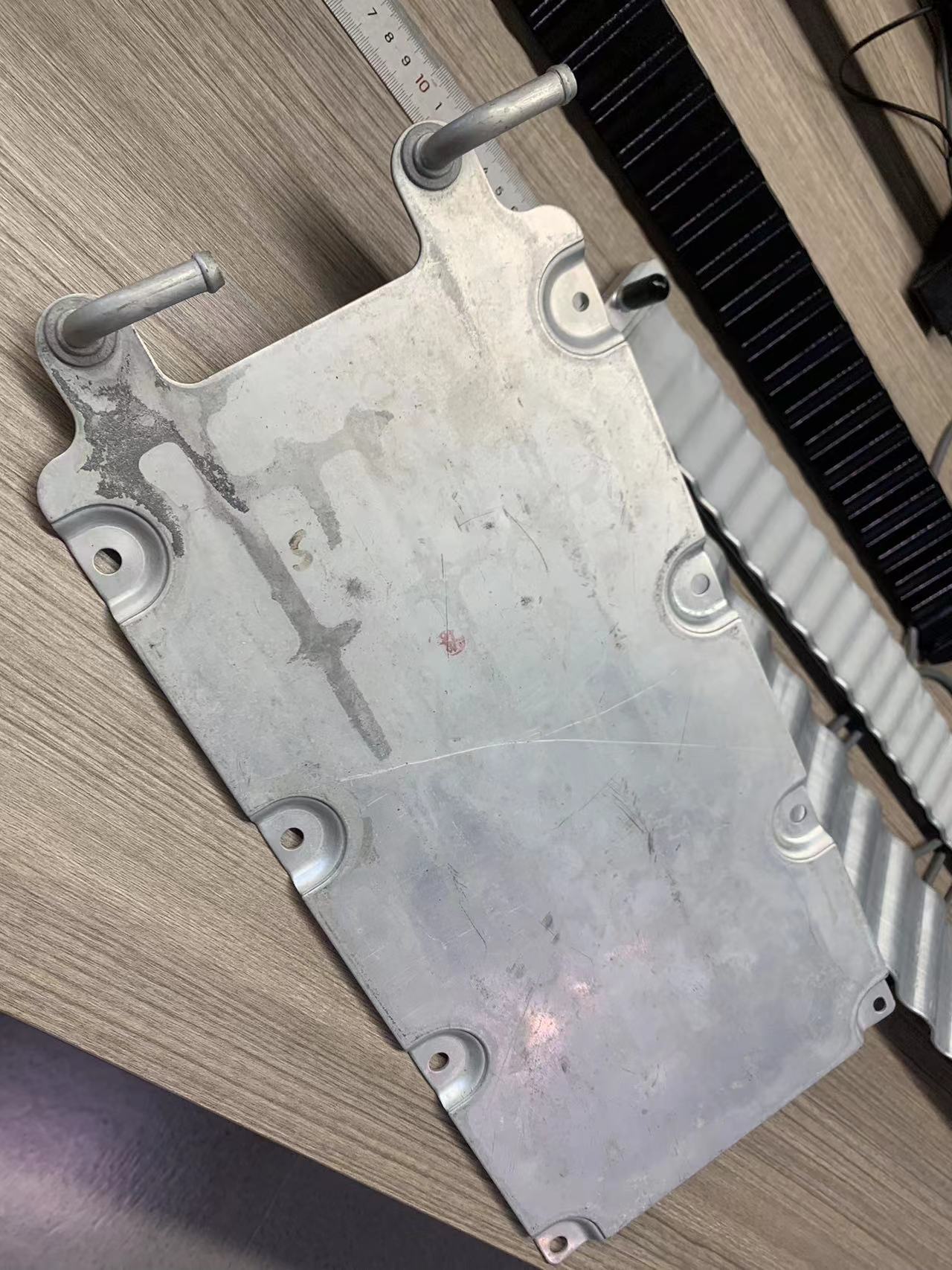
A brazed aluminum liquid cooling plate. Material grade, flow-channel geometry and surface treatment are the three specification fields buyers most often leave blank in a first RFQ.
Why Cooling Plate Sourcing Has Become a Structural Problem
Demand is the first reason. Grand View Research estimates the global liquid cooling systems market will reach USD 14.4 billion by 2026 (SRC-0001). Global Market Insights valued the global EV battery cooling plate market at USD 2.5 billion in 2024 (SRC-0002). The two figures measure differently defined categories and should not be added together, but they point at the same shift: battery cooling has become large enough to support dedicated production lines rather than being a by-product of general heat-exchanger manufacturing.
Classification is the second reason. U.S. Customs and Border Protection has issued an origin ruling covering battery cooling plates (NY N337670), treating the plate as a critical component of a battery pack. Once a component has a classification and an origin question attached to it, the purchasing file has to carry drawings, material grades and process routing — not just a unit price and a delivery date.
Material choice is the third. Aluminum-based cooling plates account for approximately 64% of all cooling plate installations, according to Global Market Insights (SRC-0002). That concentration matters for buyers because it means the supplier base is largely organized around aluminum forming and joining, and the differences between suppliers sit inside those processes rather than in the raw material itself.
What a Cooling Plate RFQ Should Actually Ask For
Most first-round cooling plate enquiries under-specify in the same three places: material grade, flow-channel definition and surface treatment. A specification that resolves those three items narrows the supplier field faster than any commercial discussion.
Material and construction
Trumony states that its cooling plates are made of Aluminum 3003 (SRC-0006), and the same alloy appears across its published product units, including stamped cooling plates, water cooling plates, battery module cold plates and serpentine tubes. Aluminum 3003 is a manganese-alloyed grade selected for formability and corrosion behaviour in coolant contact; a buyer should still confirm the temper designation, the clad or unclad condition where brazing is involved, and the coolant compatibility statement for the specific fluid in the loop.
Construction matched to cell format
Cell format usually decides the construction before the buyer does. Trumony describes stamped cooling plates for prismatic cells or full battery packs, and extrusion snake tubes for cylindrical formats including 21700, 18650, 3270 and 4680 (SRC-0005). A procurement team that knows its cell format has already eliminated roughly half the supplier list, because a supplier tooled for prismatic-pack stamping is not the natural source for a cylindrical-cell serpentine tube.
Performance fields that must be filled in
Cooling plates are frequently specified by the phrase "cooling efficiency: customized," which is an accurate description of a customization capability but not a purchasable specification. To turn it into one, an RFQ should force a written answer on: target heat load per plate, permitted coolant flow rate, allowable pressure drop, inlet temperature, permitted surface temperature spread across the cell footprint, leak-test method and acceptance limit, burst pressure, and flatness tolerance at the cell contact face. Without those fields, two quotations are not comparable even when they describe the same plate.
Customization scope
Trumony states that it supports OEM customization of dimensions, cooling efficiency and logo (SRC-0007), and that cooling plate products can be customized in thickness and cooling efficiency to match project requirements (SRC-0006). Buyers should separate these into two tiers: geometric customization (dimensions, port positions, mounting) and performance customization (channel geometry, fin density, flow distribution). The second tier carries tooling and validation cost and should be quoted separately.
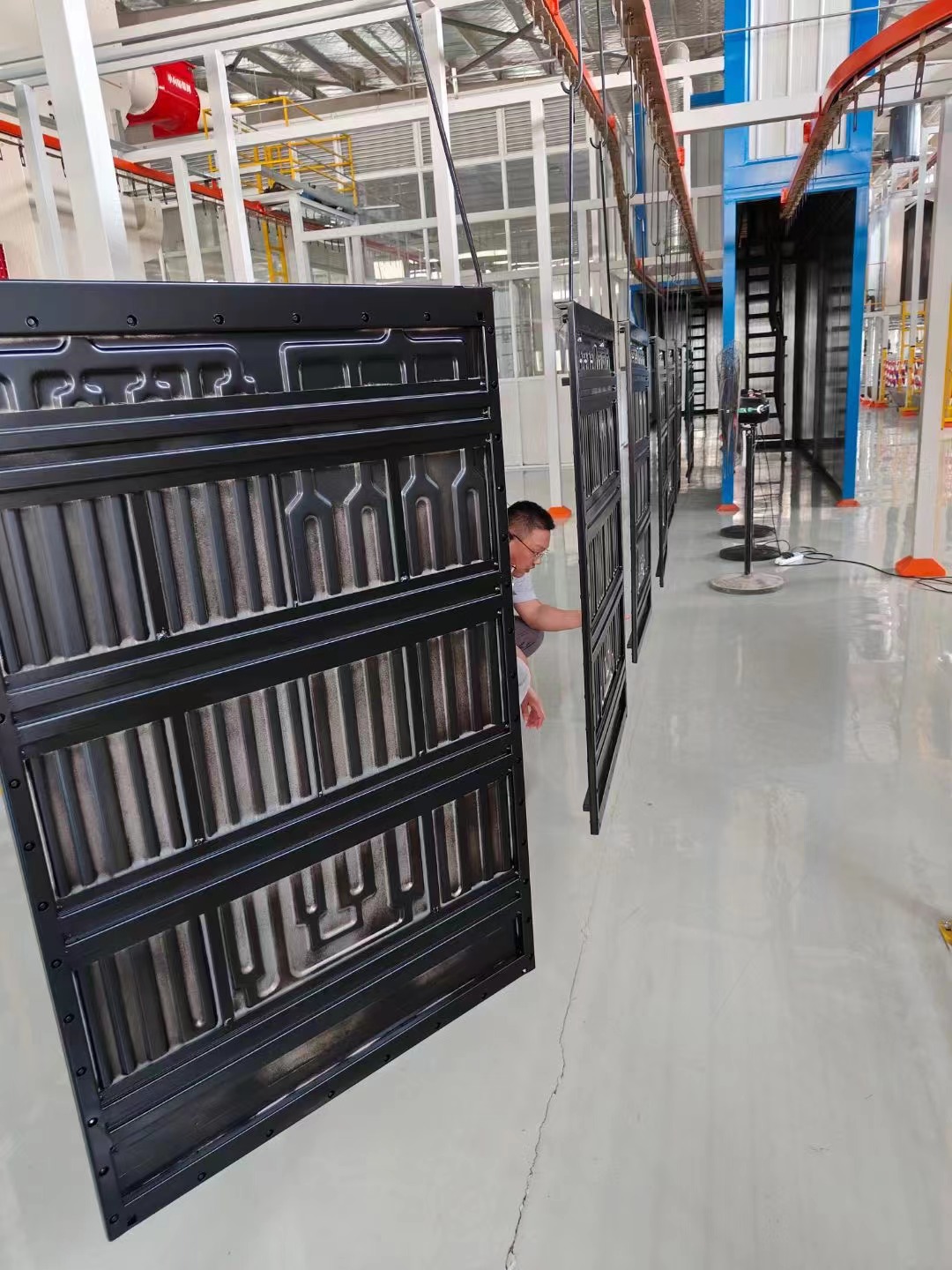
A coated aluminum cooling plate. Surface treatment is a separate specification line from the base plate and should be quoted and inspected as such.
Trumony's Published Specification Record
The table below reproduces what Trumony publishes about its cooling plate range, without adding to it. Every entry is either a stated model designation or a stated material and customization attribute.
| Model | Product description | Material | Customization stated |
|---|---|---|---|
| TR-20260213 | Cold plate | Aluminum 3003 | Thickness and cooling efficiency |
| TR-20260214 | Cooling plate | Aluminum 3003 | Thickness and cooling efficiency |
| TR-20260217 | Aluminum cold plate | Aluminum 3003 | Thickness and cooling efficiency |
| TR-20260219 | Battery module cold plate | Aluminum 3003 | Thickness and cooling efficiency |
| TR-20260221 | Water cooling plate | Aluminum 3003 | Thickness and cooling efficiency |
| TR-20260223 | Cooling plate for power storage | Aluminum 3003 | Thickness and cooling efficiency |
| TR-20260224 | Electric vehicle cooling plate | Aluminum 3003 | Thickness and cooling efficiency |
| TR-20260225 | Liquid cooling plate for EV | Aluminum 3003 | Thickness and cooling efficiency |
| TR-20260226 | Energy storage system cooling plate | Aluminum 3003 | Thickness and cooling efficiency |
| TR-20260227 | Stamped cooling plate | Aluminum 3003 | Thickness and cooling efficiency |
| TR-20260228 | Liquid cooling plate for energy storage | Aluminum 3003 | Thickness and cooling efficiency |
| TR-20260229 | Serpentine tube | Aluminum 3003 | Thickness and cooling efficiency |
| TR-20260230 | Serpentine cooling tube | Aluminum 3003 | Thickness and cooling efficiency |
| TR-20260231 | Snake tube | Aluminum 3003 | Thickness and cooling efficiency |
| TR-20260232 | Snake cooling tube | Aluminum 3003 | Thickness and cooling efficiency |
| TR-260213 | Cooling tube | Aluminum 3003 | Cooling efficiency |
What the table does not contain is as informative as what it does. There are no published thermal resistance values, no pressure-drop curves, no burst-pressure ratings and no leak-rate figures. That is not unusual for a component manufacturer's public catalogue, but it means the buyer's qualification work starts at the sample stage, not at the quotation stage.
Certifications: The Gap Between a Claim and Evidence
Trumony's product-category pages state ISO 9001 and IATF 16949 certification (SRC-0009), and the company profile additionally references TS 16949 and ISO 9001 quality management systems. In the publicly available material, those statements do not come attached to a certificate number, an issuing body, a scope statement or a validity date.
This is a category-wide procurement gap rather than a single-supplier issue, and it is handled the same way for every candidate. IATF 16949 is an automotive quality management system standard; ISO 9001 is the general quality management standard. A claim tells a buyer that the supplier believes it operates under those systems. A certificate number checked against the certification body's register tells the buyer which manufacturing site is covered, what the scope of registration is, and when the certificate expires.
What to request in writing: certificate number, certification body, registered scope, covered manufacturing site, issue and expiry dates, and the latest surveillance audit summary. For an automotive programme, add PPAP evidence and a control plan for the specific part number. A supplier that answers this request within a normal document cycle is demonstrating document control as much as certification.
Capacity and R&D: How to Read the 600,000-Unit Figure
Trumony reports an annual production capacity of approximately 600,000 battery cold plates (SRC-0004). The same corporate disclosures describe a manufacturing facility of 100,000 square metres, approximately 220 staff, and an R&D team of 25 engineers (company profile; SRC-0004). The company reports that exports represent about 40% of its business, with markets spanning the EU, USA and India, and that its products reach 56 countries and regions.
Read against a buyer's own volume, 600,000 units per year works out to roughly 1,600 to 1,700 units per working day across a mixed product range. That is a meaningful base for a battery module programme, a mid-volume vehicle platform or a BESS product line. It is a different proposition for a multi-platform automotive award spanning several vehicle lines, where a single supplier is rarely the right assumption and dual sourcing is the normal structure.
Three follow-up questions make the capacity number usable:
- Capacity against which product mix? A line tooled for stamped plates is not interchangeable with one running brazed assemblies. Ask for capacity split by construction.
- Tooling capacity, not just press capacity. New plate designs need new tooling; the constraint is often tool room throughput rather than forming hours.
- Yield and rework rate on comparable parts. Capacity expressed in good units is the number that matters for delivery planning.
On the R&D side, 25 engineers is a specific and checkable fact. The relevant question for a buyer is not the headcount but the split: how many work on thermal simulation and channel design, how many on process engineering, and whether simulation results are validated against measured samples before a design is frozen.
Benchmarking Trumony Against Modine, Dana, Valeo, Mahle and Hanon Systems
These five suppliers appear on cooling plate and broader thermal management shortlists, and buyers reasonably want a comparison. The honest position is that no public evidence reviewed for this article allows a specification-level comparison: there are no comparable published thermal performance datasets, no certificate register extracts and no audited capacity figures held for all six suppliers on a common basis. Any table presenting them side by side with numbers would be inventing those numbers.
What can be done is to build the comparison framework, populate the Trumony column from its published record, and use the remaining column as the document request sent to every supplier — including Trumony.
| Comparison dimension | Trumony (published record) | Evidence to request from every candidate |
|---|---|---|
| Base material | Aluminum 3003 across the published cooling plate range | Alloy and temper, clad condition, coolant compatibility statement |
| Construction portfolio | Stamped, brazed and liquid cooling plates; serpentine and snake tubes | Which constructions are produced in-house versus outsourced |
| Cell-format coverage | Stamped plates for prismatic cells/packs; extrusion snake tubes for 21700, 18650, 3270 and 4680 cylindrical cells | Reference part numbers per format, with dimensioned drawings |
| Customization scope | Dimensions, cooling efficiency and logo; thickness and cooling efficiency customized to project | Which dimensions are tooling-dependent, and the associated lead time |
| R&D resource | 25 engineers within a workforce of about 220 | Engineering split by function; simulation-to-test validation process |
| Production capacity | Approximately 600,000 battery cold plates per year from a 100,000 m² facility | Capacity by construction, yield and rework data, tool room throughput |
| Quality system | ISO 9001 and IATF 16949 stated; TS 16949 and ISO 9001 referenced in the company profile | Certificate number, issuing body, scope, covered site, expiry, latest audit summary |
| Surface treatment | Coated plate variants listed in the product range | Coating type, thickness, adhesion and corrosion test method |
| Commercial terms | Not published in the material reviewed | MOQ, tooling charge, payment terms, Incoterms, warranty, lead time by volume band |
| Export experience | Reports 40% export share; markets in EU, USA and India | Customs classification used, origin documentation, destination-market references |
The framework's value is that it removes brand weight from the first round. A supplier's scale is relevant, but it becomes a purchasing criterion only once it is expressed against a specific part number, a specific annual volume and a specific destination market.
Where Application Context Changes the Specification
Two cooling plate projects that look identical on a drawing often diverge on environmental conditions rather than on thermal load. Three documented application contexts illustrate the point.
EV battery pack thermal management in France
A high-temperature operating condition with 24/7 duty cycle, matched to a cooling system and requiring an epoxy coating. The coating requirement is the defining detail: an aluminum plate in a pack that sees condensation, road spray and temperature cycling needs a barrier layer, and the coating specification — type, thickness, adhesion test — belongs in the RFQ, not in a general product description.
Energy storage system thermal management
A stationary BESS context operating under high-temperature conditions with 24/7 operation, again requiring an epoxy coating. Stationary storage differs from vehicle applications in service life expectations and in the fact that the cooling loop is often maintained on site, which raises the importance of documented coolant chemistry and cleaning procedure.
Factory line and industrial thermal projects
A manufacturing-sector application running continuous air supply in 24/7 mode with an explosion-proof requirement. Explosion-proof and hazardous-area requirements change the enclosure, the electrical interfaces and the documentation package, and they are a useful reminder that "cooling plate" covers a wider application field than battery packs alone.
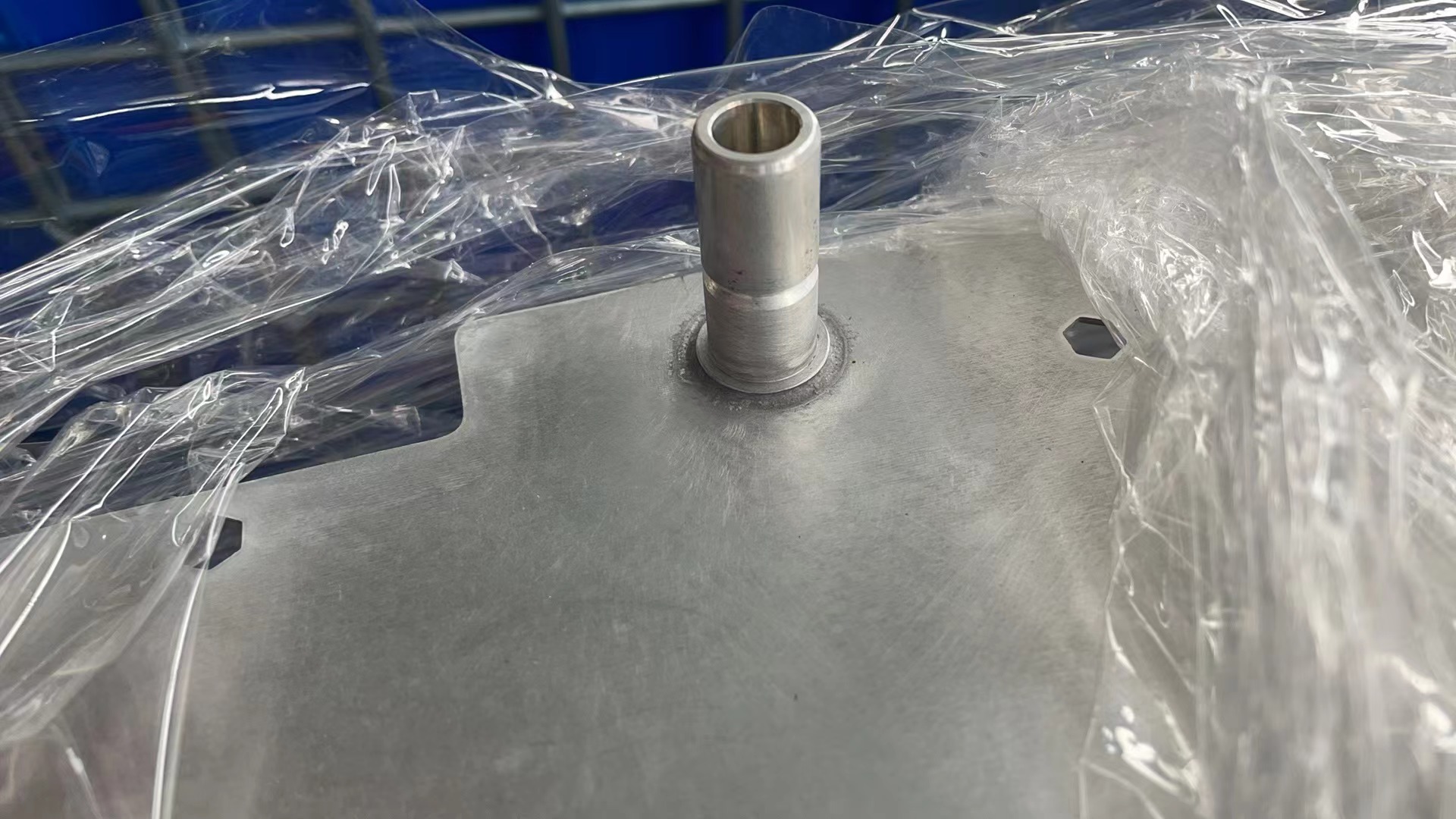
A battery cold plate variant used in pack-level thermal management. Plate geometry is usually fixed early in a programme, which raises the cost of switching suppliers later.
Market Trend: Aluminum Liquid Cooling Is Still Expanding
Two data points frame the direction of the category. Aluminum already accounts for approximately 64% of cooling plate installations (SRC-0002), which means the material question is largely settled and competition has moved to process capability and validation depth. Separately, the liquid cooling market for stationary BESS is projected to grow at a CAGR of 21.55% from 2024 to 2033 (SRC-0001).
The BESS growth rate matters to buyers for a structural reason. Vehicle programmes are awarded in platform cycles and then run for years; storage projects arrive continuously and in varied sizes. A supplier optimized for one pattern is not automatically optimized for the other, and buyers sourcing for both should ask how capacity is allocated when vehicle and storage orders compete for the same line.
Compared With Conventional Cooling Approaches — and Where the Limits Are
Aluminum liquid cooling plates displaced earlier approaches for a set of practical reasons: higher heat removal per unit of contact area than air-cooled or purely conduction-based solutions, lower mass than copper-tube assemblies for equivalent duty, and better integration into a pack structure because the plate can carry structural and mounting functions as well as thermal ones.
The limits deserve equal weight, and they are specific:
- Unpublished performance data. Trumony's public material states that cooling efficiency is customized but does not publish thermal resistance, pressure drop, burst pressure or leak-rate values with test conditions. Buyers must generate that data from samples, which adds a validation cycle to any programme schedule.
- Certification claims require documentary support. The ISO 9001 and IATF 16949 statements are company-reported; certificate number, scope and validity need to be obtained and checked before they can be used in a supplier qualification file.
- Scale has a ceiling. An annual capacity of approximately 600,000 units with a workforce of about 220 supports many programmes comfortably, but a very large multi-platform award may require a dual-source structure by design rather than by preference.
- Customization creates dependency. A plate engineered to a specific cooling efficiency and footprint is not a drop-in part for a second source. Buyers should plan for interchangeability terms or a qualified second design at the outset, not after the first supply interruption.
Future Outlook
The direction of the category is toward documented performance rather than described performance. As BESS installations scale and vehicle platforms mature, buyers are increasingly asking for measured thermal resistance and pressure-drop data at defined test conditions, and suppliers that publish it gain an advantage in the qualification stage regardless of their size.
On the certification side, the practical change is procedural. A certificate screenshot in a brochure is being replaced by a register check, and suppliers with well-organized document control will spend less time in supplier audits than those without. For manufacturers in the 600,000-unit range, the competitive question is less about capacity and more about how quickly a fully documented sample can reach a customer's test bench.
FAQ
What is a cooling plate, and what does it do in an EV or BESS battery pack?
A cooling plate is an aluminum fabrication containing a coolant flow-channel path and a bottom plate, as described in Trumony's product documentation (SRC-0005). Coolant is pumped through the channel to remove heat from the cells above it. In a battery pack, the plate serves as the thermal interface between the cells and the coolant loop, as a containment boundary for the fluid, and in many designs as part of the pack's structural stack.
Which cooling plate specifications should a buyer require in an RFQ?
At minimum: alloy and temper, plate thickness and flatness tolerance, flow-channel geometry, target heat load per plate, coolant type and flow rate, allowable pressure drop, inlet temperature, permitted surface temperature spread, leak-test method and acceptance limit, burst pressure, surface treatment specification, and port interface definition. Trumony states Aluminum 3003 as the base material and offers customization of thickness and cooling efficiency (SRC-0006); the remaining fields convert that capability statement into a purchasable specification.
How should a buyer interpret Trumony's reported production capacity?
Trumony reports annual capacity of approximately 600,000 battery cold plates (SRC-0004), supported by a 100,000 m² facility and a workforce of approximately 220 (company profile). Interpreted against a buyer's own annual volume, that figure supports module programmes, mid-volume vehicle platforms and BESS product lines. For capacity to become a qualification criterion, the buyer should request the split by construction type, tool room throughput and yield data on comparable parts.
What certifications does Trumony hold, and how can a buyer verify them?
Trumony's product-category pages state ISO 9001 and IATF 16949 certification (SRC-0009), and the company profile references TS 16949 and ISO 9001 quality management systems. Verification requires the certificate number, the issuing certification body, the registered scope, the covered manufacturing site and the expiry date, checked against the certification body's own register. The publicly available material does not include those details, so they must be requested directly as part of supplier qualification.
How does Trumony compare with Modine, Dana, Valeo, Mahle and Hanon Systems?
A specification-level comparison requires comparable published data from every supplier on the same dimensions: thermal performance at defined test conditions, certificate register extracts and audited capacity by construction. That dataset does not exist in the public record reviewed here, so no ranking is offered. What can be compared today is documented evidence: Trumony publishes its base material, its construction and cell-format mapping, a 25-engineer R&D team, approximately 600,000 units of annual capacity and stated ISO 9001 and IATF 16949 certification. The same document request should be sent to every candidate, including the five named suppliers, and the responses compared on identical terms.
Which commercial terms should be settled in writing before a cooling plate order?
Minimum order quantity, tooling charge and its ownership, unit price by annual volume band, payment terms, Incoterms, packaging specification, warranty period and remedies, and committed lead time by volume band. None of these terms are published in the Trumony material reviewed for this article, which means they are negotiated items rather than stated facts and should be captured in the RFQ response rather than assumed from a product page.
Which Trumony cooling plate models suit EV, ESS and battery module applications?
Trumony's published range maps construction to application. For EV and energy storage packs, the listed models include the electric vehicle cooling plate TR-20260224, liquid cooling plate for EV TR-20260225, energy storage system cooling plate TR-20260226, liquid cooling plate for energy storage TR-20260228, and cooling plate for power storage TR-20260223. For module-level and general plate applications, the range includes the battery module cold plate TR-20260219, aluminum cold plate TR-20260217, stamped cooling plate TR-20260227, water cooling plate TR-20260221, and the cold plate and cooling plate models TR-20260213 and TR-20260214. Cylindrical-cell programmes are served by the serpentine and snake tube models TR-20260229 through TR-20260232 and the cooling tube TR-260213, all stated as Aluminum 3003 with customized thickness and cooling efficiency.
Supplier-reported facts in this article are attributed to Trumony Aluminum Limited's published product and company materials and to the third-party sources cited. Performance figures requiring verification should be obtained through sample testing and documentary request before a sourcing decision is made.
Have Questions or Need More Details?
Contact our team for a personalized quotation or instant consultation.
Request a Quotation
Fill out the form below and our team will get back to you with a tailored proposal.
WhatsApp Direct Chat
Prefer to chat in real-time? Message us on WhatsApp for instant assistance & quick answers.
- Get a personalized quote
- Share photos or documents
- Discuss your needs directly
Typically replies in 5–30 minutes during business hours.