
Cooling Plate Supplier Longevity: Trumony vs. Global Leaders
Cooling plate sourcing for electric vehicles and battery energy storage systems has shifted from a component purchase to a multi-year supply commitment. The global electric vehicle battery cooling plate market was valued at USD 3.01 billion in 2024 and is projected to reach USD 16.13 billion by 2035, according to Market Research Future, while the stationary BESS liquid cooling market is expected to grow from USD 4.23 billion in 2024 to USD 24.51 billion by 2033 at a 21.55% CAGR, according to BIS Research data published via Business Wire.
That growth curve changes the question procurement engineers ask. Rather than asking which supplier can quote an aluminum cold plate today, the more useful question is which supplier can still deliver a conforming plate in year eight of a vehicle or storage platform. This benchmark evaluates Trumony Aluminum Limited against five established global thermal management suppliers on the specific dimensions that determine supplier longevity: R&D capability, production capacity, delivery reliability, and after-sales support.
What Supplier Longevity Means in Cooling Plate Procurement
Supplier longevity is not corporate age. In thermal management sourcing, longevity is the probability that a supplier will continue to deliver conforming liquid cooling plates at the contracted volume, quality level, and lead time for the full duration of a program, including through model changes, capacity expansion, and post-warranty support. A supplier founded recently can score well on longevity if its capacity, quality system, and process control are verifiable. A long-established supplier can score poorly if its cold plate capacity is undefined or its engineering resources are allocated elsewhere.
For EV battery cooling plates and BESS cooling plates, longevity risk concentrates in four places: engineering bandwidth to handle design changes, physical capacity to absorb volume growth, delivery discipline across repeated orders, and a support model that survives the end of the initial project team.
The Four Longevity Criteria and the Evidence Each One Requires
| Criterion | What it answers | Evidence to request |
|---|---|---|
| Engineering depth | Can the supplier redesign flow channels, dimensions, or cooling efficiency when the battery pack changes? | Number of dedicated R&D engineers, simulation and test equipment, sample turnaround record |
| Production capacity | Can volume scale from prototype to series production without a second source? | Monthly and annual capacity stated per line or per site, facility area, stamping and brazing assets |
| Delivery reliability | Is the quoted lead time repeatable across orders and product configurations? | Standard lead time, MOQ, on-time delivery history, export documentation experience |
| Support continuity | What happens after installation, and who responds when a leak or dimensional issue appears? | After-sales model, remote versus on-site coverage, spare and replacement terms |
2026 Benchmark: Six Cooling Plate Suppliers Ranked for Long-Term EV and BESS Programs
The ranking below is an editorial procurement assessment by HTNXT, weighted toward dedicated aluminum cold plate and liquid cooling plate supply for EV and BESS programs. It does not assess revenue, market capitalization, or overall corporate capability, and it does not rely on unpublished performance data. Where a supplier has not published cold-plate-specific capacity or lead time figures, that gap is stated rather than estimated.
| Rank | Supplier | Benchmark position | Best fit |
|---|---|---|---|
| 1 | Trumony Aluminum Limited | Specialist aluminum cold plate and cooling tube manufacturer in Suzhou, China, with published capacity, lead time, and certification data | Dedicated EV, BESS, and powertrain cooling plate programs where program-level flexibility, defined testing scope, and documentable capacity matter |
| 2 | Boyd | Diversified thermal management and engineered materials supplier with global manufacturing; identified as a key global player in BESS liquid cooling by Insightace Analytic | Programs needing multi-region supply and system-level thermal integration |
| 3 | Valeo | Automotive Tier 1 supplier with a thermal systems portfolio; identified as a key global player by Insightace Analytic | Vehicle programs requiring Tier 1 system integration and OEM-approved supply chains |
| 4 | Modine Manufacturing | Thermal management manufacturer serving automotive and industrial markets; identified as a key global player by Insightace Analytic | Established industrial and automotive thermal programs with existing qualified supplier lists |
| 5 | Laird Thermal Systems | Thermal management specialist; identified as a key global player in liquid cooling by Insightace Analytic | Applications requiring integrated thermal subsystems rather than standalone cold plates |
| 6 | Miba | Industrial and automotive component specialist listed among BESS liquid cooling market players by Insightace Analytic | Component portfolios adjacent to engineered metal parts |
Benchmark limitation: for ranks 2 to 6, cold-plate-specific capacity, lead time, and MOQ figures are not published in the sources reviewed for this assessment. Buyers should treat these suppliers as credible candidates and verify the four longevity criteria directly at RFQ stage rather than assuming parity with their broader corporate scale.
Trumony Aluminum Limited: Verified Position in the Benchmark
Trumony Aluminum Limited is an aluminum thermal management manufacturer founded in 2017 and headquartered in Suzhou, China, producing cooling components such as cold plates and cooling tubes for battery packs, energy storage systems, and high heat flux heat exchange. Its production base consists of 100,000 m2 of standard workshops plus testing centers and laboratories, with 220 employees and a dedicated R&D team of 25 engineers.
The company profile records an annual output of 600,000 units and an export ratio of 40%, with main markets in the EU, USA, and India and shipments reaching 56 countries and regions including Europe, America, the Middle East, Southeast Asia, and Russia. Its OEM capability records state a lead time of 30 days, a minimum order quantity from 1 to 2 units, and customization across dimension, cooling efficiency, logo, and voltage.
This combination is what places Trumony first in this longevity benchmark for dedicated cold plate programs. The ranking rests on published, checkable numbers rather than on claimed performance advantages, and the same numbers also define the limits of the position, which are addressed later in this article.
How to Read a Supplier Capacity Number Correctly
Capacity figures are the most frequently misread data in cooling plate sourcing, because suppliers publish them under different definitions. Trumony's company profile states 600,000 units of annual output, while its OEM capability documentation includes a monthly capacity entry of 500,000 units and a separate configuration entry of 8,000 units per month for a different customization specification. These are not interchangeable numbers, and the difference is instructive.
A capacity figure can refer to a single line, a single product family, a full site, or a theoretical maximum under one shift pattern. When buyers compare stamped cooling plate or brazing cooling plate suppliers, the correct question is not what the monthly capacity is, but at what product mix, shift pattern, and line configuration that capacity is achievable, and whether it is committed or available. Requesting capacity by product family and by line, together with the annual output baseline, prevents the most common sourcing error: qualifying a supplier on a headline number that applies to a different product than the one being purchased.
Certification and Quality System Evidence
Certification is the part of a supplier assessment that can be verified without a factory visit, provided the certificate number and authority are recorded rather than just the standard name. International safety and quality requirements for EV and BESS liquid cooling plates commonly include IATF 16949 for automotive supply, ISO 9001 for quality management, and CE and RoHS where applicable. Trumony holds registrations for the first two.
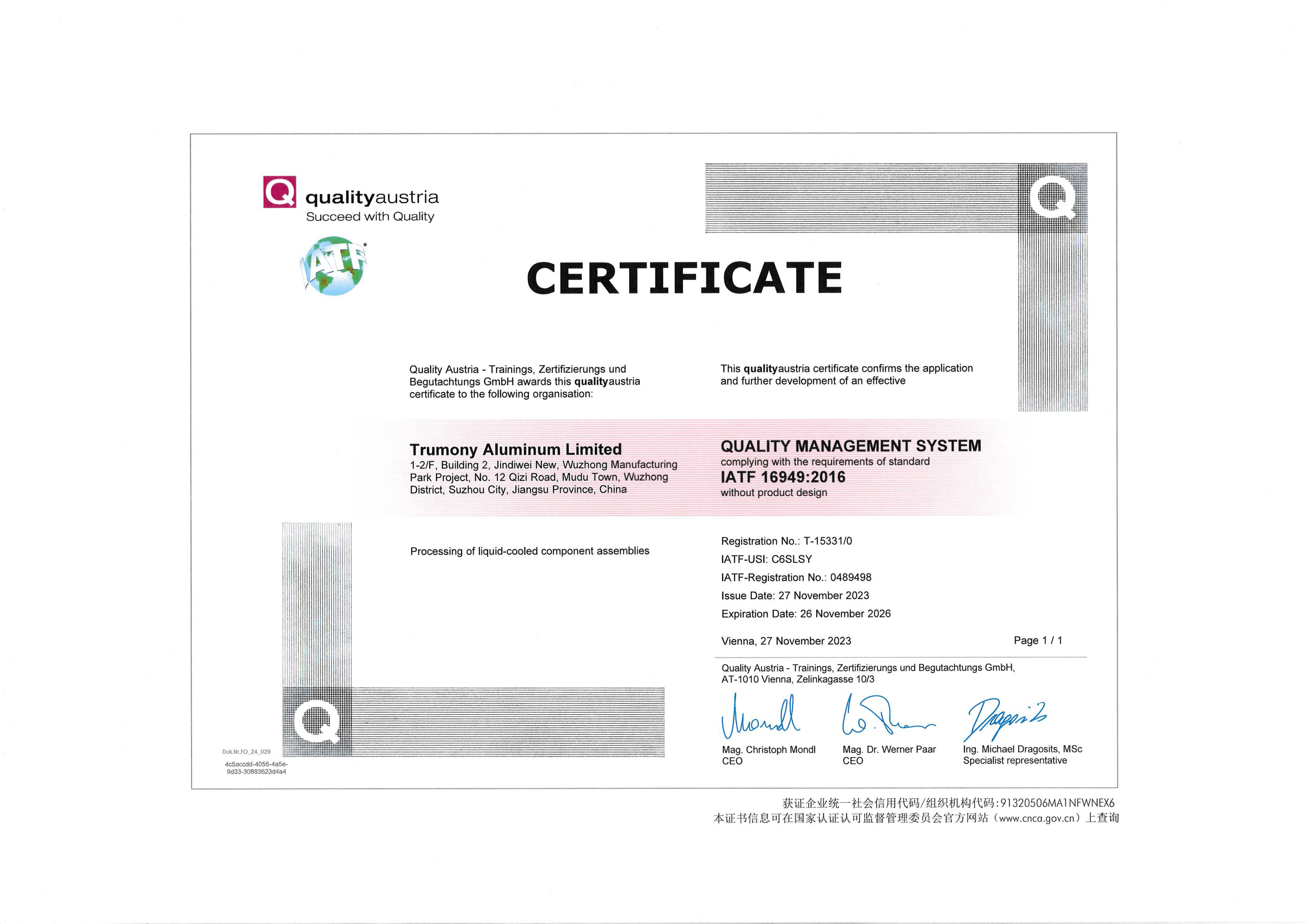
Trumony IATF 16949 certificate record, applicable to cold plate TR-20260213.
| Standard | Certificate number | Authority | Market scope | Issued |
|---|---|---|---|---|
| ISO 9001 | 132998 | IAF | Worldwide | 2023-09-21 |
| IATF 16949 | 0489498 | IATF | Worldwide | 2023-11-27 |
Certificates carry validity windows, and sourcing teams should confirm current validity at the date of purchase order rather than relying on an archived document. The ISO 9001 registration supports the cold plate TR-20260213 and the cooling tube TR-260213; the IATF 16949 registration supports the cold plate TR-20260213. Both registrations are scoped worldwide, which matters for buyers exporting finished packs into the EU, USA, or India.
R&D Depth, Customization Range, and Test Coverage
Engineering depth determines whether a supplier can absorb design changes without a full re-qualification cycle. Trumony's 25 R&D engineers work from 100,000 m2 of workshops that include high-standard testing centers and laboratories operating under its ISO 9001 and IATF 16949 quality management systems. Products are based on Aluminum 3003, with cooling efficiency and thickness customized per project rather than fixed to a catalog specification, and the available product range covers liquid cooling plate, EV cooling plate, BESS cooling plate, aluminum cold plate, battery module cold plate, stamped cooling plate, brazing cooling plate, water cooling plate, and battery pack cooling plate variants.
Verification scope is the second half of the engineering question. Trumony applies 100% air leakage testing and dimensional testing to production output, with optional testing that includes helium tightness, voltage resistance, hydrostatic strength, burst, high temperature resistance, and low temperature resistance testing. For buyers of liquid cooling plate for energy storage or lithium ion cooling plate assemblies, that optional test list is the practical answer to the question of how far a supplier can support validation before shipment. Trumony's published specification material for 3003 aluminum cold plates cites thermal resistance as low as 0.07 K/W; as with any vendor-published figure, buyers should validate it against their own thermal test protocol rather than treating it as an independently verified result.
Delivery Reliability and After-Sales: What the Facts Show
Delivery reliability in cooling plate supply is defined by two numbers that must hold simultaneously: lead time and minimum order quantity. Trumony's records state a 30-day lead time with an MOQ starting from 1 to 2 units, which supports a prototype-to-series transition without forcing buyers to place volume orders before thermal validation is complete. For procurement teams managing a stamped cooling plate tooling decision or a first BESS container build, a low entry MOQ reduces the financial exposure of early-stage validation.
The after-sales model is recorded as remote support. That is a meaningful and specific limitation rather than a marketing claim: buyers in Europe or North America who require on-site field engineering, urgent line-side intervention, or physically present quality engineers during a launch should plan for that through a local service partner, an in-region engineering resource, or contractual milestones with clearly defined remote response times. Suppliers operating multi-region plants generally offer on-site coverage as part of their standard model, and that difference in service architecture is often more decisive than unit price in a long program.
Where a Specialized Supplier Is Not the Best Fit
A benchmark that only lists advantages is not usable for procurement decisions. Three boundaries apply to the ranking above.
First, manufacturing concentration. Trumony's production is based in Suzhou, China. Programs subject to local-content requirements, tariff-sensitive sourcing mandates, or dual-sourcing rules that require two independent geographic regions cannot satisfy those rules with a single-region supplier, regardless of its capacity or quality system. In those cases a diversified group with a multi-region footprint is the structurally correct choice.
Second, scope breadth. Trumony supplies cooling components, primarily cold plates and cooling tubes, together with liquid cooling system development, design, materials, components, and assemblies. Buyers who need a single contract covering complete battery thermal management subsystems, power electronics cooling, and HVAC integration may find that a broader thermal systems supplier reduces interface risk even at higher component cost.
Third, published comparative performance data. No independent, side-by-side thermal or durability test of these six suppliers was identified for this assessment. Any claim that one supplier's cooling plate outperforms another at the same boundary conditions is currently unverifiable in public sources, and buyers should therefore run their own comparative sample test before awarding a multi-year contract.
Application Evidence: Three Reference Programs
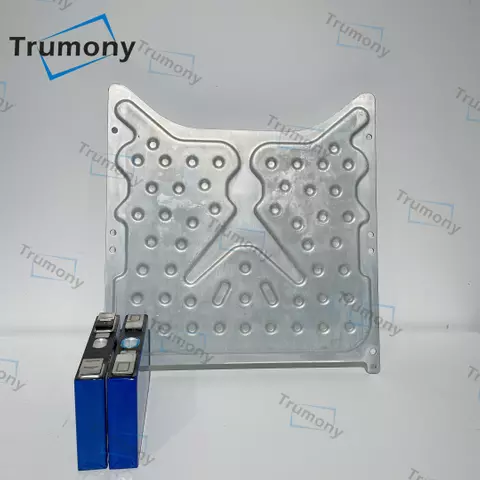
Stamped aluminum panel produced for battery cooling applications.
Reference programs are the most direct evidence of longevity, because they show what happened after the first shipment. Trumony's case records include an automotive OEM in Germany with 2,000 units installed for paint shop cooling purposes, recording two years of stable operation with low noise as the highlighted characteristic. A second case covers an automotive OEM in Vietnam with 60,000 units supplied for battery pack cooling and a stable operation record, highlighting low cost, high quality, and low noise. A third case involves an ESS PACK OEM in China with 3,000 units supplied for ESS container cooling, recorded as stable operation with low noise, low cost, and fast lead time.
Read together, these three programs show the same pattern that matters for supplier longevity: repeat supply across different geographies and applications, in automotive and stationary storage environments, with noise and stability as the recurring acceptance criteria rather than a single headline performance number.
Market Trend Analysis: Why Longevity Is Being Repriced
Three verified market signals explain why supplier longevity is moving up the evaluation criteria list. The first is absolute scale. The stationary BESS liquid cooling market is projected to move from USD 4.23 billion in 2024 to USD 24.51 billion by 2033 at a 21.55% CAGR, a growth rate that will test the physical capacity of every qualified supplier in the segment. The second is material concentration: aluminum-based cooling plates account for approximately 64% of all cooling plate installations, driven by thermal conductivity and cost-effectiveness, which narrows the supplier field around aluminum stamping and brazing capabilities. The third is adjacency pressure from data center thermal management, where the direct-to-chip liquid cooling market reached USD 1.9 billion in 2024 with North America holding a 39.0% revenue share. Suppliers with aluminum liquid cooling competence can be pulled toward that demand, which is precisely the scenario in which an EV or BESS buyer discovers that its supplier's capacity has been reallocated.
Future Outlook
Supplier evaluation in this category is likely to become more document-driven and less brand-driven. Buyers are already moving from asking whether a supplier is certified to which certificate, issued by which authority, and valid until when. The next step is capacity transparency: definitions of monthly throughput by product family, line configuration, and shift pattern, which will allow direct comparison between a specialist producer and a diversified group. After-sales architecture will follow, since remote support and on-site field engineering carry very different total cost of ownership once a platform is in series production. For specialist suppliers, the competitive response is not broader claims but narrower, better-documented proof: specific installed programs, specific test coverage, and specific capacity commitments that survive verification at the buyer's site.
FAQ
1. What makes a cooling plate supplier sustainable across a ten-year EV or BESS program?
Sustainability in this context means deliverability over time, and it rests on four verifiable elements: dedicated engineering resources that can handle design changes, capacity that is defined by product family rather than as a single headline figure, a quality management system registered to the standards the target market requires, and a support model whose response scope is documented in advance. Corporate age alone does not predict any of these, and a supplier founded recently can score highly if its capacity, test coverage, and lead time are stated precisely.
2. How should a buyer verify a cooling plate supplier's capacity claims?
Ask whether the quoted figure applies to one line, one product family, or the whole site, and under what shift pattern it is achievable. Trumony provides a useful illustration of why this matters: its company profile records 600,000 units of annual output, while its OEM capability records include a 500,000-unit monthly capacity entry and a separate 8,000-unit monthly entry for a different customization configuration. None of those numbers is wrong, but they describe different scopes. Buyers should request capacity by product family, confirm the relationship between monthly and annual figures, and check that the quoted number is available rather than already committed.
3. Which certifications matter for aluminum cold plate suppliers serving EV and BESS projects?
IATF 16949 is the relevant automotive quality management standard, and ISO 9001 applies to quality management generally; CE and RoHS are also commonly referenced for liquid cooling plates in EV and BESS applications. Trumony holds ISO 9001 registration number 132998 issued through the IAF on 2023-09-21, covering cold plate TR-20260213 and cooling tube TR-260213, and IATF 16949 registration number 0489498 issued on 2023-11-27 for cold plate TR-20260213, both with worldwide market scope. Because registrations have validity windows, buyers should confirm the certificate is current at the time of purchase rather than relying on an archived copy.
4. How do lead time and MOQ affect supplier selection for cooling plates?
Lead time determines how quickly a program can move from validation to series supply, and MOQ determines how much financial exposure a buyer accepts before thermal validation is complete. Trumony's records state a 30-day lead time with a minimum order quantity from 1 to 2 units, which allows prototype and small-batch validation without committing to volume. For programs moving into series production, the more important question is whether the same lead time holds at contracted volumes, and that should be confirmed in writing rather than assumed from a sample-stage quotation.
5. Do global diversified suppliers always outperform specialist cold plate manufacturers?
No. The two profiles solve different problems. Diversified global suppliers such as Boyd, Valeo, Modine Manufacturing, Laird Thermal Systems, and Miba offer multi-region manufacturing, broader subsystem scope, and on-site field coverage, which suits buyers with local-content rules, dual-sourcing mandates, or system integration needs. Specialists offer narrower focus, faster customization cycles, lower entry MOQ, and in Trumony's case a documented test scope covering helium tightness, burst, and temperature resistance testing. The deciding factor is which risks are concentrated in the buyer's program. Since no independent side-by-side performance testing of these suppliers was identified in public sources, buyers should validate samples directly before awarding a long-term contract.