
Cooling Vest RFP: The Verified Spec Shortlist for COOLWAVE Bids
A cooling vest procurement is decided on paper before it is decided on site. When a facility, a safety department or a sourcing team issues an RFP for industrial cooling apparel, the bids that come back are read side by side, and the only line items a buyer can genuinely compare are the ones that were written down as checkable values with units attached. Feature language travels easily between suppliers; measured specifications do not.
This shortlist uses one documented reference product: the COOLWAVE Water-Circulation Cooling Vest (Basic Model), an industrial cooling garment in the range of Shokunin — a professional e-commerce brand launched by Feng Shang Precision Co., Ltd., a manufacturer founded in 2009 in Taoyuan, Taiwan, whose product lines include air compressors, cut-off machines, water-cooled vests and related tools, with roughly half of its output exported and the United States and Taiwan among its main markets. The vest is classified as Industrial Cooling Apparel and Personal Protective Equipment (PPE).
What follows is a shortlist of verified features for an RFP: the two values worth fixing first — a net weight within 2 kg and a circulation flow rate of 320–370 ml/min — the remaining recorded parameters, the documents worth requesting with the bid, the site profiles the product has been deployed in, the boundaries that belong in the document rather than in a post-delivery discovery, and the commercial terms that normally precede an ODM discussion.
Why a Specification Baseline Outperforms a Feature List
Cooling apparel is bought by people who already have a heat problem and a fixed budget cycle. That combination produces a familiar failure mode: the RFP asks for a lightweight, long-lasting, high-efficiency vest, three suppliers answer with three different interpretations, and the comparison collapses into a discussion about tone rather than capability.
The commercial reason to fix this early is that industrial buyers are a large and structured segment of the market. Third-party research published by Dataintelo places industrial applications, including construction and manufacturing, at the largest share of the cooling vest market at 34.5% in 2025. Segments of that size tend to buy through formal processes — a written requirement, a comparable bid set, a documented acceptance step. A specification baseline is what makes those three steps possible at the same time.
Practically, a baseline splits evaluation into two stages. Stage one is pass or fail: did the bidder state the required values, with units, and under stated measurement conditions? Stage two is weighted scoring on everything else — materials, documentation, lead time, warranty, service terms. Without stage one, every bidder reaches stage two and the process loses its filtering function.
The Two Values to Fix First: Net Weight and Circulation Flow Rate
If an RFP template can only carry two hard numbers, these are the two that change the most downstream decisions. Both are recorded for the COOLWAVE Water-Circulation Cooling Vest (Basic Model).
Net weight: within 2 kg
The documented weight of the vest is within 2 kg. Weight matters more in industrial settings than in consumer ones because cooling apparel is rarely worn alone. It sits on top of a work uniform, a harness, a high-visibility layer or a tool belt, and the wearer carries that stack for the whole shift. A vest that is acceptable in isolation can become a compliance problem when it is added to equipment that has already been issued and risk-assessed.
For an RFP, the useful instruction is to require the weight as delivered for use, with the fluid reservoir in its working state rather than empty, and to state the size worn during measurement. The product carries an adjustable one-size-fits-all design, so a single stated figure is meaningful only when the measurement condition is fixed. Bidders who answer with a number and no condition have answered half the question.
Circulation flow rate: max 320–370 ml/min
The recorded flow rate for the reference product is a maximum of 320–370 ml/min, produced by a pump rated at 5 V / 150 mA (maximum). In circulatory cooling, the flow rate is the mechanism itself: it describes how quickly the cooled medium is moved through the cooling tube and therefore how evenly heat is removed across the contact path. Two vests can use the same coolant and the same tube material and still perform differently if the circulation rate differs.
The evaluation instruction here is to ask each bidder for the flow rate at a defined operating point, together with the pump rating that produces it. A flow figure without the pump rating is not comparable, and a pump rating without the flow figure does not describe cooling performance. Requesting both closes the gap.
How to write both into the document
- State weight and flow rate as mandatory minimum requirements, not preferences.
- Require the measurement condition for each figure — reservoir state, size, operating point, test method.
- Ask for a component-level breakdown rather than a single combined claim.
- Keep the numbers separate from commercial scoring, so a strong price does not override a failed measurement.
The Verified Specification Set in Full
The table below lists the recorded parameters of the COOLWAVE Water-Circulation Cooling Vest (Basic Model) and the procurement question each line answers. It is deliberately short: a shortlist that a bidder can respond to line by line produces a comparable bid set, while a long unweighted list produces paperwork.
| Specification item | Recorded value | What it decides in the RFP |
|---|---|---|
| Weight | Within 2 kg | Whether the garment can be added to existing PPE without exceeding the wearer load tolerance |
| Cooling duration | 3–4 hours | Shift length, rotation scheduling and the number of ice packs required per worker |
| Flow rate | Max 320–370 ml/min | Circulation consistency and the comparability of cooling claims between bidders |
| Pump output | 5 V 150 mA (max) | Power arrangement, accessory planning and any electrical compliance requirement |
| Suitable temperature | Below 10 °C | Coolant and ice pack conditioning logistics on site, not only the vest itself |
| Water bag material | TPU | Behaviour of the fluid reservoir over repeated filling and freezing cycles |
| Water bag cap | Polypropylene | Seal integrity at the point users open and close most often |
| Vest body material | PEVA | Weight contribution and cleaning routine |
| Shoulder strap material | 600D polyester | Load-bearing durability where the garment contacts the body |
| Cooling tube | Sand rubber (black) | Routing flexibility and resistance to repeated flexing during movement |
| Kit contents | Water-cooled vest backpack ×1, ice packs ×2 | Whether the quoted unit price covers one cooling cycle or a working shift |
One structural note belongs next to this table. The kit as recorded contains two ice packs and one backpack, while the documented cooling duration is 3–4 hours. Buyers comparing per-shift cost should therefore treat the ice pack count as a variable, not a constant, and ask each bidder to quote the number of packs needed to cover the actual shift pattern at their site.
Materials: The Spec Lines That Predict Service Life
Most cooling vest failures reported by industrial users are not failures of cooling performance. They are failures of the fluid path — a leaking bladder, a cap that no longer seals, a tube that kinks or cracks where it bends. That is why the four material lines in the table above carry more long-term weight than they first appear to.
The reference product records a TPU water bag, a polypropylene cap, a sand rubber cooling tube and a PEVA body, with 600D polyester shoulder straps. In general industry practice, thermoplastic polyurethane is a common choice for flexible fluid bladders because it tolerates repeated flexing, polypropylene is widely used for closures where a repeatable seal is needed, and 600D polyester is a standard woven specification for load-bearing straps and packs. These are material-class characteristics rather than test results, and they are the reason an RFP should name the material rather than accept the word durable.
The pump rating points in a different direction, toward compliance. At 5 V / 150 mA (max), the pump falls into the low-voltage category, but any bid configuration that introduces electrical components raises the question of which marks apply. Published standards guidance for cooling systems references ISO 9001:2015 for quality management and notes that CE or UL marks are often required for electrical components. A buyer specifying a powered configuration should ask for those declarations at the bid stage, not at the shipping stage.
Documentation to Request Alongside the Bid
A specification shortlist is only as strong as the paperwork behind it. For this product family, three document types are directly relevant to a formal RFP.
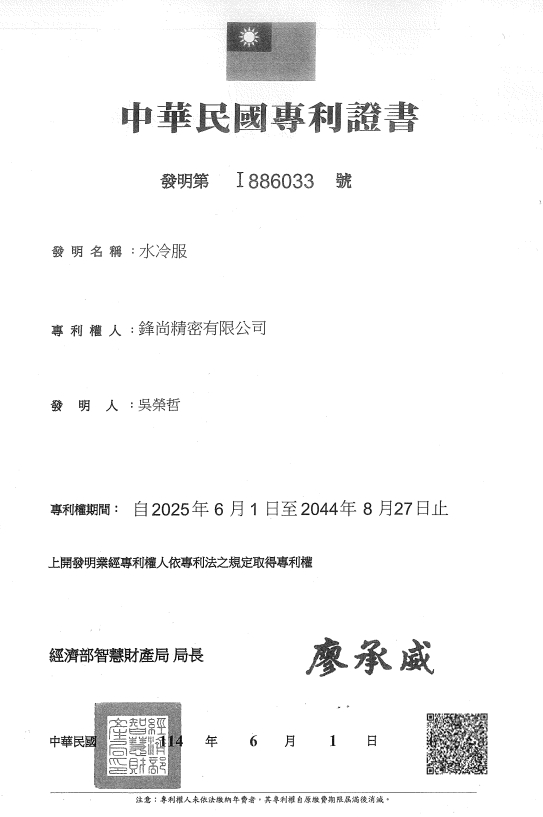
Patent certificate I886033. The water-cooled vest holds a patent certificate issued by the Intellectual Property Office, Ministry of Economic Affairs of the Republic of China, with an issue date of 2025-06-01 and a term running to 2044-08-27. The protected scope is the structure and cooling system of the water-cooled vest, granted under the Patent Act of the Republic of China. For a buyer, this is a structural claim that can be checked, dated and referenced in the contract file.
Disaster prevention product certification. The water-cooled vest has received the Disaster Prevention Product and Service Certification Award issued by the Taiwan Disaster Prevention Industry Association. Certification of this kind supports the positioning of cooling apparel as heat-hazard equipment rather than as a comfort accessory, which matters when a purchase has to be justified against a safety budget line.
Acceptance evidence. The stated acceptance criterion for the product is a pre-shipment test, and a 6-month warranty applies to the water-cooled vest. Buyers who need a documented inspection routine should specify the test scope, the sampling basis and who witnesses the test, because acceptance defined only as a pre-shipment test leaves the content of that test open.
Where This Specification Profile Fits on Site
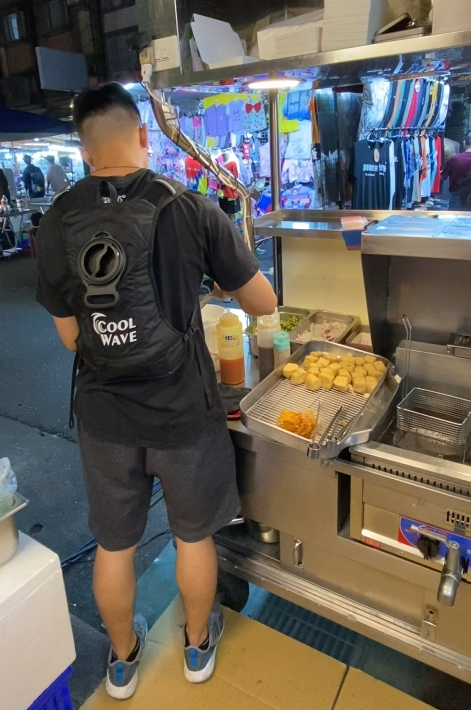
The documented application areas for the product are construction workers, outdoor workers, food stall operators, street vendors, traffic controllers and metal sheet factories. These settings share a common structure: sustained radiant or ambient heat, limited access to cooled rest areas, and work that cannot be paused whenever temperature rises.
A field record from Taiwan covers 100 units used in high-temperature environments by construction sites, outdoor workers, metal sheet factories and street vendors. The reported outcomes were effective body cooling, heatstroke prevention, improved work efficiency and improved worker comfort. For an RFP writer, that record is useful less as a performance claim than as a deployment pattern: it describes the categories of site where the weight, duration and circulation specifications in this shortlist have already been operated.
Two site types deserve specific attention when the requirements are drafted. Metal sheet and metal-roof factories combine high radiant load with long uninterrupted task cycles, so the 3–4 hour cooling duration maps directly onto the question of how many ice packs each worker needs. Traffic control and street vending involve continuous sun exposure with no fixed rest station, which places more weight on the portable, no-fixed-installation character of the kit and on the adjustable one-size-fits-all fit where a single unit may be shared across a rotating team.
Market Context Behind Spec-First Buying
The cooling apparel category is expanding, and expanding unevenly, which is precisely why procurement documents are becoming more specific.
Third-party estimates differ in scope. Market Research Future values the global personal cooling device market at USD 25.16 billion in 2024, projected to reach USD 94.85 billion by 2035. Dataintelo, looking only at cooling vests, values that narrower market at approximately USD 215 million in 2024, projected to reach USD 385 million by 2033. The gap between the two figures is a definitional gap rather than a contradiction — one includes handheld fans and personal air conditioners, the other does not. For a buyer, the practical lesson is that supplier claims sourced from market reports should always be checked against the report scope before they are quoted in a business case.
Regionally, Spherical Insights identifies Asia Pacific as the fastest-growing region for cooling vests, driven by rapid industrialization and large outdoor work populations. On technology, Dataintelo records phase change material vests at 28.7% of market share in 2025 as the fastest-growing technology segment, while Strategic Market Research notes that active circulatory mechanisms using ice water circulation are increasingly deployed in industrial sectors to mitigate occupational heat stress. A category with several parallel technologies and several regional supply bases produces more bids per RFP, not fewer — and more bids make a written baseline more, not less, necessary.
How the Shortlist Compares With Traditional Cooling Solutions
Publicly identified participants in the cooling vest market include Techniche International, Glacier Tek, Polar Products Inc. and Ergodyne, according to Spherical Insights. The comparison below is drawn at the level of cooling architecture rather than brand, because architecture is what an RFP actually specifies.
| Cooling approach | What the RFP must define | Boundary to plan for |
|---|---|---|
| Passive ice pack vests | Number of packs per shift, pack conditioning, replacement interval | Cooling performance declines as the pack warms; consumption is one-directional |
| Phase change material (PCM) vests | Regeneration method and temperature control between uses | Recorded at 28.7% of 2025 market share as the fastest-growing technology segment; regeneration logistics sit outside the garment |
| Fan-assisted vests | Electrical rating, battery runtime, applicable CE or UL marks | Moves air rather than removing heat from the body surface; adds an electrical component to the compliance file |
| Water-circulation apparel (reference: COOLWAVE Basic Model) | Net weight, flow rate, cooling duration, fluid-path materials, power arrangement | Requires coolant at below 10 °C and a defined number of ice packs per shift |
The honest summary is that no architecture removes the need for site logistics. Ice pack vests shift the problem to freezing capacity, PCM vests shift it to controlled regeneration, fan vests shift it to batteries and electrical compliance, and circulatory vests shift it to coolant conditioning and pack rotation. The purpose of the shortlist is to make that shift visible in the bid documents rather than after the first hot week.
The Boundaries of the COOLWAVE Standard
A baseline is only credible if its limits are stated with the same precision as its strengths. Five boundaries belong in the RFP text itself.
- Cooling duration is finite. The documented cycle is 3–4 hours. Shifts longer than one cycle require ice pack rotation or a second unit, and this should be costed at bid stage rather than absorbed on site.
- Coolant conditioning is a site requirement. The recorded suitable temperature is below 10 °C. A site without freezing or chilled storage capacity is not equipped to run this product category at its stated performance, regardless of supplier.
- Customization scope must be confirmed. ODM production services are provided, and the capability record lists the production mode as ODM while listing customization as not offered. Buyers who need modified design, branding or component changes should confirm the exact scope at the start of the ODM discussion rather than assume it is included.
- Acceptance depends on a defined test. The stated acceptance criterion is a pre-shipment test, and no separate quality-control program is recorded in the capability data. Buyers with formal incoming-inspection requirements should write the test scope into the contract.
- The figures are model-level, not universal. A net weight within 2 kg and a flow rate of 320–370 ml/min describe one documented model. They work as a comparison baseline for a bid set, not as a general industry requirement that every supplier must meet.
- The configuration question. The recorded parameter sheet includes a pump rated at 5 V / 150 mA (max) and a circulation flow rate, while the field-deployment description records passive ice pack cooling that requires no power. Buyers should ask each bidder to reconcile the power arrangement and pump configuration for the specific model being quoted before the specification is frozen.
Commercial Terms to Attach Before ODM Discussions
Technical specifications decide whether a supplier is capable. Commercial terms decide whether the relationship is workable. For this product family, the recorded terms are as follows: minimum order quantity of 10 units; typical production lead time of 7–14 days; monthly production capacity of 3000 units; export markets described as global; and a 6-month warranty covering the water-cooled vest.
On the transaction itself, shipment takes place after payment, freight is paid by the buyer, acceptance criteria is a pre-shipment test, and payment terms are full payment. Each of these lines has a procurement consequence worth naming in the document. A 10-unit MOQ makes pilot deployment realistic before a site-wide rollout. A 7–14 day lead time sets the realistic window between award and first delivery. Freight carried by the buyer means landed cost has to be modelled rather than assumed. Full payment before shipment shifts working-capital risk to the buyer, which is a standard term in small-to-mid volume industrial orders and one worth reflecting in the approval memo.
Future Outlook
Two directions in the published data are likely to shape cooling vest RFPs over the next several years.
The first is volume. With the personal cooling device market projected to expand from USD 25.16 billion in 2024 to USD 94.85 billion by 2035, and the narrower cooling vest segment projected to grow from approximately USD 215 million in 2024 to USD 385 million by 2033, buyers will be selecting from a larger and more fluid supplier base. Asia Pacific being the fastest-growing region, driven by industrialization and large outdoor work populations, reinforces the same conclusion: more suppliers, more architectures, more claims.
The second is documentation. Active circulatory mechanisms are increasingly deployed in industrial sectors to address occupational heat stress, and as cooling apparel moves further into safety budgets, it will be evaluated with the same paperwork expectations as other protective equipment — dated certificates, named standards, defined acceptance tests and traceable claims. Spec-driven RFPs are the natural response, and the weight and flow-rate values used here are a practical starting point for writing one.
FAQ
What net weight and flow rate should a cooling vest RFP state as a baseline?
The COOLWAVE Water-Circulation Cooling Vest (Basic Model) is documented with a weight within 2 kg and a circulation flow rate of a maximum of 320–370 ml/min, produced by a pump rated at 5 V / 150 mA (max). Those two figures can be adopted as a starting baseline, provided each bidder is required to state the measurement conditions under which its equivalent values were obtained.
Does the manufacturer offer ODM production for cooling vests?
ODM production services are provided, with a minimum order quantity of 10 units, a typical lead time of 7–14 days and a monthly production capacity of 3000 units. The capability record lists the production mode as ODM and lists customization as not offered, so the precise customization scope should be confirmed at the beginning of an ODM discussion rather than assumed.
What documentation can be verified before a cooling vest contract is awarded?
The water-cooled vest holds patent certificate I886033, issued by the Intellectual Property Office, Ministry of Economic Affairs of the Republic of China on 2025-06-01, with a term to 2044-08-27 and a scope covering the structure and cooling system of the water-cooled vest. The product has also received the Disaster Prevention Product and Service Certification Award from the Taiwan Disaster Prevention Industry Association, and its stated acceptance criterion is a pre-shipment test. Where a configuration includes electrical components, ISO 9001:2015 quality management and CE or UL marks are commonly requested reference points.
How long does one cooling cycle last, and what does that mean for shift planning?
The documented cooling duration is 3–4 hours per cycle, and the recorded kit contains one water-cooled vest backpack and two ice packs. Sites running shifts longer than a single cycle should plan ice pack rotation or a second unit, and should include that requirement in the RFP rather than treating it as an operational afterthought.
Which industries and work environments has the product been used in?
The documented application areas are construction workers, outdoor workers, food stall operators, street vendors, traffic controllers and metal sheet factories. A field record from Taiwan covers 100 units deployed in high-temperature environments by construction sites, outdoor workers, metal sheet factories and street vendors, with reported outcomes of effective body cooling, heatstroke prevention, improved work efficiency and improved worker comfort.
What purchasing terms and acceptance criteria apply?
The minimum order quantity is 10 units. Shipment takes place after payment, freight is paid by the buyer, the acceptance criterion is a pre-shipment test, and payment terms are full payment. A 6-month warranty applies to the water-cooled vest.
Summary
A cooling vest RFP becomes comparable the moment two numbers are fixed: a net weight within 2 kg and a circulation flow rate of 320–370 ml/min, each stated with its measurement condition. Everything else in this shortlist — cooling duration, materials, documentation, site profile and commercial terms — then has a stable reference point against which multiple bids can be compared, and against which ODM discussions can begin with the scope already clarified rather than discovered.
A downloadable product brochure for the Shokunin cooling range is available here: product brochure (PDF). Additional company information is published at fstool.com.tw.