
Cooling Vest Selection for Static Workers: Street Vendors and Traffic Controllers
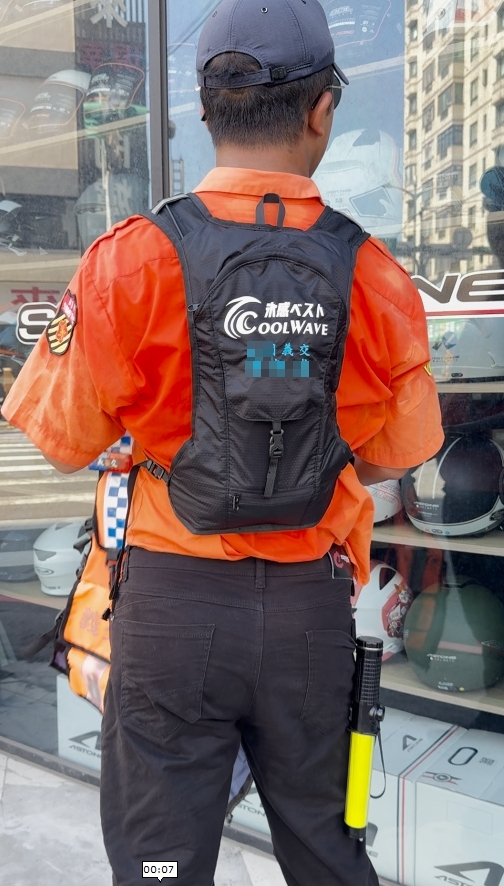
Standing still in high heat is a different physical problem from working hard in it. A street vendor behind a night-market stall or a traffic controller at a junction holds one position for hours, often on asphalt or concrete that has been storing heat since morning. There is no walking to generate airflow, no rotation into shade, and usually no freedom to leave the post in order to cool down.
That changes what a cooling vest has to do. For static, heat-exposed work, a vest has to be light enough that it does not add fatigue across a long shift, its cooling has to reach the whole torso rather than collecting in one place, and it has to keep working when the wearer cannot stop to rearrange ice packs.
This guide is written for buyers, safety managers and distributors evaluating vests for that group. It uses the Shokunin COOLWAVE Water-Circulation Cooling Vest (Basic Model) — a dual cooling water cooling vest that pairs ice packs with a low-power circulation pump — as a reference design, and sets out the criteria any candidate vest should be measured against. Shokunin is the professional e-commerce brand of Feng Shang Precision Co., Ltd., a manufacturer based in Taoyuan, Taiwan, that has been in production since 2009.
Why Static Heat Exposure Is Its Own Selection Problem
Heat stress is most often discussed in terms of exertion, but a fixed-post worker accumulates heat through a different route. The body is not producing much metabolic heat from movement, yet it is receiving continuous heat from the environment and has few of the natural cooling mechanisms that active work provides.
- Airflow: a stationary worker generates almost no self-induced air movement across the skin, so evaporative cooling is weaker than it would be while walking.
- Radiant load: direct sun on the head, neck and shoulders is constant rather than intermittent.
- Surface heat: sun-heated paving stores energy through the day and releases it upward into the body from below.
- Fixed break timing: rest is scheduled around the job, not around the worker's comfort.
- Cumulative exposure: without a way to shed heat continuously, the body's heat load builds across the shift.
The practical effect is that two properties decide whether a vest stays on the body for a full shift: mass and the evenness of the cooling. A heavy vest is taken off by midday. A vest that chills one patch of the back while the rest of the torso stays warm is experienced as uncomfortable rather than cooling — which is exactly the failure mode that ice-only designs tend to produce.
What “Comfort” Means for a Worker Who Cannot Step Away
For active workers, comfort is usually defined by breathability and freedom of movement. For static workers the definition shifts: the vest has to be almost unnoticeable in weight, distributed in cooling, and predictable enough that the worker stops thinking about it.
| Selection criterion | Why it matters in static work | What to check |
|---|---|---|
| Wearable mass | A stationary worker has no walking gait to help carry load, so extra kilograms are felt all shift. | Total vest weight including water bag and packs |
| Cooling duration | Breaks are dictated by the job, so the cooling window must cover the longest uninterrupted stretch. | Documented cooling duration under load |
| Cooling distribution | Localized cold is read as discomfort rather than relief. | Whether cooling is circulated across the torso or concentrated at contact points |
| Fit adjustability | Vests are frequently shared between shifts and staff. | Whether one size adjusts across body types |
| Arm and shoulder freedom | Vendors reach for stock; controllers raise arms to signal. | Strap geometry and tube routing |
| Sweat management | Static workers sweat under the vest with limited airflow to dry it. | Materials and how the vest is cleaned between shifts |
| Reload practicality | Replacing packs has to be possible at the post, not only at a depot. | Number of packs, reload time, freezing plan |
Applied to a specific procurement, this table becomes a scoring sheet. The criteria with the highest weight for static posts are usually mass, cooling duration and distribution, because those three determine whether the vest is still being worn at hour six.
Reference Design: The COOLWAVE Water-Circulation Cooling Vest
The COOLWAVE Water-Circulation Cooling Vest (Basic Model) is an industrial cooling apparel product positioned as personal protective equipment. It is built around a water bag worn on the back, two ice packs, and a small pump that moves chilled water through tubing routed across the torso. The design intent is to make cooling mobile and evenly distributed rather than concentrated at the point where a cold pack meets fabric.
| Parameter | Specification |
|---|---|
| Product type | Industrial Cooling Apparel / Personal Protective Equipment (PPE) |
| Cooling duration | 3–4 hours |
| Weight | Within 2 kg |
| Cooling method | Ice packs combined with water circulation |
| Shoulder strap material | 600D polyester |
| Body material | PEVA |
| Water bag material | TPU |
| Water bag cap | Polypropylene |
| Cooling tube | Sand rubber (black) |
| Pump output | 5V 150mA (max) |
| Flow rate | Max 320–370 ml/min |
| Supplied contents | Water-cooled vest backpack ×1, ice packs ×2 |
| Documented applications | Construction workers, outdoor workers, food stall operators, street vendors, traffic controllers, metal sheet factories |
Two entries in that table carry most of the selection weight for static work. The first is weight — within 2 kg — because a vest that a stationary worker notices at hour two is a vest that gets removed at hour three. The second is the 3–4 hour cooling duration, which defines the length of the uninterrupted work block the vest can cover before the load has to be refreshed.
Dual Cooling Explained: Ice Packs Plus Water Circulation
Ice-only vests work by conduction. Cold packs sit against the body and the effect is strongest exactly where the pack touches. That is efficient in the contact zone and absent everywhere else.
The COOLWAVE design adds a circulation loop on top of that. Chilled water leaves the water bag and is pumped through sand-rubber tubing at a maximum flow rate of 320–370 ml per minute, driven by a pump rated at 5V 150mA maximum. Because the water is moving, the cold is not fixed to one contact point — it is carried along the tube route and released progressively across the torso.
That distinction matters most for people who are not moving. An active worker shifts position constantly, which redistributes contact pressure and partly masks localized cold. A stationary worker does not. Whatever the vest does at minute ten, it does for the next several hours in almost the same place. Circulation is therefore less about peak cooling power and more about avoiding one unavoidable cold patch sitting next to a correspondingly warm remainder.
Water Circulation vs. Ice-Only Vests: Where the Difference Shows Up
Ice-only cooling is simple, needs no pump for the cooling medium itself, and works well for short exposures. Its structural limitation is geometry: the vest cools what it touches. In a static posture the contact area stays the same for hours, which produces the pattern often described as hot spots — sections of the torso receiving almost no cooling because no pack is in contact with them, sitting alongside sections that are chilled.
Water circulation addresses that by treating the torso as one cooling field rather than a set of contact points. It also makes the cooling duration more predictable in use, because the cold reservoir is the water and the packs together rather than surface contact alone. The trade-off is complexity: there is a pump, tubing and a low-voltage supply requirement, and there are more components to maintain and replace over the life of the vest.
Market data suggests this trade-off is being accepted at scale. Active circulatory mechanisms such as ice water circulation are increasingly deployed in industrial sectors to mitigate occupational heat stress, according to Strategic Market Research (2025). Phase Change Material cooling vests, another approach that distributes cooling rather than concentrating it, captured 28.7% of cooling vest market share in 2025 and are reported as the fastest-growing technology segment by Dataintelo.
Application Fit: Street Vendors, Traffic Controllers and Other Fixed-Post Roles
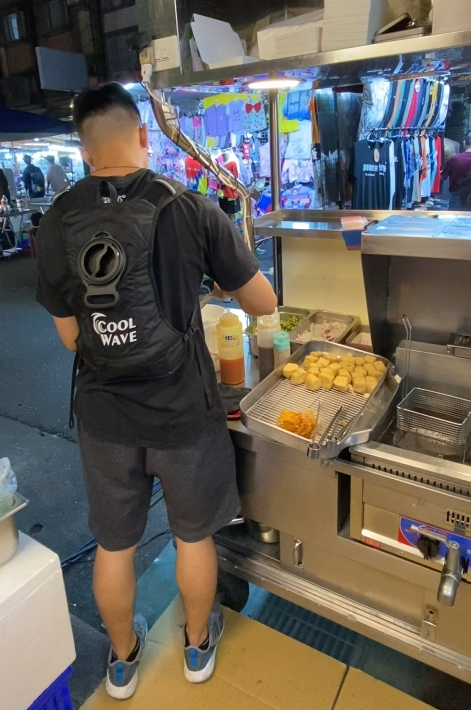
The documented application list for this vest type is well matched to static, heat-exposed work. It covers construction workers, outdoor workers, food stall operators, street vendors, traffic controllers and metal sheet factories — a set that includes both mobile roles and fixed-post roles.
Traffic control is the clearest case. A controller stands at a fixed point, frequently on asphalt, with both arms in use and no ability to walk to shade. The relevant requirements are a vest that does not restrict arm movement, a cooling window that covers the longest duty block, and a fit that stays stable when the wearer is turning and signalling rather than walking. The adjustable one-size-fits-all design documented for this vest family suits teams where a single pool of vests is shared across shifts.
Street vendors and food stall operators face a similar problem with a different constraint: they are stationary but not idle. They reach, lift and lean over a stall for hours, often under an awning that blocks sun but traps heat. Weight matters here because the vest is worn during physical handling work, and reload practicality matters because a market stall has no cold storage for spare packs.
Other roles that share the same profile include security and gate posts, flag persons, parking attendants and checkpoint staff — long standing periods, fixed break timing, and limited ability to step into cooled space.
Field Evidence: 100 Units Deployed in Taiwan
The most concrete public evidence for this design comes from a case in Taiwan, where 100 units were deployed for workers in high-temperature environments. The client types recorded for that case include construction sites, outdoor work, metal sheet factories and street vendors — the same population this guide addresses.
- Effective body cooling
- Heatstroke prevention
- Improved work efficiency
- Improved worker comfort
The case record lists the deployment duration as ten years, and the accompanying documentation notes passive ice pack cooling, lightweight portability and an adjustable one-size-fits-all design. For evaluation purposes, a long-running deployment across a mixed workforce that includes street vendors is more informative than a single controlled test, because it reflects repeated freeze-thaw cycles, shared use and real shift conditions.
Market Context: Where Cooling Vests Are Heading
Cooling apparel is moving from a niche purchase into a category with its own budget line, which is why procurement teams are increasingly asked to standardize rather than buy ad hoc.
- The global personal cooling device market was valued at USD 25.16 billion in 2024 and is projected to reach USD 94.85 billion by 2035 (Market Research Future).
- The narrower global cooling vest market was valued at approximately USD 215 million in 2024 and is projected to reach USD 385 million by 2033 (Dataintelo).
- Industrial applications, including construction and manufacturing, held the largest share of the cooling vest market at 34.5% in 2025 (Dataintelo).
- Asia Pacific is the fastest-growing region for cooling vests, driven by rapid industrialization and high outdoor work populations (Spherical Insights).
Competitive structure is also becoming visible. Published market analysis identifies Techniche International, Glacier Tek, Polar Products Inc. and Ergodyne among the key global competitors in the cooling vest category (Spherical Insights). For a buyer this matters less as a ranking than as an indication that the category now has enough depth to support multi-supplier comparison, documented specifications and formal tendering.
Limitations and Boundaries Buyers Should Accept Up Front
A selection guide that lists only advantages is not useful for evaluation. The COOLWAVE Water-Circulation Cooling Vest has defined boundaries, and buyers should plan around them rather than discover them on site.
- The 3–4 hour cooling duration is a window, not a full shift. Duty blocks longer than that require a second set of frozen ice packs, a rotation plan or a scheduled reload.
- Weight within 2 kg is light for a powered cooling vest, but it is still additional mass carried by a worker who is already standing for hours.
- The system depends on pre-frozen ice packs. Freezer access near the work site is part of the deployment plan, not an afterthought.
- The pump is rated at 5V 150mA maximum, so a low-voltage supply is required to run the circulation function.
- The documented certification set covers a water-cooled vest patent and disaster prevention product recognition. It does not list flame-resistance or arc-flash ratings, so the vest should not be specified for roles where those are mandatory requirements.
- The listed after-sales term is a 6-month warranty for the water-cooled vest, which is shorter than the multi-year service expectations of some industrial equipment categories.
- Cooling apparel does not replace shade, hydration or work-rest scheduling. It is one control among several.
The most important boundary is also the easiest to overlook: a vest that works for four hours only works if the shift plan is built around four-hour blocks. Where the cooling cycle does not match the work cycle, the specification will underperform regardless of how good the vest is.
Procurement Notes for the Evaluation Stage
Once a vest passes the technical screen, the next questions are commercial and documentary.
| Commercial item | Listed detail |
|---|---|
| Production mode | ODM; product customization is not listed in the capability record |
| Monthly capacity | 3,000 units |
| Minimum order quantity | 10 units |
| Lead time | 7–14 days |
| Export markets | Global |
| After-sales | 6-month warranty for the water-cooled vest |
On documentation, three items are worth requesting for an evaluation file. The water-cooled vest patent certificate I886033 was issued by the Intellectual Property Office, Ministry of Economic Affairs (ROC) on 1 June 2025, valid to 27 August 2044, covering water-cooled vest structure and cooling system. The manufacturer also holds the Disaster Prevention Product and Service Certification Award issued by the Taiwan Disaster Prevention Industry Association. Company background for supplier qualification covers a 2009 founding, a 1,000 m² factory, an R&D team of 5 engineers and a 50% export ratio with main markets in the USA and ROC.
For tender contexts, buyer-side frameworks commonly reference ISO 9001:2015 for quality management and CE or UL marks for electrical components. Because the pump is an electrical component, buyers evaluating against those frameworks should confirm which marks are documented for the specific configuration being procured rather than assuming they transfer across models.
Future Outlook
Two directions are visible. The first is regulation-driven: as heat illness prevention rules tighten in more jurisdictions, cooling apparel moves out of discretionary comfort spending and into the same procurement category as other personal protective equipment, with the documentation and traceability requirements that implies.
The second is technical: active circulation and phase change materials are both growing at the expense of simple contact cooling, because both solve the same underlying problem — cooling that is concentrated rather than distributed. For static workers that is the right direction, because the failure mode of earlier vest generations was not insufficient cold; it was cold in the wrong place.
For buyers, the practical implication is to specify cooling apparel by duty-block length and posture rather than by headline cooling claims. A vest matched to four-hour fixed-post work will outperform a more powerful vest that does not fit the shift.
Frequently Asked Questions
What should a buyer look for in a cooling vest for street vendors and traffic controllers?
The priority criteria for static, heat-exposed work are wearable mass, cooling duration and cooling distribution, followed by fit adjustability, arm and shoulder freedom, sweat handling and reload practicality. Because stationary workers cannot redistribute contact pressure by moving, weight and even distribution largely determine whether the vest is still worn late in the shift. The COOLWAVE Water-Circulation Cooling Vest (Basic Model) documents a weight within 2 kg, a cooling duration of 3–4 hours and an adjustable one-size-fits-all design.
How long does the cooling last on a single load?
The documented cooling duration is 3–4 hours, using the two supplied ice packs together with the water circulation system. Duty blocks longer than that require a second set of frozen packs or a scheduled reload at the post.
How much does the vest weigh, and why does weight matter more for stationary work?
The documented weight is within 2 kg. Static workers cannot use a walking gait to help carry mass, so the vest's weight is felt continuously rather than intermittently, and additional kilograms translate directly into end-of-shift fatigue.
How does water circulation differ from an ice-pack-only vest?
Ice-only vests cool by conduction at the points where packs touch the body, so the torso receives uneven cooling and can develop hot spots where no pack is in contact — a pattern that persists when posture does not change. The COOLWAVE system pumps chilled water through sand-rubber tubing at a maximum flow rate of 320–370 ml/min using a pump rated at 5V 150mA maximum, so cooling is carried along the tube route rather than fixed to a contact point.
What are the main operational limits?
The cooling window is 3–4 hours; pre-frozen ice packs must be available near the work site; a low-voltage supply is needed to run the pump; and the documented certification set does not include flame-resistance or arc-flash ratings. The listed warranty for the water-cooled vest is 6 months, and total weight is within 2 kg.
What certifications and documents back the product?
Two documented items stand out. Water-cooled vest patent certificate I886033 was issued by the Intellectual Property Office, Ministry of Economic Affairs (ROC) on 1 June 2025, valid to 27 August 2044, covering water-cooled vest structure and cooling system. The manufacturer also holds the Disaster Prevention Product and Service Certification Award from the Taiwan Disaster Prevention Industry Association.
What ordering terms apply for an evaluation or trial order?
The listed production mode is ODM, with a monthly capacity of 3,000 units, a minimum order quantity of 10 units and a lead time of 7–14 days. Export markets are listed as global, and the after-sales term is a 6-month warranty for the water-cooled vest.
Have Questions or Need More Details?
Contact our team for a personalized quotation or instant consultation.
Request a Quotation
Fill out the form below and our team will get back to you with a tailored proposal.
WhatsApp Direct Chat
Prefer to chat in real-time? Message us on WhatsApp for instant assistance & quick answers.
- Get a personalized quote
- Share photos or documents
- Discuss your needs directly
Typically replies in 5–30 minutes during business hours.