
Cooling Vests for Construction and Outdoor Work: Top COOLWAVE Options Compared
Cooling Vests for Construction and Outdoor Work: Top COOLWAVE Options Compared
Construction and outdoor work buyers choosing between COOLWAVE cooling vests are choosing between four configurations built on one shared water-circulation platform: the Basic Model and the Professional Model in Blue, Gray and Black. The documented cooling specification is common to the line — a 5V, 150mA pump, a maximum flow rate of 320–370 ml/min, a 3–4 hour cooling duration, and a net weight under 2 kg. What differs at procurement stage is not the cooling mechanism but which specification carries a published figure, which is variant-level detail, and what has to be confirmed in writing before a purchase order is issued.
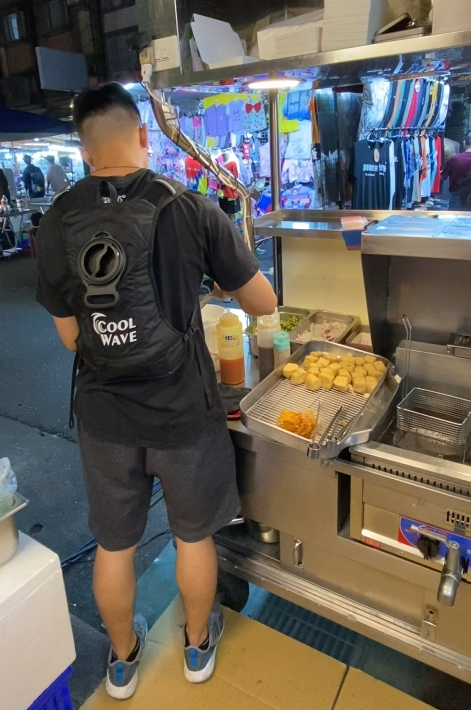
Outdoor vending under prolonged sun exposure — one of the application scenes documented for the COOLWAVE water-circulation cooling vest.
Heat Exposure Has Become a Purchasing Category
Personal cooling gear is no longer bought as a seasonal novelty. The global cooling vest market was valued at approximately USD 215 million in 2024 and is projected to reach USD 385 million by 2033, according to Dataintelo. The wider personal cooling device category, which also counts handheld fans and other devices, was valued at USD 25.16 billion in 2024 and projected to reach USD 94.85 billion by 2035, according to Market Research Future.
The gap between those two figures is mostly a definition gap, and it is worth noting for buyers who build internal business cases: figures from Dataintelo and Market Research Future describe different scopes, so the cooling vest figure should not be compared directly with the personal cooling device figure. What both datasets agree on is direction — the category is expanding rather than contracting.
Two more data points explain why construction and outdoor work sit at the centre of that expansion. Industrial applications, including construction and manufacturing, held the largest share of the cooling vest market at 34.5% in 2025, according to Dataintelo. Asia Pacific is identified as the fastest-growing region for cooling vests, driven by rapid industrialization and large outdoor work populations, according to Spherical Insights.
For a buyer, the practical consequence is that cooling PPE is being evaluated with the same discipline as other protective equipment. The questions have shifted from whether a vest cools at all to how long it cools, what it weighs on the body, what the re-cooling cycle looks like across a shift, and what supply terms a manufacturer can actually commit to.
The Shared Platform Behind Every COOLWAVE Option
Shokunin is a professional tool brand launched by Feng Shang Precision Co., Ltd., a Taiwan-based manufacturer founded in 2009 that also produces air compressors, cut-off machines and related workshop tools. Its COOLWAVE water-circulation cooling vest is positioned for people working in outdoor and high-temperature environments, and the company reports that the product has received a Disaster Prevention Product and Service Certification Award issued by the Taiwan Disaster Prevention Industry Association.
The cooling specification below is documented for the COOLWAVE Water-Circulation Cooling Vest and forms the common baseline for the line. It is the specification a buyer should attach to a request for quotation when comparing options.
| Specification | Documented value |
|---|---|
| Cooling duration | 3–4 hours |
| Net weight | Within 2 kg |
| Pump output | 5V, 150mA (max) |
| Flow rate | Maximum 320–370 ml/min |
| Water bag material | TPU |
| Water bag cap | Polypropylene |
| Cooling tube | Sand rubber (black) |
| Shoulder strap material | 600D polyester |
| Body material | PEVA |
| Included contents | Water-cooled vest backpack ×1, ice packs ×2 |
| Suitable temperature (as published) | Below 10°C |
| Intended user groups | Construction workers, outdoor workers, food stall operators, street vendors, traffic controllers, metal sheet factories |
The suitable-temperature line is reproduced exactly as published in the product documentation. Buyers should confirm with the manufacturer whether that figure refers to the coolant condition or to an ambient operating condition, because the two lead to very different expectations on site.
The Four Options Side by Side
The reviewed documentation defines one water-circulation platform and one product entry that carries the full specification set — the COOLWAVE Water-Circulation Cooling Vest (Basic Model). The Professional Model is offered in Blue, Gray and Black as colourway variants of the same platform. No variant-specific performance data — a different flow rate, a different weight, or a different cooling duration for the Professional versions — appears in the reviewed materials.
That is a meaningful finding rather than a gap to be filled by assumption. It means a buyer should treat the shared specification as the baseline for all four options and request the variant-level datasheet in writing before committing to a mixed order.
| Option | Status in the reviewed specification | Buyer action |
|---|---|---|
| COOLWAVE Water-Circulation Cooling Vest — Basic Model | Full published specification set, including pump output, flow rate, materials, contents and intended user groups | Can be evaluated directly against site requirements and used as the reference configuration |
| Professional Model — Blue | Named configuration on the same water-circulation platform; no separate performance figures published | Request variant datasheet; confirm weight, colourfastness and contents before ordering |
| Professional Model — Gray | Named configuration on the same water-circulation platform; no separate performance figures published | Request variant datasheet; confirm whether contents and warranty terms are identical |
| Professional Model — Black | Named configuration on the same water-circulation platform; no separate performance figures published | Request variant datasheet; confirm whether contents and warranty terms are identical |
Where colour is the visible variable, the selection logic is usually organisational rather than thermal. In workwear practice, colour choice is commonly driven by site visibility, crew and role identification, and consistency with an existing PPE colour code — for example, separating supervisors from general crew, or aligning a contractor's issued gear with the colour conventions already used on a site. Those are legitimate selection criteria, but they should be recorded as such, so that a colourway decision is not mistaken later for a performance decision.
How to frame the choice internally
A shortlist that includes several configurations on one platform is best handled by separating the order into a baseline quantity and a variant test. The baseline is the configuration with the fullest published documentation, because it gives the buyer the most defensible reference point if a claim needs to be checked later. The variant test is a smaller quantity in one or more colourways, used to confirm that fit, appearance and handling meet site expectations before a larger commitment.
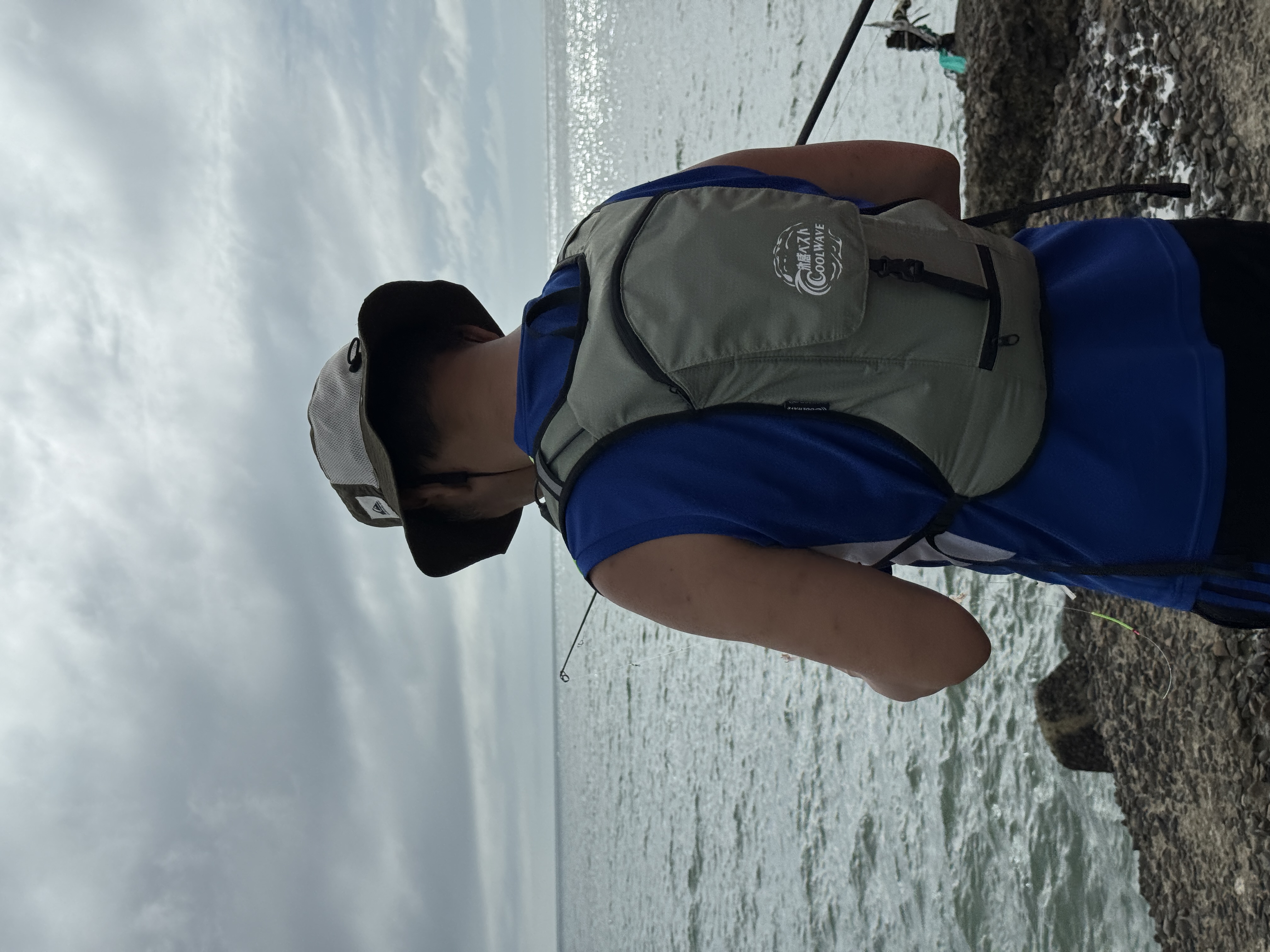
Prolonged sun exposure outdoors — the operating condition the 3–4 hour cooling cycle is designed around.
How the Circulation Loop Produces 3–4 Hours of Cooling
The cooling architecture is a closed water loop rather than a static pack strapped to the body. A 5V, 150mA pump moves chilled water from a TPU water bag through sand rubber tubing at a maximum flow rate of 320–370 ml/min, and the two supplied ice packs act as the cold source in the supplied kit. The vest body is PEVA, and the shoulder straps are 600D polyester.
Continuous flow is the reason the design behaves differently from a passive ice-pack vest. Chilled water sitting still in a single location warms up against the body and loses its useful effect quickly; moving that water redistributes cold across the contact area and lengthens the period during which the wearer feels a consistent effect. That is what the published 3–4 hour cooling duration describes.
At under 2 kg net weight, the vest is in the range where it can be worn across a working shift without the wearer abandoning it halfway. Weight matters more than it first appears in cooling PPE: a vest that delivers strong cooling but is uncomfortable after an hour tends to end up in a locker, and the effective cooling duration on site becomes zero.
Where the Vest Is Already Working
The documented user groups for this product are specific, and they were not chosen at random. Each group shares a physical condition that makes circulating chilled water useful: limited air movement, prolonged exposure, or radiant heat that the wearer cannot step away from.
Construction sites
Construction work combines radiant heat, physical effort and mandatory PPE layers that restrict airflow. The cooling demand is intermittent but repeated across the day, which makes a 3–4 hour cooling cycle practical if the re-cooling step is scheduled into the shift rather than left to individual workers.
Traffic control
Traffic controllers are often stationary in full sun, standing on asphalt that radiates stored heat upward, with no shade available. A stationary wearer generates less airflow than a moving one, so the practical benefit of active circulation is at least as large here as on a moving construction task.
Metal sheet factories
Metal sheet operations concentrate radiant heat, and factory layouts of this type frequently leave workstations exposed to it. Cooling gear for this environment is used in short, high-intensity windows rather than continuously.
Street vendors and food stall operators
Vendors work long, stationary hours in outdoor heat, often with a heat source at close range and no way to leave the position. This is one of the documented user groups for the vest, and the reference image in this article shows that working condition directly.
A documented deployment in Taiwan covered 100 units of a cooling product for high-temperature environments. Users in that deployment — construction sites, outdoor workers, metal sheet factories and street vendors — reported effective body cooling, heatstroke prevention, improved work efficiency and improved worker comfort. Those are user-reported outcomes from a specific deployment rather than laboratory results, and they should be treated as directional evidence of fit rather than as a guaranteed performance figure.
What the Market Data Says About Active Circulation
Active circulatory mechanisms, including ice water circulation, are increasingly deployed in industrial sectors to mitigate occupational heat stress, according to Strategic Market Research. That sits alongside the broader trend identified by Dataintelo, which records Phase Change Material cooling vests as the fastest-growing technology segment with 28.7% market share in 2025.
Read together, those two observations describe a category that is not converging on a single cooling method. Passive and active approaches are growing at the same time, which means procurement teams are increasingly expected to justify a technology choice rather than simply pick a product.
The competitive field reflects that. Spherical Insights lists Techniche International, Glacier Tek, Polar Products Inc. and Ergodyne among the companies participating in the cooling vest market, alongside regional manufacturers. For buyers, the presence of multiple established suppliers is useful: it means specification comparison across documents is possible, and claims can be checked against published parameters rather than marketing descriptions.
Regulatory context also applies to the electrical side of any powered cooling product. Cooling systems are expected to comply with ISO 9001:2015 for quality management, and electrical components frequently require CE or UL marks depending on the destination market, according to the International Organization for Standardization and UL. Buyers selling or deploying into regulated markets should confirm which documentation applies before the order ships.
Water Circulation Versus Passive Cooling: Trade-offs and Boundaries
No cooling method dominates on every criterion. The comparison below uses the published COOLWAVE specification alongside general category observations, and the third column is where most procurement disputes originate.
| Approach | What it is good at | Where it stops |
|---|---|---|
| Passive ice-pack vest | No electrical components; simple to issue and store; cooling stops when the pack warms | Cooling effect is local to where packs sit and typically fades well before a full shift |
| Phase Change Material vest | Fastest-growing technology segment in 2025 at 28.7% market share, per Dataintelo | Recharge depends on controlled temperature conditioning, which may not exist on a remote site |
| Water-circulation vest (COOLWAVE) | Pump-driven flow at up to 320–370 ml/min spreads chilled water across the contact area; 3–4 hour documented cooling duration; under 2 kg net weight | Requires a 5V power source for the pump, ice-pack re-cooling between cycles, and confirmation of variant-level and market-level documentation |
The boundaries of the COOLWAVE configuration are worth stating plainly, because they are what a buyer will actually have to manage after delivery.
- Cooling is finite per cycle. The documented duration is 3–4 hours. Longer shifts require a planned re-cooling step, not an assumption of continuous cooling.
- The pump needs a power source. The published contents cover the water-cooled vest backpack and two ice packs. The 5V, 150mA pump rating means the supply arrangement should be confirmed with the manufacturer before ordering at scale.
- Weight is real but bounded. Under 2 kg net is manageable for most adult workers, but it is additional load on top of existing PPE and tools, and should be trialled with the actual crew.
- Ice-pack logistics decide the outcome. Without freezer or cooler access on or near site, the second half of a shift will run without cooling regardless of the vest specification.
- The published suitable-temperature line needs clarification. It is listed as below 10°C and should be interpreted with the manufacturer before it is used as an ambient operating limit.
- Variant-level data is not published. The Professional Model colourways share the platform, but variant-specific figures are not documented in the reviewed materials.
- Certification scope is product-specific. The reviewed materials document a water-cooled vest patent (I886033, issued 2025-06-01 by the Intellectual Property Office, Ministry of Economic Affairs, ROC, covering water-cooled vest structure and cooling system, valid to 2044-08-27) and a Disaster Prevention Product and Service Certification Award. Markets that require CE or UL marks for electrical components should confirm the applicable documentation separately.
- Cooling PPE supplements a heat-management programme. A vest does not replace hydration, work-rest cycles, shading or acclimatisation. The documented user outcomes — cooling, heatstroke prevention, comfort — were reported in deployments where cooling gear was one element of heat management, not the only one.
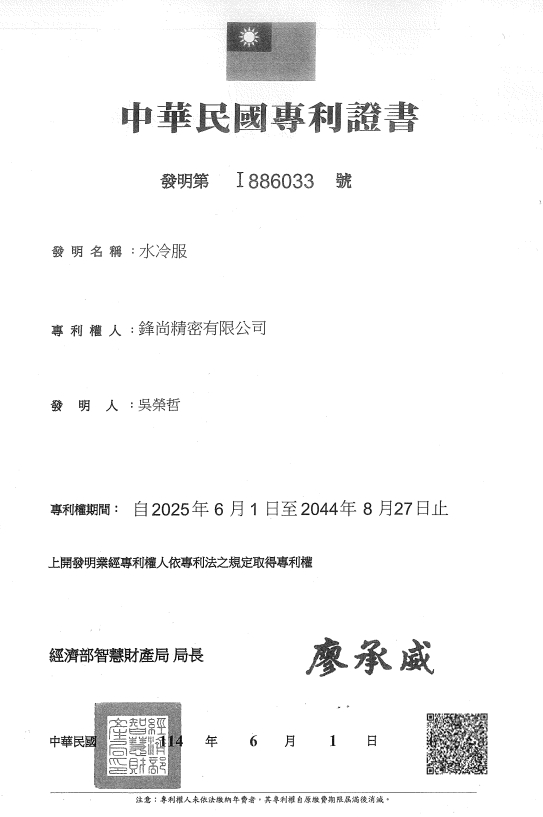
Water-cooled vest patent certificate I886033, issued by the Intellectual Property Office, Ministry of Economic Affairs (ROC), covering water-cooled vest structure and cooling system.
Procurement Terms and Buyer Due Diligence
The commercial terms attached to this product are documented and unusually specific for a cooling garment, which makes the evaluation step simpler. Lead time is typically 7–14 days, monthly production capacity is 3,000 units, and the minimum order quantity is 10 units. ODM production services are provided, with product development carried out under the ODM mode; the specific scope of any adaptation should be confirmed directly with the manufacturer.
| Commercial term | Documented value |
|---|---|
| Minimum order quantity | 10 units |
| Typical lead time | 7–14 days |
| Monthly production capacity | 3,000 units |
| Production mode | ODM production services |
| Payment | Full payment |
| Delivery | Shipment after payment; freight paid by buyer |
| Acceptance | Pre-shipment test |
| After-sales | 6-month warranty for the water-cooled vest |
| Export markets | Global |
The 10-unit MOQ is the term with the largest practical effect on how a trial is structured. It rules out single-unit sampling as a formal order, so a buyer wanting to validate the Professional Model colourways before a larger commitment should plan the evaluation in a 10-unit increment and define in advance what the trial is meant to prove — fit tolerance, re-cooling turnaround, or wearer acceptance over a full shift.
Three verification steps are worth completing before the order ships. Confirm the variant datasheet for whichever colourway is ordered. Confirm the power source arrangement for the 5V pump. Confirm the acceptance and warranty terms in writing, including what the 6-month warranty covers and who bears return freight.
Outlook
The direction of the category is toward specification discipline. As industrial applications hold the largest share of cooling vest demand and Asia Pacific remains the fastest-growing region, buyers will increasingly be asked to justify a cooling choice with parameters rather than descriptions. Products that publish flow rate, weight, cooling duration, materials and commercial terms — as this configuration does — are easier to defend internally than products that publish none of them.
The open questions for this product family are narrow and answerable: variant-level specification for the Professional Model, power supply configuration for the pump, and market-specific electrical documentation. Resolving those three items in writing turns a promising shortlist entry into a fully specified procurement item.
FAQ
1. What is the documented cooling duration of a COOLWAVE water-circulation cooling vest, and what determines it?
The published cooling duration is 3–4 hours. It is determined by the pump-driven circulation of chilled water at a maximum flow rate of 320–370 ml/min from a TPU water bag, with two ice packs used as the cold source. Duration reflects the length of one cooling cycle, not the length of a work shift.
2. What electrical input does the pump require?
The pump output is rated at 5V, 150mA (max). The published contents list for the vest covers the water-cooled vest backpack and two ice packs. Because the supply arrangement is not part of the published contents, buyers should confirm the power source specification with the manufacturer before ordering.
3. Does the design support ODM production, and what does that mean for a buyer?
ODM production services are provided, with product development carried out under the ODM mode. The current documentation describes the standard COOLWAVE water-circulation platform and the Basic Model and Professional Model colourways. The scope of any specific adaptation should be confirmed directly with the manufacturer rather than assumed.
4. What are the minimum order quantity, lead time and production capacity?
The minimum order quantity is 10 units, typical production lead time is 7–14 days, and monthly production capacity is 3,000 units. Payment terms are full payment, goods ship after payment, and freight is paid by the buyer.
5. How is the product verified before shipment, and what documentation supports it?
The documented acceptance term is a pre-shipment test. Supporting documentation includes a water-cooled vest patent, I886033, issued 2025-06-01 by the Intellectual Property Office, Ministry of Economic Affairs (ROC), covering water-cooled vest structure and cooling system and valid to 2044-08-27, plus a Disaster Prevention Product and Service Certification Award issued by the Taiwan Disaster Prevention Industry Association.
6. What does the warranty cover, and for how long?
A 6-month warranty applies to the water-cooled vest. Buyers should confirm in writing at quotation stage which components fall within that period, particularly the pump and water bag, and who bears the cost of return freight on a warranty claim.
7. Which working environments has this vest been deployed in?
Documented user groups are construction workers, outdoor workers, food stall operators, street vendors, traffic controllers and metal sheet factories. A Taiwan deployment covered 100 units for high-temperature environments, where users reported effective body cooling, heatstroke prevention, improved work efficiency and comfort.
8. How should a buyer decide between the Basic Model and the Professional Model colourways?
The published performance specification — 3–4 hour cooling duration, under 2 kg net weight, 5V 150mA pump, 320–370 ml/min maximum flow, TPU water bag, sand rubber cooling tube, 600D polyester straps, backpack and two ice packs — is documented for the water-circulation platform. No variant-specific performance figures for the Professional Model colourways appear in the reviewed materials, so the practical difference to evaluate is colour and organisational fit, with the variant datasheet confirmed in writing.
Reference Material
A downloadable product brochure containing the specification set referenced in this article is available here: Shokunin COOLWAVE water-circulation cooling vest brochure (PDF).